ACA Submits Amicus Brief in Debt Collector’s Statute of Limitations Case

ACA International recently filed an amicus curiae brief with the Sixth Circuit Court of Appeals in the case of Buchanan v Northland Group Inc., No. 13-2523 (6thCir. filed Nov 12, 2013). At issue is the district court’s decision that a debt collector does not mislead a consumer and therefore does not violate the Fair Debt Collection Practices Act by making a settlement offer to collect a debt without disclosing that the statute of limitations for filing a collection lawsuit has expired. Buchanan v Northland Group Inc., D.C. No. 1:12-CV-1011 (W.D. Mich. Nov 7, 2013). 

The Buchanan case stems from a collection letter sent by a debt collector to a consumer offering an opportunity to settle a debt after Michigan’s six-year limitations period for taking legal action to collect on the debt had passed. The consumer filed a class action complaint accusing the debt collector of violating the FDCPA.

The consumer argued that the debt collector’s statements in the letter that interest on the debt would continue to accrue and that it was “not obligated to renew” the settlement offer, along with the debt collector’s omission of a disclosure that the debt was out-of-statute, could mislead unsophisticated consumers into believing that they could still be subject to legal action. The district court disagreed with the consumer and dismissed the case.

The district court followed the Third and Eighth Circuits and district courts elsewhere by upholding the proposition that a debt collector that requests voluntary repayment of debt beyond the applicable statute of limitations does not violate the FDCPA, so long as its efforts to collect on such debt is not accompanied by actual litigation or threat, either implied or explicit, of future litigation.

The district court reasoned, “to hold that a debt collector cannot offer payment options as part of an effort to resolve outstanding debt, possibly without litigation, would force honest debt collectors seeking a peaceful resolution of the debt to file suit in order to advance efforts to resolve the debt—something that is clearly at odds with the language and purpose of the FDCPA.”

The Seventh Circuit, however, has created a split in the circuits as it held that offers to “settle” time-barred debts may falsely suggest that the debt is actually legally enforceable. (McMahon v LVNV Funding, LLC and Delgado v. Capital Mgt. Servs., LP, 744 F.3d 1010 (7th Cir. March 11, 2014.)

The Consumer Financial Protection Bureau joined the Federal Trade Commission in filing a joint amicus brief in Buchanan supporting the consumer’s position. The CFPB and the FTC argue that, “actual or threatened litigation is not a necessary predicate for an FDCPA violation in the context of time-barred debt” and “a settlement offer can erroneously lead unsophisticated consumers to believe a debt is enforceable in court even if the offer is unaccompanied by a clearly implied threat of litigation.”

ACA filed a “friend of the court” brief with the Sixth Circuit in Buchanan to provide assistance and insight to the court with respect to the adverse public-policy and due process consequences of a time-barred debt disclosure rule. ACA’s amicus brief fundamentally challenges the CFPB’s and the FTC’s position that debt collectors should be required to disclose to consumers the legal enforceability of debts through lawsuits.

In particular, ACA argues that such a rule imposes a burden and accompanying risk of liability on debt collectors that does not exist under the FDCPA. In addition, ACA explains that the disclosure requirement suggested by the CFPB will chill legitimate debt-resolution efforts by debt collectors, and may result in unsophisticated consumers being misled.

Finally, ACA also asks the Sixth Circuit to not give excessive deference to the CFPB and the FTC, as such deference may violate debt collectors’ due-process rights.  Agency reports, consent decrees and amicus briefs do not provide “fair notice” to debt collectors with respect to what they need to do to comply with FDCPA regulations. Accordingly, ACA urges the Sixth Circuit to affirm the district court’s decision.

ACA’s efforts to proactively support the Industry are part of ACA’s Industry Advancement Program and are made possible by funding through ACA’s Industry Advancement Fund.  Stay tuned for further developments.  ACA will continue to provide more information to its members when the court issues a decision in the case.

To read more about the most recent significant judicial decisions involving the Industry, ACA members can find concise summaries of these decisions on ACA’s Industry Advancement Program Web page.


ACA Submits Amicus Brief in Debt Collector’s Statute of Limitations Case
http://www.insidearm.com/daily/debt-collection-news/debt-collection/aca-submits-amicus-brief-in-debt-collectors-statute-of-limitations-case/
http://www.insidearm.com/feed
insideARM

Accounts Receivable Management

JCC Participates in Annual ACA Collector Challenge

J.C. Christensen & Associates, Inc. (JCC), an ARRAY Services Group company, along with 14 other organizations in the collection industry, participated in fundraising this spring to contribute to the ACA International Foundation scholarship program.

JCC employees raised $1,662.75, and with a corporate match of $1,000.00, a total of $2,662.75 went to support Financial Literacy. Proceeds are used to fund $10,000.00 in scholarships which the ACA awards to four individuals who work in or are affiliated with the collections industry.

JCC utilizes this week to conduct its annual ACA Code of Ethics Training and has each collector recommit to the Collector Pledge.  The company takes this opportunity to educate and remind employees about the ACA and Financial Literacy, and plans activities to get employees interested and involved.

Sales of healthy snacks, ‘throw-back’ candy, and pizza, paying for casual days, and a raffle for a reserved parking spot were some fun activities that JCC employees participated in during financial literacy awareness week.

JCC-charity-snacksBecky Pelkey, ACA-certified Training Manager at JCC, spent time in a local high school talking to 11th and 12th graders about the collection industry and how it helps the economy. “The sessions were very interactive,” she said, “and the feedback I received was positive!” She also discussed how teenagers can use credit responsibly and things they can do now to help them be successful in the future.

Array Services Group and its three innovative business units – CareCall, ProSource and J.C. Christensen & Associates – offer professional services in call management disciplines, accounts receivable and revenue cycle management, empowering clients for immediate and future success. For more information visit www.arraysg.com.

JCC Participates in Annual ACA Collector Challenge
http://www.insidearm.com/daily/debt-collection-news/debt-collection/jcc-participates-in-annual-aca-collector-challenge/
http://www.insidearm.com/feed
insideARM

Accounts Receivable Management

Interactive Intelligence Releases Findings of Second Annual Global Customer Service Survey

Interactive Intelligence Group Inc. (Nasdaq: ININ), a global provider of software and services designed to improve the customer experience, has released findings of its second annual Global Customer Service Survey.

The survey, which was administered by independent research firm, Actionable Research, was designed to answer the question, “What are the customer service expectations and preferences of consumers and the IT professionals who work for companies providing service?”

“This survey uncovered many interesting differences between the attitudes of consumers and IT professionals,” said Joe Staples, Interactive Intelligence chief marketing officer. “For instance, while 61 percent of IT professionals found interactive voice response a valuable service, only 37 percent of consumers did. These types of findings are the first step toward better aligning the expectations of those receiving and providing service.”

Based on the customer service primary research, the top 10 key findings were as follows:

  1. Although alternate channels are making inroads, a phone call with an agent is still the preferred communications channel by consumers (51 percent). Email was the next preferred method at 18 percent, followed by Web chat at 11 percent, which was similar to last year.
  2. A timely response is the most valued factor by consumers and IT professionals in a customer service interaction. Next valued by consumers is a knowledgeable agent, while next valued by IT professionals is professionalism.
  3. Not being able to understand the agent on the phone and a condescending agent are equally the greatest consumer frustrations. This year both were equal at 75 percent, followed by an initial long wait time at 64 percent. These results are similar to last year.
  4. If an agent is condescending or demanding, the majority of consumers (62 percent) say they are likely to seek an alternate vendor. Nearly half (48 percent) would seek an alternate vendor if the agent lacks appropriate knowledge, and 47 percent would do so if an agent shows a lack of effort.
  5. The majority of consumers (64 percent) said that they tell others when they have a positive customer service experience. This is up from 59 percent last year.
  6. Only 10 percent of consumers are willing to pay for a higher level of service. Note that 16 percent would pay more if the cost was reasonable.
  7. Nearly half of consumers (45 percent) always or usually make purchase decisions based solely on customer service.
  8. Consumers are more likely to share a positive experience using social media (37 percent), than they are to share a negative experience (29 percent).
  9. IT professionals stated that offering an easy way for customers to provide feedback was the most valuable service (56 percent). This was followed by the ability to transfer customer information from agent to agent (53 percent), and having complete interaction history accessible by agents across communications channels (52 percent).
  10. When using a mobile device to obtain service, consumers ranked the ability to get a callback once an agent becomes available as the most valuable mobile capability. This is followed by phone self-service then automated proactive notifications.

The customer service survey, which was conducted between March 27 and April 24, 2014, was based on a respondent sample size of 1,462 and 459 for consumer and IT professionals, respectively. Respondents resided in Australia, Brazil, Canada, Germany, South Africa, Sweden, the U.K., and the U.S.

A 32-page report containing the complete survey results can be downloaded here: http://www.inin.com/resources/Documents/Customer-Service-Experience-Research-Study.pdf.

A 13-page executive summary of the report can be downloaded here: http://www.inin.com/resources/Documents/Customer-Service-Experience-Research-Study-Executive-Summary.pdf.

Interactive Intelligence Group Inc. (Nasdaq: ININ) is a global provider of software and services designed to improve the customer experience. The company’s 6,000-plus customers worldwide have benefitted from its cloud and on-premises solutions for contact center, unified communications, and business process automation. Interactive Intelligence is among Software Magazine’s 2013 Top 500 Global Software and Service Providers, and has received a Frost & Sullivan Company of the Year Award for the last five consecutive years. In addition, Glassdoor honored Interactive Intelligence with its 2014 Employees’ Choice Award as one of the Best Places to Work in the U.S., and Mashable ranked Interactive Intelligence second on its 2014 list of the Seven Best Tech Companies to Work For. The company was founded in 1994 and employs more than 1,900 people worldwide. Interactive Intelligence is headquartered in Indianapolis, Indiana and has offices throughout North America, Latin America, Europe, Middle East, Africa and Asia Pacific. It can be reached at +1 317.872.3000. Visit Interactive Intelligence on the Web at www.inin.com; on Twitter at www.inin.com/twitter; on Facebook at www.inin.com/facebook; or on LinkedIn at www.inin.com/linkedin.

Interactive Intelligence Releases Findings of Second Annual Global Customer Service Survey
http://www.insidearm.com/daily/collection-technologies/collection-technology/interactive-intelligence-releases-findings-of-second-annual-global-customer-service-survey/
http://www.insidearm.com/feed
insideARM

Accounts Receivable Management

FTC in $5.5 million Debt Collection Settlement with Auto Lender/ARM Firm

The Federal Trade Commission Thursday announced a settlement with a national subprime auto lender and debt buyer/collector that will see the company pay $5.5 million in penalties, refunds, and account adjustments. The charges relate to the firm’s collection practices on its own accounts and loans it was servicing as a third party.

Consumer Portfolio Services, Inc. (CPS), headquartered in Irvine, Calif., agreed to refund or adjust 128,000 consumers’ accounts more than $3.5 million and forebear collections on an additional 35,000 accounts to settle charges the company violated the FTC Act. CPS will pay another $2 million in civil penalties to settle FTC charges that the company violated the Fair Debt Collection Practices Act (FDCPA) and the Fair Credit Reporting Act (FCRA)’s Furnisher Rule.

The FTC alleged that CPS’s collection violations included disclosing the existence of debts to third parties; calling consumers at work when not permitted or inconvenient; calling third parties repeatedly with intent to harass; making unauthorized debits from consumer bank accounts; falsely threatening car repossession; and deceptively manipulating Caller ID.

Because for many of its accounts CPS is a creditor, the complaint charges these practices violated Section 5 of the FTC Act. For those accounts where CPS is a debt collector, the complaint charges these practices violated the FDCPA.

In a statement provided to insideARM.com, CPS said that it cooperated with the investigation and is glad to put the issue to rest.

“We are pleased to have resolved the matter with the FTC,” said Charles E. Bradley, Jr., President and Chief Executive Officer.  “We cooperated fully with the FTC during their inquiry and made several system and procedural changes related to their comments. Furthermore, we are pleased that the final settlement is consistent with our expectations. Accordingly, the amounts we’ve agreed to pay for customer refunds and the civil penalty are covered entirely by the legal provision expenses we’ve previously recognized.”

CPS is publicly traded on the NASDAQ stock exchange under the ticker symbol CPSS. The company provides indirect automobile financing to consumers with poor credit and also purchases retail installment sales contracts primarily from franchised automobile dealerships.

In an unrelated move, the Consumer Financial Protection Bureau (CFPB) recently disclosed that it is pursuing rules for defining larger participants in the auto finance industry. Once that rule is in place, the CFPB will be able to regulate and supervise auto lenders in the same way as many other financial markets.


FTC in $5.5 million Debt Collection Settlement with Auto Lender/ARM Firm
http://www.insidearm.com/daily/banks-and-credit-grantors/auto-finance-receivables/ftc-in-5-5-million-debt-collection-settlement-with-auto-lenderarm-firm/
http://www.insidearm.com/feed
insideARM

Accounts Receivable Management

POLL: How many consumer complaints from the CFPB has your company received this year?


Take Our Poll

In April 2014, the Consumer Financial Protection Bureau received 3,582 consumer complaints about debt collection; that’s down one percent from March 2014, but this data doesn’t necessarily represent a turning tide in the collection industry. Signing up for the CFPB portal is the only way a collection agency can see and respond to the complaints filed against it. Once your company does that, you must make sure you’re appropriately responding to consumer complaints, while taking steps to reduce them. To the Point: CFPB Collection Complaints shows you the top four things your company can do right now to perfect its complaints management system.

POLL: How many consumer complaints from the CFPB has your company received this year?
http://www.insidearm.com/poll/poll-how-many-consumer-complaints-from-the-cfpb-has-your-company-received-this-year/
http://www.insidearm.com/feed
insideARM

Accounts Receivable Management

FDCPA Lawsuits on Track for Third Straight Year of Declines

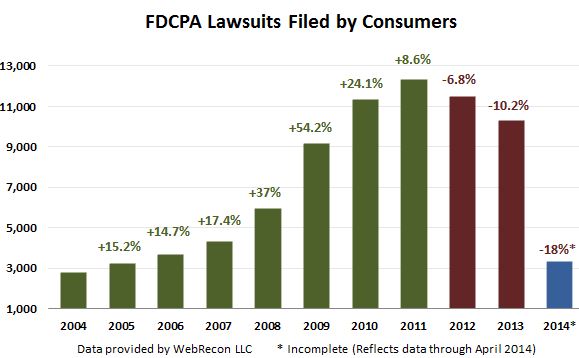
Lawsuits against ARM companies filed by consumers under the Fair Debt Collection Practices Act (FDCPA) are on track to decline again in 2014. If the trend holds, it would be the third-straight year of declines in total FDCPA lawsuits after years of rapid growth.

In the first four months of 2014, there have been 3,294 FDCPA cases filed in federal courts across the U.S. That number is 18 percent below the total at the same time last year, according to data provided by WebRecon LLC.

In April 2014 alone, there were 947 FDCPA suits filed, down 17 percent from April 2013, but actually up eight percent from the previous month.

FDCPA lawsuits filed against ARM firms rose rapidly from 2005 to their peak of 12,330 in 2011. Ever since then, fewer cases claiming FDCPA violations have showed up in the court system. Industry watchers had expected the rate of decline to slow as the “market” for plaintiff cases corrected. But it actually appears that the decline is accelerating.

FDCPA-suits-April2014

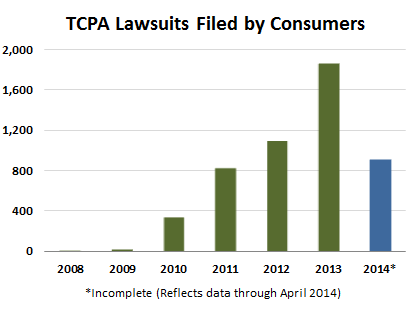
While FDCPA suits decline, cases claiming violations of the Telephone Consumer Protection Act (TCPA) continued their explosive growth in 2013.

TCPA cases were up nearly 70 percent in 2013. Consumers filed nearly 1,900 suits seeking remedy under the statute intended for telemarketers. In April 2014, there were 235 such cases filed, up 47 percent from April 2013. For the year, total TCPA lawsuits are up 46 percent from the same point last year.

TCPA-suits-April2014The recent growth in TCPA lawsuits largely mirrors the increase in FDCPA suits seen in the middle and end periods last decade. In 2008, there were only 14 TCPA cases filed, followed by just 31 the following year. But beginning in 2010, consumers and their attorneys saw an opportunity and began focusing on TCPA cases. While the total number of cases is still dwarfed by FDCPA cases, the trend in filings has caused many ARM firms to shift legal resources.

FDCPA Lawsuits on Track for Third Straight Year of Declines
http://www.insidearm.com/daily/debt-buying-topics/debt-buying/fdcpa-lawsuits-on-track-for-third-straight-year-of-declines/
http://www.insidearm.com/feed
insideARM

Accounts Receivable Management

Healthcare Providers Can Improve ARM and Reduce Risk with a ‘Credit Card on File’ System

High-performing physician practices empower their front end workers the resources, tools and training needed to make successful receivables happen. An important tool that physician practices can use to mitigate their risk of not getting paid on the back end is the Credit Card on File system.

What is ‘Credit Card on File’ System?

In a Credit/Debit Card on File (CCOF) system, every patient’s credit card information is stored in an off-site source. This enables physician practices to charge the credit card automatically for deductibles, co-insurance, co-pays, balances and non-covered services. Furthermore, CCOF system helps physician practices to set payment plans, so that patient payments can be automatically credited on a predetermined schedule mutually decided by the facility and patient. Credit/Debit Card on File systems shift patient’s back-end accounts receivable system to a front-end accounts receivable system.

For the rest of the blog entry, including three specific steps to implementing a CCOF system, check out the full post on the Array Services Group blog here.

Healthcare Providers Can Improve ARM and Reduce Risk with a ‘Credit Card on File’ System
http://www.insidearm.com/opinion/healthcare-providers-can-improve-arm-and-reduce-risk-with-a-credit-card-on-file-system/
http://www.insidearm.com/feed
insideARM

Accounts Receivable Management

Account Control Technology Donates $5,000 to Project Graduation – San Angelo

Account Control Technology, Inc. (ACT), a national leader in delivering debt management and recovery solutions, is pleased to announce that employees of its San Angelo office recently delivered a donation of $5,000 in support of the community’s Project Graduation program, which provides an alcohol and drug-free celebration for high school seniors the night of graduation.

The money was raised in individual contributions by ACT’s San Angelo office employees as well as through a donation match by the Account Control Technology Foundation.

“The month of May is a dangerous time for teens as prom and graduation celebrations can lead to alcohol-related accidents,” said Brian Shively, Director of ACT’s San Angelo office. “ACT is happy to support Project Graduation which helps keep our community’s kids safe on what should be one of the happiest nights of their young lives.”

San Angelo’s Project Graduation 2014 event is for graduating seniors from all of San Angelo’s public and private high schools. It will be held the night of Saturday, May 31, beginning at 9 pm and ending at 4 am. This year’s event has a theme of “Ready for the World” and will feature food, casino games, a rock climbing wall, music, a hypnotist show, a mechanical bull and a large array of prizes.

Front Row: ACT San Angelo representatives Brenda Coats (far left) and Trudy Taylor (far right) present a check to Project Graduation representatives Sandy Sawyer and Joanne Bishop (middle). Back Row (L-R):  ACT representatives Yvonne Rodriguez, Brian Shively (Director of Operations), Monica Parker, Rebecca Becknell and Stephanie Martinez.

Front Row: ACT San Angelo representatives Brenda Coats (far left) and Trudy Taylor (far right) present a check to Project Graduation representatives Sandy Sawyer and Joanne Bishop (middle). Back Row (L-R): ACT representatives Yvonne Rodriguez, Brian Shively (Director of Operations), Monica Parker, Rebecca Becknell and Stephanie Martinez.

Account Control Technology, Inc. is a leader in providing consultative debt management, collection, call center and business office solutions for education, government, commercial and consumer entities. Established in 1990, ACT has been recognized as an Inc. 5000 fastest-growing private company for the past seven years running. The company serves clients nationwide from five office locations: Bakersfield, California; Woodland Hills, California; Mason, Ohio; Dallas, Texas; and San Angelo, Texas. For more information, call 800-394-4228 or visit www.accountcontrol.com

The Account Control Technology Foundation is a charitable organization established by Dale and Debbie Van Dellen with a stated mission “to improve the future of students and the greater community by offering financial literacy and debt management education, mentorship and support to those in need.” Each year, the Foundation awards $50,000 in college scholarships in addition to supporting local and national charities. For more information, visit www.accountcontrolfoundation.org.

Account Control Technology Donates $5,000 to Project Graduation – San Angelo
http://www.insidearm.com/daily/debt-collection-news/debt-collection/account-control-technology-donates-5000-to-project-graduation-san-angelo/
http://www.insidearm.com/feed
insideARM

Accounts Receivable Management

ACA International Education Foundation’s Collectors Challenge Month a Success

A month of workplace fun by 15 organizations in the consumer debt collection industry raised more than $24,000 in ACA International Education Foundation’s Collectors Challenge Month.

Proceeds from Collectors Challenge Month, which featured workplace-friendly fundraising activities such as casual days, company meals, snack breaks and games, will be used to enhance the Loomer-Mortenson Scholarship.

Each year, ACA International Education Foundation awards post-secondary scholarships totaling $10,000 to four individuals who work in or are affiliated with the collections industry (1st place = $5,000; 2nd place = $3,000; two 3rd place = $1,000 each). Scholarship applications are accepted through May 15 and the scholarship recipients are announced in July.

ACA International Education Foundation would like to thank the following 15 organizations for their exceptional fundraising efforts:

  • ConServe – Fairport, NY
  • ACA International – Minneapolis, MN
  • J. C. Christensen & Associates, Inc. – Sartell, MN
  • North American Credit Service – Chattanooga, TN
  • Pro Com Services of Illinois, Inc. – Springfield, IL
  • American Profit Recovery – Farmington Hills, MI
  • Sunrise Credit Service – Farmingdale, NY
  • Nationwide Credit Corporation – Alexandria, VA
  • Delta Outsource Group – O’Fallon, MO
  • Helvey & Associates – Warsaw, IN
  • Uptain Group – Knoxville, TN
  • Oliver Adjustment Company of Kenosha & Racine – Kenosha, WI
  • Credits, Inc. – Hermiston, OR
  • ProCollect Inc. – Dallas, TX
  • Wilber and Associates – Normal, IL

In addition, a drawing was held for the participating companies. The winners are:

  • North American Credit Service – ACA International 75th Annual Convention registration
  • Sunrise Credit Service – Complimentary Training Pass
  • Wilber and Associates – Complimentary registration to ACA International’s 2014 Fall Forum
  • Helvey & Associates – Airfare for one to the ACA International 75th Annual Convention

The ACA International Education Foundation is a 501 (c)(3) non-profit organization founded in 1996 that is committed to helping men and women in the consumer debt collection industry with their post-secondary education through the Loomer-Mortenson Scholarship. It is the philanthropic arm of ACA International, the trade association representing the third-party debt collection industry. For more information, visit www.acainternational.org/foundation.

ACA International Education Foundation’s Collectors Challenge Month a Success
http://www.insidearm.com/daily/debt-collection-news/debt-collection/aca-international-education-foundations-collectors-challenge-month-a-success/
http://www.insidearm.com/feed
insideARM
Accounts Receivable Management

We Asked, You Answered: Collectors are Watching the CFPB on Time-Barred Debt

As the Consumer Financial Protection Bureau tries its hand at rulemaking and surveying in the debt collection industry, Ronald Canter – founder  of The Law Offices of Ronald S. Canter, LLC and panelist at ARM-U – wrote about five key court cases the industry should look towards as precedent for the Bureau’s proposed reforms. But at the end of the day, it seems as though one major case is getting on everyone else’s…well…case. According to a recent insideARM.com poll, nearly 50 percent of you said you thought time-barred debt would be the first thing the CFPB addresses as it attempts to overhaul the Fair Debt Collection Practices Act.

Coming in at a distant second, 24 percent of you said you thought the CFPB would first address debt verification as a potential FDCPA reform. Individually, insideARM.com readers said they were also concerned about how the CFPB will address “frequent calls to the wrong person,” “cell phones” and “including creditors as third-party debt collectors.” Debt verification and time-barred debt were two of the key issues covered in the CFPB’s 162-question Advance Notice of Proposed Rulemaking earlier this year.

VIEW RESULTS-What do you think will be the CFPB’s first move in overhauling FDCPA?

Experts predict that the CFPB will ultimately take the stance that debt collectors should make an affirmative disclosure to consumers when they are seeking to collect debts that cannot be judicially enforced, and that failure to do so may violate the FDCPA. But in an op-ed Tuesday, attorney Tomio Narita argued that “If the CFPB discourages delinquent consumers from paying debts they admittedly owe, this raises the cost of credit for all consumers, and it may eliminate the availability of credit to low and moderate income consumers who need it the most.”

At ARM-U (October 14-15, 2014 in Washington, DC), Canter will join Kim Phan of Ballard Spahr and Anita Tolani of Weinberg, Jacobs & Tolani for a panel discussion about what the regulatory future looks like for debt collectors – including the huge role the CFPB will play – and how agencies can prepare for the future right now. This exclusive event will bring together senior compliance and operations officers, collection attorneys and HR/training experts, and allow them to learn from each other, discuss pitfalls and identify areas of improvement.


We Asked, You Answered: Collectors are Watching the CFPB on Time-Barred Debt
http://www.insidearm.com/daily/we-asked-you-answered-collectors-are-watching-the-cfpb-on-time-barred-debt/
http://www.insidearm.com/feed
insideARM
Accounts Receivable Management