New TCPA Rules: Key Insights You Should Be Thinking About

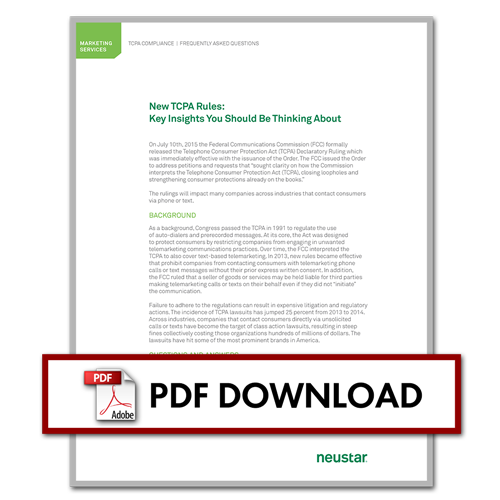
2015-08-new-tcpa-rulesOn July 10th the FCC released a package of declaratory rulings to provide clarity on how the commission interprets TCPA, close loops and strengthen consumer protections. Download Neustar’s new FAQ: New TCPA Rules: Key Insights You Should Be Thinking About to get answers to common questions about the new ruling, such as:

  • What the new special exemptions are
  • What the new ruling says about reassigned numbers
  • How the FCC is currently interpreting the “one call” allowance

The FAQ also includes a valuable section on industry best practices with recommendations on determining phone type, verifying that a number has not been reassigned, selective use of the one call exemption, and more.

New TCPA Rules: Key Insights You Should Be Thinking About
http://www.insidearm.com/freemiums/new-tcpa-rules-key-insights-you-should-be-thinking-about/
http://www.insidearm.com/feed
insideARM

Accounts Receivable Management

Robo-Calling and the ARM Industry: An Open Letter to the FCC

Tim Bauer

Tim Bauer

An Open Letter to FCC Commissioners Wheeler, Clyburn, and Rosenworcel:

I watched with a great deal of interest the June 18, 2015, FCC hearing where you trumpeted new TCPA Rules. I then reviewed the 13 page Declaratory Ruling and Order that was released on July 10. Since then I have read just about every article, blog, or opinion on the Ruling. I have also reviewed the pleadings in the various appeals of the ruling. 

During the hearing all three of you went to great lengths to tell the world that these rules were designed to put an end to “Robo-Calling”. That term makes a great soundbite.  It is also fans the flames to bolster your argument for the new rules.

Unfortunately, you have completely missed the mark. In your desire to end “robo-calling” you have dramatically injured and hindered many legitimate businesses, including every legitimate company in the ARM industry.

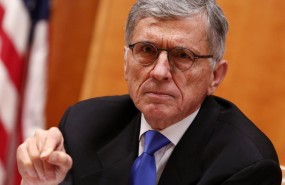
FCC Commissioner  Tom Wheeler

FCC Commissioner
Tom Wheeler

Worse, and I hate to break this to you, but robo-calling by thieves, scam artists and criminal enterprises continues. Your new rule has done nothing to stem that tide and will do nothing in the future to reduce those calls. Let me break it to you gently. Those calls will continue. Criminal and thieves break the laws. That is why they are called criminals and thieves.

As of January 1 of this year I work out of my home office. For my entire prior working career I have worked in a traditional office setting.  Moving to a home office environment has been an absolute eye opener for me. The sheer amount of “telemarketing” and scam artists calls to my home office phone on a daily basis is staggering. These are calls I would refer to as “robo-calls”. I have no prior relationship with the caller or the subject of the call. The caller is randomly calling a list of phone numbers. (BTW, this is NOT what a legitimate ARM company does.) These calls come despite the fact that I am on the national “Do Not Call” registry.

FCC Commissioner Mignon Clyburn

FCC Commissioner
Mignon Clyburn

Just a few of my favorites:

Rachel from Cardmember services” has been replaced by another name and tagline, but the same type of calls continue. This is my last chance to lower the interest rate on my credit cards.


Just yesterday I received a call from “Dennis Gray from the U.S. Treasury Department”  “Dennis” wanted me to call him back before the Sheriff, Police Department , FBI and every famous movie cop knocked on door to arrest me. (BTW, this scam is particularly despicable. It preys upon those not savvy enough to recognize the absurdity of the call.)


One of my other favorite scam artist calls in from the “Windows Help Desk”.  They want to help me with my computer viruses.  All I need to do is give them access to my system.


Finally, I get the “Senior Alert” calls at least once a day. Fortunately I do not yet have a need for the “I’ve fallen and I can’t get up device” even though my doctor has already authorized it for me.

These calls are typically made from individuals and entities outside the United States. The phone number on the caller ID is spoofed. They are not going to stop calling.

FCC Commissioner Jessica Rosenworcel

FCC Commissioner
Jessica Rosenworcel

Meanwhile, legitimate ARM businesses are in full-fledged scramble mode trying to comply with your draconian Declaratory Order. The TCPA was designed to limit telemarketers, not companies with legitimate business reasons to contact consumers over a prior business relationship.

On the bright side, you have given predatory consumer and defense lawyers a retirement plan.  TCPA lawsuits will keep them happy for years to come.

Robo-Calling and the ARM Industry: An Open Letter to the FCC
http://www.insidearm.com/daily/debt-collection-news/accounts-receivables-management/robo-calling-and-the-arm-industry-an-open-letter-to-the-fcc/
http://www.insidearm.com/feed
insideARM

Accounts Receivable Management

Local Counsel Collective One of Inc. Magazine’s Fastest Growing Companies

Local Counsel Collective, an appearance counsel service company, announced today that Inc. Magazine has named it one of the Top 5000 Fastest-Growing Private Companies in the United States.

Local Counsel Collective has been recognized for substantial growth and is the fastest growing company in the appearance counsel industry to make the Inc. 5000 list. Local Counsel Collective secured the No. 204th overall ranking (top 4%); recognized for significant growth over the previous three years. In that same time, Local Counsel Collective quadrupled its staff and revenues. The firm focuses on providing hearing coverage for large law firms, through its network of professional local attorneys with a focus on regulatory compliance.

The 2015 Inc. 500|5000 list of fastest growing companies is ranked according to percentage revenue growth when comparing 2011 to 2014. To qualify, companies must meet minimum revenue requirements and have been founded and generating revenue byMarch 31, 2011. Companies must be U.S.-based, privately held, for-profit, and independent — not subsidiaries or divisions of other companies — as of December 31, 2014.

“We are obviously proud to be named as one of the country’s fastest growing companies,” said Brandon Fuller, CEO of Local Counsel Collective. “If I had to attribute our success to one thing, it would be that we are continually looking for ways to improve and provide the most efficient and effective service. Technology progresses so quickly and that’s our specialty – leveraging technology to streamline hearing coverage, which saves our clients money.”

About Local Counsel Collective: www.localcounselcollective.com

Founded in 2010, Local Counsel Collective was created and developed by high volume collection attorneys who saw that law firms and agencies, which practice primarily in creditor’s rights, needed to efficiently schedule and retain high quality attorneys to attend short procedural hearings in many jurisdictions. Major areas of focus are local appearance counsel, regulatory compliance, and information security.

Local Counsel Collective One of Inc. Magazine’s Fastest Growing Companies
http://www.insidearm.com/daily/debt-collection-news/local-counsel-collective-one-of-inc-magazines-fastest-growing-companies/
http://www.insidearm.com/feed
insideARM

Accounts Receivable Management

How Healthcare ARM Companies Can Take Advantage of Regional Economic Data

The healthcare industry is one of the largest market segments; many government officials talk about its impact in such all-encompassing terms that most citizens only consider it on a national level. Looking at broad economic data can have its benefits for politicians, think-tanks, and national health insurers. However, there are limitations for ARM and RCM companies.

Kaulkin Ginsberg recommends ARM companies focused on the healthcare vertical take a regional approach to their analyses. Most healthcare providers are strongly linked to the communities they serve, and the state-level unemployment rate is one of the best indicators of whether individuals in a certain region are likely to have health insurance. Studying this data allows you to examine the local labor force, providing insight into the types of consumers you’ll be working with and their propensity to pay.

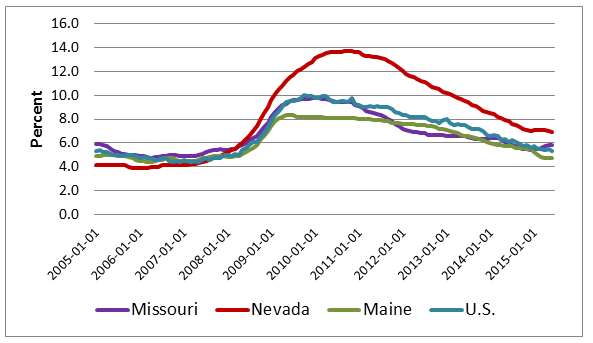
Chart 1

By comparing the unemployment rates of Missouri, Nevada, and Maine against the national unemployment rate, we see that they all follow a similar trend. However, Missouri’s unemployment rate is slightly higher than the national average, and Maine’s is slightly lower. As for Nevada, a state built on consumption and tourism, we see a substantially higher unemployment rate compared to the national average. States and cities with significantly higher levels of unemployment necessitate a different strategy for collection operations, given the correlation between employment status and insurance.

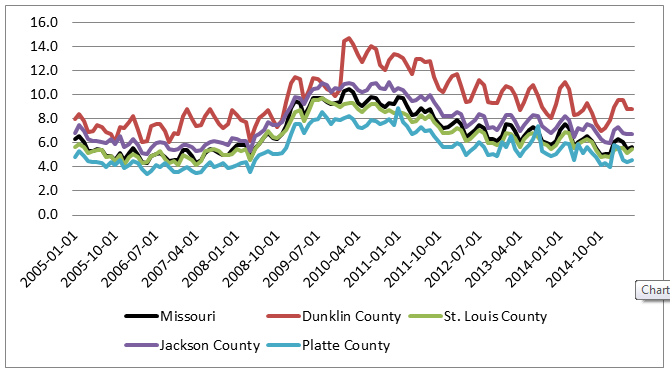
Chart 2

Taking this example one step further, the chart above depicts the unemployment rate for several counties in Missouri. Once again, we see variation, and this time between areas of a single state. Dunklin County is at one extreme with a current unemployment rate of 8.8%, and Platte County is at the other with 4.6%. That’s nearly half that of Dunklin County and 1.1% less than the state average.

Nearly all of the data provided on the national level can be obtained on a regional level. If it’s not accessible, it generally holds true at all levels (i.e. interest rates are the same in any region).

We are happy to work with you to discuss the impact different economic variables will have on your operation, or explore advanced financial modeling and projection projects. To schedule a confidential discussion of your business needs, please contact us at hq@kaulkin.com. For more information about the healthcare industry or for access to our exclusive KG Prime archives, please contact Danielle Dredger at ddredger@kaulkin.com.

How Healthcare ARM Companies Can Take Advantage of Regional Economic Data
http://www.insidearm.com/obs-in-focus/how-healthcare-arm-companies-can-take-advantage-of-regional-economic-data/
http://www.insidearm.com/feed
insideARM

Accounts Receivable Management

FCC Will Host Robocall/Caller ID Spoofing Workshop

One of the main points of contention for the FTC commissioners was robocalling. Commissioner Rosenworcel explicitly called out the practice in her prepared comments during the FCC’s June hearing on the TCPA:

“I detest robocalls. I’m not alone. Year-in and year-out, Telephone Consumer Protection Act complaints are the largest single category of complaints that consumers lodge with us here at the Commission. We receive thousands of complaints a month about robocalls. Our friends across town at the Federal Trade Commission receive tens of thousands more—at one point receiving nearly 200,000 in a single month.”

As part of its commitment to consumer protection, the FCC’s Consumer and Governmental Affairs Bureau will host a Robocall and Caller ID Spoofing Workshop on Wednesday, September 16, 2015, at FCC Headquarters, Commission Meeting Room, 445 12th Street SW, Washington, DC.

Per the FCC’s press release: “The workshop will continue the Commission’s recent work helping consumers fight unwanted robocalls by examining the current state of robocall-blocking solutions, steps industry is taking to protect consumers from unwanted robocalls, and potential solutions to caller ID spoofing. The workshop will be an all-day event with panelists representing service providers, developers of call-blocking solutions, consumer groups, and others.”

The workshop will be streamed live on the Commission’s website, for persons interested in participating via the Internet. The full agenda will be available in the coming weeks.

insideARM’s Perspective:

What’s a little frustrating for the collection industry is this: collection agencies don’t robocall. So, again, a law that was never really meant to affect the ARM industry is having a considerable affect on the ARM industry.

This is not an issue of collection agencies opposing consumer protections. Just the opposite, in fact. Consumers who owe debt but take steps to limit or cease communications with a collection agency are actually not doing what’s best for their financial well-being.

This focus of the FCC’s on robocalling is good, but it has the possibility of ultimately negatively affecting consumers in the long run.

FCC Will Host Robocall/Caller ID Spoofing Workshop
http://www.insidearm.com/daily/debt-collection-news/accounts-receivables-management/fcc-will-host-robocallcaller-id-spoofing-workshop/
http://www.insidearm.com/feed
insideARM

Accounts Receivable Management

4 Collection Agencies File Motion to Intervene in Support of Appeals of FCC’s July 10, 2015 Declaratory Ruling

On August 7, 2015, MRS BPO LLC, Cavalry Portfolio Services, LLC, Diversified Consultants, Inc., and Mercantile Adjustment Bureau, LLC filed a joint motion for leave to intervene  in the consolidated appeal of the FCC’s July 10, 2015 Declaratory Ruling and Order.

On July 10, 2013 ACA International (the Association of Credit and Collection Professionals) (“ACA”).  ACA filed its petition for review with the United States Court of Appeals for the District of Columbia Circuit on July 10, and filed an amended petition on July 13, 2015.

PACE (the Professional Association for Customer Engagement, Inc.) also filed a petition for review with the United States Court of Appeals for the Seventh Circuit on July 14, 2015. On the same day, Sirius (Sirius XM Radio, Inc.) filed a virtually identical petition for review with the United States Court of Appeals for the District of Columbia Circuit.

The three petitions for review were then consolidated and randomly assigned to the United States Court of Appeals for the D.C. Circuit.

The motion to intervene is broken into 2 components.

The first: STATEMENT OF THE INTEREST OF THE MOVING PARTIES, addresses what interests the 4 companies have in the case. In this section the companies describe their business, their investments and use of telephony technologies, and the spurious class action cases involving alleged TCPA violations.

The second: GROUNDS FOR INTERVENTION, addresses why the 4 companies have the requisite “standing” of the parties to intervene. To have standing, a party seeking to intervene must show: “(1) injury-in-fact, (2) causation, and (3) redressability. The 4 companies provide information to meet all 3 elements.

If not allowed to intervene, the 4 agencies also make an alternative request to participate in the case as an AMICI CURIAE. (Editor’s Note: Amici Curiae translated is literally “Friend of the Court”. It is someone who is not a party to a case, but offer information that bears on the case.)

insideARM Perspective

insideARM will continue to monitor and report on all aspects of this matter.  The FCC rules as presently written will have a dramatic impact on the ARM industry.  The FCC did not recognize the difference between “robo-calling” telemarketers and businesses that have a legitimate need to contact a consumer.

4 Collection Agencies File Motion to Intervene in Support of Appeals of FCC’s July 10, 2015 Declaratory Ruling
http://www.insidearm.com/daily/debt-collection-news/4-collection-agencies-file-motion-to-intervene-in-support-of-appeals-of-fccs-july-10-2015-declaratory-ruling/
http://www.insidearm.com/feed
insideARM

Accounts Receivable Management

Citizens Bank Fined by CFPB, FDIC and OCC

In a news release from the Consumer Financial Protection Bureau (CFPB) yesterday the CFPB announced that the CFPB, the Federal Deposit Insurance Corporation (FDIC) and the Office of the Comptroller of the Currency (OCC) have all issued fines against Citizens Bank for allegedly failing to credit consumers for the full amounts of their deposited funds.

Citizens Bank, N.A., was formerly known as RBS Citizens Bank, N.A.; Citizens Financial Group, Inc., formerly known as RBS Citizens Financial Group, Inc.; and Citizens Bank of Pennsylvania.

The bank kept money from deposit discrepancies when receipts did not match actual money transferred. “Citizens Bank regularly denied customers the full credits of their deposits when there were discrepancies between deposit slips and the actual money transferred into the bank,” said CFPB Director Richard Cordray. “The bank chose to ignore these discrepancies and harmed many consumers by pocketing the difference.”

The CFPB investigation found that from January 1, 2008 to November 30, 2013, Citizens Bank violated the Dodd-Frank Wall Street Reform and Consumer Protection Act’s prohibition on unfair and deceptive practices by failing to properly credit consumers’ checking and savings accounts. In cases where the bank’s scanner misread either the deposit slip or the checks, or if the total on the deposit slip did not equal the total of the actual checks, Citizens Bank did not take action to fix the mistake if it fell below a certain dollar amount.

Specifically, the CFPB found that Citizens Bank failed to credit consumers the full amount of their deposits and falsely claimed that it would verify deposits

The CFPB consent order requires the bank to provide approximately $11 million in refunds to consumers and pay a $7.5 million penalty for the violations.

The CFPB took the action in coordination with the FDIC and the OCC. The FDIC separately ordered Citizens Bank of Pennsylvania to pay restitution and a $3 million civil penalty. The OCC separately ordered Citizens Bank, N.A., to pay restitution and a $10 million civil penalty. In total, Citizens Bank must pay about $11 million in consumer refunds and $20.5 million in federal penalties for these coordinated actions. As part of these actions, the FDIC and OCC are ordering additional relief relating to business accounts.

insideARM Perspective

While the activity that was the subject of this CFPB action did not involve collections nor recovery efforts, the announcement is important for a couple of reasons. First, the coordinated activity between the CFPB, the OCC and the FDIC should be noted. The CFPB is following up on their promise to coordinate their investigations and enforcement activity with other regulatory bodies. Second, the action represents yet another major fine against a significant financial institution.

Citizens Bank Fined by CFPB, FDIC and OCC
http://www.insidearm.com/daily/debt-collection-news/accounts-receivables-management/citizens-bank-fined-by-cfpb-fdic-and-occ/
http://www.insidearm.com/feed
insideARM

Accounts Receivable Management
Collection Attorneys In New York Dealt A Blow

On August 5, 2016 the Second Circuit Court of Appeals ruled that a New York City law intended to prevent law firms that also work as debt collectors from engaging in abusive practices does not infringe on the state’s authority to regulate the legal profession.

The decision in Eric M. BERMAN, P.C., Lacy Katzen, LLP  v. CITY OF NEW YORK, et al, United States Court of Appeals, Second Circuit, No. 13‐598‐cv, is the latest development in a long and convoluted legal journey. The case has bounced between US District Court, the U.S.  Court of Appeals, the New York State Court of Appeals and back to the U.S. Court of Appeals. With this latest decision it has been remanded back to U.S. District Court “for further proceedings consistent with” the Court of Appeals opinion.

The primary issue in this case is a law (referenced throughout as Local Law 15) passed by the City of New York in 2009 that required debt buyers and collection attorneys to obtain licenses as collection agencies and adhere to new rules also laid out in the legislation. It was the position of the Berman and Katzen law firms that the City had no authority to regulate the practice of law in the state of New York.

insideARM has previously reported on developments in this case. In October of 2012, we reported an initial victory for Mr. Berman (a prior director of the National Association of Retail Collection Attorneys) and his co-plaintiffs. In that first stage of this marathon case a U.S. District Court judge ruled that the New York City Department of Consumer Affairs has no authority to regulate lawyers’ conduct.

In October of 2014 insideARM reported again on the latest development in the case. At that time the U.S. Court of Appeals for the Second Circuit ruled that New York’s highest court would need to resolve the legal questions in a case brought by a debt collection law firm challenging a New York City statute that regulates certain activities of collection attorneys.

The Court of Appeals panel certified two questions to be considered by the New York State Court of Appeals:

  1. Does Local Law 15, insofar as it regulates attorney conduct, constitute an unlawful encroachment on the State’s authority to regulate attorneys, and is there a conflict between Local Law 15 and Sections 53 and 90 of the New York Judiciary Law?
  2. If Local Law 15’s regulation of attorney conduct is not preempted, does Local Law 15, as applied to attorneys, violate Section 2203(c) of the New York City Charter?

On June 30th of this year the New York State Court of Appeals answered the questions posed above.

For question #1 the court answered in the negative. The court held that Local Law 15 is “not preempted” by New York State’s authority over attorney conduct.

For question #2, the State Court of Appeals reformulated the question as follows: “If Local Law 15’s regulation of attorney conduct is preempted, does Local Law 15, as applied to attorneys, also violate Section 2203(c) of the New York City Charter?”  Having reformulated the second question as conditional on an affirmative answer to the first, the Court of Appeals declined to reach a decision on the issue. Rather, the Court of Appeals instructed that the second question “should be answered in accordance with [its] opinion.”

The Second Circuit reviewed the New York State Court of Appeals June 30th decision and ruled accordingly in a per curiam decision. A per curiam decision (or opinion) is a ruling issued by an appellate court of multiple judges in which the decision rendered is made by the court acting collectively and unanimously.  The Court of Appeals vacated the prior District Court Decision and remanded the case back to the District Court for further proceedings.

insideARM Perspective

From a procedural perspective this case could be on a law school Civil Procedure exam. How so many courts could be involved in a single issue is likely mind boggling to non-lawyers.  However, the current (perhaps final?) result is that collection lawyers are subject to Local Law 15.


Collection Attorneys In New York Dealt A Blow
http://www.insidearm.com/opinion/collection-attorneys-in-new-york-dealt-a-blow/
http://www.insidearm.com/feed
insideARM

Accounts Receivable Management

Financial Regulator Bans Firm From Doing Business In New York

The New York Times reported earlier this week that Promontory Financial Group, a respected and influential consultant to large banks on regulatory matters, has been effectively banned by New York State’s financial regulator from doing business in the future with banks licensed in New York State.

The regulator would accomplish this by denying the firm confidential documents that consultants need to advise banks.

Previously, the newspaper reported that six Promontory employees were called in for depositions as part of a two-year investigation by New York’s financial regulator. The investigation was focused on an assignment the firm completed for Standard Chartered, a British bank that was suspected of processing billions of dollars on behalf of Iran. The bank hired Promontory to review transactions related to entities in question and then submit its findings to regulators. The regulator has accused Promontory of sanitizing its report to paint Standard Chartered in a more positive light.

Promontory has promised a legal battle, representing the first significant challenge to the regulator’s authority.

insideARM Perspective

The New York Department of Financial Services is the same regulator that has recently imposed strict, far-reaching – and some would argue unclear – new rules regarding the sale and collection of charged off receivables. These rules, unlike the FDCPA, clearly encompass actions by original creditors as well as debt buyers and third party collectors.

Adding to the on-going implementation of Dodd-Frank, this is another example of nationwide muscle-flexing by regulators and lawmakers in the arena of financial services.

Contributing to the intrigue of this trend is the string of former regulators who have started or joined consulting firms that claim special access or understanding of government agencies.  Benjamin Lawsky who recently stepped down as head of the New York DFS, started his own firm, which Promontory has called a direct competitor. Earlier this summer, Promontory announced the acquisition of Fenway Summer, a consulting firm started by Raj Date, the former deputy director of the Consumer Financial Protection Bureau.

Financial Regulator Bans Firm From Doing Business In New York
http://www.insidearm.com/daily/featured-post/financial-regulator-bans-firm-from-doing-business-in-new-york/
http://www.insidearm.com/feed
insideARM

Accounts Receivable Management

FTC Announces More Balanced Panel for Next Debt Collection Dialogue

The Federal Trade Commission has announced the panels for the Debt Collection Dialogue in Dallas on September 29, 2015, the second of three such planned events. Representatives from the FTC, other federal and state law enforcement agencies, and the debt collection industry will discuss enforcement actions, consumer complaints, compliance issues, industry best practices, and how regulatory enforcement actions are investigated and pursued.

The first Debt Collection Dialogue, held in Buffalo in early June 2015, received criticism from industry representatives, who felt the event was more of a lecture than an actual dialogue.

The event will feature two moderated panels with representatives from enforcement agencies and the collection industry. This is the tentative schedule:


The event will be in the Center for Community Cooperation, 2900 Live Oak Street. More information, including how to pre-register and how to submit questions for the two panels in advance, is posted at www.ftc.gov/debtcollectiondialogue-dallas. Pre-registration is not necessary to attend but is encouraged for event planning. [Note that the first Dialogue – in June – effectively “sold out” in advance.]

The third Debt Collection Dialogue, to be held in Atlanta, will begin at 1:30 p.m. on November 18 at the Latin American Association, 2750 Buford Highway. Information is available at www.ftc.gov/debtcollectiondialogue-atlanta.

Both events will be free and open to the public.

FTC Announces More Balanced Panel for Next Debt Collection Dialogue
http://www.insidearm.com/daily/debt-collection-news/debt-collection/ftc-announces-more-balanced-panel-for-next-debt-collection-dialogue/
http://www.insidearm.com/feed
insideARM

Accounts Receivable Management