
Details Of The 30 Operation Collection Protection Enforcement Actions

As reported earlier this week, the Federal Trade Commission (FTC) and other law enforcement authorities around the country announced the first coordinated federal-state enforcement initiative targeting deceptive and abusive debt collection practices.

This nationwide crackdown reportedly encompassed 30 new law enforcement actions by federal, state, and local law enforcement authorities. However the press release and announcement only detailed five of those actions. The documents provided listed over 100 cases, so which 30 they were referring to was not immediately clear. We placed a call to Christopher Koegel of the FTC, who clarified that the number refers to those cases with actions since October 1, 2015. To boil this down a bit, we’ve isolated those cases.

Here are the Federal cases with actions dated since October 1, 2015:

Matter Name, Company Location, Action Location Type of Action Action Dated 10/1/15 or Later Responsible Agency
K.I.P., LLC, et. al. (Aurora, Illinois) (Northern District of Illinois, Eastern Division) Civil Lawsuit: Seeking permanent injunction and equitable monetary relief against an alleged fake debt scam. Alleged violations of Section 5 of the FTC Act, Sections 805(a), 806(2), 806(5), 807(2)(A), 807(4), 807(5), and 809(a) of the FDCPA, and analogous Illinois state laws. November 3, 2015: Stipulated Final Order filed with the Court, banning defendants from the debt collection business, prohibiting defendants from making misrepresentations about any product or service, and imposing judgment of more than $6.4 million. Federal Trade Commission & Illinois Attorney General (case filed jointly)
Kelly S. Brace, et al. (Buffalo, NY) (Western District of New York, Buffalo Division) Civil Lawsuit: Seeking permanent injunction and equitable monetary relief. Alleged violations of Section 5 of the FTC Act, various sections of the FDCPA (15 U.S.C. §§ 1692(c)-(e) & (g), and analogous New York State laws. October 5, 2015: Complaint Filed TRO, and later a preliminary injunction, with asset freeze and restraining order Granted Case Pending Federal Trade Commission & New York Attorney General (case filed jointly)
BAM Financial (Irvine, California) (Central District of California) Civil Lawsuit: Seeking permanent injunction and equitable monetary relief for allegedly violating the FTC Act and the FDCPA by collecting unsubstantiated debts, pretending to be process servers, and falsely threatening to report consumers to government authorities. October 19, 2015: Complaint filed Ex parte TRO with asset freeze, restraining order, and appointment of receiver Granted Case Pending Federal Trade Commission
National Check Registry (Buffalo, NY) (Western District of New York) Civil Lawsuit: Seeking permanent injunction and equitable monetary relief for allegedly violating Section 5 of the FTC Act, various sections of the FDCPA, and analogous New York State laws. October 16, 2015 Stipulated Final Order Entered banning defendants from the debt collection business, prohibiting defendants from making misrepresentations about any product or service, and imposing judgments totaling more than $8.3 million that will be suspended upon payment of $112,000 by Joseph Bella and the surrender of certain bank accounts, two cars and two boats. Federal Trade Commission
Security National Automotive Acceptance Company (Mason, Ohio) (Southern District of Ohio, Western Division) Civil Lawsuit: Seeking a permanent injunction, redress, and civil penalties against an auto loan company for aggressive and unlawful collection tactics against servicemembers, in violation of the Consumer Financial Protection Act. October 26, 2015: Stipulated Final Order Issued October 29, 2015: Administrative Order Issued Company ordered to correct its business practices, pay $2,274,855.70 in redress to consumers and $1 million to the CFPB civil money penalty fund. Consumer Financial Protection Bureau
Cesar Luis Kou Reyna (Miami, Florida) (Southern District of Florida) Indictment: Charged that defendant, through Fonomundo FC Corp in Miami and Mater Call and other affiliated call centers in Peru, used telephone calls to Spanishspeaking consumers in the United States, threatening lawsuits, arrest, deportation, and harmed credit to coerce victims into paying fraudulent settlements for nonexistent debts. October 14, 2015: Defendant pleads guilty to one count of conspiracy to commit mail fraud and wire fraud Consumer Protection Branch, Civil Division, U.S. Department of Justice
Travell Thomas, the co-owner, CEO, and president of a Buffalo-based debt collection company, Maurice Sessum, a co-owner and COO of the Company, Anthony Brzezowski, the Company’s director of operations, 3 managers and 5 debt collectors (Buffalo, New York) (Southern District of New York) Indictment: 11 charged with wire fraud and conspiracy to commit wire fraud in connection with a nationwide debt collection scheme that took in more than $31 million from thousands of victims across the United States As alleged, the defendants engaged in what is believed to be the largest fraudulent debt collection scheme ever to be prosecuted, falsely threatening arrest and prosecution of countless Americans, including those who suffered from disabilities October 27, 2015: Charges unsealed U.S. Attorney’s Office, Southern District of New York
Mark Lavin John Salatino, Jessica Mann, And Jennifer Sherk (Buffalo, New York) (Southern District of New York) Guilty Pleas: Guilty pleas unsealed as to 4 persons in connection with case charging an additional 11persons with wire fraud and conspiracy to commit wire fraud in connection with a nationwide debt collection scheme that took in more than $31 million from thousands of victims across the United States As alleged, the defendants engaged in what is believed to be the largest fraudulent debt collection scheme ever to be prosecuted, falsely threatening arrest and prosecution of countless Americans, including those who suffered from disabilities October 27, 2015: Guilty pleas unsealed U.S. Attorney’s Office, Southern District of New York


And here are the State cases with actions dated since October 1, 2015:

Matter Name, Company Location, Action Location Type of Action Action Dated 10/1/15 or Later Responsible Agency
The People of the State of California v. JPMorgan Chase & Co., Chase Bank USA, N.A., and Chase BankCard Services, Inc. (Newark, Delaware) (Superior Court of California, Los Angeles County) Civil Lawsuit: Civil lawsuit alleging collection violations against tens of thousands of California consumers in connection with its credit-card debt-collection lawsuits and sale of consumer credit-card debt. November 2, 2015: Stipulated judgment filed Supplementing the nationwide relief in the multistate settlement between Chase and 47 states, and the settlements with the CFPB and the OCC, the California settlement includes an enforceable stipulated judgment and resolves violations of California’s Rosenthal FDCPA (Civil Code section 1788 et seq,) related to improper prelitigation attorney demand letters, as well as privacy violations and violations of the Servicemembers Civil Relief Act, 50 USC Appendix section 501 et seq., and California Military and Veterans Code section 400 et seq. The judgment includes $50 million in civil penalties and other payments to California, and additional injunctive and monetary relief focused on servicemembers. California Attorney General
Julie Ann Meade, Administrator v. P.C. Legal Services LLC and Mike Harden (Aurora, Colorado) (District Court Denver, City and County of Denver) Civil Lawsuit: Seeking injunctive relief, civil penalties and alleging violations of the Colorado FDCPA. October 13, 2015: Default Judgment entered against Harden. Colorado Attorney General
In the Matter of Cavalry Portfolio, LLC (Valhalla, New York) (Denver, Colorado) Administrative Action: Violations of the Colorado FDCPA. October 5, 2015: Stipulation and Final Agency Order Entered – Provides for injunctive relief and $17,385 administrative fine. Colorado Attorney General
In the Matter of Georgia Receivables Inc., Frederick J. Hanna (Marietta, Georgia) (Denver, Colorado) Administrative Action: Denial of license renewal application. October 20, 2015: Final Agency Order – denying application. Colorado Attorney General
FTC & State of Illinois v. K.I.P., LLC, et. al. (Aurora, Illinois) (Northern District of Illinois, Eastern Division) Civil Lawsuit: Seeking permanent injunction and equitable monetary relief against an alleged fake debt scam. The Illinois AG alleged violations of Section 2 of the Illinois Consumer Fraud and Deceptive Business Practices Act, (Illinois Consumer Fraud Act), 815 ILCS 505/2 and Sections 2, 4, and 9(a) of the Illinois Collection Agency Act, 225 ILCS 425/2, 225 ILCS 425/4, and 225 ILCS 425/9(a). November 3, 2015 Stipulated Final Order filed with the Court, banning defendants from the debt collection business, prohibiting defendants from making misrepresentations about any product or service, and imposing judgment of more than $6.4 million. Illinois Attorney General & Federal Trade Commission (case filed jointly)
In re Gregory K. Pugh, Gregory K. Pugh, P.C. dba Dominion Asset Recovery and EZ Payday Loans of America (Virginia Beach, Virginia) (Indianapolis, Indiana) Civil Lawsuit: Alleged violations of IC 24-5- 0.5-3(a)(20), including the collection of stale debt and false threats of suit and jail. October 6, 2015: Assurance of Voluntary Compliance Approved by Court Prohibits future consumer debt collection in Indiana and requires: (1) accounts to be cancelled; (2) refunds to consumers; and (3) a $5,500 payment to the Consumer Protection Fund. Indiana Attorney General
In re Dynamic Recovery Solutions, LLC (Greenville, South Carolina) (Indianapolis, Indiana) Civil Lawsuit: Alleged violations of IC 24-5- 0.5-3(a)(20), including the collection of stale debt. October 27, 2015: Assurance of Voluntary Compliance Pending Approval by Court In collecting stale or potentially stale debt, company is required to disclose that it cannot sue on the debt and that if a consumer makes a partial payment a new limitations period could arise that would allow company to sue. Indiana Attorney General
State of Louisiana vs. Stephen F. Wilson and Revenue Recovery & Investigations, LLC (Covington, Louisiana) (Baton Rouge, Louisiana) Notice of Unfair Trade Practices pursuant to Louisiana Revised Statutes 51:1401, et seq.: Practices include failing to register with the Secretary of State as a debt collector and threatening criminal prosecution against alleged debtors. October 26, 2015: Assurance of Voluntary Compliance filed AVC includes injunctive relief and civil penalty. Louisiana Attorney General
In the Matter of P.N. Financial, Inc., and Nelson Macwan (Lincolnwood & Skokie, Illinois) (Before the Maryland State Collection Agency Licensing Board; Baltimore, Maryland) Administrative Action: Following issuance of a Summary Order to Cease and Desist for unlicensed collection activity in Maryland and engaging in collection practices on illegal and usurious consumer loans and Order to Produce documents and information, a Final Order to Cease and Desist was issued. October 26, 2015: Final Order Issued to Cease and Desist resulting in order directing a monetary fine of $12,000 and a permanent order to cease and desist from engaging in collection activity. Maryland Office of the Commissioner of Financial Regulation
Delbert Services Corporation (also CashCall, Inc., Western Sky Financial, LLC, WS Funding, LLC and their owners J. Paul Reddam and Martin Webb) (Las Vegas, Nevada) (Suffolk County Superior Court, Boston, Massachusetts) Consent Judgment & Consent Order: Settling allegations that Delbert, a then licensed debt collector, collected on illegal, high-interest loans, made over the internet to thousands of consumers by CashCall, Western Sky and WS Funding without proper license or registration to conduct business in Massachusetts. October 26, 2015: Consent Judgment Entered Entitles more than 2,000 borrowers to refunds totaling approximately $2.4 million. It is estimated that the settlement could provide more than $17 million in debt relief to Massachusetts consumers. October 27, 2015: Consent Order Entered Terminates Delbert’s Debt Collector License in Massachusetts and prohibits its owner, J. Paul Reddam, from ownership in any licensed entity in the future. Massachusetts Division of Banks & Massachusetts Attorney General
American Credit Bureau, Inc. (Boca Raton, Florida) (St Paul, Minnesota) Findings of Fact & Conclusions of Law: Respondent threatened to take unauthorized actions which were abusive and harassing to a debtor; they were unlicensed to do collect in MN; and failed to respond to the Department’s investigation. October 8, 2015: Final Order Entered Order provides for a civil penalty of $10,000. Minnesota Department of Commerce
SKO Brenner American Inc. (Farmingdale, New York) (St. Paul, Minnesota) Administrative Action: Allegation – conducted collection activity from an unlicensed location. October 28, 2015: Civil Penalty Agreement Agreement provides for a civil penalty of $5,000. Minnesota Department of Commerce
State of Minnesota v. United Credit Recovery, LLC (Sanford, Florida) (Minnesota State Court in Hennepin County) Civil Lawsuit: Seeking injunctive relief and civil penalties against a Florida debt buyer that purchased millions of charged-off consumer accounts from large banks, and then manufactured on a mass scale fraudulent affidavits to assist with collection of the alleged debts. The company used a computer mail-merge program to cut and paste notarized signatures of bank officials from other documents onto fraudulent affidavits, which it then disseminated to consumers, courts, and other debt buyers as “proof” of the alleged debts. October 30, 2013: Complaint filed November 6, 2014: Summary Judgment entered against the company in Minnesota’s civil action, permanently enjoining the company from doing business in Minnesota and awarding a monetary judgment of $1.5 million against the company. October 30, 2015: Monetary judgment of $1.5 million against the company in Minnesota’s civil action filed with the Seminole County Circuit Court in Florida. Minnesota Attorney General
State of Minnesota v. Jeremy M. Umland and Terrill Joseph Jasicki dba TJ Process Service (Wadena, Minnesota) (Minnesota State Court in Koochiching County) Civil Lawsuit: Seeking injunctive relief, civil penalties, and restitution against a Minnesota process serving company (TJ Process Service) and one of its servers (Jeremy Umland) for falsely claiming in affidavits of service that individuals were served with debt collection lawsuits, resulting in default judgments against individuals who were not actually served with lawsuits. October 2015: Stipulated orders filed in six Minnesota counties for vacation of over $1 million in default judgments obtained against Minnesota consumers in debt collection actions that were filed with purported affidavits of service bearing the signature of Defendant Jeremy Umland. Minnesota Attorney General
Collect Pros, LLC (Pacoima, California) (Carson City, Nevada) Administrative Action: Alleging company collected debts in Nevada without a license. October 14, 2015: Settlement Agreement entered prohibiting unlicensed debt collection in Nevada and providing for a $10,000 administrative fine. Nevada Financial Institutions Division
CFS2, Inc. (Tulsa, Oklahoma) (Santa Fe, New Mexico) Administrative Action: License application denied for violations of the New Mexico Collection Agency Regulatory Act §61-18A-1 NMSA 1978. October 9, 2015: Order Denying Renewal of License New Mexico Regulation & Licensing Department, Financial Institutions Division
FTC & People of the State of New York v. Kelly S. Brace, et al. (Buffalo, New York) (Western District of New York, Buffalo Division) Civil Lawsuit: Seeking permanent injunction and equitable monetary relief. Alleged violations of Section 5 of the FTC Act, various sections of the FDCPA (15 U.S.C. §§ 1692(c)-(e) & (g), and analogous New York State laws. October 5, 2015: Complaint Filed TRO with asset freeze and restraining order Granted Stipulated Preliminary Injunction with a ban from debt collecting and asset freeze So Ordered Case Pending New York Attorney General & Federal Trade Commission (case filed jointly)
State of Ohio v. Rotech Holdings, Ltd., Glenn R. Lista, and Sean M. Lista (Buffalo area, New York) (Franklin County Court of Common Pleas, Columbus, Ohio) Civil Lawsuit: Seeking declaratory judgment, permanent injunctive relief, consumer damages, and civil penalties for unfair, deceptive, and unconscionable debt collection practices. October 30 2015: Complaint filed Case Pending Ohio Attorney General
Christi L. Jones, Individually and as President of Christi L. Jones & Associates, Inc. and Christi L. Jones & Associates, Inc. (Tamaqua, Pennsylvania) (Schuylkill County Court of Common Pleas, Pottsville, Pennsylvania) Civil Lawsuit: Seeking permanent injunction, fines, and restitution. Alleged violations of Pennsylvania’s Fair Credit Extension Uniformity Act, 73 P.S. § 2270.1, et seq., Unfair Trade Practices and Consumer Protection Law, 73 P.S. § 201-1, et seq., as well as, the Judicial Code, 42 P.S. § 2524, et seq. for using deceptive means to collect or attempt to collect debts and giving the false impression that Defendants were attorneys licensed to practice law in Pennsylvania. October 15, 2015: Order approving Consent Petition for Final Decree Permanently enjoining Defendants from: (1) future violations of law; (2) advertising and offering to investigate, enforce, and recover unpaid judgments or collecting other past due balances on behalf of consumer and business clients; and (3) representing themselves as attorneys in Pennsylvania. Defendants also required to pay monetary relief in the amount of $14,000. Pennsylvania Attorney General
Fairbanks, Goldstein & Rodriguez, L.L.C., FG&R, L.L.C, YMS, L.L.C. and Ashley Claudio (McAllen, Texas) (370th District Court of Hidalgo County, Texas) Civil Lawsuit: Seeking a permanent injunction and monetary relief for alleged violations of the Texas Debt Collection Act and Texas Deceptive Trade Practices – Consumer Protection Act. October 28, 2015: Complaint Filed Case Pending Texas Attorney General
Fletcher, Goldmen & Ross, Inc. and Travis Edward Dubcak (McAllen, Texas) (430th District Court of Hidalgo County, Texas) Civil Lawsuit: Seeking a permanent injunction and monetary relief for alleged violations of the Texas Debt Collection Act and Texas Deceptive Trade Practices – Consumer Protection Act. October 28, 2015: Complaint Filed Case Pending Texas Attorney General
State of Washington v. Garnishment Services, LLC, and Richard Brees, d/b/a Garnishment Services, Judgment Day Collections, and The Judgment Recovery Group (Tacoma, Washington) (King County Superior Court, Seattle, Washington) Civil Lawsuit: Seeking injunction, penalties and restitution for alleged violations of the Washington Collection Agency Act and Washington Consumer Protection Act arising from Defendants’ operation of a “judgment recovery service.” November 2, 2015: Complaint filed Case Pending Washington Attorney General


Details Of The 30 Operation Collection Protection Enforcement Actions
http://www.insidearm.com/daily/collection-laws-regulations/collection-laws-and-regulations/details-of-the-30-operation-collection-protection-enforcement-actions/
http://www.insidearm.com/feed
insideARM


Accounts Receivable Management

CFPB Again Rejects FOIA Request to Release Leaked Agency Documents

McLEAN, VA —For the second time in four months, the Consumer Financial Protection Bureau (CFPB) has quashed efforts to make public a number of leaked agency documents that  undermine many of the CFPB’s long-running claims that it is not attempting to regulate auto dealers in circumvention of the Dodd-Frank Act.

The CFPB’s latest rejection came in response to an Oct. 8, 2015, Freedom of Information Act (FOIA) request, filed by the National Automobile Dealers Association (NADA), asking the CFPB to release internal documents, leaked to American Banker, acknowledging that the agency intended to regulate the auto finance market through enforcement action, and showing that it eschewed evidence that its methods for estimating disparate impact were deeply flawed.

In July, NADA asked the CFPB to make publically available documents – also leaked to American Banker – in which CFPB officials admitted in a private memo that they intended to eliminate the ability of dealers to offer discounted financing rates to consumers, despite the Bureau’s statutory prohibition against regulating auto dealers, as well as numerous public pronouncement s from Director Richard Cordray that the Bureau was not – as both Republicans and Democrats in Congress have worried – straying from its Congressional mandate.

The CFPB denied NADA’s July FOIA request three days after it was filed. The rejection of NADA’s latest request comes directly on the heels of a series of Wall Street Journal articles highlighting the significant shortcomings in the CFPB’s process of identifying minority borrowers. According to The Wall Street Journal, the CFPB’s continued use of this flawed methodology has resulted in non-minority borrowers receiving settlement funds that were specifically earmarked for minority borrowers.

“CFPB actions in the auto finance market are costing consumers money, and may very well be hurting the very people the agency is trying to help,” said NADA President Peter Welch. “Consumers deserve a transparent process that will allow their concerns to be heard and considered before their rights are taken away by an overzealous Washington regulator.”

Concerns about the manner in which the CFPB has attempted to influence the auto finance market prompted the House Financial Services Committee to approve H.R. 1737, a bill to provide accountability and transparency to that process. The committee approved the bill with a strong bipartisan vote of 47-10, and currently 102 House Republicans and 65 House Democrats have cosponsored the bill.

CFPB Again Rejects FOIA Request to Release Leaked Agency Documents
http://www.insidearm.com/cfpb/cfpb-again-rejects-foia-request-to-release-leaked-agency-documents/
http://www.insidearm.com/feed
insideARM

Accounts Receivable Management

NARCA Supports Eliminating “Bad Players”

The Federal Trade Commission’s announcement of its coordinated efforts with other law enforcement agencies against illegal and unscrupulous debt collectors is hailed by NARCA as a positive move to rid the industry of the “bad apples” that tarnish reputable and legal debt collection businesses.

NARCA supports the cooperative efforts of both industry entities and governmental agencies to root out the businesses that harm consumers through truly deceptive practices. The industry and consumers are much better off by collaborative and complementary practices to insure that “bad players” are eliminated from practicing debt collection.

NARCA has been at the forefront of ensuring that its members abide by a Code of Ethics and Professional Conduct that is separate and in addition to the rules in their respective states which govern their law licenses.  Harvey Moore, NARCA Board President, commented, “ Collaboration, communication and cooperation between industry groups and the regulatory bodies that enforce laws to eliminate those who consciously harm consumers through deceptive practices is key to keeping the credit eco-system for this country strong.”

Contact Information
Jim Podewitz
Communications Specialist
NARCA – The National Creditors Bar Association
Direct: 202-861-0706
Email: jim@narca.org
Web: www.narca.org

About NARCA

The National Creditors Bar Association is a nationwide professional trade association of 600 creditors rights law firms and in‐house counsel of creditors.  NARCA members are committed to being professional, responsible and ethical in their practice of creditors rights law.


NARCA Supports Eliminating “Bad Players”
http://www.insidearm.com/daily/collection-laws-regulations/collection-laws-and-regulations/narca-supports-eliminating-bad-players/
http://www.insidearm.com/feed
insideARM

Accounts Receivable Management

Performant Earnings Announcement Hits Three Hot Topics

Performant Financial Corporation (PFMT), historically one of the Department of Education’s (ED) top performing private collection agencies, yesterday announced financial results for its third quarter ended September 30, 2015. The company also hosted a conference call to discuss the results.

Third Quarter Financial Highlights

  • Total revenues of $38.5 million, compared to $39.6 million in the prior year period, down 2.9%
  • Adjusted EBITDA of $6.5 million, compared to $5.7 million in the prior year period
  • Adjusted net income of $0.8 million, or $0.02 per diluted share, compared to $0.7 million and $0.01 per diluted share, respectively, in the prior year period
  • Student lending revenues in the third quarter were $28.5 million, an increase of 1.6% from $28.1 million in the prior year period.
    • Revenue attributed to the guaranty agencies was $22.5 million (vs. $15.1. million in Q3 of 2014) or roughly 58% of the total revenue for the company.
    • Q3 revenue attributed to the ED contract was $6.0 million (vs. $13.0 million in Q3 of 2014) or roughly 15% of the total revenue for the company.
  • Student loan placement volume during the quarter totaled $0.5 billion, compared to $1.7 billion in the prior year period. This figure reflects the lack of placements from the Department of Education and fluctuations in placement volume from Guaranty Agencies.

As always, the earnings report and press release provide the raw numbers.  The investor’s conference call, and specifically the Q&A portion of the call, provides additional color. As we have noted in our prior quarterly reporting on Performant’s quarterly earnings reports, the investor’s conference call provides the ARM industry with a detailed view of the company’s experience with government contracts, and specifically, the Department of Education contract.

Highlights from the Conference Call

Investment analysts covering Performant are very in tune to current events that could impact the company. It was no surprise that many of the audience questions focused on three primary topics:

  1. Status of the Department of Education RFP – During last quarter’s conference call, Lisa Im, Perfromant’s CEO, offered her best guess that the ED RFP results would have been announced by the end of September. Obviously, that time frame has come and gone. Ms. Im was much more guarded in her comments yesterday regarding any timing of an award.  Analysts tried to get her to predict the contract award by the end of 2015, but she did not take the bait.
  2. Autodialing of cell phones – Analysts were also aware that the latest budget deal includes a provision allowing the use of an autodialer for federal debt collectors. When asked about it Ms. Im commented: “We’re very excited about that. We think that will actually be — it is finally sort of bringing the TCPA into the modern age. And so with respect to how it will impact our business, it will certainly be helpful in allowing us to work better with borrowers, to help resolve their obligations for any of our federal agencies. So we think it will definitely be a productivity enhancer.”
  3. Possibility of IRS Outsourcing Collections to Private Agencies – One of the analysts asked about the pending house transportation bill that contains a provision requiring the IRS to outsource collections to private agencies. Ms Im commented: “There is legislation and it’s been in the press with respect to the IRS and the legislation from what we’ve read is to have the IRS actually contract with vendor partners. So of course, with any legislation, we don’t know what the outcome of that will be. It is being supported in a bipartisan fashion. We hope that it will pass and it will provide an opportunity for the growth for experienced tax collectors and we certainly provided those services to state agencies in the past.”

For those interested in listening to the entire earnings call, a replay of the call will be available on the Company’s website or by dialing 877-870-5176 (domestic) or 858-384-5517 (international) and entering the passcode 13622730.

insideARM Perspective

Performant’s Third Quarter Earnings Announcement sheds considerable light not only on the financial impact of the ED contract generally, but also on the impact of ED’s decisions earlier this year regarding the ED contract and the ongoing RFP saga.

It has been now been 6 months since Performant has received any new placements from ED.  Even if the contract awards were announced by the end of 2015, and assuming Performant receives a new contract, management was very candid that ED revenue under any new contract would be negligible in 2016 as most of the ED revenue takes 9 months or more after placement to develop.

The company’s ED revenue in Q3 was $6.0 million. That is less than half of ED revenue in the same period last year ($13.0 million).  One can assume that the ED revenue will continue to decline unless and until the company is awarded a new contract and placements are received under that contract.

Performant Earnings Announcement Hits Three Hot Topics
http://www.insidearm.com/daily/debt-collection-news/debt-collection/performant-earnings-announcement-hits-three-hot-topics/
http://www.insidearm.com/feed
insideARM

Accounts Receivable Management

Will Federal Push to “Ban the Box” Affect Debt Collection Hiring Practices?

It isn’t uncommon for clients to push debt collection agencies to disqualify job candidates for criminal histories. Agencies may not be able to deliver on that demand much longer. Many states have already adopted a “ban the box” policy, which prohibits employers from asking about criminal convictions in job applications. (Check out our recent and thorough coverage on the risk in criminal background checks right here.) Now it appears that the Feds are following suit.

President Obama appeared earlier this week in Newark, N.J. to announce a series of measures designed to help former criminals become productive and reenter society. In his comments, the President announced an executive order directing the Office of Personnel Management (OPM) to delay inquiries into criminal history until later in the hiring process. What’s more, the President also called on Congress to follow recent state law and pass legislation designed to “ban the box” on job applications.

“We know that having millions of people in the criminal justice system, without any ability to find a job after release, is unsustainable,” President Obama said on Friday as part of his weekly address. “It’s bad for communities and it’s bad for our economy.”

And when it comes to helping former convicts move back into society, “everyone has a role to play, from businesses that are hiring ex-offenders to philanthropies that are supporting education and training programs,” he added.

If it were not already clear that Federal agencies plan to meet some of the most aggressive state laws and policies on criminal history and employment, the Consumer Financial Protection Bureau has also gotten in on the action. Less than two weeks ago, the CFPB took action against two of the largest employment background screening report providers, General Information Services (GIS) and its affiliate, e-Background-checks.com, Inc. (BGC), for “failing to take basic steps to assure the information reported about job applicants was accurate.” The companies are now on the hook for $10.5 M in relief to consumers the agency identifies as having been harmed by the two background check companies.

The agency alleges that GIS and BGC did not use basic procedures for matching public records to the correct individual and that the companies did not use an audit process to verify the accuracy of their reports. The agency also accuses the two companies of including impermissible information in reports, such as civil suit and civil judgment information older than seven years.

insideARM perspective

The signals are clear, and so is the risk to your firm. Agencies simply can’t rule out a candidate simply because he or she has a criminal record. As Radius Global Solutions HR VP Stacy Spradling explained here on insideARM recently, agencies have to take a more sophisticated, broader view of each candidate. A criminal history can’t be an automatic disqualifier, but rather one of many details hiring officers need to consider.

“Considering a candidate’s criminal convictions over their skills and abilities may subject the employer to further scrutiny, ultimately compounding claims of discrimination,” she wrote. “To prevent risk an employer should know the regulations, ask questions about criminal backgrounds later in the process, and only disqualify candidates whose conviction strictly correlates to them being unsuccessful in the role.”

Will Federal Push to “Ban the Box” Affect Debt Collection Hiring Practices?
http://www.insidearm.com/daily/debt-collection-news/debt-collection/will-federal-push-to-ban-the-box-affect-debt-collection-hiring-practices/
http://www.insidearm.com/feed
insideARM

Accounts Receivable Management

Registration Open For ARM Quarterly Review Webinar: Wrapping Up 2015

Rockville, MD — 2015 has been a tumultuous year for the ARM industry. What can we expect to see in this final quarter and into 2016? Join Mike Ginsberg, President and CEO of Kaulkin Ginsberg, and Rozanne Andersen, Chief Compliance Officer of Ontario Systems, for their webinar, ARM Quarterly Review: Wrapping Up 2015, on Thursday, November 12th, at 2 PM EST.

They will address these new topics you won’t hear anywhere else:

  • Secrets about the CFPB’s complaint portal
  • Why the FTC is holding all of these industry meetings
  • Key market segment highlights
  • A breakdown of current transaction pricing
  • The reason behind the drop-off in M&A activity in 2015

Registration is free, so invite your leadership teams to this essential, informative presentation.

About Mike Ginsberg

Mike Ginsberg is president and CEO of Kaulkin Ginsberg, offering M&A and strategic advisory expertise to the accounts receivable management industry for nearly 25 years. He is also co-founder of Topline Valuation Group, providing ARM owners and executives with authoritative technical, financial, and benchmarking services designed to improve decisions at the corporate and operational levels.

Mike is a member of ACA International, DBA, and the Association for Corporate Growth.  He sits on the advisory boards of several industry associations and publications.

He is a frequent speaker on important industry issues and is often interviewed as an industry expert by the trade, financial, and consumer media. Mike writes a regular blog about the industry and maintains the page “ARM in Focus” on insideARM.com.

Mike has been the recipient of numerous industry awards, including the NARCA Don Kramer Award and Collection Advisor’s award for one of the industry’s most influential professionals for four years in a row.

About Rozanne Andersen

Rozanne is widely recognized for her advocacy work on behalf of the collection, debt purchasing and financial services industries, but equally acclaimed for her expertise in association law, corporate governance and general counsel services. Rozanne was named by Minnesota Lawyer magazine as Attorney of the Year for 2004 for excellence in providing in-house legal services. In February 2007 and again in 2008, she was profiled as one of the “5 Women You Should Know” due her positive impact on the financial services industry.

Her expertise keeps Ontario Systems on top of the constantly changing legal and regulatory environment, ensuring products and services help clients comply with the broad spectrum of state and federal requirements. She has successfully led the company’s efforts to bring Ontario Systems CFPB Consulting Services, Consumer Complaint Resolution Program and its comprehensive Compliance Management Systems to the market place.

Registration Open For ARM Quarterly Review Webinar: Wrapping Up 2015
http://www.insidearm.com/obs-in-focus/registration-open-for-arm-quarterly-review-webinar-wrapping-up-2015/
http://www.insidearm.com/feed
insideARM

Accounts Receivable Management

Collectors Calling on Federal Debt May Now Use ATDS to Dial Cell Phones?

Last week I wrote about the latest budget deal working through Congress, and its inclusion of a provision to allow those collecting federal student loans to call consumer cell phones using an autodialer (ATDS). That two-year budget has since passed the Senate Friday by a vote of 64 to 35, and was signed into law yesterday by President Obama.

According to an article in The Consumerist, some are determined to get the cell phone provision rolled back. This week, Sen. Ed Markey (D-MA)  introduced the Help Americans Never Get Unwanted Phone calls (HANGUP) Act. This bill — co-sponsored by Sen. Ron Wyden (Oregon), Sen. Claire McCaskill (Missouri), and Sen. Bob Menendez (New Jersey), Sen. Richard Blumenthal (Connecticut), Sen. Patrick Leahy (Vermont), Sen. Elizabeth Warren (Massachusetts), Sen. Bernie Sanders (Vermont), and Senators Al Franken and Amy Klobuchar (Minnesota) – would re-amend the Communications Act by removing the language inserted by the budget bill.

The ARM industry should note that the provision in the bill signed earlier this week includes a deadline of “not later than nine months after the date of enactment of the Act, [the FCC] shall prescribe regulations to implement the amendments made by this section.” So you’re not going to want to turn on that autodialer just yet.

I asked a range of industry sources if they’d like to comment on the new law. Here’s what people are saying:

James P. Bergeron, President, National Council of Higher Education Resources: “There is nearly universal agreement that distressed student loan borrowers need timely and accurate information in order to successfully navigate the often-confusing array of student loan repayment options. The new law, supported by Congress, the Obama Administration, and the financial aid community, will allow servicers and collectors to use 21st Century technology preferred by consumers to reach tens of thousands more student loan borrowers each month, ensuring that these borrowers will not ‘time out’ and default on their student loans, or languish needlessly in default. We oppose the HANGUP Act because it would remove this important consumer protection for student loan borrowers and discourage effective borrower communication, a priority for all higher education stakeholders. The HANGUP Act would harm the very consumers it purportedly wants to protect.”

Troy Ortega, Chief Operations Officer, Account Control Technology, Inc.: “We are optimistic about this legislation.  We are aware that this legislation does not give us the freedom to bombard or harass consumers, and we will continue to refrain from such practices.  What we are able to do is more effectively contact consumers that are in student loan repayment distress about the numerous financial relief options available under federal law.  The hardest part of conveying information about financial relief options is actually getting in contact with the consumers that are in distress.  By easing the ability to contact consumers, we can more effectively convey those financial relief options.”

Rozanne Andersen, VP & Chief Compliance Officer, Ontario Systems: “This amendment to the TCPA is a huge win for the federal government and seemingly those private organizations that collect student loan and any other debt on behalf of the federal government. Unfortunately in the short run, the amendment creates a very unlevel playing field for the industry and frankly for consumers. For example, millions struggling to pay their student loan debts will be called by the federal government on their cell phones if they fall into arrears. Yet at the same time, these students will have grounds to file a TCPA law suit against any debt collection agency that contacts them on their cell phone [without consent] in connection with a debt not owed to the federal government. This is a rather absurd result and likely an unintended consequence. Although the amendment makes clear that not later than nine (9) months after the date of enactment, the FCC, in consultation with the Department of Treasury, shall prescribe regulations to implement the amendments made by this section; only time will tell if and how the amendment will impact private collection agencies that collect government-owed debt.  My hope is the amendment serves as the impetus for change to extend the right to call consumers using an ATDS to all who collect consumer debt.”

John K. Rossman, Attorney, Moss & Barnett: “Clearly our government recognizes that the TCPA places unreasonable restrictions on communicating with consumer on cell phones.  Further, most consumer advocates agree consumers would prefer to be contacted on their cell phones to learn about debts that are in default.  It defies common sense for Congress to allow ATDS initiated communications to consumers’ cell phones when calls are made regarding student loans, but require different rules when other types of debt are involved.  However, I guarantee that once election season kicks into full gear in 2016, the legislators in Washington will be back again amending the TCPA to exempt political calls from coverage under the TCPA.”  

Chris Hodges, Senior Vice President, Noble Systems: “We are certainly pleased with this new development and how it will positively impact those in the ARM industry that collect on Federal Government debt and are hopeful that this is a harbinger for clarity on the rules for the rest of the debt collection industry. Only class action lawyers and their litigants benefit with the current confusion in the marketplace.”

Rob Meck, former CEO of federal student loan debt collection agency: ”Today there are so many options available to students having difficulty in repaying their federal student loans.  Many are based on the students ability to repay the loan.  The key is to be able to contact these borrowers and explain to them how they can benefit from these programs.  I think everyone understands that households are dropping landlines in favor of cell service.  This transition is even more prevalent in the younger student borrower population.  These new regulations should have an immediate positive impact by allowing collection contractors to more effectively reach these students and provide them with available options in resolving their debts.”

Joann Needleman, Attorney, ClarkHill: ”On urging from the Obama Administration, the new fiscal budget provided a nice carve out from the FCC’s Order, effectively mandating which debts are important and which are not. As it relates to student loans, the Administration recognized that it was important for debt collectors to communicate with student borrowers to assist them in repaying their debts. Isn’t that what all debt collectors are supposed to do? In three short months, has the desire for “unwanted robo-calls” disappeared just because of who you may make the check payable to?  Do student loans now take precedent over car loans and mortgages?  Are public debts now the priority for our economy? Self-interest, a powerful motivator for human action, is not discriminatory but in this case it has led to moral hypocrisy.” (Note: You can read Joann’s full position on this here.)

David Sargent, Executive Vice President, DialConnection: ”We see the new budget bill as a positive step, and one that will hopefully build momentum to bring greater balance and fairness back to the industry. Both Congress and the President clearly understand the importance of holding those responsible for their debts and the need to leverage cellular technology to reach these millennials. It is the predominant way they communicate. As is the case with debts held by a large and growing percentage of all Americans, engaging those individuals without using their cell phones is simply not realistic. Any business practice that is carved out for the government should also be afforded to U. S. private sector companies as well.”

Dusty Whitesell, Chief Evangelist and 20+ ARM operation exec, LiveVox: “The recent approval of the budget bill is a prime example of the ongoing changes and variations in the compliance environment.  We believe that the key to survival in this rapidly changing environment continues to be flexibility and speed, as laws and regulations continue to evolve, sometimes favorably, sometimes not.”

Another industry source states: “In an age where cell phones are the predominant method of communication for the student borrower demographic, the ability to contact more students, both delinquent and or defaulted, will allow servicers and their agents to better communicate ‘all options’ available to better manage their federal loans. While the Master Promisory Note provides these permissions to some, the new language will permit servicing agents a better opportunity to deliver messaging to all federal student loan borrowers relative to resolving their student loan delinquency and or default without the burden or risk of being non-complaint.”

Additional insideARM Perspective

In the student loan world, this is really a pro-consumer development. In a regulatory environment that is increasingly cutting off communication with consumers, any rules that allow servicers and/or collectors to actually talk with people to resolve their obligations is a good thing. I don’t have to re-hash the statistics about how many consumers no longer have land lines – or ignore their snail mail. What’s clear is that without the ability to have a back and forth conversation, more consumers will likely default on their loans, experience negative credit score consequences, and/or be sued by creditors.

The term “robocall” has a negative connotation that really isn’t fair. The point of using an automated dialer is that – in addition to making the process more efficient (Isn’t that the goal for all businesses?And, by the way, as taxpayers, don’t we all want government agencies to be more efficient too?) – they allow legitimate companies to ensure compliance with dozens of federal and state laws that dictate when/how often consumers can be contacted. To expect thousands of individual collectors to manually comply with the litany of rules is completely impractical. Technology from the 21st century — you know, computers — is the most effective way to ensure compliance. Tying businesses hands — for instance, by making them strip out advanced software capabilities and effectively asking employees to make calls on 1980′s style rotary phones — is not the way forward.

Yes, consumer groups or legislators could (and will) point to examples of abuse, but I would argue that the broader benefit of contact in this case will outweigh the negatives for consumers.

Collectors Calling on Federal Debt May Now Use ATDS to Dial Cell Phones?
http://www.insidearm.com/daily/debt-collection-news/accounts-receivables-management/collectors-calling-on-federal-debt-may-now-use-atds-to-dial-cell-phones/
http://www.insidearm.com/feed
insideARM
Accounts Receivable Management

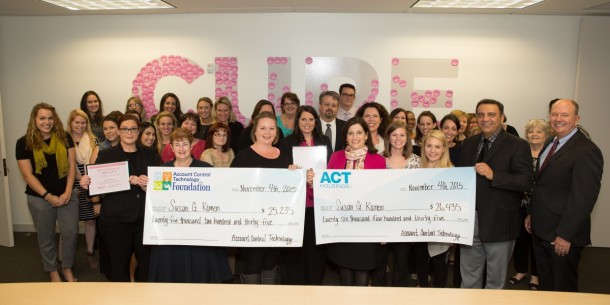
Account Control Technology Holdings, Inc. Donates $51,670 to Susan G. Komen® and the Fight to End Breast Cancer

DOVER, DE – Account Control Technology Holdings, Inc. (ACT Holdings), a holding company that provides comprehensive business process outsourcing and financial services, recently donated $51,670 to Susan G. Komen®, a nonprofit organization which works to end breast cancer in the U.S. and throughout the world through support for groundbreaking research, community health outreach, advocacy and programs in more than 30 countries. The donation includes money raised by Account Control Technology, Inc. (ACT) and Convergent employees from local offices located throughout the United States, as well as a corporate match to employee donations and a contribution in honor of ACT Holdings clients.

To reach such a large contribution, the company’s nonprofit ACT Foundation organized a month-long fundraising campaign called “ACT for a Cure” to benefit Komen and improve breast cancer awareness. Offices participated in luncheons, casual days, bake sales, contests, raffles, tournaments and more to promote donations.

The ACT for a Cure campaign was initiated in 2011 by a long-time employee, Jessi Karrer, who selected the cause of breast cancer awareness to honor her grandmother, who had passed away due to the disease. The annual campaign gained tremendous support from company employees, and it has raised a total of more than $145,000 over the past five years.

“Each year, I’ve been amazed by the generosity of our employees and their outpouring of support for this incredible cause,” said Nabil Kabbani, CEO of ACT Holdings. “I’m especially proud that the entire ACT for a Cure initiative was the idea of a single employee, and it has since grown to an annual event improving our company’s teamwork while having a major impact on the communities we serve.”

Demonstrating the initiative’s ongoing support, ACT Holdings employees raised 61.4% more money for the cause in 2015 than in 2014.

“We are pleased to support Susan G. Komen’s work to improve lives and one day end the disease of breast cancer,” said Dale Van Dellen, chairman of ACT Holdings and the ACT Foundation. “With our company’s dedication to service and ongoing charitable support, we continue to show that together, we can do great things.”

“We are so grateful to the passionate employees at ACT Holdings who are committed to making a difference in the lives of people affected by breast cancer,” said Christina Alford, SVP of development for Susan G. Komen. “The funds raised by ACT Holdings employees – more than $51,000 this year alone – will help us fund lifesaving research and offer more options, more hope and more help to families facing the disease.”

ACT Holdings Komen Donation

Front Row –RIGHT to Left: Dale Van Dellen, ACT Holdings Chairman, and Ray Eshghipour, Director of the ACT Dallas office, present checks totaling $51,670 to Komen representatives Kristen Lauck, Michelle Magargee and Judy Salerno, President and CEO; with ACT representatives Amanda Wanoreck, Jessica Bridges (holding check), Gail Davidson, and Rachel Roland (certificate) providing support as additional Komen and ACT representatives (back rows) show their appreciation.

About Susan G. Komen®

Susan G. Komen is world’s largest breast cancer organization, funding more breast cancer research than any other nonprofit while providing real-time help to those facing the disease. Since its founding in 1982, Komen has funded more than $889 million in research and provided $1.95 billion in funding to screening, education, treatment and psychosocial support programs serving millions of people in more than 30 countries worldwide. Komen was founded by Nancy G. Brinker, who promised her sister, Susan G. Komen, that she would end the disease that claimed Suzy’s life. Visit komen.org or call 1-877 GO KOMEN. Connect with us on social at ww5.komen.org/social.

About Account Control Technology Holdings, Inc. (ACT Holdings)

Account Control Technology Holdings, Inc. provides comprehensive business process outsourcing and financial services to diverse industries. Our companies partner with clients to help them run the “business” behind their operations so they can focus on what they do best – whether it’s serving customers, educating students, caring for patients, or keeping communities moving forward. ACT Holdings companies include Account Control Technology, Inc. and Convergent. For more information, visit http://accountcontrolholdings.com.

About Account Control Technology, Inc. (ACT)

Account Control Technology, Inc. is a leader in providing consultative debt management, collection, call center and business office solutions for education, government, commercial and consumer entities. Established in 1990, ACT has been recognized as an Inc. 5000 fastest-growing private company for the past nine years running. The company serves clients nationwide from five office locations: Bakersfield, California; Woodland Hills, California; Mason, Ohio; Dallas, Texas; and San Angelo, Texas. For more information, call 800-394-4228, email info@accountcontrol.com or visit www.accountcontrol.com.

About Convergent

One of America’s largest business process outsourcing firms, Convergent has more than sixty years of history serving a diverse client base with customer care outsourcing services, commercial receivables management and healthcare revenue cycle management. With contact centers located nationwide, Convergent empowers its clients with an innovative combination of an adaptable workflow engine, technology-enabled operations, next-generation analytics and professional services to deliver superior financial performance and high levels of client and consumer satisfaction. For more information, visit www.convergentusa.com.

About the ACT Foundation

The Account Control Technology Foundation is a non-profit, charitable organization established by Dale and Debbie Van Dellen with a stated mission “to improve the future of students and the greater community by offering financial literacy and debt management education, mentorship and support to those in need.” In addition to funding scholarships and supporting charitable causes, the ACT Foundation promotes financial wellness and higher education planning. For more information or to make a donation, visit www.accountcontrolfoundation.org or email foundation@accountcontrol.com.

Account Control Technology Holdings, Inc. Donates $51,670 to Susan G. Komen® and the Fight to End Breast Cancer
http://www.insidearm.com/doing-it-right/account-control-technology-holdings-inc-donates-51670-to-susan-g-komen-and-the-fight-to-end-breast-cancer/
http://www.insidearm.com/feed
insideARM

Accounts Receivable Management

TekCollect Collaborates with Neighborhood Services, Inc. of Columbus for Corporate Drive

Columbus, Ohio – TekCollect has partnered with Neighborhood Services, Inc. of Columbus to conduct a large corporate clothing drive this past month.

The drive was held for two weeks in October as part of a larger effort to collect clothing for a variety of philanthropic organizations. TekCollect segmented a portion of the drive specifically to collect children’s clothing and shoes, as well as adult men and women’s clothing. Neighborhood Services, Inc. was chosen as the local recipient for the donations, as they exist in the effort to alleviate poverty and provides food services, and material assistance to persons in need in the Columbus community.

TekCollect’s collection efforts included 520 clothing items and pairs of shoes.

“TekCollect chose to partner with Neighborhood Services, Inc. because our staff felt strongly that collected clothing should be distributed freely to local community members and families in need, rather than resold or sent out of town,” said Ron Douglas, Executive Vice President for TekCollect. “We are pleased to add Neighborhood Services, Inc. to our community partners, and look forward to more opportunities to work with them as they serve our city.”

Martin Butler, Executive Director for Neighborhood Services, Inc., said, “We are grateful to the TekCollect team for their focus on people in need in our community. So far this year, NSI have distributed 4,810 families a seven day supply of food. And have had 371 families use our clothing room. Without the generous support of businesses like TekCollect, we would not be able to help the most vulnerable in our community.”

About Neighborhood Services, Inc.

Neighborhood Services, Inc. improves the quality of life in the Columbus community by compassionately and respectfully serving neighbors in need. Neighborhood Services, Inc. was founded in 1965 and primarily serves working, low-income families and individuals, unemployed individuals and their families, and single heads of household with young, dependent children in the Columbus community. To learn more, visit www.NeighborhoodServicesInc.org.

About TekCollect

TekCollect provides comprehensive accounts receivable management, collections and customer retention solutions to nearly 30,000 businesses nationwide. The Company partners with business owners to optimize their internal accounting practices, limit and control delinquencies, and improve positive cash flow for the long-term. TekCollect’s technologically advanced approach generates the highest recovery ratios in the marketplace, and their non-alienating strategies preserve business’s valued customer relationships. For more information, visit www.tekcollect.com.

TekCollect Collaborates with Neighborhood Services, Inc. of Columbus for Corporate Drive
http://www.insidearm.com/doing-it-right/tekcollect-collaborates-with-neighborhood-services-inc-of-columbus-for-corporate-drive/
http://www.insidearm.com/feed
insideARM

Accounts Receivable Management

Third Circuit Gives TCPA Litigants Additional Support

On October 23, 2015, a Third Circuit Court of Appeals decision gave Telephone Consumer Protection Act (“TCPA”) plaintiffs additional ammunition supporting an expanded definition of an “ATDS.” In Dominguez v. Yahoo, Inc., No. 14-1751, (3d Cir. Oct. 23, 2015), based on the July 10, 2015 Federal Communications Commission (“FCC”) order that expanded the definition of an automated telephone dialing system “ATDS” under the TCPA, the court vacated a prior summary judgment decision in Yahoo, Inc.’s favor.

insideARM previously wrote about this case in October of last year.  The facts in the case are not complicated. Dominguez received text messages from Yahoo on his cell phone. The cell phone was a reassigned telephone number. The prior owner of the phone had enrolled the number in Yahoo’s text message system to receive a text notification when he received an e-mail to his Yahoo! account.  The consumer alleged that Yahoo used an ATDS to send thousands of unsolicited text messages (nearly 50 to 60 per day for many months) to his cell phone, ultimately totaling 27,809 texts.

The plaintiff filed a putative TCPA class action against Yahoo, alleging a violation of the TCPA.

The TCPA provision at issue is 47 U.S.C. § 227(b)(1)(A)(iii), which prevents…. making “any call (other than a call made for emergency purposes or made with the prior express consent of the called party) using any ATDS… to any telephone number assigned to a… cellular telephone service.”

The TCPA defines an ATDS as:  “equipment which has the capacity (A) to store or produce telephone numbers to be called, using a random or sequential number generator; and (B) to dial such numbers.”

Prior to the FCC’s July order, Yahoo had successfully moved for summary judgment. Yahoo’s argument was that the TCPA required an ATDS to actually have a “random or sequential number generator,” which its text-messaging system did not have. Instead, it dialed numbers from a compiled list.

The Third Circuit, however, vacated the prior summary judgment decision. The court cited two reasons in its opinion.

First, it found evidence offered by Yahoo, an affidavit from its expert stating that Yahoo’s text-messaging system did not qualify as an ATDS, was “nothing more than a legal conclusion couched as a factual assertion.” The court then stated, “Because this is an issue of heightened importance in light of the 2015 FCC Ruling, and the District Court did not previously have the benefit of the FCC’s ruling in addressing the issue, remand is appropriate to allow that Court to address more fully in the first instance whether Yahoo’s equipment meets the statutory definition.”

Second, the court felt that the term “capacity” needed further review. The court commented, “Because this is an issue of heightened importance in light of the 2015 FCC Ruling, and the District Court did not previously have the benefit of the FCC’s ruling in addressing the issue, remand is appropriate to allow that Court to address more fully in the first instance whether Yahoo’s equipment meets the statutory definition.”

insideARM Perspective

This case is another blow to the ARM industry and any other business that calls cellular phones. Though the written opinion specifically states, “The disposition is not an opinion of the full Court and pursuant to Internal Operating Procedures of the U.S. Court of Appeals for the Third Circuit (I.O.P. 5.7) does not constitute binding precedent,” you can be certain that this case will be cited in every pending TCPA case (and every case that will be filed in the future).

This case also highlights the potential exposure to businesses in TCPA litigation. The court’s opinion highlights the potential exposure, “A successful plaintiff under the TCPA is entitled to $500 in damages per violation. 47 U.S.C. § 227(b)(3)(B). Therefore, Dominguez stands to win $13,904,500.”  The court did not address the potential treble damages if Yahoo was found to have “willfully or knowingly” violated the TCPA, nor the potential exposure if a class was certified.  The numbers are staggering.

Third Circuit Gives TCPA Litigants Additional Support
http://www.insidearm.com/daily/collection-laws-regulations/tcpa/third-circuit-gives-tcpa-litigants-additional-support/
http://www.insidearm.com/feed
insideARM

Accounts Receivable Management