
DBA International Launches Version 3.1 of the Receivables Management Certification Program

In DBA International’s pursuit of continuous improvement, we are proud to announce the adoption of version 3.1 of the Receivables Management Certification Program. The Certification Program offers two distinct certification designations – the “Certified Professional Receivables Company” (CPRC) for companies and the “Certified Receivables Compliance Professional” (CRCP) for individuals.

The uniform industry best practices for companies contained in the CPRC designation sets a standard higher than that required by state and federal law for those debt buying companies, collection law firms and third party collection agencies. Financial institutions and other originating creditors can be confident when working with CPRC companies. These companies hold themselves to higher expectations and rigorous standards for consumer protection and transparency that are subject to independent third party auditing.
Among the changes contained in Version 3.1:

  • Education Credits – Increases from 12 to 16 the number of biennial educational credits a person can receive online (out of the 24 credit requirement) toward their CRCP designation.
  • Standard # 4 (Employee Training Program) – Clarification that employees should be trained on how to comply with applicable: (i) Certification Standards, (ii) corporate policies and procedures, and (iii) laws and regulations.
  • Standard # 15 (Vendor Management) – Adds checking certification status and reviewing complaints on the CFPB portal as additional examples of vendor due diligence.
  • Standard # 20 (Resale) – Adds a requirement that certified companies conduct “reasonable due diligence” on a purchasing company before selling accounts to that company.
  • Standard # 26 (Consumer Complaint) & Standard # 29 (Client Communications) – Adds complaints received from the Federal Trade Commission (FTC), state consumer regulatory agencies, and state and federal attorneys general to the types of complaints a collection law firm and third party collection agency must transmit to its affected clients.

Additional information and resources on DBA International’s Receivables Management Certification Program can be found on the DBA International website.

About DBA International

DBA International (DBA) is the nonprofit trade association that represents more than 575 companies that purchase performing and nonperforming receivables on the secondary market. DBA’s Receivables Management Certification Program and its Code of Ethics set the “gold standard” within the receivables industry due to its rigorous uniform industry standards of best practice which focus on the protection of the consumer. DBA provides its members with extensive networking, educational, and business development opportunities in asset classes that span numerous industries. DBA continually sets the standard in the receivables management
industry through its highly effective grassroots advocacy, conferences, committees, taskforces, publications, webinars, teleconferences, and breaking news alerts. Founded in 1997, DBA International is headquartered in Sacramento, California.

____

Editor’s note: insideARM is an authorized provider of certification credits. Those items that qualify include this notice: “This product is approved for DBA International Certification Credit.”

DBA International Launches Version 3.1 of the Receivables Management Certification Program
http://www.insidearm.com/daily/debt-buying-topics/debt-buying/dba-international-launches-version-3-1-of-the-receivables-management-certification-program/
http://www.insidearm.com/feed
insideARM

Accounts Receivable Management

LiveVox Presents a Follow Up to insideARM’s First Party Outsourcing Summit, Focusing on the Impacts of the TCPA into 2016

SAN FRANCISCO – LiveVox Inc., a leading provider of cloud contact center solutions for enterprise operations, announced it will host a webinar focusing on the discussions that emerged during insideARM’s October 2015 First Party Outsourcing Dummit session, “Impact of Latest FCC Ruling on Creditor In-House and Outsourced Contact Strategies”. The event will feature the Summit’s guest speakers, John Bedard, Principle, Bedard Law Group and Dusty Whitesell, Chief Evangelist, LiveVox. They will be joined by LiveVox Corporate Counsel, Mark Mallah.

To register, click here

This year insideARM held the ARM industry’s first conference focusing on First Party Collections and Outsourcing. One of the most thought provoking sessions of the event took place in a panel covering the impacts of the latest FCC Ruling on both in-house and outsourced operations.

In response to popular demand for a follow up discussion, this webinar will take a deeper dive into the arising best practices and concerns from the session’s executive attendees led once again by the event’s guest speakers.

As consumers continue to drive the use of cell phones, the number of TCPA litigation has and will continue to rise – one can only expect the FCC’s latest expansion of the TCPA will escalate, if not compound the risks to the first party industry into 2016.

To help prepare your organization’s strategy for consumer cell phone contacts, join this webinar for a unique cross-industry insight on the top applicable approaches and apprehensions regarding the FCC ruling from insideARM’s exclusive October event.

On the event, Dusty Whitesell, Chief Evangelist, LiveVox states, “insideARM provided a unique platform for leaders in the first party industry to discuss the specific concerns and best practices affecting their business. The TCPA and FCC Ruling, of course, remained at the forefront of topics discussed. The round-table like discussions that took place during this session unveiled some interesting insights and I am very excited for the opportunity to spend a bit more time discussing them with legal experts like Mr. Bedard and Mr. Mallah.”

About the event:

EVENT: insideARM First Party Outsourcing Summit Follow Up: FCC Ruling’s Leading Risk Mitigation Approaches and Concerns

DATE/TIME: Thursday, December 3, 2015 at 11:00am PT/ 2pm ET

REGISTER: Click here

About LiveVox, Inc.

LiveVox is a leading provider of cloud contact center solutions for enterprise operations.  Through a patented PCI-certified cloud platform and redundant IP/MPLS mesh, it delivers true multi-tenant, highly scalable and burstable contact center solutions such as ACD, predictive dialer, IVR, centralized call recording, business analytics and compliance suite. LiveVox enables fast deployment of contact center solutions from the cloud, while offering customers full control to manage their day-to-day business requirements in a cost-efficient way. For more information, visit http://www.livevox.com.

LiveVox Presents a Follow Up to insideARM’s First Party Outsourcing Summit, Focusing on the Impacts of the TCPA into 2016
http://www.insidearm.com/daily/collection-laws-regulations/collection-laws-and-regulations/livevox-presents-a-follow-up-to-insidearms-first-party-outsourcing-summit-focusing-on-the-impacts-of-the-tcpa-into-2016/
http://www.insidearm.com/feed
insideARM
Accounts Receivable Management

CFPB Brings Action Against Online Lender for Deceiving Borrowers

The Consumer Financial Protection Bureau (CFPB) took action yesterday against an online lender, Integrity Advance, LLC, and its CEO, James R. Carnes, for deceiving consumers about the cost of short-term loans. The Bureau alleges that the company’s contracts did not disclose the costs consumers would pay under the default terms of the contracts. The Bureau also alleges that the company unfairly used remotely-created checks to debit consumers’ bank accounts, even after the consumer revoked authorization for automatic withdrawals.

Pursuant to the press release issued by the CFPB, the Bureau has filed an administrative lawsuit seeking redress for harmed consumers, as well as a civil money penalty and injunctive relief. The administrative action was initiated by a “Notice of Charges.” A Notice of Charges initiates proceedings in an administrative forum, and is similar to a complaint filed in federal court. Under this procedure, the case will be tried by an Administrative Law Judge from the Bureau’s Office of Administrative Adjudication, an independent adjudicatory office within the Bureau. The Administrative Law Judge will hold hearings and make a recommended decision regarding the charges, which may be appealed to the Director of the CFPB for a final decision.

The Notice of Charges has not yet been released to the public. The Bureau’s Rules of Practice for Adjudication Proceedings provide that the CFPB may publish the actual Notice of Charges ten days after the company is served. If allowed by the hearing officer, the charges will be available on the CFPB website after that date.

The CFPB alleges that Integrity Advance violated the Truth in Lending Act and the Electronic Fund Transfer Act, and that Integrity Advance and Carnes violated the Dodd-Frank Wall Street Reform and Consumer Protection Act’s prohibition against unfair and deceptive acts and practices.

The unlawful practices alleged by the CFPB include:

  • Hiding the total cost of loans
  • Requiring repayment by pre-authorized electronic funds transfers
  • Continuing to debit borrowers’ accounts after consumers canceled the authorization

insideARM Perspective

Online and payday lenders are under intensive scrutiny from regulators across the country. Just to name a few public examples:

In August of last year insideARM wrote about two separate actions brought by the Federal Trade Commission and the CFPB against different payday lenders.

In January of this year insideARM reported on a 21 Million Dollar settlement with two online lenders in an action brought by the Federal Trade Commission.

Just 2 months ago the CFPB sued another payday lender and various related entities for allegedly illegally collecting loan amounts and fees that were void or that consumers had no obligations to repay.

Finally, at yesterday’s FTC Debt Dialogue in Atlanta, the state and federal regulators on both panels often mentioned online and payday lenders as “issues” for their agencies.  Expect more enforcement actions against these businesses in the future.

CFPB Brings Action Against Online Lender for Deceiving Borrowers
http://www.insidearm.com/daily/banks-and-credit-grantors/credit-grantors/cfpb-brings-action-against-online-lender-for-deceiving-borrowers/
http://www.insidearm.com/feed
insideARM

Accounts Receivable Management

Actions Speak Louder Than Words: FTC Debt Dialogues Come to a Close in Atlanta

The FTC wrapped up its three city Debt Dialogue tour in Atlanta, Georgia yesterday afternoon with very animated “dialogues” among regulators and representatives of the credit and collections industry.  Georgia’s Attorney General Samuel Scott “Sam” Olens welcomed a packed room of attendees to the third debt dialogue and signaled the importance of regulatory coordination among state and federal law enforcers.

Sam Olens opens 3rd Debt Dialogue

Georgia Attorney General Sam Olens opens 3rd Debt Dialogue

Attorney General Olens applauded the FTC on Operation Collection Protection and confirmed Georgia’s support for the initiative.  The warm introduction was followed by a panel comprised of the Federal Trade Commission (FTC), ACA International Board Member Nick Jarman, and three state regulators: Carri Gruge Lybarker, from South Carolina’s Department of Consumer Affairs; Olha Rybakoff, Senior Counsel in the Tennessee Attorney General’s Office; and John Sours, the Director of Georgia’s Consumer Protection Unit (now part of the Attorney General’s office).

The FTC’s Cindy Liebes, coordinating the first panel, covered many topics in discussions about rogue, fraudulent, and legitimate debt collectors.  The panelists, including ACA Board Member Nick Jarman, reviewed complaint data related to debt collection activity, noting how few complaints are actually generated given the millions – possibly billions – of contacts debt collectors have with consumers annually (fewer than five percent of accounts in collections).

Several of the state regulators noted that debt collection complaints are not necessarily the most prevalent complaints they receive, and may be on the decline.   John Sours, Georgia’s Director of Consumer Protection, told attendees that the number of complaints is not necessarily a good indicator of good or bad conduct and emphasized that good companies may have one or many rogue collectors – what is critical is that they monitor the conduct of their employees and take appropriate action when improper conduct is detected.

Atlanta Debt Dialogue Panel 1

Atlanta Debt Dialogue Panel 1

The message was that it is both the state and federal regulators’ expectation that debt collection agencies must be responsive both to consumer complaints and disputes as well as to regulatory inquiries and that considerable attention would be paid not only to whether debt collectors have appropriate compliance documentation, but to whether or not they have trained it out, monitor it, and take meaningful corrective action when individual collectors fail to follow compliance policies.

South Carolina’s Lybarker emphasized that a critical way for consumers to distinguish legitimate from fraudulent debt collectors is whether or not a debt collector is willing and able to substantiate the debt it may be attempting to collect.   All the state regulators, in harmony with the FTC’s Liebes, indicated disappointment for recurring unanswered complaints or agencies that do not take effective corrective action against bad actors.  Each made the point that in an investigation each will look to see what an agency actually does to foster a compliant environment – not just develop policies that are not truly a part of the agency’s operations.

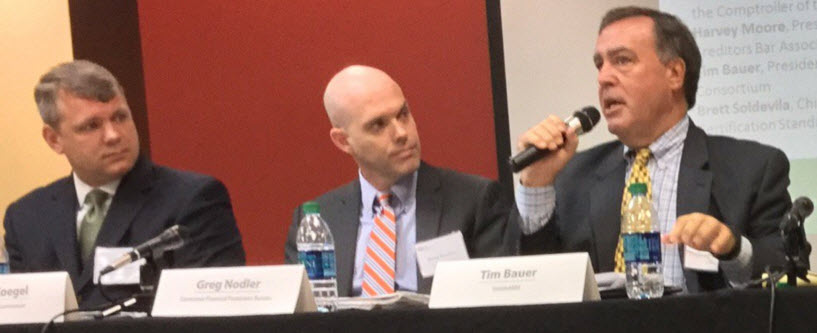
The second panel included Debt Dialogue regulars Chris Koegel, Assistant Director, FTC Division of Financial Practices, and Greg Nodler, Senior Counsel for Enforcement Policy & Strategy, CFPB; who were joined by Kenneth Lennon, Assistant Director of the Community and Consumer Law Division of the Office of the Comptroller of the Currency.  Industry representatives included Harvey Moore, NARCA’s new President and President of The Moore Law Group; DBA representative and Chief Compliance Officer of Security Credit Services, LLC, Brett Soldevila; and Tim Bauer, President of insideARM and co-Executive Director of the Consumer Relations Consortium.

Atlanta Debt Dialogue Panel 2

Atlanta Debt Dialogue Panel 2

An issue initially raised by Bauer – the barriers to communication between consumers and debt collectors – led to a spirited discussion with the entire panel. On the consumer side, there is a tremendous (and justifiable) fear of criminals and thieves posing as debt collectors. From the debt collector side, technology (such as caller ID, voice messaging services, and smart phones), inconsistent laws, and, to no one’s surprise, the TCPA, are all limiting communication between the parties. This led the FTC’s Kane to ask Bauer to talk about a publication released yesterday from the non-profit group, Consumer Action, entitled   When a collector calls: An insider’s guide to responding to debt collectors. Bauer explained that the publication was produced by Consumer Action in partnership with the Consumer Relations Consortium, and is an excellent example of what can happen when consumer groups and collectors have open and honest dialogue.

On the theme of unintended consequences that overregulation of debt collection could yield, the OCC’s Kenneth Lennon engaged in a lively dialogue with DBA International’s Brett Soldevila regarding the OCC’s Bulletins on debt sales and vendor management. Soldevila acknowledged that in developing its certification standards DBA adopted a number of the standards in the OCC bulletin.  He did take issue with a matter in the OCC vendor management bulletin, but indicated that DBA is engaged in discussions with the OCC regarding the roles and responsibilities of a debt seller and debt buyer post-closing a debt sale.

Following this exchange, a friendly debate between NARCA President Harvey Moore and the FTC’s Chris Koegel focused on issues related to whether or not the system of debt collection is broken – and what alternatives may be available in the debt collection process for encouraging consumers to communicate with collectors to resolve outstanding accounts.  They took differing positions on whether or not the laws and regulations related to debt collection are clear and whether an absence of clarity leads to ambiguity.

Industry representatives from both NARCA and DBA indicated that more clarity on how to communicate with consumers is needed.  The CFPB’s Greg Nodler, speaking for himself, stated that he believes the debt collection laws are clear and that, for example, in regard to leaving messages, Nodler feels the Foti decision is clear.  NARCA’s Moore indicated that some of the complexity of applying laws that were enacted before current technology evolved may create opportunities for unnecessary and costly litigation.

Although FTC’s Koegel opened the third and final Debt Dialogue acknowledging that debt collection plays a critical role in our economy, he later emphasized “where there is a need to communicate with consumers there should be a pathway” but that “nothing in the legal and regulatory scheme obligates consumers to communicate with debt collectors.”

NARCA’s Moore reported that only two percent of all messages left for consumers result in a call back. In reply FTC’s Koegel questioned why collectors would then leave messages at all if they prove ineffective in generating a response.  FTC’s Koegel encouraged debt collectors to explore other means for communicating with consumers that may be more consumer-driven.

As in past Debt Dialogues, the regulators were asked to review some recent enforcement examples. The FTC and CFPB agreed that there are too few resources to pursue all possible actions so Operation Collection Protection and coordination with other agencies is critical to pick actions strategically, to foster deterrence of harmful conduct, and to encourage remediation.  All of the state and federal regulators were supportive of the industry trade associations’ actions to self-regulate and drew the Debt Dialogue to a close.

Actions Speak Louder Than Words: FTC Debt Dialogues Come to a Close in Atlanta
http://www.insidearm.com/daily/debt-buying-topics/debt-buying/actions-speak-louder-than-words-ftc-debt-dialogues-come-to-a-close-in-atlanta/
http://www.insidearm.com/feed
insideARM

Accounts Receivable Management

Illinois Bill Provides Welcome Fix to Illinois Collection Agency Act

A recent Illinois bill provides a welcome fix to the Illinois Collection Agency Act (ICAA). The legislation, SB 1369, corrects amendments made to the ICAA this past August.  Those amendments potentially expanded sections of the ICAA to commercial debt and would require disclosures contrary to (and possibly in violation of) the federal Fair Debt Collection Practices Act.

The corrective legislation:

  • Amends section 9.1 (Communication with persons other than debtor) to provide that when seeking location information from third parties, collection agencies and debt buyers must provide the name of their employer “only if expressly requested”
  • Amends section 9.3 (Debt validation) to provide that a collection agency or debt buyer provide a debtor with the name and address of the original creditor only if requested by a debtor, in writing, within the 30-day validation period
  • Amends the above sections as well as sections 2 (Definitions) and 9.2 (Communication in connection with debt) to apply only to debt incurred primarily for personal, family or household purposes
  • Adds that a collection agency or debt buyer is immune from civil liability under sections 2, 9.1, 9.2, or 9.3 of the ICCA if it can demonstrate compliance with comparable provisions of the FDCPA

The bill, which took its current form through a House Committee Amendment on Oct. 16, passed in the House on Nov. 10, and will be returned to the Senate for concurrence.  Assuming concurrence and absent a veto, the legislation will become law immediately upon the Governor’s signature or, if the Governor takes no action, within 60 days of the date it was presented.

Illinois Bill Provides Welcome Fix to Illinois Collection Agency Act
http://www.insidearm.com/daily/commercial-b2b-receivables/commercial-debt-collection/illinois-bill-provides-welcome-fix-to-illinois-collection-agency-act/
http://www.insidearm.com/feed
insideARM

Accounts Receivable Management

Consumer Litigation “Continues to Evolve in Lurches”: Your October Debt Collection Stats

“Everything is broken.” So starts Jack Gordon’s report on October’s debt industry statistics. And he’s not wrong. But this all also shouldn’t be any surprise.

Consumer litigation against debt collectors took a bump in October — and this is across all the Big Statutes: FDCPA, FCRA, and TCPA.

FDCPA suits “unexpectedly [caught] fire this year, up more than 1200 suits (+14.5%) over this time in 2014,” according to Gordon. FCRA suits “works out to a dramatic +39% increase over this time last year,” and “TCPA’s YTD numbers have recovered due to the combination of a strong October and a weak few months at the end of 2014. Now up almost 200 suits (+8.7%) over this time last year, TCPA seems to have avoided the likelihood of a decline.”

insideARM’s Perspective: I sat in on a TCPA presentation at this year’s NARCA conference in Washington, D.C. It was similar, almost to the jokes used to punctuate slides, to every TCPA presentation we’ve all heard at this point because, in a post-July world, we’ve covered all we’re going to cover and the TCPA questions are still the questions.

One interesting point mentioned, almost as a throw-away, was this: no one really paid attention to, or gave much thought to, the TCPA even as recent as five years ago. And now, it’s essentially an Old Favorite for consumer attorneys — especially after the FCC “clarified” so much of it.

As an industry, you seem to be about five to eight years behind where you should be, and you spend a lot of energy being reactive rather than proactive. And after the NARCA TCPA presentation, I asked, “So, what is the next TCPA? What is the thing that, five years from now has the potential to be a nightmare and a surprise to an industry not great at forward thinking?” And it took a while before one of the two attorneys offered, “…data security? Maybe?”

My suggestion isn’t to channel all of your intelligence and energy into the Next Big Thing — that won’t work, either. But a few more conversations with shared intelligence — “Hey, I’m noticing a sea-change around [x]; maybe we ought to address that in some industry-wide way?” — is probably not a terrible idea.

Happy Friday the Thirteenth!

[For those interested in music, here’s a gorgeous song called “Everything is Broken” by a band called Ollabelle]

Consumer Litigation “Continues to Evolve in Lurches”: Your October Debt Collection Stats
http://www.insidearm.com/daily/debt-collection-news/accounts-receivables-management/consumer-litigation-continues-to-evolve-in-lurches-your-october-debt-collection-stats/
http://www.insidearm.com/feed
insideARM

Accounts Receivable Management

A Guide to Tracking Consent and Revocation of Consent

Lex Patterson

Lex Patterson

Recent Telephone Consumer Protection Act (TCPA) developments have made it vital that collection agencies take a proactive, and sustainable, approach to managing contact consent, as well as revocation of that consent. The following list of questions may be helpful in considering where your process currently stands.

Considerations Regarding Consent at the Originator 

  • How is consent captured by the originators?
  • Do their contracts contain the broadest possible language?
  • Is the language affirmative vs. passive?
  • Are the consent clauses conspicuous?
  • Do they address downstream consent?

Tracking Consent at the Debt Collector

  • How do we currently track consent?
  • Is the process different across business lines?
  • How do we treat implied consent?
  • Which accounts do I currently have consent to call?
  • Which consumer accounts have I previously had conversations with, have they already made payments, and have they already given consent?
  • Do certain accounts create challenges for our work procedures and call flows?
  • What is our strategy for identifying and tracking wrong or re-assigned numbers?

Managing Revocation of Consent

  • Revocation of consent can come in many forms, and through many channels. Have we identified and mapped processes for all of these? (Examples include: to the agency by mail, phone call with a consumer, correspondence from an attorney, correspondence from the client)
  • Is revocation of consent addressed in our policies and procedures, as well as in our training process?
  • How is revocation data collected? Is there a central repository?
  • Are we recording 100% of our calls, and does our QA or voice analytics process turn up instances of un-recorded revocation?
  • Is there an information flow from the originator to the service provider regarding revocation of consent?

By creating workflows based on account segments, you will maximize collection potential and minimize contact risk. Today, there are many applications available to visualize your processes with flow charts for all of your policies and procedures.

The following tools, utilities, and training, whether incorporated into your collection software or added as stand-alone solutions, will assist in making your consent-related policies and procedures practical and sustainable:

  • Collection recovery scores
  • E-signature, text, and email capability to quickly facilitate consent capture
  • Call recording and retrieval technology to capture and retrieve consent recordings
  • Agency-defined database fields and screens to notate and track consent and revocation
  • Corresponding system workflows that mimic and align your system users to your consent capture policies and procedures
  • Document storage repository for electronic consent storage and retrieval
  • Thorough training for how to utilize these system features during employee onboarding
  • Ongoing refresher training courses for employees
  • Continued corporate communication highlighting the importance of compliance with the rules related to producing proof of consent

By taking a proactive and sustainable approach to managing both consent and its revocation, collection agencies will minimize TCPA risk. While many of you are likely familiar with the answers to some or most of the questions provided above, you may want to provide this article to your staff and ask them to use it as a checklist to conduct a review of your current consent-related policies and procedures.

A Guide to Tracking Consent and Revocation of Consent
http://www.insidearm.com/connections-elevated/a-guide-to-tracking-consent-and-revocation-of-consent/
http://www.insidearm.com/feed
insideARM

Accounts Receivable Management

The Supreme Court Takes Another Look at Mootness Following an Offer of Judgment in TCPA Class Litigation

Daniel Blynn, Venable, LLC

Daniel Blynn,
Venable, LLC

Note: Venable LLP Associate Samuel D. Boro and Christopher Boone also contributed to this article.

The Supreme Court wrestled with a thorny question on October 14, 2015 when it heard oral argument in Campbell-Ewald Co. v. Gomez, a case that we previewed previously.  The transcript of the oral argument is available here.

The facts in Campbell-Ewald are straightforward.  The plaintiff sued Campbell-Ewald, a U.S. Navy contractor hired to provide “multimedia recruiting campaign” services, under the Telephone Consumer Protection Act (“TCPA”) after he received an unsolicited text message from Campbell-Ewald in 2006.  Campbell-Ewald admitted fault and, pursuant to Fed. R. Civ. P. 68, offered a full settlement of $1,503 to the plaintiff, slightly more than three times the maximum award allowed under the TCPA.  But, there is a wrinkle – the plaintiff refused the offer of judgment.  That brings us to the Supreme Court, which is considering the following question: “Does a case become moot when a plaintiff receives an offer of complete relief for his claim?”

At oral argument, the justices were split along ideological lines, with the liberal justices siding with the plaintiffs and the conservatives siding with Campbell-Ewald.  The conservative justices focused on judicial economy and practicality, emphasizing the lack of adversity arguably resulting in no need for judicial involvement because the plaintiff has been offered everything to which he or she could possibly be entitled.  On the other side, the liberal wing took issue with the premise that Campbell-Ewald’s offer was for complete relief, pointing out that the plaintiff also asked for his attorneys’ fees.  In response, Justice Scalia noted, “I suppose he could ask for the key to Fort Knox, right? If it’s a frivolous claim, I don’t see why the Court can’t dispose of that initially in connection with the mootness.”

It all may come down to Justice Kennedy as the deciding vote as he found issues with the arguments from both sides.  For example, he pushed back against Campbell-Ewald’s position, stating “a settlement offer and a settlement contract . . . are different from a judgment, and you do not have a judgment . . . and if you want us to write an opinion and say, oh, well, a settlement offer is the same as a judgment – that just doesn’t equate with the Federal Rules of Civil Procedure.”  But, Kennedy also appeared troubled by whether Article III adversity would exist following an offer of full relief: “there has to be adversity. . . .  And if $10,000 is in the bank and [the plaintiff has] been injured in the sum of $10,000, there’s no adversity.”  Justice Breyer offered a potential solution to that issue by suggesting that, if a plaintiff will not accept an offer of complete relief, the defendant could deposit the money with the court and have the court issue a judgment stating that the case is over.  But, Kennedy’s hypothetical reflected an additional procedural wrinkle that could affect the outcome of the case.  Campbell-Ewald may have offered complete relief, but it did not tender the money to the court.  Kennedy emphasized this distinction by asking, “[s]uppose one day after the offer, the defendant defaulted. Would a case that was once moot now become non-­moot?”  In short, without Breyer’s potential depository solution, a defendant offering full relief could default on its offer if the money is not deposited in the court, leaving the plaintiff with no satisfaction or resolution.

The oral argument closed with two groups of opposing justices set in their opinions regarding whether an offer of judgment for complete relief moots a case or not.  The middle ground, proffered by Justice Kennedy and possibly supported by Justice Breyer, remains unresolved.  Observers are left with uncertainty as to how the Court will rule.  The question remains whether the Court can provide a mechanism for a defendant to concede liability and end litigation, while still providing a mechanism for cases to proceed where permitting an offer of judgment would not provide complete relief to the plaintiff.

The outcome of this case could have significant implications for TCPA class actions and other cases seeking statutory damages.  If the Court agrees with Campbell-Ewald, then defendants will be able to moot putative TCPA class actions by offering the plaintiff full relief.  Such a conclusion would serve as an important check on the expansive interpretation of the TCPA made by the FCC in its July 2015 omnibus order and the associated proliferation of TCPA complaint filings in the wake of that order (our most recent list of TCPA case filings is available here).  The Court, alternatively, could side with the plaintiff and hold that such an offer, if unaccepted, does not moot a case, which may make it more difficult in certain jurisdictions to obtain early resolution of TCPA class actions.


The Supreme Court Takes Another Look at Mootness Following an Offer of Judgment in TCPA Class Litigation
http://www.insidearm.com/daily/debt-collection-news/accounts-receivables-management/the-supreme-court-takes-another-look-at-mootness-following-an-offer-of-judgment-in-tcpa-class-litigation/
http://www.insidearm.com/feed
insideARM

Accounts Receivable Management

Big Mistake! Three Compliance Risks Collectors Overlook

John Rossman, Moss & Barnett

John Rossman,
Moss & Barnett

Regulators from the CFPB and the FTC encourage the debt industry to look at past enforcement actions and other publications to determine what issues are most important to those agencies.  A review of the recent enforcement actions by the CFPB and FTC, as well as other publications, reveal three distinct trends: actions involving unfair treatment of service members; the failure of debt collectors to adequately distinguish and investigate FDCPA and FCRA disputes; and, racial bias in debt collection efforts.

In this timely and though-provoking episode of the Debt Collection Drill, attorneys John Rossman and Mike Poncin discuss best practices for complying with collections involving service members, handling of FDCPA and FCRA disputes and tips for creating a program to assess and eliminate any racial bias in the debt collection process.  During the podcast, Rossman and Poncin discuss this article: The Color of Debt: How Collection Suits Squeeze Black Neighborhoods.

Listen here:


(If you cannot see the audio player above, please download the file directly at http://traffic.libsyn.com/thedrill/TDCD_ep52.mp3)

Big Mistake! Three Compliance Risks Collectors Overlook
http://www.insidearm.com/daily/debt-collection-news/accounts-receivables-management/big-mistake-three-compliance-risks-collectors-overlook/
http://www.insidearm.com/feed
insideARM

Accounts Receivable Management

Top 3 Metrics That Must Be On Your Talent Acquisition Scorecard

Note: This is Part II of a Scorecard Series. Click here to read Part I.

Stacy Spradling

Stacy Spradling,
Radius Global Solutions

If operational effectiveness starts with and is driven by a balanced scorecard, then it is imperative that all of the functional support areas have scorecards that align to and associate closely with the goals of the operation.

The talent acquisition team is no exception. Members of this team might have individual performance goals that are not seen on the operations scorecard. However, all metrics on the recruiter’s individual scorecard should originate from and correlate to operational goals. If a metric cannot be tied back to overall operational performance, employee retention, or company culture then it does not belong on any scorecard.

In a recent break-out session on recruiting at the insideARM First Party Summit, participants were asked what metrics belong on the talent acquisition team’s scorecard. Overwhelmingly, participants agreed on the top three.

1) Class Fill Rate

I have always defined class fill by the number of candidates that complete new hire orientation. It goes without saying that if a recruiter needs to fill a class of 25 people, they should recruit and make offers to a number greater than 25 to account for background check fails and first day no shows.

(2) Early Attrition

Designating goals related to the retention of new employees through the transition from training to production is critical. Recruiters are under pressure to fill classes, but they must also have skin in the game when it comes to graduation rates and retention through days 90-120 as an early attrition measurement.

To achieve this goal, recruiters must avoid candidates who cannot demonstrate a history of job stability. Often recruiters look at candidates with prior BPO or contact center experience as premiere contenders. Unfortunately, a person who has held multiple jobs at BPOs over a short period of time is a likely to be a short-timer in your organization as well.  Make sure your recruiters understand that past performance is a solid predictor of future performance. If a candidate has worked six months at each of their last five jobs, you can predict with a beneficial amount of certainty that they will attrite in about the same amount of time with your organization. My best advice. No matter how great your organization, you will not change the behavioral patterns of a job hopper.

(3) Quality of Hires

During the break-out session there was much discussion about how to determine the quality of a new hire. Most agreed that this is a more difficult measurement because there is an unavoidable amount of subjectivity that exists when it comes to revealing a candidates suitability for the job in terms of quality. Then again, assimilating a recruiting goal with a quality measure is doable and has an eminent impact. There are a number of components that should be considered when establishing a quality metric for the recruiter’s scorecard.

The Trainer’s Observations

At the end of each training week the trainer should be able to provide the recruitment team with the answers to a few questions on the quality of a hire. Although this is subjective, there is value in this exercise. It not only serves to provide feedback about a candidate to the recruiter, it will also open a line of frequent and ongoing communication between the two functional areas. When operators, trainers, and recruiters talk about new hires frequently the collaboration shows in terms of better hiring habits. Below are some good questions that recruiters may consider asking trainers in the early days of training.

  • Does the new hire seem fully engaged in the training process? Do they ask appropriate questions? Are they taking notes
  • Does the new hire have the basic skills needed to perform the role in the time allowed for training and pre-production learning labs?
  • Does the new hire exhibit solid written and verbal communication skills?
  • Does the new hire get along well with their trainer and classmates?

Assessments

This is one of the most objective ways to measure the quality of a hire. The new hire should be able to pass an assessment associated with each training module. Successful completion of assessments should definitely be a component of the recruiter’s scorecard.

Performance Indicators

Whether you have a learning lab extension to training or newly graduated trainees go directly to the production floor, early performance numbers should be reflected as a quality of hire metric. Keep in mind that newer employees will often need a graduated or phased approach to achieving key performance indicators. Regardless of how you arrive at the performance scorecard for new employees, the recruiters’ scorecard should reflect an aggregate of these numbers for each training class.

I am not a big fan of packing a scorecard with more than three or four metrics. However, there are a number of valuable metrics that for measuring the overall effectiveness of your recruiting strategy. I recommend that the individual team members have a scorecard to hold them accountable. In addition, I recommend that the talent acquisition department also have a scorecard to highlight the overall recruiting strategy’s strengths and gaps. Only focusing on individual performance is a fallacy because an individual who is executing based upon a flawed strategy will appear to fail over time.

Some recommended metrics for the talent acquisition scorecard can be found below.

Applicant to Hire Ratio (AHR) – For entry level jobs an AHR between 1:3 and 1:5 is standard. It is critical that the organization clearly define applicant.  Most companies define an applicant very simply as someone who has applied (submitted a resume or filled out an application). Others define an applicant as someone who has applied and meets the basic qualifications of the job (they have been lightly pre-screened and qualified as an applicant). Note that neither way is right or wrong. However, if you choose the latter your AHR goals should hover around the 1:3, 1:4 range depending on the location. In more populated locations it is reasonable to have a higher AHR.

Retention – I am not talking about early attrition rates. I am talking about the company’s overall attrition goal. Every single department in the organization should be responsible for overall attrition. Some will argue that this goal does not belong on a talent acquisition scorecard because once a person is hired and trained operations owns the relationship. I say, nonsense! Every department has an impact on an employee in some way. Figure out what part of the relationship your department owns and stay focused on keeping it healthy.

Time to Fill – In the BPO space, most entry level positions or classes are filled with a class start date as the deadline. In this case, the scorecard class fill rates do the trick. However, time to fill should be a separate and highly visible metric when it comes to leadership and niche roles. The time to fill goals for all key roles should be determined during the scorecard set up, not when the roles become vacant. An IT programmer role may need 45 days, while a quality analyst may only need 20 days depending on your location. Having time to fill goals assigned to all key roles will encourage the recruiting team to source for those roles all the time instead of only when the roles are vacant.

Return on Investment (ROI) or Cost Effectiveness – The recruiting team must be accountable to the overall recruiting budget and their stewardship over spending. A team can stay within budget comfortably, but that does not necessarily mean that they are getting the best ROI. There are three components that should be tied directly to this measurement.

  1. Applicant to Hire Ratio – Track the source of each applicant and determine a cost per applicant.
  2. Class fill – Track the source of each hire and determine the cost per hire, by source. The most common mistake I have seen made by recruiters is that they continue to use a source that boosts their recruiting pipeline, but they fail to recognize that the source rarely results in a quality hire.
  3. Retention – Continue tracking the source through the employee lifecycle.

Top 3 Metrics That Must Be On Your Talent Acquisition Scorecard
http://www.insidearm.com/opinion/top-3-metrics-that-must-be-on-your-talent-acquisition-scorecard/
http://www.insidearm.com/feed
insideARM

Accounts Receivable Management