
BillingTree Completes HIPAA Security Assessment as Part of its Focus on Regulatory Compliance

BillingTree®, one of the nation’s premier payment solutions providers, today announced it has completed the 2014 assessment in line with the Health Information Portability and Accountability Act (HIPAA) Security Rule. The HIPAA assessment, which was carried out by nationwide independent security and compliance experts A-Lign, confirms to healthcare receivables firms that the company continues to remain compliant with industry regulations.

The successful assessment is part of BillingTree’s industry-leading policy of regulatory compliance – the company is also holds PCI DSS Level 1 Compliance certification and is accredited with an ‘A+’ rating by the internationally respected independent Better Business Bureau (BBB). In August the company also announced its successful examination in conformity with the Statement on Standards for Attestation Engagements (SSAE) No. 16.

The HIPAA assessment certifies that BillingTree’s processes, procedures and controls have been formally evaluated and tested against guidelines laid down by the U.S Department of Health and Human Services. A-Lign conducted the assessment using a combination of interviews, observation and inspection of evidence to determine BillingTree’s controls and procedures are in place as required.

“At BillingTree we are committed to ensuring our customers and partners enjoy complete compliance across a range of industries,” commented BillingTree’s CEO Edgars Sturans. “This latest HIPAA assessment shows BillingTree’s continued dedication to ensure our payment processing services are secure and compliant. It’s evidence that our controlled procedures and environment continue to operate in line with up-to-date industry standards.”

Organizations in the healthcare receivables marketplace interested in more information on healthcare compliance can register here for a replay of a recent BillingTree webinar around the topic.

About BillingTree
BillingTree’s mission has centered around assisting companies with growing their business by delivering cost-effective, compliant payment solutions that increase and accelerate collections. Committed to and serving the accounts receivable industry for over a decade, BillingTree is the industry leader in the breadth of integrations with core collection platform systems and payment technologies, and in payment compliance. At BillingTree – Your Growth is Our Business. For more information, visit www.mybillingtree.com or call 877.4.BILLTREE.

BillingTree Completes HIPAA Security Assessment as Part of its Focus on Regulatory Compliance
http://www.insidearm.com/daily/medical-healthcare-receivables/medical-receivables/billingtree-completes-hipaa-security-assessment-as-part-of-its-focus-on-regulatory-compliance/
http://www.insidearm.com/feed
insideARM


Accounts Receivable Management

CFPB Shuts Down Student Loan Debt Relief Scam as Senators Press ED on Loan Discharges

In two separate actions Thursday, the CFPB and a group of U.S. Senators turned their attention to debt relief for students struggling to repay loans. The CFPB shut down two student “debt relief” scams while 13 Senators asked the Department of Education to forgive student loans held by companies that break the law.

The CFPB announced that it took action to put an end to two student “debt relief” scams that illegally tricked borrowers into paying upfront fees for federal loan benefits. The CFPB, in a joint filing with Florida’s Attorney General, shut down student debt relief company College Education Services and separately filed a lawsuit against Student Loan Processing.us for illegally marketing student debt relief services.

The Bureau also issued a consumer advisory warning student loan borrowers to be wary of paying high fees for free federal loan benefits.

College Education Services, its owner, Marcia Elena Vargas, and advisor and employee, Frank Liz, marketed and advertised debt relief services to student loan borrowers with loans in default. Based in Tampa, Florida, the company advertised through Internet ads and operated websites including CollegeDefaultedStudentLoan.com and HelpStudentLoanDefault.com. The company reaped millions of dollars in advance fees from thousands of consumers before it ceased operations around February 2013.

Specifically, College Education Services:

  • Charged illegal advance fees
  • Falsely promised lower payments
  • Falsely claimed quick relief from default or garnishment

Under the Dodd-Frank Wall Street Reform and Consumer Protection Act, the Bureau has the authority to take action against companies engaging in unfair, deceptive, or abusive practices (UDAAP).  The Bureau asked a federal district court to enter a consent order that would permanently ban College Education Services, Liz, and Vargas from engaging in any debt relief businesses. In addition to the permanent ban, the proposed order requires College Education Services, Vargas, and Liz, to pay a $25,000 civil penalty, which was based on the defendants’ inability to pay a more substantial amount.

Student Loan Processing.US, a fictitious business name of Irvine Web Works, Inc., is headquartered in Laguna Nigel, California, with an office in Dallas, Texas. The CFPB alleges that since at least July 2011, the company and its owner, James Krause, has been marketing and advertising services to advise and assist borrowers applying for Department of Education federal student loan repayment programs. The company operates websites under the names StudentLoanProcessing.us, StudentLoanProcessing.org, and slpus.org.

In the complaint filed Thursday, the Bureau is accusing the company and Krause of:

  • Falsely representing an affiliation with the U.S. Department of Education
  • Charging illegal advance fees
  • Deceiving borrowers about the costs and terms of its services

Separately from the CFPB and Florida AG actions, a group of 13 Democratic U.S. Senators sent a letter to the Department of Education urging the agency to implement clear policies for using its existing authority to discharge federal student loans for students who attend colleges that break the law. The letter was signed by Senators Warren, Barbara Boxer (D-Calif.), Richard Durbin (D-Ill.), Jack Reed (D-R.I.), Sheldon Whitehouse (D-R.I.), Jeff Merkley (D-Ore.), Al Franken (D-Minn.), Richard Blumenthal (D-Conn.), Brian Schatz (D-Hawaii), Tammy Baldwin (D-Wis.), Christopher Murphy (D-Conn.), Mazie Hirono (D-Hawaii), and Edward Markey (D-Mass.).

In the letter, the senators ask ED to immediately discharge loans for students who attended Corinthian Colleges, Inc. campuses and have legal claims against the school. Corinthian Colleges is currently the subject of lawsuits by the Massachusetts and California state attorneys general and the CFPB, and is under investigation by more than a dozen other state attorneys general for unlawful practices.

The senators also highlighted the importance of strong federal legal protections for borrowers to ensure accountability for schools and for regulators.

In the letter, the senators call on ED to implement clear policies and procedures that put teeth into its existing legal authority to discharge federal student loans when borrowers have legal claims against their schools. The senators wrote, “Without such a process, duplicitous colleges are free to break the law, to suck down billions in federal student loan dollars, to treat students unfairly — and to stick borrowers with the bill. This is exactly what we have seen at Corinthian Colleges.”


CFPB Shuts Down Student Loan Debt Relief Scam as Senators Press ED on Loan Discharges
http://www.insidearm.com/daily/collection-laws-regulations/cfpb-shuts-down-student-loan-debt-relief-scam-as-senators-press-ed-on-loan-discharges/
http://www.insidearm.com/feed
insideARM
Accounts Receivable Management

CFPB Addresses Medical Debt Collection, Mandates Tighter Policing of Credit Report Furnishers

Consumer Financial Protection Bureau Director Richard Cordray today will call on credit reporting agencies to take a more active role in policing the companies that furnish data on consumers, including a mandate to report consumer disputes made against specific companies. The new requirements stem from a CFPB study on debt collection tradelines in credit reporting.

In a speech in Oklahoma City Thursday, Cordray will announce that large national credit reporting bureaus will now be required to track which creditors, debt collectors, debt buyers, and other companies are providing information for publication on consumer credit reports that see the highest level of disputes from those consumers. The credit reporting agencies will then provide an “accuracy report” to federal regulators.

The CFPB will also be tracking which industries draw the most disputes and which companies receive the highest number of disputes relative to their peers within industries.

The federal financial watchdog released a sample accuracy report that it suggested credit reporting agencies could use to comply with the new requirement.

The Bureau did not say how it will use the information it collects from the credit bureaus, but it did say that it “expects the credit reporting agency to investigate, identify if there is a problem, and take appropriate action” against companies with a high number of disputes. In his speech, Cordray said that appropriate action “may include declining to accept information from the troubled furnisher.”

In conjunction with the new requirement announcement, the CFPB released a study on the impact debt collection has on consumer credit reports. The focus was primarily medical debt, but the new requirements for national credit reporters – specifically, TransUnion, Equifax, and Experian — will be neutral on the type of debt being reported.

Still, the CFPB’s report showed that 52 percent of all debt on credit reports is from medical expenses. So a lot of the information in the report, and in Cordray’s speech, was focused on medical debt.

“It’s hard for consumers to navigate the medical debt maze and come out with a clean credit report on the other side,” said CFPB Director Richard Cordray. “The CFPB is taking action to improve credit report accuracy. Getting medical care should not make your credit report sick.”

The CFPB’s research revealed that nearly 20 percent of all Americans have a medical debt on their credit report, with seven percent having only a medical debt collection tradeline and no other negative marks.

The impact medical debt has on consumers’ credit reports is a huge concern for the CFPB, especially since the transaction that creates the debt is often far different from typical credit behavior. The report is also a continuation of the work the CFPB has been doing in the area.

In May, the CFPB published a report that focused on the consequences of medical debt in collections on consumers’ credit scores. In both the report and in official statements made surrounding its release, the CFPB did not make recommendations for policy changes. At the time, the report was seen as the first step in the process of proposing a rule about medical debt reporting and collection.

The CFPB stopped short of making rule proposals today, but the new requirement on national credit reporting agencies is not the only step the Bureau is considering.

The report lauds efforts by credit scoring outfits, specifically FICO, to re-weight paid collection accounts and medical debt. The CFPB also mentioned the joint effort by ACA International and the Healthcare Financial Management Association (HFMA) to develop standards for medical debt collection and credit reporting.

Outside of the medical ARM sector, the report contained some additional interesting information. The CFPB’s research revealed that more than two-thirds (67.5 percent) of all collection tradelines on consumer credit reports are reporting on accounts that did not originate with a traditional credit agreement. In addition to healthcare providers, utility companies and telecom companies – and their debt collection agencies – are responsible for the bulk of collection tradelines.

The Bureau also discussed “passive collection,” or parking collection tradelines on consumer credit reports in an attempt to get inbound service from debtors. But the CFPB did note that in many cases, a collection agency’s credit reporting behavior is dictated by its creditor client, including healthcare providers.

Finally, the CFPB announced the publication of a new consumer advisory, “7 Ways to Keep Medical Debt in Check.”

CFPB Addresses Medical Debt Collection, Mandates Tighter Policing of Credit Report Furnishers
http://www.insidearm.com/daily/debt-collection-news/debt-collection/cfpb-addresses-medical-debt-collection-mandates-tighter-policing-of-credit-report-furnishers/
http://www.insidearm.com/feed
insideARM

Accounts Receivable Management

Congressmen Urge Scrutiny of For-Profit College Sale to Debt Collector

Three Congressmen wrote a letter to the Department of Education this week urging careful scrutiny of a plan that would see 56 campuses previously owned by Corinthian Colleges, Inc. sold to ECMC Group, a student loan guarantor and parent company of a student loan debt collection agency. The letter cited debt collection tactics, among other things.

The Congressmen – Reps. Steve Cohen (D-Tenn.), Raul Grijalva (D-Ariz.), and Mark Takano (D-Calif.) – accused ECMC of being a bad fit for running colleges because as one of the largest student loan guaranty agencies in the country, it “has benefited by collecting loan payments from student, sometimes using dubious tactics.”

Under the plan, ECMC Group is forming a non-profit subsidiary, Zenith Education Group, to facilitate the sale and run the campuses post-transaction. ECMC is the parent company of Educational Credit Management Corporation, one of the largest student loan guaranty agencies in the U.S. and Education Department partner, as well as Premiere Credit of North America, a debt collection agency that also collects student loans on an ED contract.

ECMC said that the transition from for-profit to non-profit status would involve transforming “the culture and education model at the acquired schools, including lowering tuition and introducing strict accountability standards for program completion and job placement rates.”

But the letter noted that once the transition is complete, Zenith will not be held to new measurable standards set for for-profit institutions involving job placement goals and the ability of its students to repay student loans.

Further, the Congressmen wrote that, “We are concerned that neither the ECMC Group nor the Zenith Education Group has any previous experience in operating an academic institution.”

Rep. Cohen is also the lead sponsor of the Private Student Loan Bankruptcy Fairness Act of 2013 with Congressman Danny Davis (IL-07), which aims to restore fairness in student lending by treating privately issued student loans the same as other types of private debt in bankruptcy.

Congressmen Urge Scrutiny of For-Profit College Sale to Debt Collector
http://www.insidearm.com/daily/featured-post/congressmen-urge-scrutiny-of-for-profit-college-sale-to-debt-collector/
http://www.insidearm.com/feed
insideARM

Accounts Receivable Management

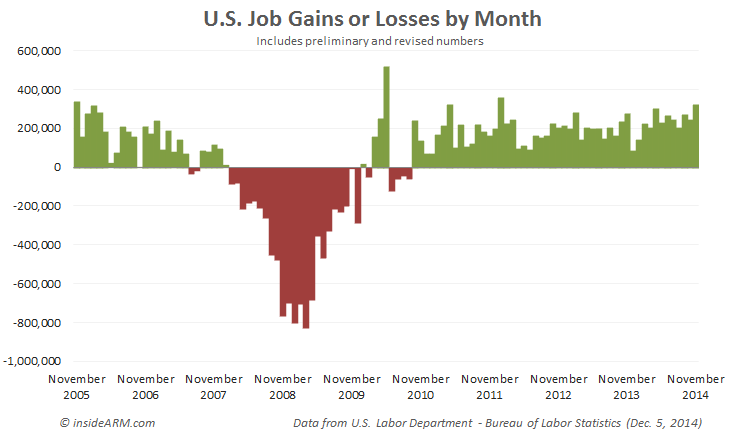
Job Gains Soar in November as Unemployment Rate Stays at 5.8 percent

The U.S. added an unexpectedly large 321,000 jobs in November, the largest single-month gain in nearly three years according to the Labor Department’s Friday release. The unemployment rate remained at 5.8 percent due to slightly more people entering the workforce.

Analysts and economists had been expecting a reading of around 235,000 new jobs.

The gains were broad across nearly all sectors. Professional and business services added 86,000 jobs, retail was up 50,000, healthcare added 29,000 jobs, and manufacturing positions increased by 28,000.

With revisions to September and October’s numbers totaling a net gain of 44,000 across the two months, the September-November 2014 period marks the best three-month stretch of job gains since March-May 2010. But May 2010’s numbers were artificially inflated due to hiring for the 2010 Census. Taking that period of out the equation, the most recent three month stretch was the best since the first three months of 2006.

US-job-gains-Nov-2014

The labor force participation rate in November was 62.8 percent, flat from October and up very slightly from September’s 62.7 percent. Similarly, the employment-to-population ratio, 59.2 percent, was flat month-over-month, but up from 58.6 percent in November 2013. There were also about 72,000 fewer discouraged workers in November compared to October.

The U-6 alternative measure of unemployment – which counts discouraged workers, those in part-time jobs against their will, and “marginally attached” workers – was 11.4 percent in November, down slightly from 11.5 percent in the prior month and down from 13.1 percent in November 2013. The U-6 measure is considered by some to be the “real” unemployment rate.

Hourly wages increased 9 cents in November, but only 4 cents for non-managerial positions. Wages have increased only 2.1 percent over the past year, which economists say is a sign there is still significant slack in the labor market.

Job Gains Soar in November as Unemployment Rate Stays at 5.8 percent
http://www.insidearm.com/daily/collections-jobs-news/collection-jobs/job-gains-soar-in-november-as-unemployment-rate-stays-at-5-8-percent/
http://www.insidearm.com/feed
insideARM

Accounts Receivable Management

CFPB Takes Action Against Debt-Settlement Firm

The Consumer Financial Protection Bureau (CFPB) announced Thursday that it has asked a federal district court to enter a consent order requiring Premier Consulting Group LLC to pay a fine of $69,075 for charging consumers illegal upfront fees for debt-settlement services they never received, and take other steps to prevent future legal violations.

“These companies took advantage of consumers in financial distress, charging tens of thousands of dollars for services they failed to deliver,” said CFPB Director Richard Cordray. “Charging upfront fees for debt-settlement services is against the law, and today’s action is another reminder that these illegal practices will not be tolerated.”

In May 2013, the CFPB filed a complaint in federal district court against two debt-settlement service providers, Premier and Mission Settlement Agency, as well as several related entities, including the Law Office of Michael Lupolover, which is also named in today’s settlement. Premier and the Lupolover Firm are New Jersey-based firms with customers in multiple states. The CFPB alleged that the companies routinely charged consumers upfront fees before settling consumers’ debts. The illegal fees and the companies’ failures to provide effective services often caused consumers to fall further into debt and harm their credit history in the process. These practices violate the Federal Trade Commission’s Telemarketing Sales Rule, which the CFPB has the authority to enforce.

The United States Attorney for the Southern District of New York brought criminal charges against Mission Settlement, its owner, and related entities. In November 2014 the owner of Mission Settlement was sentenced to nine years in prison after pleading guilty to conspiracy charges of mail and wire fraud. Earlier this year, the CFPB settled its civil case against Mission Settlement and its owner.

Under the terms of the settlement announced today, Premier will pay a civil penalty of $69,075. That sum represents the amount of advance fees the companies took from consumers who did not have any debt settled. Premier and the Lupolover Firm will also be prohibited from any future violations of the Telemarketing Sales Rule. Consumers who were harmed by these violations may be eligible for relief from the CFPB’s Civil Penalty Fund in the future.

A copy of the proposed consent order is available at: http://files.consumerfinance.gov/f/201412_cfpb-cfpb-v-premier-consulting-group-et-al-proposed-stipulated-final-judgment-and-order.pdf

CFPB Takes Action Against Debt-Settlement Firm
http://www.insidearm.com/daily/collection-laws-regulations/collection-laws-and-regulations/cfpb-takes-action-against-debt-settlement-firm/
http://www.insidearm.com/feed
insideARM

Accounts Receivable Management

Executive Change: insideARM Hires ARM Veteran to Provide Expertise on Collection Compliance Operations

insideARM today announced the addition to its staff of Terri Haley as Director of Compliance, and the promotion of Mike Bevel, to Director of Education. These changes are part of an overall strategy to provide deep and specific educational content as well as peer networks to the ARM industry.

Terri Haley is a veteran Compliance Officer with 20+ years’ experience in the debt collection industry. She has established compliance management systems from scratch, navigated through one of the first CFPB audits, and managed key creditor relationships on behalf of her collection agency employers, including an eight-year stint as iQor’s VP of Compliance and Client Services and most recently as a Compliance Officer with Credit Bureau Collection Services.

Previously, Haley served in compliance and consumer advocacy roles for a number of collection agencies. She has a business administration degree from Georgetown University.

Stephanie Eidelman, CEO of insideARM commented “I am so excited to add Terri’s insight and expertise to our team. Her experience brings first-hand understanding of the level of information our clients need to feel confident that they are up to date.”

Mike Bevel has been an Editor with insideARM for four years, and has become the voice that many have heard as moderator of dozens of webinars. His willingness to ask questions that others won’t, his ability to curate an evolving cadre of respected industry experts, and his intelligent (…shall we say offbeat) sense of humor bring unique value to the insideARM portfolio of educational content.

Eidelman explained, “Mike and Terri will team together to ensure we provide leading quality information to compliance professionals, who often find themselves on an island within their firms. Look for a series of exciting new developments in the coming months!”

Executive Change: insideARM Hires ARM Veteran to Provide Expertise on Collection Compliance Operations
http://www.insidearm.com/daily/collection-laws-regulations/collection-laws-and-regulations/executive-change-insidearm-hires-arm-veteran-to-provide-expertise-on-collection-compliance-operations/
http://www.insidearm.com/feed
insideARM

Accounts Receivable Management

Twitter Forced to Defend TCPA Lawsuit on Text Messages; Possible Ramifications for SMS Use in Collections

Using reasoning from a controversial Circuit Court decision involving a debt collection agency, a federal judge in California has denied Twitter, Inc.’s motion to dismiss a class action TCPA case that alleges it used an “automated telephone dialing system” to send text messages to cell numbers belonging to consumers that had not consented to receive them.

The social media platform had moved to dismiss the potential class action case against it, Nunes v. Twitter.

The plaintiff in the case alleged that she received unsolicited text messages of a promotional nature from the company, even though she had never opened a Twitter account. Nunes says that Twitter is continuing to send the promotional texts to “recycled numbers,” cell phone numbers that previously belonged to people who had provided consent but that had since been transferred to other consumers.

And because Twitter’s technology platform for sending the texts closely mirrors the mechanics of an automated telephone dialing system (ATDS), the texts violated the TCPA.

In considering Twitter’s motion to dismiss, Judge Vince Chhabria, sitting in the Northern District of California, quickly noted that a text message is considered to be a “call” under the TCPA. But determining whether Twitter’s system qualifies as an ATDS was a little trickier.

Relying on the FCC’s interpretation of the statute, Chhabria said that Twitter’s system “appears” to meet the definition of an ATDS.

“Although [the FCC’s] language is not crystal clear, it appears to encompass any equipment that stores telephone numbers in a database and dials them without human intervention,” wrote Chhabria. “This appears to be the way predictive dialers worked (the technology at issue in the FCC orders), and it is the way Nunes alleges that Twitter’s equipment works in this case.”

With that out of the way, the judge said that using the precedent set in the Seventh Circuit’s ruling in Soppet v. Enhanced Recovery Co. that Twitter’s arguments for dismissal fail.

The Soppet case, which dealt with prior express consent, has already had an impact in the debt collection industry. Other Circuit Courts have adopted the rationale in the case and it has been at least partially blamed for a rise in TCPA cases brought against ARM firms.

The Nunes case could have further consequences for the industry, however, depending on the final outcome. It directly addresses the way companies facilitate the sending of text messages. The debt industry will need to watch it closely.

Twitter Forced to Defend TCPA Lawsuit on Text Messages; Possible Ramifications for SMS Use in Collections
http://www.insidearm.com/daily/collection-laws-regulations/twitter-forced-to-defend-tcpa-lawsuit-on-text-messages-possible-ramifications-for-sms-use-in-collections/
http://www.insidearm.com/feed
insideARM

Accounts Receivable Management

DBA International Recommendations Incorporated in New York’s Final Debt Collection Rules

DBA International recognizes and appreciates the time and effort that the New York State Department of Financial Services (DFS) spent thoughtfully analyzing and accommodating the concerns DBA International brought forth in our October 1, 2013 and August 15, 2014 correspondence as part of the rulemaking process leading to the department’s final rules on debt collection which were issued today.

DBA’s comments to DFS were predicated on input from our Members and the highly regarded uniform industry standards adopted in its national certification program.

“DBA International is confident that the association’s productive dialogue with DFS over the past 16 months has resulted in a stronger regulatory framework for the protection of New York consumers while accommodating the legitimate operational concerns of companies that must implement these rules,” indicated Bryan Faliero, DBA International Board President.

“DBA will monitor the implementation of the new regulations to identify any unintended consequences for consumers or industry participants and seek additional clarification when needed,” elaborated Jan Stieger, DBA Executive Director.

DBA International is the nonprofit trade association that represents the interests of public and private companies that purchase performing and nonperforming receivables on the secondary market. Founded in 1997 by a small group of companies to provide a forum to advance best practices within the industry, today DBA has grown to represent over 525 companies. DBA provides its members with networking, educational, and legislative advocacy opportunities through an annual conference, an executive summit, regional seminars, state and regional committees, newsletters, webinars, teleconferences, and other media. DBA maintains a code of ethics and a national certification program that promote uniform industry standards of best practice which member companies must comply with in order to maintain membership. DBA is headquartered in Sacramento, California.

DBA International Recommendations Incorporated in New York’s Final Debt Collection Rules
http://www.insidearm.com/daily/debt-buying-topics/debt-buying/dba-international-recommendations-incorporated-in-new-yorks-final-debt-collection-rules/
http://www.insidearm.com/feed
insideARM

Accounts Receivable Management

Establishing an Effective Advisory Board Starts with Preparation

Mike Ginsberg

Mike Ginsberg

Year-end is a popular time for board meetings. Most leadership teams finished their strategic planning sessions in the fall, and their companies are wrapping up another year. Directors are meeting to evaluate current performance, set bonuses and review plans for growth, but they seldom influence the strategic direction of the business.

As the CEO, you’ve thought about establishing an outside advisory board to work with you and your leadership team to develop and execute a strategy. In today’s dynamic marketplace where change is the only constant, the question might be, “What are you waiting for?”

When constructed effectively, advisory boards can be an excellent way to tap into the talents of experienced and well-connected individuals on a variety of issues within a company. If done incorrectly, they can be time-consuming, distracting, unproductive and hard to unwind. The difference between success and failure comes from establishing the basic operating parameters up front, including:

Defining the key objective – Advisory boards can be general in scope or targeted to specific markets, industries or issues, such as adopting new technology or going global. They provide insight about trends and competitors, as well as legislative and regulatory developments. They can help a company enter a new market or look at current markets with an open mind. Advisory boards can be comprised of former customers and prospective new customers who provide insights into product development and marketing issues.

Hand-selecting participants Tap into your network to find problem solvers who are quick studies, have strong communication skills and are open-minded. Recruit professionals with experience running, operating, growing and exiting from a business like yours. Industry knowledge is a plus. Recruiting big names can also be a bonus… but not always. Getting a heavyweight can give your company credibility, but it’s also important to have members who are going to spend the time giving you thoughtful advice or are well-connected and willing to make introductions.

Members need to be honest and critical, so don’t be offended if you hear things you don’t like. Yes, people disguised as advisory board members are not helpful. If you realize you’ve made a bad choice, get rid of him or her. Unlike a board of directors, advisers can be replaced without a lot of legal headaches.

Establishing the rules of engagement Set ground rules for what is expected of each member with regards to time, responsibilities and duration of their term. Specify the areas in which you’re seeking help. If the advisory board is going to discuss issues that include private information, members should be notified they will be asked to sign a confidentiality agreement. Additionally, setting term limits might help remove unproductive board members. You should also determine compensation for the members. Depending upon whom you are recruiting and how involved you want them to be, compensation can vary from simply supplying food and covering travel expenses, to paying a small stipend and providing stock options. Members will likely benefit themselves in a variety of ways by being on your board. They will be exposed to ideas and perspectives, expand their own networks and have an opportunity to give back. These intangibles are very significant and should be factored in when establishing your board.

Determining the number of participants – The right number to start with is more than three and less than eight active participants, but the value of an advisory board is determined by the quality of its members and not by its size. Seek out participants with the necessary skills to meet the current challenges of the business. Over time, the venture’s critical business issues may change. Then the entrepreneur can add new advisers with the needed skills.

How can you get the most out of advisory board meetings? Schedule meetings well in advance and choose a location that is comfortable and free of distractions. Careful thought should be given to developing the agenda and managing the meeting. Distribute relevant information ahead of time so participants can prepare. Run the session as you would any professional meeting, and follow it with an action plan. The minutes should be written up and circulated to top management.

Establishing an advisory board is a choice, not a necessity. Advisory board members have no authority over your company whatsoever. They offer advice that you can choose to take, or not.  Preparation is the key differentiator between success and failure. When effective, an advisory board can make a CEO look very smart.


Establishing an Effective Advisory Board Starts with Preparation
http://www.insidearm.com/obs-in-focus/establishing-an-effective-advisory-board-starts-with-preparation/
http://www.insidearm.com/feed
insideARM

Accounts Receivable Management