Top 10 Pitfalls to Avoid When Selling a Business

Mike Ginsberg, Kaulkin Ginsberg

Mike Ginsberg,
Kaulkin Ginsberg

You worked decades to build a successful business, and now you’re ready to sell it. If you’re like most owners, your goals are fairly straightforward: you want to sell the business for the highest possible price with the most favorable terms. You also don’t want to lose your mind when it comes time to sell out.

Issues will inevitably arise, but knowing where potential landmines lie before engaging in a sale process could be the difference between a successful outcome and being forced to pick up the pieces after a failed effort. With that in mind, I offer you the top 10 pitfalls to avoid when selling a business.

  1. Not establishing realistic price expectations. Many owners have unrealistic expectations regarding the value of their own business. They were told their competitor sold for a high price, and they perceive their business is better so their price should be higher. Setting unrealistic expectations leads to disappointment. Work with an experienced adviser to objectively determine the components of your business that may add to, or potentially detract from, value to set realistic expectations. Remove the emotion from the valuation process.
  1. Not properly preparing the business for a sale. Many business owners fall into the trap of waiting until they are “ready to sell” before preparing their company for sale. Worse, some owners will respond to a buyer’s inquiry without addressing the issues that exist. Proper preparation on the front end will translate into a smoother transaction, a potentially higher purchase price, and more favorable deal terms.
  1. Not researching buyer candidates. One of the keys to maximizing shareholder value through a sale is locating the one buyer that recognizes the most value in your business. By tapping into the marketplace of buyer candidates and creating competition, your shareholders will know that you achieved maximum market value through a sale process and that you didn’t settle for the first offer that was made.
  1. Not pre-qualifying buyers. Only select buyer candidates should be made aware that your business is for sale. Pre-qualifying buyers ensures that only the right buyers receive sensitive, confidential information about your business.
  1. Not hiring an experienced transaction attorney. Most business owners have a trusted attorney that knows their business. There is a level of trust between council and a client that is established after many years. Sometimes owners mistakenly hire their corporate attorney to handle their sale. An experienced transaction attorney understands all facets of sale and will protect your interests throughout the process. This is not an area to save a few bucks.
  1. Not emotionally preparing for a sale. The sale of a business is like a roller coaster ride for a business owner with its high highs and low lows. There will be a  lot of twists and turns, but, unlike a roller coaster that comes to an abrupt stop after 90 seconds, the emotional experience for an owner isn’t over when the transaction closes. An owner’s role will likely change dramatically and as much as he/she prepares the business for the sale, he/she should be prepared emotionally.
  1. Not getting the financial house in order. Most business buyers will want to closely review historical, current and projected financial statements on the business during their due-diligence process. Some owners have their financial house in order at all times. Most do not. Owners should learn what is expected up front to avoid any unnecessary confusion when it comes time to sell.
  1. Not engaging an experienced M&A adviser. Some owners are averse to hiring an intermediary to represent them in the sale of their business. Sometimes they find a potential buyer on their own and want to save a fee. Yes, there are instances where a negotiated transaction with one buyer might achieve the best possible outcome, but an experienced adviser can help negotiate more favorable terms for you with one or multiple buyers. Owners are the experts in running their business, not selling it.
  1. Not avoiding breach of confidentiality. Word sometimes gets out to clients, staff and/or competitors about a potential sale. It could happen intentionally or by accident, but once the toothpaste is out of the tube, you can’t put it back in. Protecting confidentiality is essential to achieving a successful outcome.
  1. Not engaging management in the sale process. Your staff is a part of your business’ success and your management team leads the charge every day. Not engaging key people in the sale process could be a critical mistake and should be evaluated in advance of the sale process. Most buyers will want to talk to key staff members prior to a closing, and knowing this might influence your decision.

The sale of a business should be one of the most gratifying experiences of an owner’s professional career. Proper planing up front will help pave the way to a successful sale. There is no better time than the present to get started.

Top 10 Pitfalls to Avoid When Selling a Business
http://www.insidearm.com/obs-in-focus/top-10-pitfalls-to-avoid-when-selling-a-business/
http://www.insidearm.com/feed
insideARM

Accounts Receivable Management

FDCPA Lawsuits Still Rising in Early Part of 2015 as TCPA Claims Decline

Over the first quarter of 2015, the number lawsuits filed by consumers claiming violations of the Fair Debt Collection Practices Act (FDCPA) is up compared to the same period in 2014, a reversal of a three year trend in those types of actions. TCPA cases are down in the same time frame, also a change from recent trends.

In March 2015, FDCPA lawsuits filed in federal court increased 3.2 percent compared to March 2014, according to data provided by WebRecon LLC. Over the first three months of the year, FDCPA lawsuits are up nearly 12 percent from the first quarter of 2014.

It marks a sharp reversal in FDCPA suits filing trends that began three years ago.

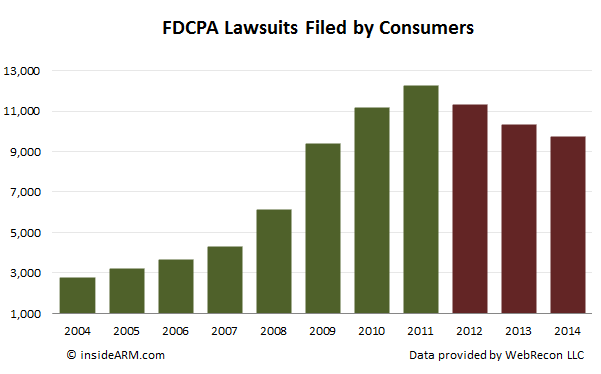
In the mid-2000s, the volume of FDCPA was relatively low, but increasing steadily. In 2008, however, FDCPA lawsuits surged. And for the next three years, filings increased at double digit rates.

That all ended in 2012, though, as FDCPA filing dropped for the first year ever. Each subsequent year has seen a decrease in FDCPA suits.FDCPA-lawsuits-2004-2014It’s a slightly different story for TCPA lawsuits. In March 2015, lawsuits claiming violations of the TCPA decreased 9.2 percent from March 2014. Through the first three months of the year, TCPA suits are down 7.4 percent.

But WebRecon noted that the gap between 2014 and 2015 TCPA filings is closing, and that they expect TCPA suits to catch up to year-over-year comparisons in the coming months.

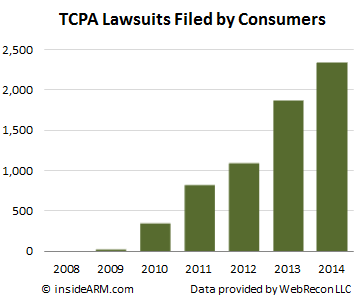
TCPA-lawsuits-2008-2014TCPA lawsuits have grown very rapidly over the past several years. Five years ago, the TCPA was a minor blip on the radar of ARM compliance professionals. A dramatic increase in the usage of mobile phone usage in the U.S., combined with several other factors, has made the TCPA a much more enticing statute for aggrieved consumers and their legal representation.

While still far below the total volume of FDCPA suits, the increased focus on the telephone communications statute has left many ARM companies scrambling to bring their operations into sharper compliance.

FDCPA Lawsuits Still Rising in Early Part of 2015 as TCPA Claims Decline
http://www.insidearm.com/daily/debt-collection-news/debt-collection/fdcpa-lawsuits-still-rising-in-early-part-of-2015-as-tcpa-claims-decline/
http://www.insidearm.com/feed
insideARM

Accounts Receivable Management

ConServe Employees Support Local Youth

ConServe employees, along with the company’s “Matching Gift Program,” donated $11,230 through its Jeans for Charity Program in March to Big Brothers Big Sisters of Greater Rochester and Erie County.

ConServe’s Jeans for Charity program benefits a different local charity every month and, in exchange for a small donation, employees are given the option to dress down for the entire month.

“We are grateful to ConServe and its employees for generously supporting our mentoring programs through their employee dress down program,” said Thomas J. Guagliardo, CEO Big Brothers Big Sisters of Erie County. “These much needed funds will help us make a difference in the life of a child facing adversity by matching them with a caring Big Brother or Big Sister.”

ConServe employees and their families also attended Big Brothers Big Sisters of Greater Rochester’s Bowl for Kids’ Sake event hosted by Clover Lanes in Rochester, NY on March 7th. Self-declaring March the “Month of Mentoring,” ConServe employees are dedicated to the company’s mission of “improving the human condition.”

ConServe has been ranked consistently as a top-performing agency by the federal government and the U.S. Department of Education. Representing less than 1% of collection agencies nationwide, ConServe has achieved the ACA International Professional Practices Management System (PPMS) certification, representing the collection industry’s standard for quality management, and has completed the SSAE 16 Type II Engagement. Nationally accredited by the Better Business Bureau (BBB) with an A+ rating, ConServe is a recipient of the Rochester Business Ethics Award, has repeatedly appeared on Inc. Magazine’s Inc. 5000 list of fastest-growing companies and has been named a Rochester Top 100 company 12 times in the last 13 years. ConServe has been voted a Best Place to Work in Collections (for the last three consecutive years), has been recognized by Training magazine on its Top 125 list of organizations with the most successful learning and development programs in the world, and has earned both the Greater Rochester Quality Council’s Customer Excellence and Operations Excellence Awards. Visit ConServe online at www.conserve-arm.com

ConServe Employees Support Local Youth
http://www.insidearm.com/daily/debt-collection-news/debt-collection/conserve-employees-support-local-youth/
http://www.insidearm.com/feed
insideARM

Accounts Receivable Management

Debate Over North Carolina Debt Buyer Bill Gets Personal, and Nasty

A Senate Committee in the North Carolina legislature this week approved a bill that would soften that state’s requirements for debt collection lawsuits, especially for debt buyers. The prospect of a change to the rules has led to protests from some lawmakers and consumer advocates.

But while most opponents have substantive issues with the proposal, at least one member of the personal finance media resorted to name-calling and histrionics Wednesday.

Steve Rhode, under his brand the Get Out of Debt Guy, wrote an article unhelpfully titled, “NC Senator Michael Lee Might Be a Debt Collection Idiot.” The article, originally run on his own site, was posted to Huffington Post late Wednesday.

Michael Lee (R) is the sponsor of North Carolina Senate Bill 511, the legislation in question.

Rhode calls Lee’s bill, “idiotic,” and “ill-advised, ill-conceived and unwarranted.” Other than potentially calling a state Senator an idiot in his headline, he also characterizes Lee as “ill informed” in the piece.

So what’s in that bill, exactly?

Proponents of the measure argue that North Carolina’s infamous 2009 law targeting debt buyer collection lawsuits went too far, making the collection of legitimate debt onerous in the state. Most in the ARM industry consider the rules to be among the most restrictive in the country.

The biggest change the law would make is loosening requirements for documentation that debt buyers must present in a collection action. SB 511 would allow a “charge-off statement” from the original creditor in lieu of a copy of the original contract creating the obligation.

As Rhode states in his article, the “only” things required to bring a collection suit would be:

  1. The original account number.
  2. The original creditor.
  3. The total amount claimed to be owed.
  4. An itemization of post charge‑off payments or credits, where applicable.
  5. The charge‑off balance, or, if the balance has not been charged off, an explanation of how the balance was calculated.
  6. An itemization of post charge‑off fees, where applicable.
  7. The date of last payment, where applicable.
  8. The amount of post charge‑off interest claimed, and the basis for the interest charged.

Rhode also calls another Senator who defended the bill “clueless.” The article’s main contention, that Lee is a “debt collection idiot” is based partly on selective editing.

Rhode contends that Lee may be a debt buyer himself, because his law firm’s website states, “The firm focuses on…debt acquisition.” What Rhode omits is the fact that Lee’s practice focuses almost entirely on commercial real estate, and the unedited passage from Lee’s site reads, “The firm focuses on complex commercial real estate finance, debt acquisition and development matters as well as complicated entitlement and zoning cases.”

The bill passed out of the Senate Judiciary Committee on Tuesday and has been referred to the Committee on Finance. If Rhode’s opinion piece is any indication, there could be a fight brewing when the bill is presented to the full Senate or House for consideration.

Debate Over North Carolina Debt Buyer Bill Gets Personal, and Nasty
http://www.insidearm.com/daily/credit-card-accounts-receivable/charge-off/debate-over-north-carolina-debt-buyer-bill-gets-personal-and-nasty/
http://www.insidearm.com/feed
insideARM

Accounts Receivable Management

ARM Acquisition: The CMI Group Buys The Affiliated Group

Tom Stockton, CEO of The CMI Group, Inc. (CMI) and Mark Neeb, CEO of The Affiliated Group, Inc. (TAG), in a joint statement to their respective companies, announced the stock purchase of TAG by CMI.

The exact terms of the deal were not disclosed. TAG and Affiliated Credit Services will become wholly owned subsidiaries of The CMI Group along with its other subsidiaries, A to Z Call Center Services, LP and Credit Management, LP.  All companies will operate under their current names. TAG will remain in Rochester, MN. The CMI Group, Inc. will remain in Carrollton, TX.

The CMI Group, Inc. is a 100% employee owned enterprise.

Stockton said, “The acquisition of TAG has been under consideration for some time.”

Both Neeb and Stockton have served on the American Collectors Association board of directors and are past presidents of ACA. As such, they have known each other for some time and have been somewhat familiar with the progress of each other’s companies over the years. During a friendly discussion of each other’s plans and desires for the future, Stockton said, “it occurred to us that we should investigate the possibility of uniting our companies.”

Neeb said, “The marriage of our two companies is a perfect fit, not only for my own personal plans, but also to maximize the benefit to my associates and clients at TAG. I am thrilled that TAG employees will be part of a much bigger enterprise and actually have ownership under The CMI Group, Inc. ESOP plan.  In addition, TAG clients will benefit from the experience, technology and customer-first focus that CMI brings to the partnership, while maintaining the strong performance and relationships developed with TAG employees over the years. It’s a win for everyone involved.”

Stockton added, “Mark and I have worked on ACA business for many years and we have come to know how closely our philosophies of running an ARM company align.  We are both committed to top-notch service to our clients, regulatory compliance and the best possible working conditions for our associates. I couldn’t be happier that we have been able to put this deal together. I know our respective staffs will work together seamlessly to make sure our clients continue to get the excellent service they have come to expect.”

The combined companies have 3rd party collection experience in cable, communications, medical, utility and government industries, as well as, a wide range of 1st party and customer service experience in multiple industries.


ARM Acquisition: The CMI Group Buys The Affiliated Group
http://www.insidearm.com/daily/debt-collection-news/debt-collection/arm-acquisition-the-cmi-group-buys-the-affiliated-group/
http://www.insidearm.com/feed
insideARM
Accounts Receivable Management

ACA International Board of Directors Support Legislation to End Operation Choke Point

The Board of Directors of ACA International, the association of credit and debt collection professionals, has unanimously voted to support legislation and policy changes that would bring an end to the Department of Justice program known as “Operation Choke Point.”  This viewpoint was expressed Wednesday in a letter to ACA membership, which represents tens of thousands of industry professionals.

Operation Choke Point is a program in which the Federal Deposit Insurance Corporation and Department of Justice reportedly applied pressure to financial institutions in order to cut off financial services to certain licensed, legally operating industries.

“This initiative has already been shown to have severe, negative impact on legal and legitimate businesses – including our nation’s legitimate debt collectors,” the letter from the ACA Board of Directors said. “As we have done since this emerged in 2014, we will continue to share examples of members being negatively impacted by Operation Choke Point with legislators and regulators as a key part of our advocacy efforts in Washington.”

ACA International President Rick Doane said that this action by the Board of Directors demonstrates that the health and well-being of the debt collection industry remains a top priority for the association.

“ACA’s presence in Washington has always been focused on the issues that affect our membership everyday. This letter goes far to ensure that our members are aware of our on-going, persistent effort to introduce and support legislative and policy changes that will protect the debt collection industry and its positive impact on the nation’s economy,” Doane said.

ACA International (ACA), the association of credit and collection professionals, is the largest membership organization in the credit and collection industry. Founded in 1939, ACA brings together third-party collection agencies, law firms, asset buying companies, creditors and vendor affiliates, representing tens of thousands of industry professionals. ACA produces a wide variety of products, services and publications, including educational and compliance-related information, and articulates the value of the credit and collection industry to businesses, policymakers and consumers. www.acainternational.org.

ACA International Board of Directors Support Legislation to End Operation Choke Point
http://www.insidearm.com/daily/debt-collection-news/debt-collection/aca-international-board-of-directors-support-legislation-to-end-operation-choke-point/
http://www.insidearm.com/feed
insideARM
Accounts Receivable Management

RevSpring to Host Enterprise Risk Assessment Webinar

Regulatory scrutiny of receivables management continues to grow. Organizations must implement risk assessment processes as part of their compliance strategies, or risk suffering potentially significant consequences.

A core risk assessment process can help your organization proactively manage these concerns. On May 7, 2015 at 2 p.m. EDT RevSpring will host its next webinar, “Conducting an Enterprise Risk Assessment.”

Analiese Fusner, chief compliance officer at RevSpring will cover several topics, including:

  • Defining and evaluating risk
  • Gauging the current compliance landscape for key indicators
  • Offering techniques to complete a risk assessment
  • Identifying hot trends in risk assessment
  • Detecting dangers in current processes
  • Appreciating the importance of culture in risk assessment

Attendees will leave the webinar with valuable tips for establishing risk assessment strategies that will deliver long-term, company-wide benefits.

Click here to register or contact learnmore@revspringinc.com for more information.

About RevSpring
RevSpring is a leading provider of revenue cycle technology services offering data analytics, multi-channel customer communications and payment solutions to the healthcare and financial services end markets. The company’s services enable customers to accelerate cash collections across the revenue cycle through an integrated, technology-driven and end-to-end service offering, all while ensuring regulatory compliance.  For more information visit their web site at www.revspringinc.com. 

RevSpring to Host Enterprise Risk Assessment Webinar
http://www.insidearm.com/accelerate-revenue/revspring-to-host-enterprise-risk-assessment-webinar/
http://www.insidearm.com/feed
insideARM

Accounts Receivable Management

FTC Launching Series of Live “Dialogues” with Debt Collection Industry; New York Up First

The Federal Trade Commission announced Thursday that it is launching a series of “Debt Collection Dialogues” around the country. The meetings will feature representatives from the FTC and other regulators and will specifically focus on questions and comments from members of the debt collection industry.

The first dialogue meeting will be held in Buffalo, N.Y. on June 15. The event is being jointly conducted with New York Attorney General Eric Schneiderman’s office. The FTC noted that a representative from the Consumer Financial Protection Bureau (CFPB) will participate as well.

According to the FTC, the event will feature regulators discussing “recent enforcement actions, consumer complaints about debt collection practices, and compliance issues.” The speakers will welcome questions and comments from collection industry members and others who attend.

Indeed, the series is being billed as “Debt Collection Dialogue: A conservation between government and business.” The free events, open to the public, are a perfect opportunity for ARM professionals to ask direct questions of regulators from the federal and state levels.

ARM industry groups have already signaled their willingness to participate, with both ACA International and DBA International sending out alerts to members regarding the announcement.

The Buffalo meeting is scheduled for 1:30pm to 4pm June 15 in the Burchfield Penney Art Center at SUNY Buffalo State, 1300 Elmwood Avenue, Buffalo, NY. Pre-registration is required and the FTC has set up a page with more information and registration instructions: www.ftc.gov/DebtCollectionDialogue

In the coming months, the FTC expects to hold additional dialogues, including events in Dallas and Atlanta. Specific information for those two events is not yet available.


FTC Launching Series of Live “Dialogues” with Debt Collection Industry; New York Up First
http://www.insidearm.com/daily/debt-buying-topics/debt-buying/ftc-launching-series-of-live-dialogues-with-debt-collection-industry-new-york-up-first/
http://www.insidearm.com/feed
insideARM

Accounts Receivable Management

Taking Advantage of the Health Care Buzz

In September 2014, Kaulkin Ginsberg wrote about Health Care and the Amazing Aging U.S. Population, a blog post discussing the implications of the baby boomer generation’s impending retirement.

Now, we take a look at some of the major regulations impacting both the U.S. health care system and the ARM industry, and how ARM providers can get involved with this expanding segment.

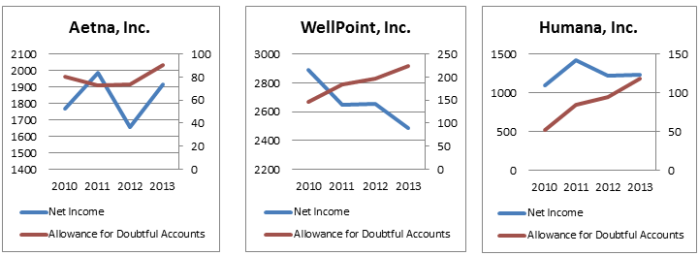
The Affordable Care Act – also known as “Obamacare” – created a new, growing market for uncollectible debt. As depicted in the graphs below, three of the largest health insurance providers participating in the Affordable Care Act are experiencing significant increases in their allowance for doubtful accounts. This is because many participants don’t fully understand their new insurance plans, especially when it comes to post-service billing procedures and high-deductible health savings accounts (HSAs). As a result, insurance providers have outsourced more of their work to stay on top of the influx of new clients.

KGC-healthcare-blog-graphsAnother regulation the ARM industry should consider is ICD-10, a massive overhaul of the medical coding procedures for health care providers. It will add nearly 68,000 new codes to the electronic health records (EHR) system. In the past, a hand injury may have been basically coded to read: “injured hand.”

Now, health care providers are required to submit a much more detailed description that would say: “left hand, vertical laceration from knife, 20 stitches used.” Failing to code properly could result in a rejected claim from federal or private insurance companies, costing the health care provider a lot of time and money. For these reasons, revenue cycle management (RCM) has become an integral component to health care provider operations.

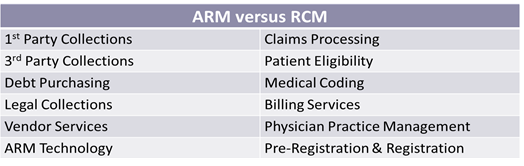
For those wishing to take advantage of the current excitement surrounding the health care segment, the list below serves as a basic guide for health care collection agencies considering a transition to RCM:

KGC-healthcare-blog-tableOne of the best places for ARM providers to start is self-pay/co-pay services, which can complement their already ongoing third-party collection work. In most cases, they have existing technology infrastructure to handle this service. Additionally, the Affordable Care Act has increased the volume of self-pay/co-pay insurance claims, and that amount is expected to climb higher over the next few years. ARM providers would, however, need to work out the details of insurance knowledge and increased scrutiny by hospitals and other providers for “above and beyond” customer service, but this is not a foreseeable challenge.

Taking Advantage of the Health Care Buzz
http://www.insidearm.com/obs-in-focus/taking-advantage-of-the-health-care-buzz/
http://www.insidearm.com/feed
insideARM

Accounts Receivable Management

Executive Change: Convergent Revenue Cycle Management Promotes Mark Schanck to President

Convergent Revenue Cycle Management, Inc., a national provider of healthcare revenue cycle management and patient access solutions to top hospitals, has announced that Mark Schanck has been promoted to company president. Schanck has 20 years of experience in healthcare services and most recently served as Convergent’s Senior Vice President of Sales & Marketing.

Schanck will now oversee all sales and operations for the Convergent healthcare division, which offers PatientQuest™ patient access, self-pay collections, third-party reimbursement, receivables management and customer service solutions. Convergent is a subsidiary of Account Control Technology Holdings, Inc.

“With his history of success in healthcare services, Mark Schanck was the obvious choice to lead our efforts to optimize internal operations while growing support for Convergent clients,” said Nabil Kabbani, CEO of Account Control Technology Holdings, Inc. “With Mark at the helm, we have a strong, flexible team that’s able to provide outstanding support to frontline operations, build relationships with clients, and grow our business to meet the needs of the rapidly changing healthcare market.”

Mark Schanck

Mark Schanck

Prior to his success in sales at Convergent, HBCS and McKesson, Schanck had a highly productive career in healthcare service operations, most notably serving as National Director of Operations at Shared Medical Systems (acquired by Siemens). There, he helped develop the company’s first provider outsourcing services center, was involved in the development of the nation’s first Medicare Plus-Choice program, and helped devise the “National Business Office” offering to provide back-end billing and follow-up services for hospitals. Schanck earned his Bachelor of Science degree in Business Administration from Oral Roberts University and his MBA from Southern Nazarene University. He is an active member in HFMA and other professional trade associations.

“I’m excited by the opportunity to continue to build on the service-oriented foundation at Convergent,” Mark Schanck said. “My goal is to expand upon our supportive employee environment and further invest in operations designed to serve our healthcare clients and partners better than any other provider. We are driven by a passion to serve our customers and ensure they experience the value Convergent brings through better processes, superior technology and resources that work to exceed expectations on a daily basis.”

About Convergent Revenue Cycle Management, Inc.

Convergent is one of America’s largest business process outsourcing, patient service, revenue cycle and receivables management companies. Convergent’s healthcare division offers patient-focused contact center technology and regulatory expertise to help hospitals and healthcare providers improve financial operating performance, enhance the patient experience, and improve relationships between patients and providers. In 2014, Convergent was acquired by Account Control Technology Holdings, Inc., which offers comprehensive business process outsourcing solutions for the consumer, education, financial, government, healthcare, telecom, utility and other markets. For more information on Convergent, visit www.convergentusa.com or call 561-862-1999.

Executive Change: Convergent Revenue Cycle Management Promotes Mark Schanck to President
http://www.insidearm.com/daily/debt-collection-news/debt-collection/executive-change-convergent-revenue-cycle-management-promotes-mark-schanck-to-president/
http://www.insidearm.com/feed
insideARM

Accounts Receivable Management