RevSpring Renews Critical Security Requirements, Complies with PCI DSS

WIXOM, Mich. – RevSpring has once again demonstrated its leadership role in security, compliance, and ethics with the renewal of key security requirements for PCI DSS v3.1.

To comply with the latest version of PCI DSS, RevSpring performed upgrades to its governing policies and processing operations.

“Adhering to the highest levels of security and compliance protocols in the regulated space is RevSpring’s top priority,” said Peter David, RevSpring’s chief security officer. “We understand that serving our clients and meeting their changing expectations is paramount to reflecting our beliefs in transparency and ethics.”

RevSpring’s leadership and commitment is demonstrated each year by the investment of certifying its facilities nationwide using qualified, independent security experts. The PCI DSS audit was conducted by Solutionary.

Customers interested in receiving copies of the security reports should contact their sales representative or email learnmore@revspringinc.com.

About RevSpring

RevSpring’s core service offerings include data hygiene and analytics, secure document creation and delivery, multi-channel communications, electronic billing and archival services and online payment tools, all while ensuring compliance with regulatory guidelines. RevSpring holds multiple security certifications including PCI DSS Level 1, HIPAA/HITECH and SSAE 16 SOC 2 and maintains rigorous legislative and regulatory compliance programs. It serves a large and diverse customer base across the healthcare, receivables management, financial services, insurance, home services and other end-markets. Its family of companies includes TalksoftRevenue AdvantageTECH LOCK and Healthcare Revenue Strategies. To learn more visit www.revspringinc.com.

Contact:
Heather Taylor                                                      
765.730.6632
htaylor@revspringinc.com

RevSpring Renews Critical Security Requirements, Complies with PCI DSS
http://www.insidearm.com/accelerate-revenue/revspring-renews-critical-security-requirements-complies-with-pci-dss/
http://www.insidearm.com/feed
insideARM

Accounts Receivable Management

Latest CFPB Complaint Report is Routine, But Provides a Nugget or Two

Yesterday, the Consumer Financial Protection Bureau (CFPB) released its latest monthly consumer complaint snapshot. This report provides a high-level snapshot of trends in consumer complaints. This is volume No. 9 of the report.  A complete copy of the Monthly Complaint Report can be found here.

The report begins with a “National Complaint Overview.” The details from that overview are as follows:

National Complaint Overview

As of March 1, 2016, the CFPB has handled 834,400 complaints nationally. Some of the highlights from the statistics in this month’s snapshot report include: 

  • Complaint volume: As of March 1, 2016, debt collection complaints represented 26 percent of total cumulative complaints submitted to the CFPB, surpassing mortgages as the most-complained-about product or service since the Bureau began accepting complaints in July 2011. Debt collection, mortgage, and credit reporting complaints continue to be the top three most-complained-about consumer financial products and services, collectively representing about 69 percent of complaints submitted in February 2016.
  • Product trends: Complaints submitted relating to credit reporting rose 13 percent between January and February 2016. During the month of February, 3,832 credit reporting complaints were submitted to the Bureau.
  • State information: Of the five most populated states, New York—12 percent—experienced the greatest month-to-month complaint volume percentage increase, while Texas—8 percent—experienced the greatest month-to-month percentage decrease. Complaints from the five most populous states, California, Texas, New York, Florida, and Illinois account for over 40 percent of complaints submitted to the CFPB since July 2011.
  • Most-complained-about companies: The top three companies about which the CFPB received the most complaints between October and December of 2015 were Equifax, Experian, and TransUnion.  Empowerment Ventures (parent company of RushCard) debuted as the 10th most complained-about company for the October – December 2015 period, averaging 290 monthly complaints.

This month’s report included a “Product Spotlight” on debt collection. That spotlight showed:

Product Spotlight: Debt Collection

Debt collection has been the most-complained-about financial product to the CFPB by consumers. As of March 1, 2016 the Bureau had handled approximately 219,200 debt collection complaints. Some of the findings in the snapshot include:

  •  Collection on debts not owed: The most common debt collection complaint had to do with both first- and third-party debt collectors attempting to collect on a debt the consumer reported was not owed. These types of complaints accounted for 38 percent of all debt collection complaints submitted.
  • Debt collectors repeatedly calling consumers: Another frequent complaint from consumers was about communication tactics used by debt collectors. Consumers complained about receiving multiple calls weekly and sometimes daily from debt collectors. Consumers often complained that the collector continued to call even after being repeatedly told that the alleged debtor could not be contacted at the dialed number. Consumers also complained about debt collectors calling their places of employment.
  • Consumers unable to verify debts owed: Consumers complained that they were not given enough information to verify whether or not they owed the debt that someone was attempting to collect.
  • Most-complained-about debt collection companies: The two companies that the CFPB received the most debt collection complaints about were Encore Capital Group and Portfolio Recovery Associates, Inc. Both companies, which are among the largest debt buyers in the country, averaged over 100 complaints submitted to the Bureau each month between October and December 2015. In 2015, the CFPB took enforcement actions against these two large debt buyers for using deceptive tactics to collect bad debts

insideARM Perspective

Generally, the monthly report provides little new information.  However, it contains some nuggets that can interest even the most seasoned industry veteran.

For example, the fact that Empowerment Ventures, the parent company of the Rush Card, “debuted as the 10th most complained about company” is an excellent example of how quickly complaints can grow if there is some type of issue that impacts multiple consumers. The Rush Card is a pre-paid debit card that experienced some technical difficulties in October.

Likewise, a simple statement on page 13 of the report caught my eye. When discussing calls to a consumer’s workplace thee report notes,

Workplace phone calls are also a concern for consumers. In these complaints, some consumers reported that they are not allowed to receive calls at work, while others said their debt was disclosed to a supervisor or other third-party. Some consumers reported that collectors made in-person visits to their workplace. (Emphasis added.)

As I wrote on December 17, 2015 after the CFPB issued a Bulletin about the Risks of In Person Collections, I continue to be shocked that any reputable ARM Company would make any in-person collection efforts on consumer accounts.

Even though the CFPB acknowledges in their press release that “company-level information should be considered in the context of company size,” there is never any further discussion on the issue. It is not surprising that Encore Capital Group and Portfolio Recovery Associates, Inc. have a large number of complaints. They are both very large companies handling a very large volume of accounts.   It would be nice to see more analysis and commentary on this.

Finally, it would also be nice to see a report that actually digs into the complaints and discusses their resolution/outcome.

Latest CFPB Complaint Report is Routine, But Provides a Nugget or Two
http://www.insidearm.com/daily/debt-collection-news/debt-collection/latest-cfpb-complaint-report-is-routine-but-provides-a-nugget-or-two/
http://www.insidearm.com/feed
insideARM

Accounts Receivable Management

SCOTUS Challenges Plaintiff Argument on Use of AG Letterhead in FDCPA Case

Yesterday the United States Supreme Court heard oral arguments in the case of Pamela Gillie, et al. (Plaintiff), v. Law Office of Eric A. Jones, LLC, et al. (Defendant). This is the first case in ten years regarding the FDCPA to be heard by the highest court, Ohio state officials are looking to overturn a lower court decision on whether a collector’s authorized use of attorney general letterhead violated the law.

According to this detailed account of the arguments by Courthouse News Service, it seems the justices leaned towards siding with the state. Justice Elena Kagan suggested that if the special counsel (i.e. third party debt collector) is using the letterhead, “The Ohio Attorney General is going to be more vigilant in policing the actions of that debt collector. You should want that.”

The central argument is how to protect consumers from scams that hide the fact that they are actually being contacted by a debt collector – who has a financial stake in the outcome – and not the government. Justice Breyer’s questions suggested that he sees the use of attorney general letterhead as helpful vs. harmful in the efforts to offer such protection.

insideARM Perspective

To me it seems pretty straightforward and not misleading. A consumer owes a debt to the State; for whatever reason the debt is not paid. The State hires a collector to pursue payment, and agrees to pay the collector for success (the collector is a business and not a charity). The collector contacts the consumer on the authority of the State, the entity to whom the consumer owes the debt.

Where is the deception? Why does the financial relationship between the State and the collector have any relevance to the consumer?

What I gather is that the core issue being raised by Plaintiffs is that if a collector (special counsel) is allowed to use official letterhead, then it opens the doors for scammers to use …unauthorized/fake official letterhead. Really? Making this against the law is going to stop scammers, who – by definition – don’t follow laws?

SCOTUS Challenges Plaintiff Argument on Use of AG Letterhead in FDCPA Case
http://www.insidearm.com/daily/debt-collection-news/debt-collection/scotus-challenges-plaintiff-argument-on-use-of-ag-letterhead-in-fdcpa-case/
http://www.insidearm.com/feed
insideARM
Accounts Receivable Management

N.C. District Court Grants Stay of TCPA Lawsuit Pending DC Circuit Challenge to FCC Order

This article previously appeared on The Consumer Financial Services Blog and is re-published here with permission.

The U.S. District Court of the Western District of North Carolina recently stayed proceedings in a suit pending the U.S. Court of Appeals for the District of Columbia’s ruling on challenges to the Federal Communication Commission’s Declaratory Ruling and Order, 30 FCC Rcd. 7961 (2015) (the “FCC Order”) under the federal Telephone Consumer Protection Act (TCPA).

A copy of the opinion in Abplanalp v. United Collection Bureau, Inc. is available here.

The plaintiff’s credit card agreement contained an arbitration provision requiring that all claims against the lender, including claims against third parties to whom the plaintiff’s debt was assigned for collection, be subject to arbitration. The card issuer assigned the plaintiff’s account to a third party debt collector. The collector manually dialed the plaintiff’s phone from a telephone system that allegedly had the capacity to place an autodialed call.

The plaintiff filed suit in North Carolina state court against the collector alleging that the collector violated the TCPA by using an “automatic telephone dialing system” (ATDS) to contact her regarding the debt. Although the collector manually dialed the plaintiff’s phone, the plaintiff claimed that the collector’s telephone system had the capacity to place autodialed calls and was thus an ATDS.

The collector removed the case to federal court, and then moved to dismiss and compel arbitration. Alternatively, the collector moved to stay proceedings pending rulings in a consolidated appeal and a class action suit that could be dispositive of the plaintiff’s claims. The Court denied the collector’s motion to dismiss, but granted the collector’s motion to stay.

The Western District of North Carolina held that the plaintiff was not required to pursue her claims in arbitration because the arbitration provision in the card agreement was not binding. The Court disagreed with the collector’s assertion that the plaintiff consented to arbitration simply by using her credit card account. The Court noted that the arbitration provision was not dated, and contained neither the plaintiff’s signature nor a proof of notice. Furthermore, the arbitration provision did not contain information linking the agreement with the plaintiff’s account. Accordingly, the Western District of North Carolina denied the collector’s motion to dismiss and compel arbitration.

However, the Court granted the collector’s motion to stay proceedings pending resolution of the DC Circuit appeal of the FCC Order. The Court explained that several appeals of the FCC Order were consolidated by the United States Judicial Panel on Multidistrict Litigation before the Court of Appeals for the District of Columbia regarding challenges to the FCC Order defining telephone systems that qualify as an ATDS under the TCPA. The Court held that resolution of the consolidated appeals in the DC Circuit could be dispositive of the borrower’s TCPA claims, noting the lack of any rebuttal from the borrower regarding this issue.

Finally, the Court denied the collector’s motion to stay the proceedings pending final approval of the class action settlement in Graff v. United Collections Bureau, Inc., Case no. 2:12-cv-02402 (E.D.N.Y.). Although the borrower was a member of the putative settlement class in Graff, the Court denied the collector’s request to stay the proceedings as moot, noting that it already granted the stay due to the DC Circuit appeal.

N.C. District Court Grants Stay of TCPA Lawsuit Pending DC Circuit Challenge to FCC Order
http://www.insidearm.com/daily/collection-laws-regulations/tcpa/n-c-district-court-grants-stay-of-tcpa-lawsuit-pending-dc-circuit-challenge-to-fcc-order/
http://www.insidearm.com/feed
insideARM
Accounts Receivable Management

CFPB Issues Fifth Annual Report to Congress on the FDCPA

On Wednesday, March 23rd the Consumer Financial Protection Bureau (CFPB) issued its fifth annual Fair Debt Collection Practices Act report to Congress. The report covers the CFPB’s activities in 2015. Until the creation of the CFPB, the responsibility for drafting of the report fell to the Federal Trade Commission (FTC). The FTC is still involved, however; the CFPB report incorporates information provided to the CFPB by the FTC in its February 12, 2016 letter to the CFPB on the FTC’s 2015 debt collection activities. The FTC letter is an Appendix to the report. A complete copy of the report can be found here.

In the transmittal letter CFPB Director Richard Cordray highlights five specific 2015 activities.

1)     Enforcement Actions

In 2015 enforcement actions by the CFPB returned $360 million to consumers wronged by unlawful debt collection practices and collected over $79 million in fines. During this time period, our colleagues at the FTC banned 30 companies and individuals that engaged in serious and repeated violations of the law from ever again working in debt collection. In addition, the FTC filed 12 new cases, a record number of debt collection enforcement actions for the FTC in a year.

Cordray also noted that three of its recent cases were particularly noteworthy: In its case with JP Morgan Chase, the Bureau took action against the bank for selling credit card debts which, in some cases, overstated the amount owed or misidentified the individual owing the debt. In its cases with Encore and Portfolio Recovery Associates, the nation’s two largest debt buyers, the Bureau took action against those entities for demanding payments and filing lawsuits on debts that they knew very little about and without reviewing the appropriate documentation to make sure they were collecting the right amount from the right consumer. Taken together, these cases paint a broader picture about how the Consumer Bureau is working to clean up the market from both ends. Regardless of whether you are a debt seller or a debt buyer, all players in the collections market need to do their part and invest the resources to ensure they are collecting the right amount from the right consumer.

2)     Development of Regulations

The Bureau continues its effort to develop the first comprehensive federal regulations covering debt collection. According to Cordray, the Bureau is considering provisions to ensure that debt collectors have sufficient information to collect the debt, prevent unfair, deceptive and abusive acts and practices, inform consumers of their rights, and provide interpretation of some sections of the FDCPA. In order to inform rulemaking efforts, the Bureau surveyed consumers in 2015 about their debt collection experiences and preferences. Furthermore, the Bureau conducted extensive interviews with industry vendors and participants to expand its understanding of the debt collection market.

The Bureau plans to convene one or more Small Business Regulatory Enforcement Fairness Act panels before issuing a notice of proposed rulemaking. Additionally, the industry can expect more Bureau engagement through roundtables, meetings, and field hearings.

3)     Data Collection

The Bureau now has two full years of data on debt collection complaints. In 2015, the Bureau handled over 85,200 debt collection complaints, making debt collection the largest source of consumer complaints. The Bureau forwarded almost half of these complaints to debt collectors, which responded in a timely manner to 90% of them. The leading reason for complaints is consumers being contacted for debts they report they do not owe.

4)     Debt Collection Agency Examinations

In its examination of debt collection agencies last year, the Bureau identified many violations of the FDCPA, including: misleading statements about credit reporting; failures of debt collectors to identify themselves as debt collectors during calls to consumers; and failures to ensure that consumer requests about communications, such as requests not to call at work, were honored. Bureau examiners directed institutions found in violation to comply with the FDCPA and in some cases directed them to improve employee training, or take other steps necessary to fully comply with the law.

5)     Work with the FTC and State Regulators

The CFPB worked closely with the FTC and state regulators to enforce the laws applicable to debt collectors, file amicus briefs, supervise debt collectors, coordinate rulemaking activities, and reach out to consumer and trade groups. The FTC has been a highly valued partner in the CFPB’s efforts to regulate the debt collection industry and enforce the FDCPA. For instance, the FTC led an effort, working with the CFPB and state regulators, to bring over 115 actions against debt collection firms and phantom debt scammers. Furthermore, the Bureau and the FTC jointly filed two amicus briefs in 2015. Additionally, the CFPB and the FTC organized and participated in events across the country to engage industry.

insideARM Perspective

The bulk of the report is a basically a summary of 2015 activities. insideARM has previously written about the highlights. However, there was an item that was prospective in nature. When discussing the long-awaited debt collection rulemaking, the report suggests that the CFPB “is preparing to convene one or more Small Business Regulatory Enforcement Fairness Act panels before issuing a notice of proposed rulemaking.”  Unfortunately, the report does not suggest any timetable for the rulemaking.

When discussing the Rulemaking, the report also highlights some of the critical issues that have been raised by industry groups, individual debt collectors, and consumer groups.  Implicit is this discussion is the likelihood of rulemaking on these specific issues.

  • Need to consider effect of technological change – Many third-party debt collectors and consumer groups noted that the debt industry has experienced significant technological changes since the enactment of the FDCPA in 1977, and the FDCPA, therefore, does not specifically address the use of new types of technology, like email. As a result, it would be useful for the Bureau to address the use of newer technologies. However, there were many differences among commenters as to how the CFPB should address these newer technologies.
  • Information accuracy and flow – Consumer groups, debt collectors, and states’ Attorneys General also repeatedly commented about the types of information that should travel with a debt when it is sold and the consumer advantages that may result from the transfer of additional information. There were also comments related to whether certain types of debt, like medical or student loan debt, should require more or less documentation. Some industry commenters noted that it was important to consider the burden of requiring particular types of information.
  • Communication issues – Many consumer groups and industry members supported rules addressing or clarifying a wide variety of issues relating to the proper time, place, and manner of debt collection communications, offering diverse views as to how the Bureau should approach these issues.
  • First- vs. third-party debt collection issues – Many consumer groups advocated for creating rules that would apply to first party collectors, because harm from first-party collectors can be equally problematic for the consumer. In contrast, credit unions and several industry groups stated that an extension of debt collection rules to first-party collectors could impose significant burdens and increase consumer confusion, and are not necessary.

The industry needs to come together and work with the CFPB on these issues. We need to educate CFPB staff on the potential impact any regulations on these issues will have on the industry and how and why the consumer might benefit by any potential regulation on these issues.

CFPB Issues Fifth Annual Report to Congress on the FDCPA
http://www.insidearm.com/daily/collection-laws-regulations/fdcpa/cfpb-issues-fifth-annual-report-to-congress-on-the-fdcpa/
http://www.insidearm.com/feed
insideARM

Accounts Receivable Management

Total CFPB Penalties Top $5B

Since its inception, the Consumer Financial Protection Bureau (CFPB) has penalized a wide variety of companies and people for violating federal consumer financial protection laws. The CFPB has the authority to issue penalties for violations of a range of laws, but the majority of fines issued to date have been for violations of several specific statutes, most often the Dodd-Frank Wall Street Reform and Consumer Protection Act of 2010.

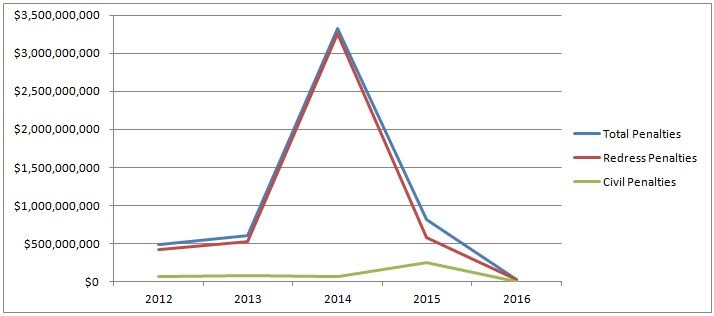
The damages assessed by the CFPB vary widely from case to case – the Bureau has issued fines ranging from $1 to over $2 billion to different companies in different circumstances. insideARM has tallied up the penalties and found that, to date, the CFPB has ordered over $5 billion in total penalties since opening for business.

chart1As you can see in the chart above, 2014 was a big year for the CFPB. The Bureau ended up issuing more than $3 billion in fines in 2014 alone, more than $2 billion of those penalties coming in one case involving Ocwen Financial Corp. and Ocwen Loan Servicing, LLC,  a case that dealt with mortgage servicing violations. Other big CFPB targets over time have been financial institutions like Bank of America, Synchrony Bank, and JPMorgan Chase. When you subtract the Ocwen outlier from the equation (see chart below), you can see a better picture of how the CFPB issues penalties, generally ordering between $500 million and $1 billion in fines annually. If past trends hold, the CFPB is likely to act on at least a few more occasions this year.
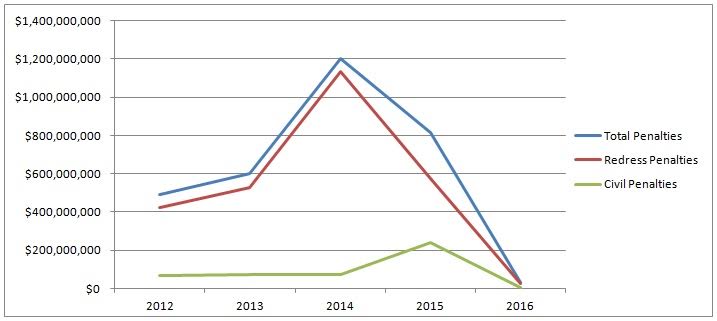
chart2Types of Penalties

The CFPB issues two main types of fines when announcing their enforcement actions – redress and civil penalties. They are similar in the sense that both are assessed for violations of consumer financial protection laws, but there are differences in where penalty payments go and the purpose they serve.

The largest fines assessed by the CFPB are usually redress penalties, which the Bureau says are designed to compensate consumers for the harm caused by a particular person or company. Redress payments are normally distributed by the penalized party directly to consumers, but in some instances the CFPB requires “Bureau-administrated redress,” where the payment goes to the CFPB to then be redistributed among victims.

The other major type of fine assessed by the CFPB is called a civil penalty, which is put into the federal Civil Penalty Fund established by the Dodd-Frank Act. That money doesn’t just go towards the CFPB’s operating expenses – the Bureau says the money goes either towards “payments to people who were harmed by the illegal actions that gave rise to civil penalties and who aren’t expected to otherwise get full compensation” or towards “consumer education and financial literacy programs designed to help consumers.” That said, the CFPB reserves the right to disperse the Civil Penalty Fund as it sees fit, saying that the Bureau can use money from the Fund to “pay any eligible victim from any case” at its discretion.

Penalized Actions

The main thing ARM companies need to watch out for in order to stay compliant and avoid a CFPB penalty are so-called “unfair, deceptive, or abusive acts and practices,” also known as UDAAPs. The prohibitions and penalties related to such acts and practices are based in Sections 1031 and 1036 of the Dodd-Frank Act, which says that an act or practice is “unfair” if it can cause substantial  injury to consumers, is not reasonably avoidable, and is not outweighed by countervailing benefits to consumers or competition; that an act or practice is “deceptive” if it misleads a consumer or could be perceived as misleading in any way; and that an act or practice is “abusive” if it materially interferes with a consumer’s understanding of a product or takes unreasonable advantage of a consumer. The vast majority of enforcement actions by the CFPB, especially actions related to debt collection, cite some sort of UDAAP as the basis for a fine.

Three recent cases highlight the CFPB’s tendency to focus on UDAAP violations when regulating the ARM industry.

Most recently, in February the Bureau fined Citibank and two of its affiliates – Department Stores National Bank and CitiFinancial Servicing, LLC – $4.89 million in redress and a $3 million civil penalty for selling credit card debt with inflated interest rates, failing to forward consumer payments promptly to debt buyers, and falsifying court documents.

In October, the CFPB ordered the Security National Automotive Acceptance Company to pay a $2.27 million redress penalty and $1 million civil penalty for exaggerating potential disciplinary action that consumers would face, contacting consumers’ supervisors about their debt, falsely threatening to garnish wages, and misleading consumers about imminent legal action.

Finally, last September, the CFPB also fined Encore Capital Group and Portfolio Recovery Associates for purchasing debts they should have known were inaccurate and attempt to collect those debts through unlawful means. Encore Capital Group was fined $42 million in redress and a $10 million civil penalty, while PRA was penalized $19 million in redress and an $8 million civil penalty.

Other laws which are often cited in enforcement actions by the CFPB include the Federal Trade Commission Act, the Fair Debt Collection Practices Act, the Fair Credit Reporting Act, the Equal Credit Opportunity Act, the Home Mortgage Disclosure Act, the Real Estate Settlement Procedures Act of 1974, the Truth in Lending Act, and the Truth in Savings Act.

insideARM Perspective

If you’re wondering what your agency specifically needs to watch out for in order to remain compliant and avoid costly enforcement proceedings, insideARM suggests a thorough review of the July 10, 2013 bulletin on “Unfair, Deceptive, or Abusive Acts or Practices in the Collection of Consumer Debts.”

In that bulletin, the Bureau says they will be “closely” monitoring the following unfair, deceptive, or abusive acts and practices:

  • Collecting or assessing a debt and/or any additional amounts in connection with a debt not expressly authorized by the agreement creating the debt or permitted by law.
  • Failing to post payments timely or properly or to credit a consumer’s account with payments that the consumer submitted on time and then charging late fees to that consumer.
  • Taking possession of property without the legal right to do so.
  • Revealing the consumer’s debt, without the consumer’s consent, to the consumer’s employer and/or co-workers.
  • Falsely representing the character, amount, or legal status of the debt.
  • Misrepresenting that a debt collection communication is from an attorney.
  • Misrepresenting that a communication is from a government source or that the source of the communication is affiliated with the government.
  • Misrepresenting whether information about a payment or non-payment would be furnished to a credit reporting agency.
  • Misrepresenting to consumers that their debts would be waived or forgiven if they accepted a settlement offer, when the company does not, in fact, forgive or waive the debt.
  • Threatening any action that is not intended or the covered person or service provider does not have the authorization to pursue, including false threats of lawsuits, arrest, prosecution, or imprisonment for non-payment of a debt.

As long as you and your company avoid those sorts of acts and practices, you will go a long way towards avoiding penalties from the CFPB.

Total CFPB Penalties Top $5B
http://www.insidearm.com/daily/featured-post/total-cfpb-penalties-top-5b/
http://www.insidearm.com/feed
insideARM

Accounts Receivable Management

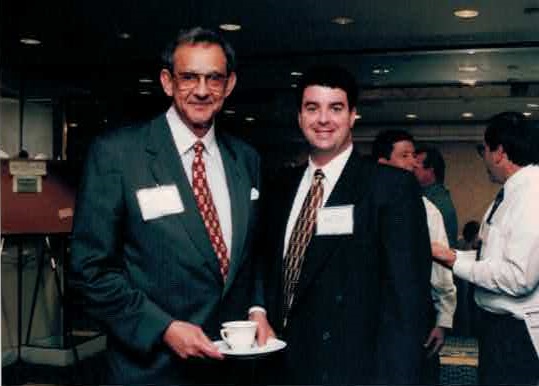
Remembering Marvin Kaulkin

marvin


Marvin Kaulkin passed away earlier this week. I was fortunate to have him as a big part of my life for more than a quarter century.

During that time, I got to know Marvin in many ways. I value the countless experiences we shared and the leadership qualities he bestowed upon me.

People want to do business with people they like and respect.

Marvin started M. Kaulkin & Associates in the late 1980s to help owners sell their businesses. Prior to that, he ran a family business for 30 years before becoming a certified financial planner. He had an unusual combination of experiences that made him extremely well-qualified to advise owners: he himself was an owner and operator of a family business for many years, he understood how to manage investments, and he realized that significant personal wealth could be realized through the sale of a closely-held business.

Marvin was a towering man at 6’5″ and he always attracted attention when he walked into the room. He was charismatic and had a magnetic personality that others wanted to be around. If he was paid a dollar every time he joked about Pittsburgh, he would have been a very rich man. Owners valued Marvin’s perspective and he was always willing to share it.

Take chances on people.

Marvin and I met in late 1990 when I was struggling to find a job. As a recent graduate of the University of Maryland, College Park, I envisioned myself working at a big Wall Street firm in New York City. I quickly realized that Wall Street wasn’t hiring undergrads from a state school with no experience, so I broadened my search to D.C. and Chicago and every city in the northeastern part of the country. I must have sent out 400 resumes and received nearly that many rejection letters.

My girlfriend at the time knew I was frustrated, so she introduced me to a dear friend of her father’s, Marvin Kaulkin. She wasn’t sure what he was doing professionally, but he lived close to me and she thought he could be a mentor.

Marvin willingly met with me and told me he wasn’t hiring. I told him that I would take the job. He said he wasn’t going to pay me anything, and I said that was more than enough for me. He said that I would have to pay for my own parking, and I said that was fine. He knew I wasn’t going away until he hired me, so he took me under his wing. We bonded that day, and we remained close until he left the business a couple of years ago. I would say it was a pretty good ride for the both of us.

Embrace challenges in business.

In 1993, I was asked to speak in Arizona in front of a group of bill collectors. Even though I feared public speaking, I accepted the opportunity, and it was one of the worst days of my professional career. I sweated profusely, read my notes instead of looking at the audience, and botched every aspect of this speaking engagement.

When I got back to the office, I told Marvin about my failure. He simply said that I was at a crossroads in business and needed to make a decision: either I could crawl into a hole and never speak publicly again, or I could get right back out there and find another opportunity.

I told him that I embarrassed myself and poorly represented his firm. Instead of harping on the negative, Marvin focused on the big picture and encouraged me to get back on the horse. So, I accepted another speaking engagement and worked diligently on improving my public speaking.

Be creative and it will pay off.

One day in 1998, Marvin returned from lunch, walked into my office, and proclaimed that we were going to be “infomediaries.” I asked him if that was a real word, and to this day I think he made it up.

He told me that he started receiving news from a media outlet by email and thought we should start doing the same thing for the debt collection industry. At the time, I don’t even think I had my own email address. Most people were still using fax machines and phone calls to communicate, but he thought this was the future and we should be a part of it.

Marvin was an entrepreneur, so when I asked him how we were going to pull this off, he wanted no part of answering it. We didn’t have anyone’s email addresses and we didn’t have any news, but he was determined to provide news to owners via email every day.

That was the start of the first news portal for the collection industry.

Tell it like it is.

Those who knew Marvin professionally knew that he wasn’t a touchy-feely kind of person. He did not acknowledge birthdays. He never had a problem telling someone how he felt, and I was the recipient of many stern lectures.

I remember when we were just getting CollectionIndustry.com off the ground, and we had a meeting with the editor of the largest industry publication at the time. The meeting did not go as planned, and Marvin was quick to point out what he thought I did wrong. I felt he was right, so I called the editor to apologize. That was Marvin’s style; he told you how he felt, but he always did so behind closed doors, one-on-one, and in a very convincing manner.

Rest in peace, Marvin. You were one of a kind, and you will be missed.

Remembering Marvin Kaulkin
http://www.insidearm.com/obs-in-focus/remembering-marvin-kaulkin/
http://www.insidearm.com/feed
insideARM

Accounts Receivable Management

F.H. Cann Among Donors Helping Navy Vet Overcome Homelessness

ARM Industry Supporters Offer Help, Hope When Vets Need It Most

Collingswood, NJ: ARMing Heroes (www.armingheroes.org), the collection industry’s charity for military veterans, today shared the story of Fletcher Crawley, a U.S. Navy veteran who dedicated 14 years of his life to serving his country, including time spent overseas. Throughout his years of service, Crawley earned several medals and commendations along the way including two Navy/Marine Achievement Medals, a Navy Sea Service Deployment Medal, a National Defense Service Medal, a Global War on Terrorism Service Medal, and many others.

When a service-connected injury prompted his separation from service, Fletcher returned home to begin his journey of adjusting to civilian life; a journey he never expected would be filled with so many challenges, hardships, and desperation. Unable to work, Veterans Administration disability benefits would be his only source of income. Unfortunately it took two years for the VA to begin paying those benefits. At one point during the wait, Fletcher found himself homeless, living in his car.

So many of America’s veterans face these unimaginable situations, unable to fill the gap between income and expenses for needs that are largely unmet by government programs or even by other military charities.  Thanks to generous donors within the ARM industry, the ARMing Heroes grant-making program is able to offer desperate vets and their families some assistance with the most basic of needs when they need it the most.

F.H. Cann & Associates, headquartered in North Andover, MA, is one of several ARM industry firms that participated in the 2015 No Debts for Vets Charity Fundraising Drive. Their company-wide fundraiser during the months of October and November included voluntary employee payroll deductions and a 50/50 raffle. Ownership then matched the funds raised by employees and made an already-generous donation to ARMing Heroes even larger.

Rick Broady, F.H. Cann’s Chief Administrative Officer, spoke about the company’s support of ARMing Heroes year after year. “This is a cause that is near and dear to FHC and we welcome the chance to make as big an impact as we can. American’s veterans face so many difficulties, everything from struggles with their VA benefits to the facing challenges of living with PTSD. FHC is serious about helping our vets and encourages other companies in our industry to do the same. We are honored to be part of ARMing Heroes.”

The grant Fletcher received from ARMing Heroes just before the holidays last year not only offered some relief from his financial burden, but also gave him much-needed help and hope as he continues his journey of rebuilding his life. When he heard the good news of his grant award, Fletcher expressed his sincere appreciation.

 “I would like to take this time to send my deepest gratitude to all the donors that support this great cause.  My road has been difficult and this grant will help as I start to rebuild my life, going from being homeless and now on track to get my life back.  I do not take this for granted and I will be volunteering and donating any way that I can to help others.  Thank you, thank you, thank you!”

 Throughout 2016, ARMing Heroes plans to spotlight additional grant recipients and how the charity was able to help ease their financial burdens. Stories of past grant recipients http://armingheroes.org/arming-heroes/vets-we-helped/2015-grant-recipients remind us all how rewarding this program can be.

The charity’s flagship No Debts for Vets Charity Fundraising Drive runs from September 11th through Veterans Day, November 11th every year, however tax-deductible donations are accepted at any time online at www.armingheroes.org and via mail to PO Box 353, Collingswood, NJ 08108, payable to ARMing Heroes. Pledges may be made to info@armingheroes.org.  Any amounts pledged or donated now will be applied to the 2016 drive.

About F.H. Cann & Associates

Located just north of Boston in North Andover, MA, F.H. Cann & Associates has been a national leader in providing its clients with compliant, best-in-class recovery rates and services since 1999. Its highly-trained, motivated staff specializes in providing solutions to the most difficult account receivables for a broad spectrum of industries including student loans, financial institutions, commercial, state and local governments, and default aversion services.

About ARMing Heroes

ARMing Heroes was founded and began operating in March, 2009.  The organization’s mission is to serve the needs of U.S. military veterans, including their spouse and children. ARMing Heroes fills a charitable niche by linking people identified with employment, credit, and financial counseling needs with the accounts receivable management industry, an industry uniquely poised to help in these areas.  Persons interested in volunteering their time and others interested in applying for benefits or pledging other forms of support are encouraged to contact the organization at www.armingheroes.org.

What Can I Do Right Now to Help?

  • Visit www.armingheroes.org and donate now.
  • Make ARMing Heroes your designated charity through the AmazonSmile program.
  • Like the ARMing Heroes page and post this article to your page on Facebook.
  • Tweet about this article on Twitter.
  • Join our group on LinkedIn, the ARMing Heroes Veterans Charity Supporter / Assistance Center.
  • Forward this article via email to your key contacts.
  • Print this article and fax it to your local congressional office and ask them to post our website on theirs as a resource for vets.

mccann1


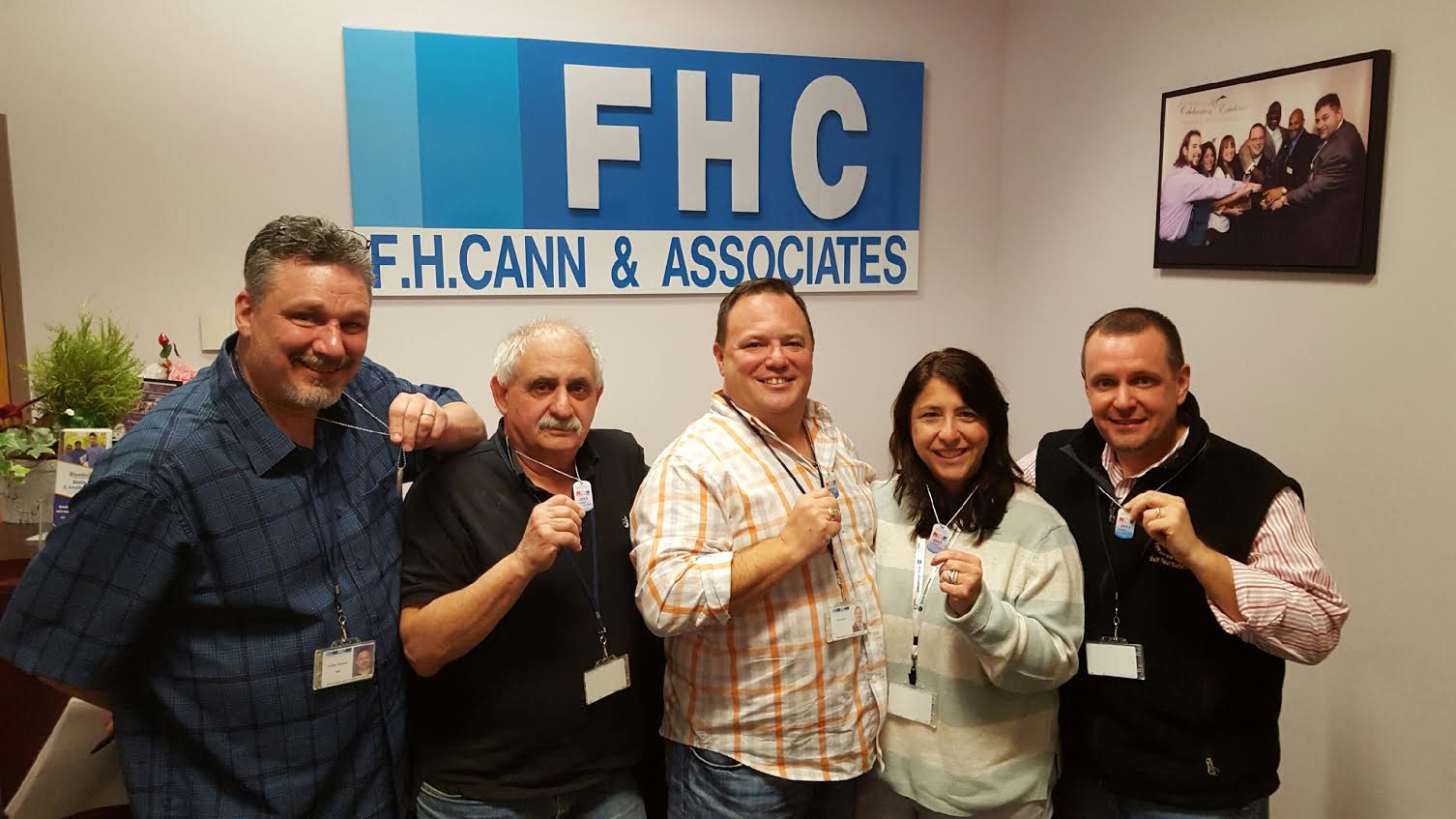
Above: Mr. Fletcher Crawley; below, from left to right: Tim Roncole  (Vet), Les Clark (Vet), Frank & Sheri Cann, and John MacDonald (Vet).

mccann2


F.H. Cann Among Donors Helping Navy Vet Overcome Homelessness
http://www.insidearm.com/daily/debt-collection-news/f-h-cann-among-donors-helping-navy-vet-overcome-homelessness/
http://www.insidearm.com/feed
insideARM

Accounts Receivable Management

Altus Welcomes Wexford & James as Newest Affiliate Member

KENNER, La. – Altus Global Trade Solutions (Altus GTS) announced that Wexford and James, the highly respected Iowa-based recovery solutions firm, recently joined as an Altus GTS Affiliate member. This partnership solidifies Wexford and James’ position as a major player in the global accounts receivables market and forges a powerful relationship between two companies that share the highest level of ethics, compliance and drive for maximum return for clients.

“We are very excited to be part of the Wexford-Altus GTS alliance because we can continue to provide an old-fashioned boutique approach to our clients in the increasingly complex word of debt recovery,” said David King, Senior Vice-President, Wexford and James. “Along with our tailored service approach, this partnership will allow us to meet the ever-changing compliance, risk mitigation and security requirements to provide unparalleled protection of our clients’ business.”

The Altus GTS Affiliate program launched in 2015 and is designed for small and medium sized commercial collection agencies that want to increase sales and grow equity.  The program has seen significant growth over the last year.

Julie Kaplan, Altus GTS Affiliate Director said, “The program’s success demonstrates the need and desire for smaller companies to play a role in the global receivables arena. Our Affiliate members can leverage Altus’ global network and suite of accounts receivable and information services to increase profitability.“

In addition, Altus Affiliate members benefit form a dynamic, supportive environment to grow a lucrative sales presence without the challenges of collections, trust accounting, and administration. The program allows the Affiliate to operate in a fully licensed, insured, and bonded environment. The Affiliate retains all the benefits of a small enterprise, while operating as a large international firm.

“It is an honor to add Wexford & James to our roster of Affiliate partners. Their participation further solidifies the Affiliate program as a mutually beneficial partnership which makes the entire debt recovery process more transparent, efficient and effective for all involved,” said Altus GTS President Thomas E. Brenan.

“We chose to partner with Altus because of their stellar reputation in the industry. We wanted to provide our clients tailored, responsive and worldwide receivables management solutions that achieve the highest rate of return while adhering to the highest professional and ethical standards. There was no doubt that Altus GTS was the ideal partner,” said King.

Click here to learn more about the Altus Affiliate Program.

About Altus

As a member of the Natixus network, Altus provides commercial debt recovery services to more than 100,000 customers in the United States and abroad. The company is a comprehensive, full service receivable management agency offering receivable management outsourcing, domestic and international commercial collections, audit collection, and business receivable management training.

Altus is fully licensed and bonded in all required jurisdictions. The company is a member of the Commercial Law League of America, the Commercial Collections Agency Association of the Commercial Law League of America, and a member of the International Association of Commercial Collectors.

Founded in 1994, Altus is headquartered in Kenner, La., with branch offices in Colorado, Washington and New Jersey and Affiliate offices in Delaware, Washington State, Arizona and Iowa. Visit us at www.TrustAltus.com.

Altus Welcomes Wexford & James as Newest Affiliate Member

http://www.insidearm.com/daily/commercial-b2b-receivables/commercial-debt-collection/altus-welcomes-wexford-james-as-newest-affiliate-member/
http://www.insidearm.com/feed
insideARM

Accounts Receivable Management

Executive Change: Law Offices of Timothy M. Sullivan Welcomes Attorney Crystal M. Duplay

CLEVELAND, Ohio — The Law Offices of Timothy M. Sullivan welcomed Attorney Crystal M. Duplay to its growing practice in February 2016.   Crystal’s legal career has primarily focused on the collection of student debt. She also has experience with mechanics liens, foreclosures, evictions, and tax obligations, among other areas of retail and commercial collections.

Crystal graduated with a B.A. from Baldwin Wallace University, and earned a J.D. from Cleveland-Marshall College of Law at Cleveland State University. She is licensed to practice in Ohio and Wisconsin. She is also admitted to practice before the U.S. District Court for the Northern District of Ohio. Crystal is a member of the Cleveland Metropolitan Bar Association, the West Shore Bar Association, and the National Association of Retail Collection Attorneys (NARCA).

The Law Offices of Timothy M. Sullivan and its affiliated collection agency are performance-driven, certified veteran-owned small businesses that have earned a reputation for professional, ethical, and excellent debt collection services.  Based in Cleveland, Ohio, our companies provide fully-integrated accounts receivable management solutions to a variety of corporate, higher education, and government client institutions.

Executive Change: Law Offices of Timothy M. Sullivan Welcomes Attorney Crystal M. Duplay
http://www.insidearm.com/daily/collections-jobs-news/executive-change-law-offices-of-timothy-m-sullivan-welcomes-attorney-crystal-m-duplay/
http://www.insidearm.com/feed
insideARM

Accounts Receivable Management