
New Georgia Wage Garnishment Law Takes Effect

The State of Georgia has a new wage garnishment law that took effect this month.  The law was passed by the Georgia legislature in March and was signed by Georgia Governor Nathan Deal on April 12, 2016. It became effective 30 days after it was signed by the Governor.

In September of 2015 the prior law was declared unconstitutional. The ruling in the case, (Strickland v. Alexander, No. 1:12-CV-02735-MHS) had essentially put a halt to garnishments in Georgia.

The Strickland case was filed after creditors garnished Tony Strickland’s Social Security income and money from his workers’ compensation settlement. The court’s opinion outlined a tragic set of health problems for Mr. Strickland that led to Mr. Strickland receiving a lump-sum workers’ compensation settlement for injuries sustained on his job and also Security Disability payments. Mr. Strickland and his spouse had used these funds for basic living and healthcare expenses.

A portion of those funds were frozen as part of a garnishment of Mr. Strickland’s savings account after a judgment was obtained for a balance owing on a delinquent credit card account.

In declaring the old law unconstitutional, U.S. District Court Judge Marvin H. Shoob determined: “The law is flawed because it doesn’t require creditors to tell debtors that some money — like Social Security benefits, welfare payments and workers’ compensation — is off limits to garnishments. When that money is wrongly taken, the law doesn’t require creditors to tell people how to get it back, and it doesn’t provide a timely procedure for determining whether funds should have been exempt.”

In theory the Strickland decision only applied in Gwinnett County where the suit was filed. However, other Georgia Counties had stopped accepting garnishments while they waited for the Georgia Legislature to respond to the ruling.

The new law dealt with the issues identified in the Strickland case. As noted in the above excerpt from Judge Shoob’s opinion, the state’s previous garnishment law didn’t require creditors to tell debtors that some money, like Social Security benefits, welfare payments, and workers’ compensation was off-limits to garnishments.

The new law also helps to clarify what money in accounts is exempt and explains how quickly it can be recovered if it is taken improperly. It outlines what a judgment debtor should do if exempt money has been taken. It also explains the potential remedies judgment debtors would have. The new law requires that a hearing should be held no more than 10 days after an exemption claim is filed. Finally, the new law requires debtors to be notified about what money can’t be taken and what appeals are available.

insideARM Perspective

The new law is a positive for both sides.  The law provides greater protections for consumers and, theoretically, will ensure a speedy and simplified process to dispute garnishment of exempt funds.

On the other side of the fence, judgments creditors in Georgia will now be able to again pursue an important post-judgment remedy. For them, the 8-month wait between the September 2015 ruling and the effective date for the new law is now over.

New Georgia Wage Garnishment Law Takes Effect
http://www.insidearm.com/daily/collection-laws-regulations/collection-laws-and-regulations/new-georgia-wage-garnishment-law-takes-effect/
http://www.insidearm.com/feed
insideARM


Accounts Receivable Management

How Spokeo May Limit Consumer Financial Services Litigation

This article was originally published on the Maurice Wutscher blog and is republished here with permission.

Don Maurice

Don Maurice

This week’s decision from the U.S. Supreme Court in Spokeo v. Robins should bolster the defense of companies subject to several federal consumer protection statutes. The ruling addresses lawsuits that claim an injury created solely by the violation of a federal statute and require the plaintiff to demonstrate not only that the statute was violated, but that the plaintiff herself suffered harm.

The opinion does not go as far as many in the consumer financial services industry would have liked (not all injuries must be “tangible”), but it does close the door on civil lawsuits many have faced. The opinion was authored by Justice Alito, with a separate concurring opinion by Justice Thomas. Justice Ginsburg authored a dissent and was joined in the dissent by Justice Sotomayor.

A copy of the opinion is available here: Link to Opinion.

Standing and ‘Injury in Fact’

The decision concerns “standing” – whether a person can bring a lawsuit in a federal court. Standing, as the Court wrote, requires three elements: first, an injury in fact; second that the injury is “fairly traceable” to the conduct of the defendant at issue; and last, that the conduct can be likely redressed by the court.

Robins claimed Spokeo compiled a report about him that contained false information in violation of the Fair Credit Reporting Act (FCRA). The trial court dismissed his case finding Robins lacked standing because he had no tangible harm — he did not allege the information compiled by Spokeo lead to, for example, the denial of a job or credit. The Ninth Circuit Court of Appeals reversed and held that the statutory violation was enough to allow Robins his day in court; first, because his claims were associated with a violation of protections afforded to him by the FCRA and, second, because his lawsuit addressed the handling of his own credit information, and these concerns are “individualized.”

Yesterday’s decision addressed whether Robins met the first element of standing – whether he had alleged an injury in fact under the FCRA. This requires pleading harm to a “legally protected interest” that is “concrete and particularized.” The harm cannot be hypothetical or conjectural; it must be “actual or imminent.” The Court held that while Robins may have pleaded a violation of a legally protected interest under FCRA that was particular harm to him, he did not plead any actual or imminent harm stemming from the alleged FCRA violation. Simply stated, all Robins alleged was a technical violation of the FCRA, which he did not allege caused him any harm beyond a hypothetical or speculative harm.

Requires a “Concrete” Injury to Assert a Claim

In the context of a statutory violation of the FCRA, one could assert like Robins did, that a credit reporting agency’s compilation of false information certainly does demonstrate a violation of a legally protected interest. That, after all, is a purpose of the FCRA: to promote and protect the accuracy of information reported. The harm was also “particularized.” Robins’ claim concerned the handling of his information and he filed a lawsuit seeking relief to redress the wrong done in the compilation and dissemination of that information.

The problem for Robins, and now for many who seek to assert similar lawsuits, is that all of this did not lead to any “concrete” injury. The Ninth Circuit’s decision focused only on whether the harm was particularized to Robins. It did not evaluate, the Court wrote, whether the harm was “‘real’ and not ‘abstract.’ ”

Concrete Harms Not Always Tangible

The opinion points out that there are some statutory violations whose transgression can itself cause a particularized and concrete harm. An example provided is a decision where the Federal Election Commission denied a group of voters information “that Congress had decided to make public.” The violation was of a certain statutory right (mandatory access to specific information) that, in and of itself, constituted a sufficient injury in fact (denial of access to the information). In such cases, a person need not identify any “additional harm” other than the harm Congress identified in the statute.

Robins’ case is different. While the FCRA imposes procedures that must be followed in order to curb the reporting of inaccurate information, not all inaccuracies result in a real harm. The mere fact there is an inaccuracy is not itself a sufficient, concrete harm. Although the information concerning Robins was alleged to be false and in violation of the FCRA, Robins did not point to any actual or imminent harm to him stemming from Spokeo’s conduct. “A violation of one of the FCRA’s procedural requirements may result in no harm,” wrote Justice Alito in the Court’s opinion. “An example that comes readily to mind,” the opinion continues, “is an incorrect zip code. It is difficult to imagine how the dissemination of an incorrect zip code, without more, could work any concrete harm.”

The decision does not close the door on Robins’ case. “We take no position as to whether the Ninth Circuit’s ultimate conclusion—that Robins adequately alleged an injury in fact—was correct,” the Court concluded. The Ninth Circuit’s analysis supporting its decision was flawed, the Court held, and because it did not examine whether the injury was “concrete,” the Court directed the Ninth Circuit to reexamine the case once more using its Spokeo analysis.

Curbs on FCRA, FDCPA, EFTA and TILA Lawsuits

The decision has immediate impact on FCRA claims alleging the reporting and furnishing of information. A failure to simply follow FCRA procedures will likely not withstand a Spokeo analysis absent pleading an actual harm.

The impact on Fair Debt Collection Practices Act (FDCPA) claims may be extraordinary. In determining whether a communication is false or misleading in violation of the FDCPA, courts have looked to whether the communication would violate a hypothetical “least sophisticated” or “unsophisticated” consumer. Several courts of appeals have defined the standard as an evaluation of how an imaginary consumer, who is gullible and naïve, would view the letter. As the Third Circuit Court of Appeals recently put it, “[t]he standard is an objective one, meaning that the specific plaintiff need not prove that she was actually confused or misled, only that the objective least sophisticated debtor would be.” While the standard may have some life left in it, the belief that the plaintiff herself need not demonstrate she has been harmed would be contrary to Spokeo. FDCPA lawsuits alleging false and deceptive communications may well be required to plead the plaintiff herself suffered some “particularized and concrete” injury that is “actual” or “imminent.”

Businesses facing claims under the federal Electronic Fund Transfers Act (EFTA) and Truth in Lending Act (TILA) could also benefit from Spokeo. The EFTA and TILA, like the FCRA, impose procedures on companies providing financial services to consumers. However a failure to follow these procedures does not always result in an actual or imminent harm, especially if courts find the statutes do not themselves define the harm.

TCPA Impact Less Clear

Many cases involving the Telephone Consumer Protection Act (TCPA) have been put on hold pending the Court’s decision. Spokeo’s impact is certainly positive in that the demonstration of some actual or imminent harm will be necessary to allow standing to sue. But expect plaintiffs to focus on the opinion’s language concerning Congress’ ability to pass a law that both provides a statutory protection and, in doing so, identifies the harm, which is protected by the right.

Impact on Class Actions

Spokeo has benefits to those defending class claims under these statutes. Even if the plaintiff can demonstrate a particularized and concrete injury that is actual or imminent, that same harm injury may not easily carry over to the class. The injury may be so unique to the class representative’s individual circumstances that even if the defendant’s conduct violated the statute, persons who do not share similar or specialized circumstances are not harmed.

State Court Litigation Option

The Court’s decision is limited to standing in federal courts. Many of the federal laws impacted, such as the FDCPA, TCPA, FCRA and EFTA, can also be brought in state courts. It will be up to each state to decide whether their courts can hear claims where there is no actual or imminent harm (tangible or statutorily identified) to the plaintiff. Comments from Justice Breyer during the Spokeo oral argument touched on states having “public action” statutes that allow persons to bring claims for statutory violations even where they have suffered no injury.

Moving Ahead with Spokeo

While Spokeo does not require only real, tangible harms in all cases, it does limit a wide array of claims and makes clear that not all alleged statutory violations are accompanied by a cognizable, statutory harm. Expect Spokeo to quickly make its way into consumer financial services litigation. The next few months should see several trial court decisions that will flesh out whether certain statutory protections themselves identify harms sufficient alone for standing or whether those violations require additional, real world harms. Also, because a lack of standing can be raised at any time during the life of a case, several appeals courts may right now be looking at Spokeo’s application to matters before them.

[Editor’s note: Read Don Maurice’s commentary on this case following oral arguments in November 2015.]

How Spokeo May Limit Consumer Financial Services Litigation
http://www.insidearm.com/opinion/how-spokeo-may-limit-consumer-financial-services-litigation/
http://www.insidearm.com/feed
insideARM

Accounts Receivable Management

Brock & Scott Collections Division Expands Operations and Presence into Michigan

FARMINGTON HILLS, Mich. — Brock & Scott, PLLC is pleased to announce an expansion of its Collections practice group into Michigan with the addition of Trott Recovery Services, PLLC.  Trott Recovery Services has been a collections and legal recovery leader serving clients nationally and across the state of Michigan for over five years.

Trott Recovery Services officially joined Brock & Scott through an asset purchase on May 4th resulting in another major milestone of growth for the firm’s Collection Division.  Doreen Hoffman, previously CEO & Managing Partner for Trott Recovery Services, joins Brock & Scott as a Partner with over 28 years’ experience in collections and litigation.  Doreen has served as compliance counsel, trial attorney and managing partner in previous roles, been on the board of the Michigan ACA and a featured speaker and panelist at many of the NARCA, DBA and ACA conferences.

brock&scottManaging Partner Clayton Gladd commented that “this is a very unique and exciting opportunity for the firm to expand into a new state outside of our current footprint.  Adding Trott Recovery Services gives us a strong presence in Michigan and a nationwide legal collection servicing program that is currently engaged with major market banks and other clients.  We are also very excited to add someone of Doreen’s caliber and industry experience to our executive leadership team as a Partner.  She has built up an impressive list of reputable and established clients, many that we currently have active relationships with across our other states.

Doreen Hoffman added, “We are pleased to partner with Brock & Scott moving forward knowing that they have a diverse and solid client base along with a proven track record of performance and compliance as our clients move to their platform.  It is important for us to be part of a multi-state and multi-practice model where we feel the industry continues to move towards.  Our team is very excited about the future growth opportunities aligning ourselves with a best-in-class legal operation that is Brock & Scott.”

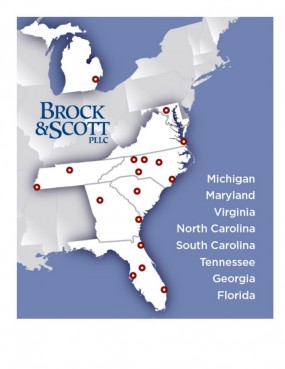
Founded in 1998, Brock & Scott has been a mainstay and a legal recovery services leader for many years with 17 offices across Michigan, Maryland, Virginia, North Carolina, South Carolina, Tennessee, Georgia and Florida.  The firm is committed to providing exemplary in-house service to their clients with a comprehensive suite of practice areas covering collection services, mortgage default, real estate, complex litigation, financial services consulting and other offerings.  They maintain scalability within their servicing model so clients’ volume needs are consistently realized while preserving quality control in their processes to deliver legal service with the utmost integrity and operational efficiency.  A strong focus on compliance and regulatory requirements allows Brock & Scott to stay ahead in a constantly changing environment.

For more information on Brock & Scott, PLLC or related to this announcement, please visit us at www.brockandscott.com or contact Clayton.Gladd@brockandscott.com or Doreen.Hoffman@brockandscott.com.

Brock & Scott Collections Division Expands Operations and Presence into Michigan

http://www.insidearm.com/daily/debt-collection-news/brock-scott-collections-division-expands-operations-and-presence-into-michigan/
http://www.insidearm.com/feed
insideARM
Accounts Receivable Management

Senate Committee to hold Hearing to Examine Effects of 25-Year-Old TCPA on Modern Consumers and Businesses

In a press release issued yesterday, U.S. Senator John Thune (R-S.D.), chairman of the Senate Committee on Commerce, Science, and Transportation, announced that he will convene a full committee hearing titled “The Telephone Consumer Protection Act at 25: Effects on Consumers and Business” on Wednesday, May 18, 2016, at 10:00 a.m.

The hearing will examine the Telephone Consumer Protection Act of 1991 (TCPA), an enacted bill that requires solicitors to maintain a “Do Not Call” list and limits the use of automatic dialing systems known as “robocalls.” The hearing will also examine the Federal Communications Commission’s application of the TCPA to new technologies and practices popularized since adoption of the Act.

Witnesses:

– Ms. Becca Wahlquist, Snell and Wilmer, testifying on behalf of the U.S. Chamber     Institute of Legal Reform
– Ms. Monica Desai, Squire Patton Boggs
– Mr. Rich Lovich, Law Offices of Stephenson, Acquisto & Coleman, testifying on behalf of the American Association of Healthcare Administrative Management
– Ms. Margot Saunders, Of Counsel, National Consumer Law Center
– The Honorable Greg Zoeller, Indiana Attorney General

* Witness list subject to change

Hearing Details:

Wednesday, May 18, 2016
10:00 a.m. ET
Full Committee Hearing
Senate Russell Building 253

Witness testimony, opening statements, and a livestream will be available on www.commerce.senate.gov.

insideARM Perspective

This ought to be an interesting hearing, one worthy of noting on your calendar and streaming the proceedings. The likely contrasting testimony from the representatives the U.S, Chamber of Commerce, Institute of Legal Reform and the National Consumer Law Center should be fascinating. What impact the hearing will have remains to be seen.

Senate Committee to hold Hearing to Examine Effects of 25-Year-Old TCPA on Modern Consumers and Businesses
http://www.insidearm.com/tcpa-compliance-and-operational-strategies/senate-committee-to-hold-hearing-to-examine-effects-of-25-year-old-tcpa-on-modern-consumers-and-businesses/
http://www.insidearm.com/feed
insideARM

Accounts Receivable Management

Maximize Digital Communication to Engage with Customers Webinar

Wixom, Mich., (May 13, 2016) – RevSpring’s next educational webinar will take place on May 19 at 2 p.m. EST and will focus on maximizing digital communication tools to interact with customers. “Using Digital Communication to Generate Results” will explore the following:

  • Best practices for emailing consumers
  • Tips for completing required documents electronically
  • Strategies to tap into the power of text messaging when communicating with consumers

By attending this webinar – a continuation of our Active Consumer Engagement series – you’ll learn more about why customer convenience is paramount in today’s environment, along with tips for remaining compliant as the landscape continues to change. We hope you’ll join us on May 19.

Click here to register or contact learnmore@revspringinc.com for more information.

About RevSpring
RevSpring facilitates over one billion customer interactions annually, serving more than 2,000 clients across the healthcare and financial services markets. Our diverse and expert solutions accelerate cash flow and improve ROI on time-sensitive consumer communications.

RevSpring’s billing and consumer communication platform allows you to receive payments faster with more connection options, including mail, web, text, and phone. Plus, we improve the design and distribution methods of your consumer communications to make your interactions more impactful, meaningful, and effective.

###

Contact:

Heather Taylor

765.730.6632 (mobile)

htaylor@revspringinc.com


Maximize Digital Communication to Engage with Customers Webinar
http://www.insidearm.com/accelerate-revenue/maximize-digital-communication-to-engage-with-customers-webinar/
http://www.insidearm.com/feed
insideARM

Accounts Receivable Management

U.S. District Court in New York Grants Debt Collector Motion to Certify Important FDCPA Issue for Interlocutory Appeal

In an Order dated May 5, 2016 a Federal Judge in New York has determined that a decision he rendered in the matter of Halberstam v. Global Credit and Collection Corp. (U.S. District Court, ED, NY, 15-cv-5696 (BMC) earlier this year should be certified for an immediate interlocutory appeal. (Editor’s Note: Interlocutory actions are certified by courts when an issue presents a question of law that should be answered by an appellate court before a trial may proceed or to prevent irreparable harm from occurring to a person or property during the pendency of a lawsuit or proceeding. Generally, courts are generally reluctant to make interlocutory orders.)

insideARM wrote about the case on January 14, 2016.  The Fair Debt Collection Practices Act (FDCPA) case involved leaving a message with a person who answers the consumer’s phone. The issue presented by the case was whether a debt collector, whose telephone call to a debtor is answered by a third party, may leave his name and number for the debtor to return the call — without disclosing that he is a debt collector — or whether the debt collector must refrain from leaving callback information and attempt the call at a later time.

The critical facts of the case were not in dispute.  Defendant debt collector telephoned plaintiff about his debt. The person answering the phone (who plaintiff did not identify) responded that “Herschel [the debtor/plaintiff] is not yet in,” and asked if he could take a message. The collection agent responded, in relevant part, “Name is Eric Panganiban. Callback number is 1-866-277-1877 … direct extension is 6929. Regarding a personal business matter.”

In his original decision on January 11, 2016 United States District Court Brian M. Cogan

determined that a polite “No, thank you, I’ll call back,” was the proper action for the debt collector and that “the only way to avoid violating the statute when the recipient of the call was asked if he could take a message was for the caller to make a different decision by politely demurring, and perhaps trying again at some point in the future.”

In the May 5, 2016 Memorandum, Decision, and Order  Judge Cogan wrote:

I had no doubt, and I remain of the view, that the purpose of leaving such a message was to induce plaintiff to return the collection agent’s call without knowing that he was calling a collection agent. Describing the purpose of the call to a third party as a “personal business matter” was at least as suggestive, and probably more, of a business opportunity for plaintiff to make money as it was of its true purpose, which was to cause plaintiff to pay money. I granted summary judgment for plaintiff because I found that by leaving a message for plaintiff with a third party that was calculated to induce a return call without the debtor knowing that he would be calling a collection company, defendant violated section 1692c(b) of the Fair Debt Collection Practices Act (“FDCPA”).

I can certify an order for interlocutory review under 28 U.S.C. § 1292(b) when the order “involves a controlling question of law as to which there is substantial ground or difference of opinion and that an immediate appeal from the order may materially advance the ultimate termination of the litigation.

I am convinced that this case has the exceptional circumstances necessary to justify certifying the case for interlocutory review. First, this case presents a controlling question of law. If the Second Circuit were to reverse my grant of summary judgment on plaintiff’s behalf, the case would be over. Further, the issue of whether leaving a message with a third party violates the FDCPA has the potential to impact a large number of other cases, as well as debt collection practices more generally.

Defendant has made a strong showing that not only its current practices, but those of the entire industry, would be significantly impacted by the Court’s ruling in this case. I think that rather than have a single district court decision cause uncertainty as to the continuation of a common practice in an entire industry, immediate appellate guidance on the issue would be preferable.”

insideARM Perspective

Kudos to Judge Cogan for recognizing the significance of his prior decision and certifying the appeal.  However, our insideARM Perspective from our January 14, 2016 article is still relevant: “The only thing clear on this issue is that there is no “right answer.” The best option may be to never leave a message under any situation.  However, in the eyes of many, that leads to what may be deemed as harassment, because it causes additional phone calls — and, perhaps, hang-ups. Let’s hope that the CFPB will address the issue in their upcoming Rulemaking for the debt collection industry.”

U.S. District Court in New York Grants Debt Collector Motion to Certify Important FDCPA Issue for Interlocutory Appeal
http://www.insidearm.com/daily/debt-collection-news/u-s-district-court-in-new-york-grants-debt-collector-motion-to-certify-important-fdcpa-issue-for-interlocutory-appeal/
http://www.insidearm.com/feed
insideARM

Accounts Receivable Management

Court Finds Settlement Offers on Time-barred Debts Without Disclosure of the Fact That the Debt is Time-Barred to be FDCPA Violation

In a Memorandum Opinion and Order filed on May 9, 2016 a United States District Court Judge for the Northern District of Illinois granted Summary Judgment in favor of the plaintiffs in a Fair Debt Collection Practices Act (FDCPA) lawsuit involving publicly traded debt buyer Portfolio Recovery Associates, LLC (PRAA). The opinion in the case, Magee and Peterson v. Portfolio Recovery Associates, LLC (Case No. 12 cv 1624, Northern District,  Illinois, Eastern Division) can be found here.

This litigation has been ongoing since March 6, 2012.  insideARM has previously written about this case. In October 0f 2015, we wrote about the class certification in the case.

Factual Background

On October 3, 2011, PRAA sent Magee, a resident of Illinois, a letter to collect on a debt originally owed by Magee to Capital One Bank. Magee alleges that this debt was incurred prior to 2004, if it was incurred at all.

The letter stated:

Your account was purchased on 7/8/2011 from Capital One Bank, N.A. This letter confirms your arrangement to make the following payment(s) to settle this account.

Payment in the amount of $250.00 is due by 10/5/2011.

Payment in the amount of $193.93 is due by 10/29/2011.

Payment in the amount of $198.93 is due by 11/29/2011.

Should you miss any of the payments described herein, this payment plan may become null and void.

If you complete this payment plan and our company is reporting our company’s trade line for this account to the three major credit reporting agencies, our company will report this account as settled.

PRAA sent Peterson, an Indiana resident, letters to collect on two separate debts that were originally owed to Capital One Bank. Peterson alleges that these debts were incurred prior to 2005, if they were incurred at all. Both letters stated:

We want to help you resolve your account and have developed three affordable options for you to pay off this account [including] Single Payment Settlement Option [,] 6 Month Settlement Plan [and] Balance in Full Payment Plan.

Your account will be considered “Settled in Full” after we post your final payment.

The Arguments

Plaintiffs contend PRAA engaged in unfair and deceptive acts and practices in violation of Sections 1692e, 1692e(5), 1692e(10), and 1692f of the FDCPA by failing to disclose to the Plaintiffs that the statute of limitations had expired and that the debt could not be collected through a court action. Plaintiffs further allege that PRAA’s offers in the collection letters to “settle” the debt are misleading because they imply that a time-barred debt is legally enforceable

Plaintiff’s complaint had two main components. In count I, plaintiffs had alleged that PRAA violated the FDCPA by “sending consumers collection letters that contain settlement offers on time-barred debts without disclosure of the fact that the debt is time barred” and that the “nondisclosure in conjunction with the offers of a ‘settlement’ implies a colorable obligation to pay and is misleading to the consumer.”

Count II allegations were that PRAA violated the FDCPA “by referring to credit reporting on debts so old that they cannot be reported on an ordinary credit report.”

The Court’s Analysis

The opinion was written by the Honorable John W. Darrah, U.S. District Court Judge, who found as follows:

As to Count I:

“Defendant (PRAA) failed to include language stating that Plaintiffs’ debt was time barred, that they could no longer be sued on that debt, and that a partial payment would reset the statute of limitations period. Defendant’s failure to include such language in the dunning letter is clearly deceptive on its face.

The “settlement” language in the Magee and Peterson letters offer a significant savings on the consumers’ debts and encourage them to act quickly to take advantage of these savings. By failing to include language that the law limits how long consumers can be sued on their debt, the statements in question urge them to make payments on time-barred debt without informing them of the consequences of making those payments, i.e. ‘a gullible consumer who made a partial payment would inadvertently have reset the limitations period and made herself vulnerable on the full amount.’ Such language could influence a consumer’s decision, and is material. Thus, Plaintiffs’ Motion for Summary Judgment as to Count I is granted.”

As to Count II:

“The language at issue here is the statement in the Magee letter that indicates that Defendant would report Magee’s debt as “settled” to a credit reporting agency if Magee agreed to the suggested payment plan. This language is nearly identical to the language discussed in Gonzalez v. Arrow Fin. Servs., LLC, 660 F.3d 1055 (9th Cir. 2011) (Gonzalez). As in that case, there is no circumstance under which Defendant could legally report an obsolete debt to a credit reporting agency or make a positive report in the event of payment. The implication that Defendant could do so here is misleading on its face.

As noted by Plaintiffs, misleading a consumer to believe a debt is legally reportable and that making a payment on that debt will improve his or her credit score is a deception that has the ability to influence that consumer’s decision. Therefore, because the statements regarding “credit reporting” are misleading on their face and materially false, Plaintiffs’ Motion for Summary Judgment is granted as to Count II.”

insideARM Perspective

insideARM has a page on its website labeled FDCPA Resources. Within that page is a FDCPA Caselaw chart that is updated on a monthly basis by Joann Needleman of the Clark Hill law firm.  A quick glance at that grid shows several other cases involving settlement offers on time-barred debt. Most, if not all of those cases are decisions that are identified as “Negative” for the ARM industry.

Calculation of the appropriate Statute of Limitations often requires an abacus, slide ruler, the latest and greatest calculator, access to a super computer, a PHD in mathematics, and a law degree. Depending upon the underlying facts, state laws, and payment history on an account, it is a challenge to determine with absolute certainty what date an account becomes “time-barred”. The cases in the aforementioned case law grid provide some guidance for the industry on what can and cannot be said in a letter on “time-barred” accounts, but nothing is black and white.

As noted above, this case dates back to 2012.  One would hope the ARM industry has studied all of the “time-barred” debt cases in the last several years (including this case) and there would not be many more cases in the future with similar facts.

Forewarned is forearmed. For those of you that studied Latin in high school or college, the Latin saying “Praemonitus, Praemunitus” loosely translates into a similar warning.

Court Finds Settlement Offers on Time-barred Debts Without Disclosure of the Fact That the Debt is Time-Barred to be FDCPA Violation
http://www.insidearm.com/daily/debt-buying-topics/debt-buying/court-finds-settlement-offers-on-time-barred-debts-without-disclosure-of-the-fact-that-the-debt-is-time-barred-to-be-fdcpa-violation/
http://www.insidearm.com/feed
insideARM

Accounts Receivable Management

Executive Change: InvestiNet Faith Braverman Executive Change Announcement

InvestiNet, LLC has announced the hiring of Faith Braverman to the position of Director, Business Development.  She joins InvestiNet after more than 10 years in the accounts receivable industry, initially as VP Client Services at YouveGotClaims and then as VP Business Development at Eltman Law, PC.

“We are excited to be working with Faith again.  Her prior experience with onboarding and managing national credit grantor clients as well as with vertical markets, outside of the credit card area, will be a significant asset to the InvestiNet team as we grow our presence in these markets.   Her experience and reputation for understanding client requirements and ensuring delivery that exceeds expectations will make her an invaluable part of InvestiNet’s growth plans,” said Howard Barnard, VP of InvestiNet, LLC.

InvestiNet is a full service, award winning, accounts receivable company with a specialty niche in Non-Performing Judgment accounts.  For more information, contact Faith or Howard, at 201.452.2690 or 843.991.6913 respectively, or visit the website;

InvestiNet, LLC has announced the hiring of Faith Braverman to the position of Director, Business Development.  She joins InvestiNet after more than 10 years in the accounts receivable industry, initially as VP Client Services at YouveGotClaims and then as VP Business Development at Eltman Law, PC.

“We are excited to be working with Faith again.  Her prior experience with onboarding and managing national credit grantor clients as well as with vertical markets, outside of the credit card area, will be a significant asset to the InvestiNet team as we grow our presence in these markets.   Her experience and reputation for understanding client requirements and ensuring delivery that exceeds expectations will make her an invaluable part of InvestiNet’s growth plans,” said Howard Barnard, VP of InvestiNet, LLC.

About InvestiNet

InvestiNet is a full service, award winning, accounts receivable company with a specialty niche in Non-Performing Judgment accounts.  For more information, contact Faith or Howard, at 201.452.2690 or 843.991.6913 respectively, or visit the website; www.Investi-net.com

Executive Change: InvestiNet Faith Braverman Executive Change Announcement
http://www.insidearm.com/daily/collections-jobs-news/executive-change-investinet-faith-braverman-executive-change-announcement/
http://www.insidearm.com/feed
insideARM

Accounts Receivable Management

Executive Change: Randy Tempest Promoted to Chief Sales Officer at Receivables Management Partners

GREENSBURG, Ind. – Receivables Management Partners (RMP), a leading provider of accounts receivable management and other outsourced revenue cycle management (RCM) services to the healthcare industry is pleased to announce the promotion of Randy Tempest to Chief Sales Officer. Previously, Randy served as the Senior Director, Sales and Client Relations for RMP. In his new role he provides leadership and direction to the organization’s sales function, accountable for sales performance company wide. In addition, he leads the marketing efforts and manages all activities that relate to client retention.

“Randy’s promotion is a direct result of his achievements through his hard work and leadership since joining RMP,” shared Mark Schabel, CEO. “His desire to see the company grow, in addition to his commitment to achieving results with integrity, has made him a valuable asset to the entire RMP team. We are excited about the future for RMP and our client partnerships with Randy’s servant leadership approach to helping our team serve our clients.”

Randy joined RMP in 2011, previously serving as Regional Sales Manager for a leading collection software company. Bringing over 20 years of experience in the healthcare receivable industry, Randy is well-positioned to lead RMP to substantial growth.

“I look forward to not only serving RMP and my team, but also the healthcare community.  Helping healthcare leaders maximize recoveries while maintaining patient goodwill is key to our sales efforts.”  explained Randy. “I look forward to achieving our goals by increasing the RMP brand through working with our existing partners, while bringing in new clients.”

About Receivables Management Partners (RMP)

RMP is a financial services firm that enables leading healthcare providers to focus on patients instead of payments. Known for its innovative culture and compassionate approach to collections, RMP has grown to over 520 people in nine offices across the U.S. The company proudly serves over 200 hospitals and over 30,000 physicians nationwide. For more information, please visit ReceiveMoreRMP.com.

Executive Change: Randy Tempest Promoted to Chief Sales Officer at Receivables Management Partners
http://www.insidearm.com/uncategorized/executive-change-randy-tempest-promoted-to-chief-sales-officer-at-receivables-management-partners/
http://www.insidearm.com/feed
insideARM

Accounts Receivable Management

Executive Change: Stellar Recovery Promotes Hayden Miller to Operations Manager

JACKSONVILLE, Fla. — Stellar Recovery announced today that Hayden Miller has been promoted to Operations Manager.  Hayden has over 10 years of operations and operations management experience in first and third party collections.  His background includes managing banking, communications, financial services, student loan, and utility verticals.  Hayden’s responsibilities include working with the collection managers to make sure they and their teams are performing at the highest levels in compliance, customer experience, and performance.

Hayden has a strong and intuitive understanding of how to lead and motivate his team to reach their individual and team goals, the client’s goals, and Stellar Recovery revenue goals.  His unique approach to training and developing agents has produced top performing representatives and managers throughout his career.

Stellar Recovery, Inc. Corporate Headquarters is located in Jacksonville, Florida, with a satellite office in Kalispell, Montana.  Please visit our website at www.stellarrecoveryinc.com.


Executive Change: Stellar Recovery Promotes Hayden Miller to Operations Manager
http://www.insidearm.com/daily/collections-jobs-news/stellar-recovery-promotes-hayden-miller-to-operations-manager/
http://www.insidearm.com/feed
insideARM

Accounts Receivable Management