
insideARM Perspective on CFPB Outline of Proposed Rules – Litigation and Time-Barred Disclosures

This is the fourth in our series of “perspective” articles about the CFPB’s Outline of Proposed Debt Collection Rules, released last week in advance of the next step in the rulemaking process, the SBREFA hearing.

Section IV of the Outline is devoted to the subjects of litigation disclosure and time-barred and obsolete debt. This article provides details and commentary on these topics.

Litigation disclosure

The CFPB highlights in the Outline the results of a series of 2009 roundtables convened by the FTC and a July 2010 Study on debt buying which conclude that a majority of consumer debt collection lawsuits result in default judgments, as few consumers who are sued actually contest those allegations in court. The Bureau believes some consumers fail to defend themselves because they lack familiarity with court process, do not understand the consequences of not defending, and do not know where to find an attorney they can afford.

As a result, the CFPB is considering a proposal that would require debt collectors to provide a brief “litigation disclosure” in all written and oral communications in which they represent their intent to sue. The disclosure would inform the consumer that the debt collector intends to sue; that a court could rule against the consumer if he or she fails to defend a lawsuit; and that additional information about debt collection litigation, including contact information for others’ legal services programs, is available on the Bureau’s website and by calling the CFPB’s toll-free phone number.

The Bureau does not anticipate providing model language for this disclosure, but is interested in feedback about the usefulness of such.

Time-barred debt and obsolete debt

The Bureau is concerned that some debt collectors sue or threaten to sue on time-barred debt, and that they take advantage of consumers’ lack of understanding of statutes of limitations. Therefore they are considering a proposal to prohibit suit and threats of suit on time-barred debt.

The Bureau also believes that few consumers understand that making a payment on a time-barred debt will revive, or “re-start the clock” on that debt. Therefore they are also considering a proposal that would require disclosures, and to waive revival, in connection with the collection of time-barred debt and obsolete debt.

The Bureau would develop a disclosure and refine its contents and design based on consumer testing. The disclosure itself would consist of a brief, plain-language statement informing the consumer that, because of the age of the debt, the debt collector cannot sue to recover it.

The Bureau is considering the following in connection with these disclosures:

  1. Whether a collector should be required to make this disclosure only if the collector knew or should have known that the debt was time-barred, or whether a collector should be strictly liable (i.e., liability would attach regardless of the collector’s state of knowledge).
  2. Debt collectors would be required to include such a statement in the validation notice and in the first oral communication in which they request payment.
  3. Potentially, debt collectors should provide the disclosure at additional intervals, including possibly in each communication in which they seek payment.
  4. Subsequent debt collectors would be bound by the actions of prior collectors, and required to provide a time-barred debt disclosure in the validation notice and the first oral communication in which it requests payment (and possibly at additional intervals). Prior debt collectors on the account would have to pass along whether they had given the time-barred disclosure to the consumer. The idea is that this would avoid different collectors making different determinations about the status of the same debt.

The Bureau is also considering an “obsolescence disclosure” that would inform the consumer whether a particular time-barred debt can or cannot appear on a credit report. The Bureau is seeking input from SERs in the SBREFA hearing about the frequency with which debt collectors furnish information to reporting agencies on debts that are both time-barred and obsolete, and the challenges of providing disclosures to consumers relating to obsolescence.

The CFPB is also considering whether to prohibit collectors from collecting on time-barred debt that can be revived under state law unless they waive the right to sue on the debt. The Bureau is considering this because testing has revealed that the concept of “revival” is so counterintuitive that even a disclosure would be too confusing for consumers.

The Bureau reports that it considered alternate proposals, including bans on both the sale and collection of time-barred debt, however they are not planning to propose such alternatives because 1) other proposals may adequately address the risks and 2) these bans may have unintended consequences for consumers, such as causing more lawsuits earlier in the collection process.

Finally, the CFPB is considering a proposal to prohibit a debt collector from accepting payment on such a debt until the collector obtains the consumer’s written acknowledgement of having received a time-barred debt disclosure and an obsolescence disclosure. Debt collectors would be free to include, as a separate document that accompanies the validation notice, a form that consumers may use to acknowledge receipt. The Bureau does not anticipate providing a model form for this purpose.

The proposals above raise a number of issues. insideARM spoke with John Rossman, Attorney at Law with Moss & Barnett, and frequent insideARM contributor. Rossman had the following observations:

“The proposal for out-of-statute debt is incomplete because the actual language of the disclosure is not included.  Further, I am concerned that the CFPB is considering the standard to be either whether the collector knew or should have known that the account is out of statute or imposing strict liability.

The complexity of the statute of limitations calculations – especially when taking into account borrowing statutes – is nearly impossible in many instances and imposing either of these standards on debt collectors would be harmful to the industry.  It is concerning that the CFPB is considering a proposal that a debt collector cannot accept payment on a debt that is both past the statute of limitations and past credit report obsolescence unless the consumer confirms in writing that he or she received a disclosure about the statute of limitations and credit reporting.”

We also spoke with Rozanne Andersen, VP, licensed attorney and Chief Compliance Officer at Ontario Systems, who offered these thoughts:

The CFPB’s proposal for out of statute debt is perhaps the most predictable of all the proposals identified in the outline. We have long been aware of the FTC’s and the CFPB’s outright disdain for the practices related to the collection of out of statute debt and if the proposal finds its way into the final regulations, the CFPB will in my opinion effectively kill the practice altogether.    

According to the CFPB, the proposals under consideration would prohibit suit and threats of suit on time-barred debt. [Page 20] I consider this to be a redundancy in the regulation. The FDCPA presently bars both of these actions regarding time barred debt and there is no need to restate current law.

Setting aside the litigation issue, the CFPB also has consumer protection concerns when a debt collector merely attempts to collect a time barred debt. They worry a consumer who does not know the statute of limitations has run on a particular debt, understand the concept of revival or grasp what the term statute of limitation means may “pay or prioritize a debt, including one the consumer does not owe, over a different obligation.” I agree with the CFPB, consumers should not be asked to pay debts they do not owe either before or after a statute of limitations expires. However, my sincerity meter moves to red when I read about the CFPB’s concern for the unsuspecting consumer who actually owes the debt and who may inadvertently pay a debt after the statute of limitations has expired or revive a statute of limitation on a debt they owe by merely making a payment.  

One thing is for sure…collection agencies heavily invested in the collection of out of statute debt and obsolete debt may want to consider diversification of their portfolios sooner than later.

One additional consideration… the devil is in the details. How these rules, once finalized and effective, may be applied to existing inventories will have a significant impact on any firm holding Out of Statute accounts.

_____________________________________

Read insideARM’s detailed coverage of the CFPB’s Outline of Proposed Rules

insideARM Perspective on CFPB Outline of Proposed Debt Collection Rules – Communication Part 1 (Contact frequency and voicemail messages)

insideARM Perspective on CFPB Outline of Proposed Debt Collection Rules – Communication Part 2 (General time, place, and manner restrictions; decedent debt; and consumer consent)

insideARM Perspective on CFPB Outline of Proposed Debt Collection Rules – Information Integrity (Data integrity, data transfer, substantiation, validation notice)

insideARM Perspective on CFPB Outline of Proposed Debt Collection Rules – Litigation and Time-Barred Disclosures

What Collectors Really Need to Know About the CFPB’s Proposed Rules – a podcast by Attorney John Rossman

15 Industry Experts React to CFPB Outline of Proposed Debt Collection Rules

Webinar: CFPB Rulemaking and Overview (August 16, repeated on August 18) – free for Compliance Professionals Forum members; $59 for others

Additional perspective to come.

insideARM Perspective on CFPB Outline of Proposed Rules – Litigation and Time-Barred Disclosures
http://www.insidearm.com/daily/debt-collection-news/accounts-receivables-management/insidearm-perspective-on-cfpb-outline-of-proposed-rules-litigation-and-time-barred-disclosures/
http://www.insidearm.com/feed
insideARM


Accounts Receivable Management

Executive Change: Stellar Recovery, Inc. Promotes Kim Harvey to Executive Vice President of Client Service and Administration

JACKSONVILLE, Fla. — Stellar Recovery is pleased to announce that Kim Harvey has been promoted to Executive Vice President of Client Services and Administration.   Kim Joined Stellar Recovery as Director of Client Services in March 2016, and since that time has provided superior support to our clients and implemented several initiatives that have improved internal processes and the client experience.  Kim and her team are building close relationships with each of Stellar’s clients to make sure they receive the highest quality of service and back office support.

Kim is now leading the Client Services, Administration, and Human Resource Departments, overseeing 10 team members.

Kim’s recent accomplishments and enhancements include:

  • Enhanced communications between Clients and Stellar Recovery
  • Developed coordination and communication methods within departments
  • Implemented automated processes and efficiencies for several administrative functions

Kim’s initiatives for Stellar Recovery and their clients are:

  • Provide superior support to our clients and their initiatives
  • Developing consistent communication between Client Services and all Executive Teams regarding new clients, existing client requirements, and updates to client processes
  • Finding efficiencies in Client Services and Administrative Processes
  • Identifying opportunities for automation to streamline processes 

Michelle Yates, President commented, “Kim has shown a level of professionalism and dedication that is being rewarded with a promotion and more responsibilities.  We are in a fast paced and fluid climate in regards to compliance and client demands, and Kim has been and will continue to be instrumental in providing our clients and internal stake holders with best in class service and support”.

Stellar Recovery, Inc. Corporate Headquarters is located in Jacksonville, Florida, with a satellite office in Kalispell, Montana.  Please visit our website at www.stellarrecoveryinc.com.

Executive Change: Stellar Recovery, Inc. Promotes Kim Harvey to Executive Vice President of Client Service and Administration
http://www.insidearm.com/daily/collections-jobs-news/executive-change-stellar-recovery-inc-promotes-kim-harvey-to-executive-vice-president-of-client-service-and-administration/
http://www.insidearm.com/feed
insideARM

Accounts Receivable Management

Real Time Resolutions, Inc. Becomes Certified Debt Buyer

DALLAS, Texas – As the DBA Executive Summit commences, Real Time Resolutions, Inc. (RTR) today announced that it has earned the highly­ regarded  designation  of Certified Professional Receivables  Company  (CPRC) after completing the comprehensive national standards contained in DBA International’s certification  program. These standards  have been recognized for exceeding state and federal laws and regulations through a series of stringent requirements  that stress responsible  consumer  protection through increased transparency and operational controls.

“I want to recognize  and commend  RTR for this milestone  and its efforts to protect consumers and creditors through the attainment of DBA International’s Receivables Management Certification  Program,” said DBA International Board President Trish Baxter. “When DBA International  members  created the Certification Program, they were expressing their desire for the industry to coalesce around uniform standards of best practices designed  to not only meet state and federal consumer  protection laws, but in many cases exceed them. The fact is that certification  is good for both consumers  and the industry.”

The CPRC designation  is granted to companies who comply with rigorous  standards  addressing such items as account documentation, chain of title, consumer  complaint  and dispute resolution, statute of limitation compliance,  vendor management,  credit bureau reporting, resale, and other relevant  operational procedures. Individual Certified Receivables  Compliance Professional designations are required for each certified company’s chief compliance  officer.

Compliance with the CPRC standards are monitored through independent third party audits as well as through a structured  self-compliance audit process. For more information  about DBA’s Receivables Management Certification  Program, or to download an application,  please visit DBA’s website at www.dbainternational.org/certification.

About Real Time Resolutions, Inc.

RTR provides industry leading servicing and collection services on pre and post charge off auto loans, bankrupt accounts, commercial loans, student loans, consumer loans, credit cards, and 1st and 2nd lien mortgage loans from a 1st party and 3rd party basis, as well as other call center services.

In addition to providing servicing and debt collection services, RTR and its affiliate, Resolution Capital, purchases commercial and consumer loan portfolios, and utilizes various strategies to resolve debts and rehabilitate borrowers.

About DBA International

DBA International  (DBA) is the nonprofit trade association that represents more than 550 companies that purchase  performing  and nonperforming receivables  on the secondary market.  DBA’s Receivables Management Certification  Program and its Code of Ethics set the “gold standard” within the receivables industry due to its rigorous  uniform industry standards of best practice which focus on the protection  of the consumer.  DBA provides  its members  with extensive networking,  educational, and business development opportunities in asset classes that span numerous industries. DBA continually sets the standard in the receivables management industry through its highly effective grassroots  advocacy, conferences, committees,  taskforces,  publications, webinars, teleconferences, and breaking  news alerts. Founded  in 1997, DBA International  is headquartered  in Sacramento, California.

For further information about Real Time Resolutions, please contact Mark Hutto, SVP of Business Development at: mark.hutto@rtresolutions.com

Real Time Resolutions, Inc. Becomes Certified Debt Buyer
http://www.insidearm.com/daily/debt-buying-topics/debt-buying/real-time-resolutions-inc-becomes-certified-debt-buyer/
http://www.insidearm.com/feed
insideARM

Accounts Receivable Management

Experian’s Contact Monitor Strengthens Business Insight on Customer Contact Info

COSTA MESA, Calif. — Experian, the leading global information services company, today released Contact Monitor to help businesses reduce wrong-party contact that supports compliance with the Telephone Consumer Protection Act (TCPA). This new product provides an efficient process for verifying contact lists; keeping them up to date by monitoring and sending daily notifications of phone ownership and carrier changes; and porting from landline to mobile and voice over IP (VoIP).

“With the significant changes and uncertainty brought forth by the TCPA and the Federal Communications Commission’s order, it’s important to understand the critical nature of increasing the accuracy of right-party contact for customer communications,” said Paul DeSaulniers, Experian’s senior director for risk scoring and trended data solutions. “Contact Monitor is a leading product in the market that can match customer contact details with the correct consumer and monitor for phone ownership changes within hours. That is invaluable data that can reduce the risk of TCPA liability.”

Experian’s technology streamlines data aggregation by allowing organizations to verify their current contact information against 5,000 Local Exchange Carriers, supplemented by Experian’s core File OneSM credit database and exclusive data sources. In addition, Contact Monitor uses a sophisticated algorithm to provide a match code that enables the level of detail necessary to create a dialing strategy that businesses can feel confident implementing.

“Express consent is now required to send a text message or use an auto-dialer to call a wireless phone number. This means all businesses should re-evaluate how they are communicating to their customer base, as these rulings are not being limited to debt collections,” said DeSaulniers.

With Contact Monitor, businesses can take a strategic approach to ensuring customer contact details are updated and accurate, mitigating the risk of hefty fines. Contact Monitor delivers:

  • Phone owner — returns the phone owner name as reported by the current carrier
  • Current carrier name — provides the phone carrier name and the date of the last change
  • Match score — gives a detailed, easy-to-interpret numeric score to support your contact strategy
  • Current phone type — identifies the current phone type (landline, cell, VoIP, etc.)
  • Time stamp — provides the time of the scrub or update
  • Daily monitoring –- gives the user the ability to select which verified contacts to monitor for daily changes in ownership, carriers and/or line type 

To learn more about Contact Monitor, as well as Experian’s other portfolio management products, visit http://www.experian.com/tcpa.


About Experian

We are the leading global information services company, providing data and analytical tools to our clients around the world. We help businesses to manage credit risk, prevent fraud, target marketing offers and automate decision making. We also help people to check their credit report and credit score and protect against identity theft. In 2015, we were named one of the “World’s Most Innovative Companies” by Forbes magazine.

We employ approximately 17,000 people in 37 countries and our corporate headquarters are in Dublin, Ireland, with operational headquarters in Nottingham, UK; California, US; and São Paulo, Brazil.

Experian plc is listed on the London Stock Exchange (EXPN) and is a constituent of the FTSE 100 index. Total revenue for the year ended March 31, 2016, was US$4.6 billion.

To find out more about our company, please visit http://www.experianplc.com or watch our documentary, “Inside Experian.”

Experian’s Contact Monitor Strengthens Business Insight on Customer Contact Info
http://www.insidearm.com/daily/collection-technologies/experians-contact-monitor-strengthens-business-insight-on-customer-contact-info/
http://www.insidearm.com/feed
insideARM

Accounts Receivable Management

CFPB’s Consumer Response Proposes New Consumer Feedback Survey

Amidst the whirlwind of information released in the last week by the CFPB regarding debt collection, you may have missed that – also last week – the CFPB’s Consumer Response division published a notice in the Federal Register for a “new information collection” aimed at further improving the complaint process for consumers and companies.

NOTE: Written comments are encouraged and must be received on or before September 30, 2016 to be assured of consideration.

The Bureau intends to give consumers the option to provide feedback on the company’s response to and handling of their complaints. The consumer would have the ability to rate the company’s handling of his or her complaint on a one-to-five scale and provide a narrative description in support of the rating. Consumer feedback will be shared with the company that responded to the complaint to inform its complaint handling and used to inform our work to supervise companies and monitor the market for consumer financial products and services.

According to the Notice, the feedback will also be used to inform CFPB’s work to supervise companies, enforce Federal consumer financial laws, write better rules and regulations and monitor the market for consumer financial products and services. Consistent with the Bureau’s policy statement on Disclosure of Consumer Complaint Data, the Bureau will evaluate the data collected from consumer feedback before publication on the Consumer Complaint Database. The Bureau anticipates publication of consumer feedback to highlight positive company behavior, provide consumers with timely and understandable information about consumer financial products and services, and improve the functioning, transparency, and efficiency of markets for such products and services. Only those feedback narratives for which opt-in consumer consent is obtained, and to which robust personal information scrubbing standard and methodology is applied, will be eligible for publication.

Here is a copy of the proposed consumer survey.

The CFPB says that this survey builds on a public inquiry issued last year seeking public input on ways to highlight consumers’ positive experiences with financial service providers. Positive feedback about the company’s handling of the consumer’s complaint would be reflected by both high satisfaction scores and by the narrative in support of the score. Negative feedback about the company’s handling of the consumer’s complaint would offer new context and be more useful to companies.

CFPB’s Consumer Response Proposes New Consumer Feedback Survey
http://www.insidearm.com/cfpb/cfpbs-consumer-response-proposes-new-consumer-feedback-survey/
http://www.insidearm.com/feed
insideARM

Accounts Receivable Management

insideARM Perspective On CFPB Outline of Proposed Debt Collection Rules – Information Integrity

This is the third in our series of “perspective” articles about the CFPB’s Outline of Proposed Debt Collection Rules, released last week in advance of the next step in the rulemaking process, the SBREFA hearing.

Section III of the Outline is devoted to the subject of data integrity, data transfer, and substantiation of a debt. The Bureau believes that data integrity is a major concern in the debt collection process.

The Bureau notes that the most common debt collection complaint received concerns collectors seeking to recover from the wrong consumer, or in the wrong amount, and believes that such problems arise in significant part from two sources:

Deficiencies in quality of information from creditor

First, the Bureau believes there are often substantial deficiencies in the quality and quantity of information collectors receive at placement or sale of the debt that frequently result in collectors contacting the wrong consumers, for the wrong amount, or for debts that the collector is not entitled to collect.In addition to these initial quality concerns, the Bureau believes that quality and accuracy of the information may degrade as debts are worked and transferred among creditors and debt collectors downstream. Information obtained by one collector from the consumer may not be transmitted to subsequent collectors. Conversely, incorrect information may be transferred downstream, for instance when payments made by the consumer are not appropriately applied to the debt.

Notices to consumers lack critical information

Second, the Bureau is concerned that the information that consumers receive in initial notices required under the FDCPA lack critical elements that would help consumers recognize whether the debt is in fact theirs, which may lead to more consumer complaints, a lack of response by consumers, or both.

The Bureau is considering three major interventions to address these two sets of problems:

  1. A requirement that debt collectors “substantiate,” or possess a reasonable basis for, claims that a particular consumer owes a particular debt. This general requirement would likely be combined with provisions describing more specific steps that collectors can take to satisfy in part their obligation to substantiate claims of indebtedness made initially, during the course of collections, and before filing litigation.
  2. A requirement that certain information that the consumer provides in the course of collections with one collector be passed on and reviewed by downstream collectors.
  3. Provision of an improved FDCPA validation notice and a Statement of Rights to provide consumers with the most critical information needed to determine whether they owe a particular debt and to navigate the debt collection process more generally.

Substantiation of Indebtedness

The Bureau is considering identifying certain fundamental information that collectors can obtain and review that, along with a representation of accuracy from the creditor and a review for warning signs (warning signs will be discussed below), would establish reasonable support for claims of indebtedness. A complete list of the items that the Bureau is considering as “fundamental” is provided in Appendix C of the Outline.

The “fundamental information” would include the following:

  • The full name, last known address, and last known telephone number of the consumer;
  • The account number of the consumer with the debt owner at the time the account went into default;
  • The date of default, the amount owed at default, and the date and amount of any payment or credit applied after default;
  • Each charge for interest or fees imposed after default and the contractual or statutory source for such interest or fees; and
  • The complete chain of title from the debt owner at the time of default to the collector.

However, the proposal would not require a debt collector to obtain every item. It would allow the debt collector to substantiate indebtedness through alternative or additional information. But, in that case, a debt collector would “bear the burden of justifying its alternative approach.”

In addition to obtaining the specified information, a debt collector would need to obtain a “written representation” from the debt owner that “it has adopted and implemented reasonable written policies and procedures to ensure the accuracy of transferred information and that the transferred information is identical to the information in the debt owner’s records.” Failure to obtain the written representation would not prohibit collection, but the debt collector would again “bear the burden of justifying its alternative approach.”

The proposals under consideration would require collectors to review the information obtained from the debt owner to look for warning signs that may raise questions as to the adequacy or accuracy of the information with respect to a particular consumer or with respect to the entire portfolio in general.

Warning signs may include:

  • Information for an individual debt is not in a clearly understandable form;
  • Information for an individual debt is facially implausible or contradictory;
  • A significant percentage of debt in the portfolio has missing or implausible information, either in absolute terms or relative to portfolios with comparable types of accounts; or
  • A significant percentage of debt in the portfolio has unresolved disputes, either in absolute terms or relative to portfolios with comparable types of accounts.

If a warning sign is uncovered, the proposed rules may require a debt collector “to take further steps before it would be able to support and lawfully make claims of indebtedness regarding the account or the portfolio, as applicable.” Such steps may include:

  • Obtaining and reviewing supplemental information from the original creditor or prior collectors;
  • Obtaining and reviewing information from other sources, such as data vendors that provide consumer contact information; and
  • At the portfolio level, obtaining and reviewing documentation “for a representative sample of accounts—or in some cases, for all accounts—in the portfolio.”

The “warning signs” review would make debt collectors responsible for undertaking some investigation in response to detected warning signs. It would not require a debt collector to confirm all of the information it receives, but it also would not permit collectors to ignore potential problems.

A collector who has each of the specific elements on the list in Appendix C, a representation of accuracy, and no warning signs of problems would have a reasonable basis for claims of indebtedness.

Information Must Be “Passed on” and Reviewed by Downstream Collectors

The Bureau believes that the subsequent placement or sale of debt to new debt collectors may exacerbate informational problems because information the consumer provided to the prior collector may not be transferred along with the debt.

  • Requirement to transfer and review certain information

To address these issues, the Bureau is considering a proposal to ensure that, prior to initiating collection activity, subsequent collectors obtain and review certain information arising from past collection activity. Specifically, the proposal under consideration would require subsequent collectors to obtain and review certain information that could either affect the subsequent collectors’ obligations to comply with the FDCPA and other federal consumer protection laws or facilitate collector behavior that may be beneficial to consumers.

The proposal under consideration would obligate prior collectors to transfer this information if the consumer provided it to them in the course of collection activity, but it generally would not require collectors to attempt affirmatively to obtain the information. Prior collectors would be required to provide this information when returning a debt to the creditor, or, if the prior collectors are debt buyers, when selling the debt to a subsequent debt buyer.

  • Requirement to forward certain information after returning or selling a debt

The Bureau is considering a proposal to require debt collectors to forward certain information that they may receive from consumers after they have returned the debt to the debt owner or sold it to a subsequent debt buyer.

The proposal under consideration would require collectors to forward to the entity to which the debt collector has already transferred the debt (i.e., the owner of the debt or a subsequent debt buyer) information that could indicate that all or part of the debt could be uncollectible or is likely to lack sufficient support.

The Bureau is considering requiring collectors to forward the following information:

  1. payments submitted by the consumer;
  2. bankruptcy discharge notices;
  3. identity theft reports;
  4. disputes; and
  5. any assertion or implication by the consumer that his or her income and assets are exempt under federal or state laws from a judgment creditor seeking garnishment.

This section of the outline is the murkiest for the ARM industry. For this to happen the CFPB must create rules that will require either an original creditor or a debt buyer and all agencies to sufficiently program their system(s) to effectively transfer all requisite information, but also receive all requested information.  This proposal doesn’t work without the original gatekeeper of the information (the creditor or debt buyer) effectively managing the data exchange process.

Proposed New Validation Notice 

The Bureau is considering issuing a model validation notice.  A debt collector would be free to use either the Bureau’s model or forms that the collector develops, but using the Bureau’s model would satisfy the relevant content requirements. The Bureau continues to test and refine the notice; Appendix F to the Outline is an example of what such a document might look like. Note: The proposed model has a “tear-off” coupon to allow the consumer to more easily dispute the debt or ask for additional information concerning the original creditor.

The proposals under consideration would also require debt collectors to provide a consumer with written copy of a “Statement of Rights” in the same mailing as the validation notice. Appendix G to the Outline is an example of what such a document might look like.

To ensure that consumers have this information throughout the debt collection process, the Bureau is also considering a proposal to require that debt collectors offer, in the first communication made more than 180 days after the consumer received the validation notice and accompanying Statement of Rights, an additional copy of the Statement of Rights.

The Bureau also believes that a substantial number of consumers would benefit from receiving translated versions of the validation notice and Statement of Rights. The Bureau is considering whether to adopt one of two alternative proposals related to the use of translated validation notices and Statements of Rights. Under both alternatives, the Bureau would develop model translations and refine their contents and design based on consumer testing.

The first alternative under consideration would require debt collectors beginning collection on an account to send translated versions of the validation notice and Statement of Rights to a consumer if the debt collector’s initial communication with the consumer took place predominantly in a language other than English or the debt collector received information from the creditor or a prior collector indicating that the consumer prefers to communicate in a language other than English. The Bureau has published in the Federal Register versions of the validation notice and Statement of Rights in the relevant non-English language. The Bureau anticipates that it would start by developing Spanish-language forms, but it might develop versions in other languages over time.

The second alternative under consideration would require debt collectors beginning collection on an account to include a Spanish translation on the reverse of every validation notice and Statement of Rights.

The proposals above raise a number of issues. insideARM spoke with John Rossman, Attorney at Law with Moss & Barnett, and frequent insideARM contributor. Rossman had the following observations:

“The proposed validation notice in Appendix F arguably violates the FDCPA due to overshadowing – the letter gives the consumer 30 days from when the validation notice is mailed to respond.  The FDCPA provides for 30 days from the consumer’s receipt of the notice. Having conferred with the CFPB Rulemaking team for the past few years, I have immense respect for their intelligence and dedication to this difficult task.  It is likely impossible to advise the consumer of exactly when the 30-day validation period expires because the period begins when the consumer receives the notice.  Also, the proposed “tear-off” coupon may result in more generic disputes and motivate consumers to dispute an account when the true issue in not a dispute, but an inability to pay.

Additionally, the mailing costs associated with inclusion of the Statement of Rights and inclusion of translated version may be crushing.  The inclusion of the consumer’s right to cease communications will be controversial, but the disclaimer in the bill of rights that a cease request “ . . . does not make the debt go away” should balance concerns about a flood of cease requests.”

_____________________________________

Read insideARM’s detailed coverage of the CFPB’s Outline of Proposed Rules

insideARM Perspective on CFPB Outline of Proposed Debt Collection Rules – Communication Part 1 (Contact frequency and voicemail messages)

insideARM Perspective on CFPB Outline of Proposed Debt Collection Rules – Communication Part 2 (General time, place, and manner restrictions; decedent debt; and consumer consent)

insideARM Perspective on CFPB Outline of Proposed Debt Collection Rules – Information Integrity (Data integrity, data transfer, substantiation, validation notice)

insideARM Perspective on CFPB Outline of Proposed Debt Collection Rules – Litigation and Time-Barred Disclosures

What Collectors Really Need to Know About the CFPB’s Proposed Rules – a podcast by Attorney John Rossman

15 Industry Experts React to CFPB Outline of Proposed Debt Collection Rules

Webinar: CFPB Rulemaking and Overview (August 16, repeated on August 18) – free for Compliance Professionals Forum members; $59 for others

Additional perspective to come.

insideARM Perspective On CFPB Outline of Proposed Debt Collection Rules – Information Integrity
http://www.insidearm.com/daily/debt-collection-news/accounts-receivables-management/insidearm-perspective-on-cfpb-outline-of-proposed-debt-collection-rules-information-integrity/
http://www.insidearm.com/feed
insideARM
Accounts Receivable Management

15 ARM Industry Experts React to CFPB Outline of Proposed Debt Collection Rules

Last Thursday, at a Field Hearing on Debt Collection held in Sacramento, the Consumer Financial Protection Bureau (CFPB) released it long awaited Outline of Proposed Debt Collection Rules as it begins the Small Business Regulatory Enforcement Fairness Act (SBREFA) process. See our July 28, 2016 article.

We asked several industry experts to give us their reactions to the Field Hearing and/or the Outline. A sampling of the responses received are included below. Some of our respondents preferred to remain anonymous.

Manny Newburger, Attorney at Law – Barron & Newburger, PC

“Although the Bureau has indicated that it may promulgate model notices it did not mention a model disclosure regarding the issuance of IRS 1099-C forms. In light of the inconsistent case law on 1099-C disclosures a model disclosure would benefit consumers and debt collectors alike.

A requirement to provide FDCPA notices in any language other than English is dangerous unless the Bureau specifies the non-English text. There is precedent for this in the FTC’s Used Car Rule (16 CFR Part 455), which provides the Spanish text of the mandatory Buyer’s Guide. Failing to specify the non-English text that is required could ultimately be harmful to Spanish-speaking consumers.

Any mandatory disclosures should be coupled with a clear preemption of all state law debt collection disclosures. It is indisputable that “more is less” when it comes to such disclosures, and merely adding to the ever-growing stack of disclosures that debt collectors are required to provide would ensure that consumers are so overwhelmed that none of the notices are likely to be effective. The Bureau has the opportunity to ensure that consumer disclosures are truly effective by dictating the text of those disclosures and prohibiting variations or additions by the states.”

Bob Deter, Vice President, Compliance – National Enterprise Systems

“My overall impression is that the field hearing was positive. There was a good mix of panelists and the CFPB seems to have done a lot of research and listened to key stakeholders on all sides. It was nice to hear the CFPB and others recognize the important role the debt collection industry plays.

I heard a general theme acknowledging the need for open communication and clear rules.  It seems these are two things all parties agree will advance the efforts of helping consumers to resolve their debt while working with legitimate debt collection companies, and, at the same time, protect consumers from scams and crooks. While stakeholders may disagree on details such as the allowable number of call attempts, exact documentation needed to prove an obligation, etc., there seems to be agreement on the overarching need for clarity in rules which will help open the lines of communication.

I look forward to seeing the outcome of the upcoming SBREFA panel and how it may impact the final regulations.”

Michael Meyer, CRO, CSO – MRS BPO, LLC.

The CFPB certainly did its homework and came up with a well-balanced and workable blueprint that focuses on the main issues for both consumers and the industry.”

Anonymous General Counsel – Larger Market Participant Collection Agency

“We applaud this and any effort of the CFPB to bring certainty to many of the processes associated with the collections process. Recognizing the importance of standardizing the disclosures to consumers of their important rights and setting consumes’ expectations fairly and clearly about the responsibilities of debt collectors would dramatically improve the customer experience during the debt collection process.

We appreciate the CFPB’s recognition that many debt collectors abide by the rules and that complaints are down.

The collections industry looks forward to further exploration of model forms and disclosures and any guidance on verifying a consumer’s preferences for communication and exploring any means of communicating with consumers that meets their preferences and expectations.”

Don Maurice, Attorney at Law – MauriceWutscher

“The outline reflects some content from the Bureau’s consent orders, but there are substantial differences. Many of those differences reflect standards and practices adopted by DBA International’s Certification Program, which is specifically mentioned. The application of the outline’s document requirements for pre-existing accounts still needs to be sorted out. Of course the final proposed rules are still in the making, but the outline is encouraging, at least for debt buying companies.”

See Don Maurice’s July 28, 2016 blog for a more detailed reaction.

John Rossman & Mike Poncin, Attorneys at Law – Moss & Barnett

“If you don’t have 4 or 5 hours to devote to reviewing the dense outline of Rules issued by the CFPB last week, don’t worry.  Attorneys John Rossman and Mike Poncin highlight the critical components of the CFPB outline and discuss what is essential for the industry now.”

Listen here to the Rossman/Poncin “Debt Collection Drill” Podcast discussing their reaction to the Outline.

Anthony E. DiResta, Partner – Holland & Knight

“It’s critical to remember that although the CFPB findings are not “final rules,” they clearly spell out the CFPB expectations for the industry.  Compliance procedures in line with these findings as well as the results of consent decrees should be developed and implemented promptly as prudent risk management.”

Tim Collins, General Counsel and Chief Ethics & Compliance Officer – Convergent Resources

“After my review of the changes the CFPB proposed I think they fall in line with how the CFPB wants our industry to evolve from small mom and pop companies to large participants to make regulating and enforcement easier for them. Also, and time will tell, there are small agencies below the $10 million threshold that may not follow the new FDCPA rule changes as closely as those that are examined by the CFPB because in order to do so would put them out of business. The risk to them would be on the litigation front, not the regulatory front.”

Christopher Willis, Attorney at Law – Ballard Spahr LLP

“The outline of the CFPB’s proposed rules contained quite a few things we expected, like requirements for information to accompany placements or debt sales, but there were some surprises and disappointments as well.

I had hoped that the proposed rules would provide guidance on how to use alternative forms of communication like text messages, but the outline only noted that this guidance would be forthcoming later.  I am very worried about the contact frequency rules in the outline, because I think they may be very detrimental to both collectors and consumers alike – collectors, because the limits will reduce collections, and consumers, because in the absence of contact with them, debt owners will have no choice but to pursue the legal collections channel.  It was also surprising to see the CFPB split the rulemaking process into separate tracks for first- and third-party collections, after the Bureau had emphasized that it wanted to create a unified set of rules largely applicable to both.“

John Bedard, Attorney at Law – Bedard Law Group, PC

The CFPB has finally tipped its hand to reveal its intentions to overhaul the collection industry.  The sky is not falling.  The end is not near.  Deep breath.  Remain calm.  Everything is going to be just fine . . .”

Michael Kraft, General Counsel – The CCS Companies

I am overall encouraged by the rulemaking as it clarifies items in the law that have been troublesome for the industry and consumers. I am encouraged by the following:

  1. Voice mail messaging rules will benefit agencies and consumers alike since it reduces the litigation risk for agencies, reduces the number of call attempts for consumers and increases the likelihood of making actual contact to resolve outstanding accounts which is beneficial to all concerned.
  2. The Outline signals a move in a direction of imposing obligations on creditors for their own records, although that has not yet been proposed.
  3. The Outline standardizes the information that agencies should receive and on which they can rely.
  4. Expectation that the CFPB will create standard disclosures which will a) improve consumers’ comprehension of the law; b) reduce lawsuits (which are still occurring) based on the disclosures currently being used.
  5. The “reasonable time, place and manner” provisions which protect consumers, but also include a safety net for agencies who could not know ahead of the call that the consumer may be in a situation where such a call could be unreasonable.

However, I also have some areas of concern until specifics are reviewed. They include:

  1. Imposing what is currently a vague requirement on watching for red flags in inventory, either upon placement or upon implementing collections – It is not clear what an agency should be watching, how they should respond and what costs will be imposed on agencies. This provision could create regulatory exposure and more importantly – may subject agencies to litigation from consumer attorneys whose primary interest is their own incomes and not their clients.
  2. Information transfer rules – These are reasonable for consumers, but there should be some protections for agencies. I anticipate this will be a source of litigation by consumer attorneys claiming that information was received by the agency and not transferred, especially after the agency has closed and returned the accounts. This could be resolved, in part, by i) strengthening the bona fide error defense and fee shifting provisions; ii) limiting the time after which an agency must forward information on closed accounts; and iii) possibly shifting the burden of proof to the consumer in these situations.
  3. Requiring a separate page of rights be included – This could significantly increase costs to agencies, but as well increase litigation exposure by attorneys who will claim that the page was not included. Better (and safer) for all concerned is to include these statements either in the body of the letter or on the reverse so that the information stays with the original notice. This can also be accomplished as done in Colorado by requiring only a web site URL.
  4. Caps on contacts – These may be reasonable for many types of accounts, but perhaps not for others (e.g. student loans).
  5. Contact with decedent’s family after death – This is reasonable, but the agency should be mindful that many states have very limited times in which to make claims and an extended pause could impact recoveries based on those limits.
  6. Record keeping for 3 years may be too long, especially for smaller agencies, particularly given the massive amounts of storage needed for voice recordings and screen captures. The statute of limitations under the FDCPA 1 year and FCRA 2 years, so 2 years should be sufficient.

Lori Gruver, Partner and Chief Compliance Officer – Linebarger Goggan Blair & Sampson, LLP

“Much of what the CFPB developed aligns with my firm’s long-standing standards and practices and those of other reputable industry players.   We are glad to have an outline of the rules and will now focus on monitoring any interpretations.  Understanding and implementing the rules should not prove to be a significant challenge to anyone who understands that treating people fairly is the best way to maintain a vibrant collection industry. “

George Buck, President – Frost-Arnett

“It’s obvious the CFPB put a great amount of work in creating the proposal for new rulemaking.  We appreciate the potential for some safe harbor in the new rules.  The proposal outline helps move us in the direction of clarity and bright lines for industry operations.”

Anonymous General Counsel – Larger Market Participant

“The Proposal reflects a substantial improvement in the CFPB’s industry knowledge since their 2013 NPRM and suggests a willingness to listen and respond to industry concerns.

In some instances, such as the handling of disputes outside of “validation” requests and communicating consumer contact restrictions and other information, the Proposal seeks to impose additional requirements in areas where the industry already has been proactive, examples being “chain of collection” information required to respond to disputes regarding our right to collect and an enhanced list of contact restrictions to be “passed through” to future collectors.

The proposal that disputes, and at least some contact restrictions, be “inherited” by subsequent collectors certainly was not unexpected; the challenge will be in how to effect the necessary communications for administering these requirements, including system revisions for transmission, receipt and assimilation to assure these obligations are met.

While reflecting thoughtful, and potentially helpful, proposals such as “limited contact” messages, ability to contact disputing consumers for clarification and right to give limited attention to repetitive disputes, the Proposal takes a more aggressive position than previous CFPB enforcement actions by imposing firm “pre-collection substantiation” requirements in addition to client assurances, reliance on which still would be limited by the presence of “warning” signs.

Contact frequency caps appear too confining in light of experience, though this may be mitigated (as the CFPB notes) if other communication channels open up as, for example, we become able to send “limited contact” text messages.

As an aside, it appears that the CFPB diverged from some state rules and proposes to permit contact at an employment email address, so long as the consumer consented.”

Kelly Knepper-Stephens, General Counsel & Chief Compliance Officer – Stoneleigh Recovery Associates, LLC

“It is exciting that the CFPB has issued the proposals under consideration.  It was good to see that some of the proposals will bring clarity to issues such as leaving voice mail messages; having a clear message will work to curtail the lawsuits our industry faces in that area.  Affirming our ability to leave a message is a relief as our ability to reach out to the consumer through a variety of tools, including through electronic means, helps consumer resolve their accounts.

Conversely, any time our ability to contact a consumer is limited it takes away our opportunity to resolve accounts–it hurts the businesses in our industry and ultimately the consumer. Stoneleigh has been selected as a SER for the SBREFA process and we are looking forward to providing the CFPB and other participating government entities on the panel with detailed feedback and data about how the outline of proposals under consideration will impact small businesses in our industry.”

_____________________________________

Read insideARM’s detailed coverage of the CFPB’s Outline of Proposed Rules

insideARM Perspective on CFPB Outline of Proposed Debt Collection Rules – Communication Part 1 (Contact frequency and voicemail messages)

insideARM Perspective on CFPB Outline of Proposed Debt Collection Rules – Communication Part 2 (General time, place, and manner restrictions; decedent debt; and consumer consent)

insideARM Perspective on CFPB Outline of Proposed Debt Collection Rules – Information Integrity (Data integrity, data transfer, substantiation, validation notice)

insideARM Perspective on CFPB Outline of Proposed Debt Collection Rules – Litigation and Time-Barred Disclosures

What Collectors Really Need to Know About the CFPB’s Proposed Rules – a podcast by Attorney John Rossman

15 Industry Experts React to CFPB Outline of Proposed Debt Collection Rules

Webinar: CFPB Rulemaking and Overview (August 16, repeated on August 18) – free for Compliance Professionals Forum members; $59 for others

Additional perspective to come.

15 ARM Industry Experts React to CFPB Outline of Proposed Debt Collection Rules
http://www.insidearm.com/daily/debt-collection-news/accounts-receivables-management/15-arm-industry-professionals-react-to-cfpb-outline-of-proposed-debt-collection-rules/
http://www.insidearm.com/feed
insideARM
Accounts Receivable Management

insideARM Perspective on CFPB Proposed Debt Collection Rules – Communication Part 1

Earlier today we reported that the CFPB has taken the long-awaited next step in debt collection rulemaking activity by releasing an Outline of Proposed Rules in advance of the required Small Business Regulatory Enforcement Fairness Act (SBREFA) consultation process. The formal SBREFA hearing is scheduled for the week of August 22.

The Outline of the CFPB’s Proposed Debt Collection Rules is a 117-page document. However, the guts of the proposals are covered in the first 71 pages.  The remainder includes the appendices. There is a lot to digest. The ARM industry will like some elements of the proposal; there are other elements that are likely to cause some heartburn. There is too much to fully address in any one post; therefore we will address the various proposals in a series of analysis articles. This first article addresses the proposals related to voice messages and contact frequency.  

Voice Messages

Litigation over voice messages has been a hotbed of consumer litigation for years. Discussion of this topic is contained in the section on Communication with the Consumer.

The Bureau is considering a proposal that would provide that no information regarding a debt is conveyed — and no FDCPA “communication” occurs — when collectors convey only: (1) the individual debt collector’s name, (2) the consumer’s name, and (3) a toll-free method that the consumer can use to reply to the collector.

For example, a voicemail could state, “This is John Smith calling for David Jones. David, please contact me at 1-800-555-1212.” This would allow collectors to leave such limited-content messages in a voicemail message, with a third-party in a live conversation, or through another method of communication (e.g., in a text message or an email), without triggering the requirement to provide the FDCPA disclosures.

The CFPB rationale for this proposal:

“Many collectors (currently) believe that, under the FDCPA, they may not be able to leave voicemails or other messages for consumers because the FDCPA requires them to leave information identifying themselves as a collector and provide certain warnings to the consumer. If such content is seen or heard by a third party, however, that would risk violating FDCPA prohibitions against revealing debts to third parties. As a result, when consumers do not answer collections calls, some debt collectors simply hang up and call back, repeating this process until the consumer picks up the call. This may result in consumers receiving many more collection calls than they presumably would if debt collectors could leave a simple message.”

insideARM believes this proposal is a reasonable, balanced approach, and is positive for the industry. It’s basically what many longtime ARM professionals refer to as the “Pre-Foti” message. This is the solution that was proposed by the Consumer Relations Consortium (a group of “larger market participants” managed by The iA Institute, which also publishes insideARM) in their response to the ANPR.

If ultimately adopted, this would appear to provide a “safe harbor” for collectors to leave messages, reduce frivolous litigation over the content of voice messages, and encourage more communication with a consumer.

Frequency of Contact

Frequency of contact is an area where there is substantial disagreement between debt collectors and consumer groups. It is likely that any proposal will have detractors from both sides.  On the other hand, ARM companies should like some definitive direction on number and frequency of contact attempt.

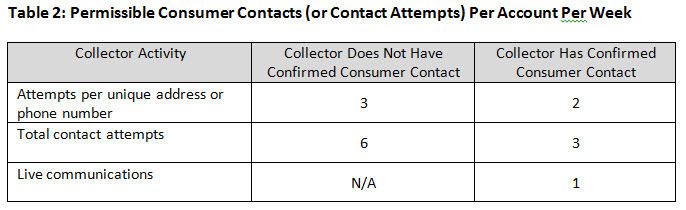
The Bureau is considering proposing regulations limiting the frequency with which debt collectors may contact, or attempt to contact, consumers. In considering proposals to restrict contact frequency, the Bureau believes that it would make sense to establish different numerical restrictions depending on whether the collector has successfully established contact with the consumer who is alleged to owe the particular debt. Under the proposed rules a new term will be added to the debt collection lexicon – “Confirmed Consumer Contact.

The Bureau is considering a rule that would provide that “confirmed consumer contact” exists once any collector—whether the current collector or a prior one—has communicated with the consumer about the debt, and the consumer has answered when contacted that he or she is the debtor or alleged debtor.

Confirmed consumer contact would not exist either: (1) prior to the consumer answering that he or she is the person whom the collector sought to contact, or (2) if the collector reasonably believes that previously confirmed contact information for the consumer has become inaccurate.

The Bureau believes a bifurcated approach may be appropriate because prior to such “confirmed consumer contact,” the collector may attempt to reach the consumer through different phone numbers or different media and may not know how best to reach the consumer. Once the collector has reached the consumer and confirmed that certain contact information is effective, the collector will know how best to reach the consumer and need not attempt to initiate contact as frequently.

insideARM suspects that this new term will lead to additional consumer litigation. It bolsters the argument for recording all phone calls.

The contact caps under consideration would limit both successful and attempted contacts. For instance, a contact attempt that ends with the collector leaving a limited-content message as described above would count toward the cap. The bureau also considered applying the contact caps on a per-consumer, rather than on a per-account, basis for all types of debts, but smartly rejected that concept.

The Bureau is also considering whether to apply the contact caps equally to all communication channels (e.g., telephone, mail, email, text messages, and other newer technologies), and whether to create separate limits per unique phone number or address as well as for total contacts per week. The acknowledgement of electronic communication in this section and elsewhere throughout the Outline is interesting. It lends some hope that the ultimate rules will recognize and account for greater and easier use of electronic communications throughout the collection process. More and more consumers prefer and want electronic communication instead of communication via a telephone call.

The Bureau is considering whether to structure the caps as “hard” bright-line limits or to provide more flexibility. For instance, one option would be to establish a general bright-line rule but with some specific exceptions. Another option would be to establish a rebuttable presumption that contacts or attempted contacts above the threshold constitute harassing, oppressive, or abusive conduct, and contacts or contact attempts at or below the thresholds do not.

Under such an approach, if the collector knew or had reason to know that a contact or contact attempt in excess of the cap would not result in harassing, oppressive, or abusive conduct for a particular consumer, the collector would not violate the regulation by contacting or attempting to contact the consumer more often than the thresholds otherwise would allow. On the other hand, if the collector knew or should have known that a contact or contact attempt below the threshold would be harassing, the collector would violate the regulation by contacting or attempting to contact the consumer at that frequency. It will be interesting to see the responses to these alternatives.

The following chart depicts the proposed contact caps for communication with consumers. Note: The caps are per account and per week.

CFPB Proposed Rules-Table 2

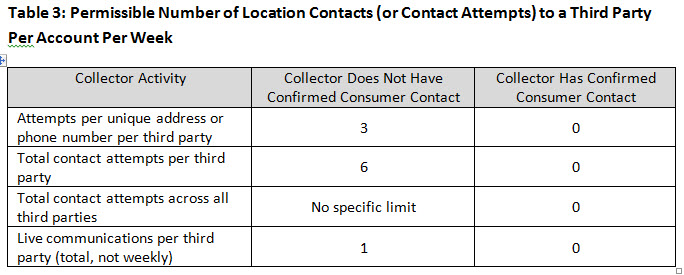
The Outline also discusses proposed contact caps for location attempts and general third party contacts. The Bureau is considering a set of contact caps that would allow collectors to make a limited number of location contacts (or attempted location contacts) with third parties when the collector does not have confirmed consumer contact. Like the consumer contact caps under consideration, the contact caps being considered for location communications would: (1) apply to all contact channels; (2) restrict both attempts per unique address or phone number and total attempts per week; and (3) apply per account, rather than per consumer.

The following chart depicts the proposed contact caps for Location Contacts (or Contact Attempts) to a Third Party Per Account. Note: These caps are also per account and per week.

CFPB Proposed Rules-Table 3

It will be interesting to see how the CFPB proposed rules on Frequency of Contact compare with the Federal Communications Commission (FCC) proposed rules on Frequency of Contact for collection of Federal Debt.  See our May 9, 2016 article on the FCC Notice of Proposed Rulemaking on the collection of government debt. In the NPRM the FCC proposed a 3 call per month limit. Also See our July 25, 2016 article on FCC Chairman Wheeler’s blog on the issue. It makes no sense to have two separate sets of call limits, one for federal debt and another for all other types of debt.

As we mentioned in the brief insideARM Perspective on our other article today, it’s clear that the CFPB has done its homework over the last three years to understand the debt collection business. This separation of call limits by pre- and post-consumer contact is a prime example. This is also a topic that the Consumer Relations Consortium focused on in multiple conversations with the Bureau. The group felt it was important that the CFPB understand there is a difference between the effort required to make contact in the first place, and the optimal follow up frequency once contact has been made.  While many assume that any weekly limit set for call attempts will be multiplied by an indefinite number of weeks, generating a dramatically large number, this is not the reality of what happens in most cases. insideARM applauds this attempt to appreciate this important nuance in the process.

Continue to visit insideARM for analysis of additional proposed rules. Our next post will be Communication Part 2, and will cover

  • general time, place, manner restrictions
  • issues concerning decedent debt
  • consumer consent

insideARM Perspective on CFPB Proposed Debt Collection Rules – Communication Part 1
http://www.insidearm.com/daily/debt-collection-news/accounts-receivables-management/insidearm-perspective-on-cfpb-proposed-debt-collection-rules-communication-part-1/
http://www.insidearm.com/feed
insideARM

Accounts Receivable Management

CFPB Outlines Debt Collection Rulemaking Proposals

The Consumer Financial Protection Bureau (CFPB) has released its long-awaited Outline of Proposed Rules governing third-party debt collectors. The proposal, released in advance of today’s 2:00 PM EDT CFPB Debt Collection Field Hearing in McClellan Park, California, is 117 pages and covers a wide range of topics that had been raised nearly three years ago in the Advance Notice of Proposed Rulemaking. According to the Bureau, the proposed rules would — among other things — “overhaul the debt collection market by capping collector contact attempts and by helping to ensure that companies collect the correct debt.”

The Outline of Proposed Rules released yesterday applies primarily to third-party debt collectors and debt buyers. The CFPB says they’ll “address consumer protection issues involving first-party debt collectors and creditors on a separate track,” saying that a second SBREFA outline and hearing is expected in the coming months. Worth noting, however, is that some of the proposals – such as data transfer – can only be successfully implemented with creditor participation.

Topics covered in the outline include:

  • Debt substantiation
  • Transfer of data from collection agency to collection agency
  • Validation notice
  • Litigation disclosure
  • Time barred debt
  • Contact frequency and voicemail messages
  • Time, place, and manner of communication
  • Decedent debt
  • Consumer consent
  • Transfer of debt
  • Recordkeeping

The Press Release issued by the CFPB can be found here.

The Prepared remarks of Richard Cordray at the Field Hearing in Sacramento can be found here.

The Press Release highlights the following protections pertaining to third-party debt collectors and others covered by the Fair Debt Collection Practices Act, including many debt buyers.

  • Collect the correct debt: Collectors would have to scrub their files and substantiate the debt before contacting consumers. For example, collectors would have to confirm that they have sufficient information to start collection, such as the full name, last known address, last known telephone number, account number, date of default, amount owed at default, and the date and amount of any payment or credit applied after default.
  • Limit excessive or disruptive communications: Collectors would be limited to six communication attempts per week through any point of contact before they have reached the consumer. In addition, if a consumer wants to stop specific ways collectors are contacting them, for example on a particular phone line, while they are at work, or during certain hours, it would be easier for a consumer to do that. The CFPB is also considering proposing a 30-day waiting period after a consumer has passed away during which collectors would be prohibited from communicating with certain parties, like surviving spouses.
  • Make debt details clear and disputes easy: Collectors would be required to include more specific information about the debt in the initial collection notices sent to consumers. This information would include the consumer’s federal rights. They would have to disclose to consumers, when applicable, that the debt is too old for a lawsuit. The proposal under consideration would also add a “tear-off” portion to the notice that consumers could send back to the collector to easily dispute the debt, with options for why the consumer thinks the collector’s demand is wrong. The tear-off would also allow consumers to pay the debt. The consumer could also verbally question the debt’s validity at any time, and prompt the collector to have to check its files again.
  • Document debt on demand for disputes: If the tear-off sheet or any written notice is sent back within 30 days of the initial collection notice, the collector would have to provide a debt report – written information substantiating the debt – back to the consumer. The collector could not continue to pursue the debt until that report and verification is sent.
  • Stop collecting or suing for debt without proper documentation: If a consumer disputes – in any way – the validity of the debt, collectors would have to stop collections until the necessary documentation is checked. Collecting on debt that lacks sufficient evidence would be prohibited. In addition, collectors that come across any specific warning signs that the information is inaccurate or incomplete would not be able to collect until they resolve the problem. Warning signs could include a portfolio with a high rate of disputes or the inability to obtain underlying documents to respond to specific disputes. Collectors also would be required to check documentation of a debt before pursuing action against a consumer in court. For example, collectors would have to review evidence of the amount of principal, interest, or fees billed, and the date and amount of each payment made after default.
  • Stop burying the dispute: If debt collectors transfer debt without responding to disputes, the next collector could not try to collect until the dispute is resolved. The proposals under consideration also outline information that collectors would have to send when they transfer the debt to another collector so that a consumer does not have to resubmit this information to the new collector.

Also of note in the Outline of Proposed Rules is the first published information regarding the Survey of Consumer Views on Debt that the Bureau conducted between December 2014 and March 2015.  The survey was designed to provide the first comprehensive and representative information on consumers’ experiences with debt collection in the United States.

A few of the findings the CFPB highlights from the survey include:

  • About one in three consumers with a credit record were contacted by a creditor or collector trying to collect a debt in the year prior to the survey.
  • Five percent of all consumers with a credit record, or 15 percent of consumers who had experienced a collection attempt in the prior year, said that they had been sued in the prior year by someone seeking repayment of a debt.
  • About one in seven consumers contacted about a collection in the prior year were uncertain whether the most recent contact was from a creditor or debt collector.
  • 34 percent of consumers who were contacted about a collection in the prior year were usually contacted less than once per week, whereas 16 percent were usually contacted 8 or more times per week, i.e., more than once per day on average.
  • Most consumers who had been contacted about a debt in collection (85 percent) said the creditor or collector stated that the reason for contacting the consumer was to collect a debt.

The Outline states that to date, the Bureau has completed much of the data processing necessary to fully analyze the survey results, but this work is ongoing. This report provides preliminary results for several of the survey questions as context for the August 2016 meeting of small-business representatives about the potential effects of proposals that the Bureau is considering for regulations regarding debt collection. After processing of the survey data is completed, the Bureau intends to report additional technical documentation of the survey methodology and tabulations from the survey. The Bureau also expects that the survey will form the basis for indepth studies of consumer finances and financial decisionmaking.

insideARM Perspective

There is too much to comment on to provide a thorough perspective in this brief space. We will be posting analysis in the coming days on the various sections of the Outline. You can read our first post now, covering contact frequency and voicemail messages.

What’s clear is that the CFPB Regulations team has done its homework. There is a clear demonstration of understanding of how the market works that is far more advanced than it was three years ago. With that said, there are some proposals that provide clarity; others require continued guesswork.

On Monday, we will publish an article with the reactions of professionals from across the industry (feel free to email editor@insidearm.com to submit your own thoughts on any of the specific proposals).

We will also be hosting a webinar series discussing the various implications/questions raised by the Outline during the week of August 8th, which will give our experts some time to digest the details. Look for announcements to sign up coming soon.

Click here for information about watching the CFPB’s live hearing at 2.pm. EDT today. We’ll have updates on our home page as well as on our Twitter account @insideARM.

CFPB Outlines Debt Collection Rulemaking Proposals
http://www.insidearm.com/daily/debt-collection-news/accounts-receivables-management/cfpb-outlines-debt-collection-rulemaking-proposals/
http://www.insidearm.com/feed
insideARM

Accounts Receivable Management

Executive Changes: DCM Services Announces Three Executive Promotions

MINNEAPOLIS, Minn. — DCM Services, the industry leader in estate account recovery solutions, this week announced the promotion of three key executives:

Tracey Bannochie is promoted to Chief Operating Officer (COO). Tracey brings over two decades of call center management experience to the DCM Services team. Her experience includes customer care through late-stage recovery operations, in addition to first-party and third-party roles. Experienced in overseeing multi-location call centers, including new center acquisitions and integration, Tracey has managed operational functions at DCMS since 2004.

DeAnna Busby-Rast is promoted to Executive Vice President (EVP) of Business Development. DeAnna is a recognized expert in the call center and receivables industry who operates as a consultative partner who seeks to understand long-term business goals and service expectations to ensure service delivery meets the highest standards of performance for our clients. DeAnna joined DCM Services in 2008 and holds more than 20 years of experience in marketing, sales, account management, and training.

Shawn Brown is promoted to Executive Vice President (EVP) and Controller. Shawn is known as an expert in facilitating annual business planning processes around strategic initiatives for sales. Shawn brings to DCM Services a high level of experience in integrating sales objectives and operational plans to support the company vision. Shawn has over 25 years of experience in the financial services industry including insurance, banking, and collections.

“Tracey, DeAnna and Shawn have all played a significant role in elevating DCM Services to its leadership position within the estate recovery market,” said Ben Boyum, Chief Executive Officer of DCM Services. “Their focus on client satisfaction through consultative partnering and operational excellence combined with the provision of value adding, innovative solutions has been and will continue to be a key differentiator for our organization.”

About DCM Services

Minneapolis-based DCM Services, is the industry leader in estate account resolution services, maximizing the value of estate portfolios across financial services, healthcare, retail, and telecom industries through innovation and performance. Its EstateWise Recovery Solutions offer a full range of services from proprietary web-based solutions to full outsourcing, maintaining an unmatched spectrum of innovative solutions that increase recoveries, protect brand value, and enhance survivor relationships – with respect and sensitivity. For more information on all DCM Services’ offerings, visit www.dcmservices.com.

Executive Changes: DCM Services Announces Three Executive Promotions
http://www.insidearm.com/daily/collections-jobs-news/executive-changes-dcm-services-announces-three-executive-promotions/
http://www.insidearm.com/feed
insideARM

Accounts Receivable Management