
Decorated War Vet Resolves $11K Debt with Help from ARM Industry Charity

Sergeant Leon Edwards gave seven years of dedicated service to the United States Marine Corps, including three tours of duty in Iraq. During that time he earned no less than a dozen awards and decorations, including an Iraq Combat Action Ribbon, an Iraq Campaign Medal, Global War on Terrorism Medals, several Unit Commendations, and others.

Upon his honorable discharge in 2009, Leon returned home with service-related disabilities, including Post-Traumatic Stress Disorder. His near-total disability rating made finding employment a challenge that has proven nearly impossible to overcome. Unfortunately, his VA benefits have not sufficiently covered his monthly expenses.

It didn’t take long for his financial situation to spiral out of control. Once Leon separated from the Marines, he was not working or attending school, and his benefits had not kicked in, so he was forced to live off credit cards for a while. With penalties and interest, his delinquent debt quickly grew to more than $11,000 and was assigned to a collection agency working on behalf of the major credit card issuer that had extended Leon the credit. With seemingly no way out, Edwards applied for a grant with ARMing Heroes (www.armingheroes.org), the collection industry’s charity for military veterans.

Edwards was approved for a grant. But it didn’t end there. Upon award of the grant, an ARMing Heroes volunteer gained permission to speak with the agency on his behalf, and documented to the agency and the creditor his military service and near-total service-connected disabilities. Because of Sgt. Edwards’ service, the agency’s willingness to communicate the facts to their client, and the creditor’s established policy of considering requests for reduced settlements involving disabled military veterans, the grant amount all but covered the settlement offered by the creditor.

Edwards received the good news just before the holidays last year, and had this to say:

“Thank you for your generous grant to help me with the reduction of my credit card debt during these strenuous times. I can now get a good night’s sleep instead of staying awake worrying about my financial situation. My family and I are extremely grateful for the ARMing Heroes organization. We appreciate all that it has done to help not only myself, but the thousands of other veterans struggling financially who feel as if there is no place to turn.”

About ARMing Heroes

ARMing Heroes was founded and began operating in March, 2009.  The organization’s mission is to serve the needs of U.S. military veterans, including their spouse and children. ARMing Heroes fills a charitable niche by linking people identified with employment, credit, and financial counseling needs with the accounts receivable management industry, an industry uniquely poised to help in these areas.  Persons interested in volunteering their time and others interested in applying for benefits or pledging other forms of support are encouraged to contact the organization at www.armingheroes.org.

What Can I Do Right Now to Help?

  • Visit www.armingheroes.org and donate now.
  • Friend us and post this article to your page on Facebook.
  • Tweet about this article on Twitter.
  • Join our group on LinkedIn, the ARMing Heroes Veterans Charity Supporter / Assistance Center.
  • Comment on this article online and ask us to contact you.
  • Forward this article via email to your key contacts.
  • Print this article and fax it to your local congressional office and ask them to post our website on theirs as a resource for vets.


Decorated War Vet Resolves $11K Debt with Help from ARM Industry Charity
http://www.insidearm.com/daily/debt-buying-topics/debt-buying/decorated-war-vet-resolves-11k-debt-with-help-from-arm-industry-charity/
http://www.insidearm.com/feed
insideARM


Accounts Receivable Management

RevSpring Announces Executive Changes

RevSpring is pleased to announce the promotion of Robert Flynn to Chief Operating Officer at RevSpring as well as the hiring of John Carson as Chief Financial Officer.

Flynn served as RevSpring’s CFO for eight years until this recent appointment. In this new role, he is overseeing all operational aspects of RevSpring as well as providing direction and leadership to future merger and acquisition activities. Prior to joining RevSpring, Flynn served as CFO of an ecommerce company, an electronic payments processing company and Vice President for Mergers and Acquisitions of a super-regional commercial bank.

Carson joins RevSpring to assume the role of CFO. He is a CPA, bringing over 20 years of Big 4 public accounting and senior financial experience. Previously he served as CFO at both service and automotive companies owned by private equity investors.

“These appointments bring additional depth to our senior team and further position us for continued growth,” said Tim Schriner, RevSpring’s president and chief executive officer. “Bob’s leadership has long been recognized as a critical component of RevSpring’s success. His new role will only strengthen our entire organization. We also are excited to have John join the senior management team to help facilitate our continued financial success.”

RevSpring’s core service offerings include data hygiene and analytics, secure document creation and delivery, multi-channel communications, electronic billing and archival services and online payment tools, all while ensuring compliance with regulatory guidelines. RevSpring holds multiple security certifications including PCI DSS Level 1, HIPAA/HITECH and SSAE 16 SOC 2 and maintains rigorous legislative and regulatory compliance programs. It serves a large and diverse customer base across the healthcare, receivables management, financial services, home services and other end-markets.

RevSpring Announces Executive Changes
http://www.insidearm.com/daily/collections-jobs-news/collection-jobs/revspring-announces-executive-changes/
http://www.insidearm.com/feed
insideARM
Accounts Receivable Management

FCRA Poll Results: Who Got it Wrong, and Why

A couple of weeks ago, our homepage poll asked this:

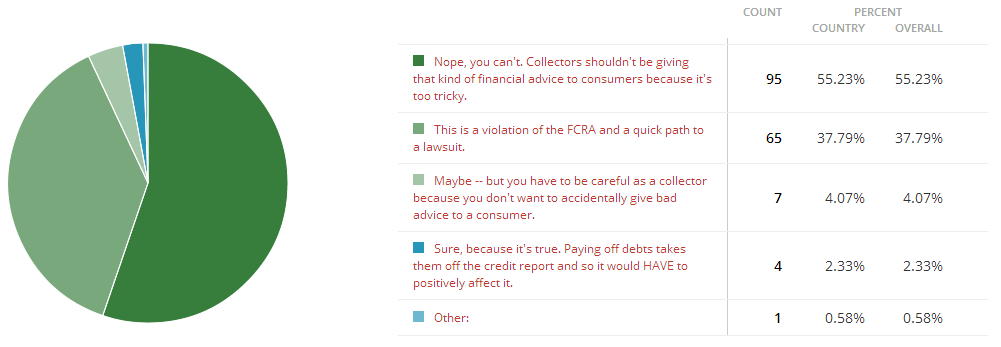
Pop Quiz! Can a collector tell a debtor that paying off a delinquent account will positively affect his credit score?

The question had been on our minds recently after publishing our Compliance Overview: FCRA – a primer for those looking for a better understanding of the intricacies of the Fair Credit Reporting Act.

Collection agencies can have an absolute influence on consumers’ credit scores. The information they provide to the Big Three CRAs (Credit Reporting Agencies) can either drive a score down or, in some cases, bump it up a couple of points.

Collection agencies can have an influence. But that doesn’t mean that they will. And that is the crux of our Pop Quiz.

20140220 Poll Result

Eleven of you… well, you missed the mark a little. One of the thing collectors have to be VERY careful about is functioning as an ad hoc credit counselor for the consumers they’re working with. You may feel like you’re helping a consumer by encouraging her to pay off her debts, and you may feel that detailing the alleged effects on her credit score will sweeten the deal. Instead, what you’re doing is: violating the FCRA.

Your best bet as a collector is: don’t give any advice at all to a consumer. Your job is to collect the debt, not promise better — or worse — credit scores.

We included two answers that seem to be the same:

Nope, you can’t. Collectors shouldn’t be giving that kind of financial advice to consumers because it’s too tricky

and

This is a violation of the FCRA and a quick path to a lawsuit

More of you chose the first option than the correct second option, so at least the majority of you understand the risks involved. But the correct answer, as far as we can tell, is This is a violation of the FCRA. There is no safe way to counsel a consumer on her credit score as a collector. Best leave that to the other professionals.

You can buy insideARM.com’s primer to the FCRA here: Compliance Overview: Fair Credit Reporting Act

FCRA Poll Results: Who Got it Wrong, and Why
http://www.insidearm.com/daily/debt-collection-news/accounts-receivables-management/fcra-poll-results-who-got-it-wrong-and-why/
http://www.insidearm.com/feed
insideARM

Accounts Receivable Management

Oregon Considering Bill to Block Use of Private Collectors for State Debt

Oregon lawmakers Wednesday held a hearing on a bill that would prevent the state’s Department of Revenue from hiring private debt collection agencies to help recover unpaid taxes.

The bill’s (SB 1568) sponsor, Sen. Chris Edwards (D-Eugene), argues that it is necessary because private collection agencies can be “downright overly aggressive” in their collection practices.  The bill has prominent backing from the local office of the Service Employees International Union (SEIU) which argues that Department of Revenue employees can do a better job collecting tax debt.

That mirrors the main argument the National Treasury Employees Union used in their opposition to private agencies collecting IRS debt. Since the program died in 2009, reports have shown that the premature cancellation of the IRS private debt collection contract was misguided and served no purpose.

Jim Markee, with the Oregon Collectors Association, pointed out in the hearing that private firms must comply with federal and state fair debt collection practices law. He also noted that the state has dragged its feet on debt collection and that whatever it’s currently doing isn’t working.

According to the latest report compiled by the state, debtors owed the state of Oregon more than $3 billion as of July 2013, of which $738 million was unpaid taxes to the Department of Revenue.

Edwards conceded that the language of the bill is “overly simple” and that it probably wouldn’t pass. But he said he wanted to start a discussion about the way the state handles tax debt.

Oregon Considering Bill to Block Use of Private Collectors for State Debt
http://www.insidearm.com/daily/debt-collection-news/debt-collection/oregon-considering-bill-to-block-use-of-private-collectors-for-state-debt/
http://www.insidearm.com/feed
insideARM

Accounts Receivable Management

Story on Debt Collection “Rocket Dockets” Largely Misses the Point

An article appearing earlier this week in American Banker focused on the use of resolution conferences in certain court jurisdictions to handle debt collection cases was largely incorrect and based on a fundamental fallacy, according to ARM attorneys with experience in the counties profiled.

The story, “Courthouse ‘Rocket Dockets’ Give Debt Collectors Edge Over Debtors” focuses much of its attention on the perceived unfairness of the resolution conferences, often called “rocket dockets” by consumer advocates. Several jurisdictions have set up the conference process to give alleged debtors one last shot at directly communicating with creditors, to either resolve the debt or actively defend it, before the plaintiff asks the courts for summary judgment.

The piece focused on the rocket dockets of two Maryland counties that border Washington, DC – Montgomery and Prince Georges. There are only a handful of courts that employ the conferences and all were set up as an additional layer of consumer protection against debt collection legal action.

But according to consumer advocates, because there are no judges or defendant attorneys present, the conferences unfairly tilt power in the direction of debt collection attorneys and their clients. Furthermore, they insist that the language used in summons imply that consumers must attend the conferences.

This is not the case, according to an ARM attorney with direct experience in the counties. “This is actually an additional protection afforded to consumers in these jurisdictions,” the attorney told insideARM.com. “The alternative to these conferences is default judgment in favor of the creditor plaintiffs.”

The attorney noted that the resolution conferences come into play only after all other communication attempts with the debtor have failed. Furthermore, consumer defendants are directed to conferences, administered by court clerks, only after they fail to state a defense to the debt collection suit, as required in the summons.

The National Association of Retail Collection Attorneys (NARCA) also took issue with the story.

“We are disappointed in the article,” said Joann Needleman, President of NARCA. “It largely ignores the fact that the conferences are an opportunity for consumers to get together with creditors in a neutral way. The safest place for consumers is in the courthouse. They have far more protections there than through any other communication channel used in debt collection.

In fact, the article did include statements from Maryland judges that directly refuted many of the contentions argued by consumer advocates and supported the position of NARCA.

They noted that the conferences are set up to aid consumers, there is always pro bono legal help present, attendance is voluntary, and that judges need not attend the conferences since that directly contravenes the purpose of the process in the first place: to resolve portions of the large volume of debt collection lawsuits. But those statements appeared in the article after more than 1,700 words of consumer stories and a thorough rehashing of the Encore Capital affidavit issue.


Story on Debt Collection “Rocket Dockets” Largely Misses the Point
http://www.insidearm.com/daily/debt-buying-topics/debt-buying/story-on-debt-collection-rocket-dockets-largely-misses-the-point/
http://www.insidearm.com/feed
insideARM

Accounts Receivable Management

Overcoming “Moral Challenges” to Point-of-Service Collections

Employing point-of-service collections can be a drastic cultural shift for healthcare organizations. Even the word “collections” remains taboo in some segments of the healthcare industry.

But in light of the financial pressures stemming from rising patient bad debt, providers must embrace the best practices for account resolution. And as the HFMA and ACA’s Patient Financial Communication Task Force points out, this includes laying the groundwork for collection success prior to service and discharge.

Check out an in-depth discussion of point-of-service collections on insideARM’s sister site, insidePatientFinance.com.

Overcoming “Moral Challenges” to Point-of-Service Collections
http://www.insidearm.com/daily/debt-collection-news/debt-collection/overcoming-moral-challenges-to-point-of-service-collections/
http://www.insidearm.com/feed
insideARM

Accounts Receivable Management

House Pushes CFPB Reform, But to What End?

The House of Representatives passed a resolution Wednesday permitting floor debate on a bill that would overhaul the leadership structure of the Consumer Financial Protection Bureau. HR 3193, sponsored by Rep. Sean Duffy (R-Wisc.), would create a five-member commission to lead the Bureau and submit the CFPB to the Congressional appropriations process.

In addition, the bill would align the pay rates for bureau employees with the pay schedule of other federal employees, require the CFPB to get permission from consumers before collecting financial information, mandate that the Bureau consider the “financial safety and soundness” of financial institutions during the rulemaking process and give the Financial Stability Oversight Council the ability to overrule any CFPB rules with a majority vote.

The House is currently in recess until February 24, so it’s unlikely that debate or a vote on the bill will happen before then. The bill is expected to pass along party lines. ACA International released a bulletin detailing the future of HR 3193 and its impact on the CFPB.

But once the bill clears the House, it basically has no future. The Senate is as likely to take up the bill as it is to take up one of the 47 House bills repealing the Affordable Care Act. And the White House has already clearly stated that President Obama will veto the bill if it ever reaches his desk. White House Press Secretary Jay Carney held a press briefing Tuesday to criticize House Republicans for pushing such partisan legislation.

“Since its creation, the CFPB has put in place safer national mortgage standards to protect borrowers; begun to implement protections governing non-mortgage products; improved disclosure requirements so that consumers are better informed; created a national consumer complaint center that has handled nearly 270,000 consumer complaints to date; secured more than $3 billion in relief for nearly 10 million consumers through enforcement actions against bad actors who violated the law; and established federal oversight of important financial industries for the first time, including non-bank mortgage lenders, payday lenders, debt collectors, and credit-reporting agencies,” Carney said. “We should be working together to continue the progress that we’ve made.”

So as it stands, the CFPB isn’t going anywhere any time soon, and the debt collection industry needs to be on guard for its growing supervisory role. One of the “hottest” issues the CFPB is monitoring in the debt collection industry is compliance with UDAAP: Unfair, Deceptive or Abusive Acts and Practices. In the past two years, the Bureau has taken a number of high-profile enforcement actions against collectors and creditors that had UDAAP violations.

For example, in 2012, the CFPB found that American Express lied about consumer debts to obtain payments in the collection process. The Bureau fined American Express $27.5 million and forced the company to pay restitution of $85 million. And recently, in December 2013, the CFPB took its first action against an online loan servicer (CashCall) – and an affiliated debt collection agency (Delbert Services Corporation) – arguing that the companies violated UDAAP and collected money consumers did not owe.

Learn more about why UDAAP compliance matters – and how to master it – with our new report, Compliance Overview: UDAAP. Get the top 10 compliance tips, sourced from industry experts, to make sure your agency and vendors are keeping up with UDAAP requirements (pg. 6). Use our comprehensive checklists to ensure your compliance management system goes above and beyond the requirements for a CFPB examination (pg. 16). This is a resource no company should be without!

Also, as the CFPB ramps up enforcement actions and audits across the board, from creditors to debt buyers to collection agencies themselves, don’t miss our timely webinar from insideCompliance: How to Survive a CFPB Audit, on Tuesday, February 25 at 2 p.m. Eastern with Nicole Strickler of Messer & Stilp Ltd. Getting organized early can help avoid confusion when the CFPB asks to see your policies; it may even reduce the odds of the Bureau setting up an in-house presence during the exam. Learn from real-world examples about how the CFPB measures accountability, so you can do the same. 

House Pushes CFPB Reform, But to What End?
http://www.insidearm.com/daily/house-pushes-cfpb-reform-but-to-what-end/
http://www.insidearm.com/feed
insideARM

Accounts Receivable Management

Pop Quiz: Can Collectors Advice Consumers About Their Credit Scores?


Take Our Poll

Looking for additional information about complying with FCRA? We’ve got you covered. Our Compliance Overview is an excellent resource for getting your head around the ins and outs of complying with the Fair Credit Reporting Act.

Pop Quiz: Can Collectors Advice Consumers About Their Credit Scores?
http://www.insidearm.com/poll/pop-quiz-can-collectors-advice-consumers-about-their-credit-scores/
http://www.insidearm.com/feed
insideARM

Accounts Receivable Management

The Key Questions to Ask Yourself Before Selling Your ARM Business

Mike Ginsberg

Mike Ginsberg

Should you sell your business now, in the future, not at all? Here are the key questions to help you make an informed decision when it comes to the sale of your ARM business.

Is my business ready for a sale?

All businesses are saleable at any time regardless of performance. Let me repeat that statement to emphasize the point. All businesses are saleable at any time regardless of performance. Whether your business is ready for a sale or not is not dependent upon its financial performance unless you have a particular price in mind.

What information will I need to produce to sell my business?

At a minimum, you will need to produce three years of historical financial statements. It is in the seller’s best interest to prepare an adjusted income statement to illustrate the business’s true level of profitability on a recast basis. Tax returns are fine for smaller businesses but I still recommend you take the time to paint an accurate picture of your business’s profitability. The current year’s budget would be helpful but not mandatory. In addition to financial statements, make sure you have a current organizational chart, facilities lease details, client contracts and details about any existing lawsuits ready.

How will a buyer value my business?

The answer to this question does not have to be a surprise. You could have a strong sense of value and potential transaction structure well in advance of a sale as specific attributes of your particular business might add to, or detract from, value.

What advisors should assist you in the transaction?

It is absolutely critical to make sure you have a qualified transaction attorney in place. Your current corporate attorney most likely does not qualify. I don’t typically see any changes in accounting firms needed to assist in a sale, provided your existing firm has a good handle on your company’s financial performance. An experienced and well-connected business broker will help you sift through buyer candidates and properly prepare you for the sale process. A valuation expert can help you determine value in advance of a sale process. A financial planner can also add value to your transaction team.

Is the timing right for me to sell my business?

Sale decisions are made on 3 different levels: macroeconomic, company and personal. A qualified consultant can help you address the first two levels to determine if the timing is right for you to sell your particular business. The personal decision is entirely up to you, your family and your health.

Can I cope with the changes on the horizon?

The collection industry is evolving right before our eyes, with intense regulatory changes that are directly impacting client decisions to sell debt or place accounts with collection agencies or collection attorneys. The cost of compliance continues to escalate as does the cost of technology improvement to keep up with client demand while operating profitability. If the heat is getting unbearable then it might be time to get out of the kitchen.

Can my business thrive (or even survive) the loss of me as the owner?

Are you the type of owner that turns on the lights each morning and is involved in every decision that is made within your business? If the truthful answer is yes, then you should expect that a buyer will structure the transaction around your retention for some period of time post sale. Having key managers in decision making roles prior to a sale will allow the buyer to justify better terms for the seller.

What are the potential deal-breakers if I were to sell my business today?

Picture the playground bully taking the 90 pound weakling upside-down by the ankles and shaking him violently until everything falls out of his pockets. An experienced buyer will sift through absolutely every aspect of your business to make an informed decision about pricing, structure, payment timing and contingencies. This scrutiny will be compounded if outside funding sources are needed to finance your transaction. I recommend that you ask yourself what potential deal breakers would exist if you were to buy your own business. Now be prepared for the buyer to ask the exact same questions.

What will my life look like after a sale?

Assuming you don’t have to work full-time, or anytime post-closing, how will you spend your time? A lot of owners say they will improve their golf game or travel the world. Perhaps that works for some owners but not most. I recommend you spend time with your wife/husband/family and decide together what your life will look like post sale. As much as the sale of a business is a financial decision, that is truly the easier part. The more challenging component of any transaction for an owner/operator (not an investor-type owner) is what their life will look like after the deal closes.


The Key Questions to Ask Yourself Before Selling Your ARM Business
http://www.insidearm.com/obs-in-focus/the-key-questions-to-ask-yourself-before-selling-your-arm-business/
http://www.insidearm.com/feed
insideARM

Accounts Receivable Management

CFPB Director Cordray Falls Short on Jeopardy as House Considers Power-Restricting Bill

Richard Cordray, Director of the Consumer Financial Protection Bureau (CFPB), came up a little short in his return to TV quiz show Jeopardy!, which aired last night. Cordray was previously an undefeated five-time champion on the show in 1987. The day before, a House Committee chairman sent a letter to his caucus preparing them for floor action on a bill that would restructure the CFPB.

Cordray was revisiting the game show for a “returning champions” week of special match-ups of previous winners. This specific episode was billed as “Battle of the Decades: 1980s.”

In 1987, while clerking for U.S. Supreme Court Justice Anthony Kennedy, Cordray won in five-straight episodes – at the time, the show’s limit – taking home more than $45,000. This time around however, Cordray was not able to keep any of his winnings; as a Presidential appointee, he cannot keep the money nor can he donate it to charity.

cordray-jeopary

Cordray’s picture from his 1987 appearance

But last night he came up a little short against stiff competition, placing second.

His appearance came just a day after U.S. Rep. Jeff Sessions (R-Texas), Chairman of the House Committee on Rules, sent a letter to his colleagues informing them of a possible meeting next week to consider a rule on the amendment process for H.R. 3193 (the “Consumer Financial Protection Safety and Soundness Improvement Act of 2013”). These types of letters generally signal that a bill will come up on the House floor soon.

The bill, which was passed by the House Financial Services Committee in November, would restructure the CFPB and fundamentally change the way the agency operates. It would create a five-member commission to head up the Bureau (rather than one director), make the CFPB a separate agency subject to Congressional appropriations (rather than getting its funding through the Federal Reserve), and give the Financial Stability Oversight Council the ability to overrule CFPB rules with a majority vote.

The bill contains much of the desired changes to the CFPB opponents have been seeking since its creation in 2010.

But even if the bill passes the full House, it faces near-certain death in the Senate and the threat of veto from the President.

CFPB Director Cordray Falls Short on Jeopardy as House Considers Power-Restricting Bill
http://www.insidearm.com/daily/collection-laws-regulations/collection-laws-and-regulations/cfpb-director-cordray-falls-short-on-jeopardy-as-house-considers-power-restricting-bill/
http://www.insidearm.com/feed
insideARM

Accounts Receivable Management