
Judge Rejects “All For the Lawyer, None for the Class” TCPA Case Settlement Agreement

Unfair, unreasonable, and inadequate, and it cannot be approved” says the Honorable Edmond E. Chang, United States District Court Judge for Northern District of Illinois (Eastern Division) of a proposed settlement in a Telephone Consumer Protection Act (TCPA) class action case.

In the matter of Grok Lines, Inc., v. Paschall Truck Lines, (Case Number: 1:14-CV-08033) Plaintiff sought approval of a settlement agreement in the proposed class action lawsuit. Under the terms of the proposed settlement, the named Plaintiff, Grok Lines would get $1,500 and Grok Lines’ attorneys, Siprut PC., would get $98,500. The class members would get zero compensation. The class would only get injunctive relief in the form of promises from Paschall not to violate the TCPA and to take steps to avoid future violations

In an opinion filed on September 18, 2015 Judge Chang denied the motion for approval of the proposed settlement.

The facts in the case are not complicated. Grok Lines filed this class action through its attorneys, Siprut PC, alleging that Defendant Paschall had sent unsolicited junk-marketing faxes to Grok Lines and numerous other unwilling recipients. Transmitting unwanted advertisements by fax is unlawful under the TCPA, except in limited situations (for example, where a prior business relationship exists or the number was taken from a commercial directory of willing recipients).

One important fact emerged quickly: the size of the class (that is, the number of recipients of the Paschall fax) is about 180, all taken from a single list of fax numbers obtained from a third-party. The court pointed out that under the relevant statute the potential liability to the defendant would have been actual damages or a statutory damages amount of $500 for each violation.

Once the parties determined the size of the class and the potential exposure, settlement discussions began.  At some point, the parties agreed that Paschall would promise not to violate the TCPA again and to take steps to avoid TCPA violations—but no money would be paid to the class. The parties then negotiated, and agreed to the attorney’s fees and incentive award proposed to the court.

Under the specific terms of the proposed settlement:

  1. “Paschall would be bound to comply generally with the TCPA and, more specifically, in case of any future faxes: to ‘take reasonable measures to verify that the recipient has expressly agreed to receive faxes’ and ‘first attempt to obtain written confirmation’; to ‘maintain a record or log’ of recipients who give only oral assent; to verify that, where Paschall uses a third-party to supply fax numbers, those recipients have given express consent; to verify that recipients of faxes who have an established business relationship with Paschall or whose fax numbers were obtained from a commercial database voluntarily gave their consent; to ensure that faxes contain information about how to opt-out of future faxes; and, to cease sending more faxes to those parties that do opt out.”
  2. There would be no payment of money damages to any class members, other than an incentive award to Plaintiff Grok Lines.
  3. Paschall would not oppose an application to the Court by Grok Lines for “an incentive award not to exceed $1,500.”
  4. Paschall would be prohibited from opposing an agreed-upon payment of $98,500 to Siprut PC as class counsel to cover attorney’s fees, costs, and expenses.

In the opinion Judge Chang discussed the legal standards for approval of a class action settlement. He noted “no apparent concerns about the certification of the proposed class.” Instead, he focused on the fairness, reasonableness, and adequacy of the proposed settlement.

In denying approval of the settlement the judge wrote:

“Plaintiff’s counsel asks for approval of nearly $100,000 in attorney’s fees—the entirety of the settlement fund (except for $1,500 to Grok Lines itself), a significant part of which even defense counsel concedes could just as easily go to satisfying the monetary claims of class members—solely on the back of proposed injunctive relief that, on the record presented, offers no prospect of meaningful impact whatsoever on either the class members’ interests or Paschall’s future behavior.”

The complete opinion can be found here.

insideARM Perspective

This TCPA case does not involve a member of the ARM industry nor a credit grantor. It does not involve calls from an automated telephone dialing system (ATDS).  Still, the case is relevant to the industry.

The opinion is a fascinating discussion on the judicial approval process for a class action settlement. The court’s consideration of the reasonableness of the attorney fee request is particularly enlightening. The court focused on the need to strike the right balance between, on the one hand, “the legal services rendered on behalf of the class and, on the other, the interests of the class members.” In the end the court sent the parties back to the negotiating table to come up with a different settlement proposal – one that balances those two needs.


Judge Rejects “All For the Lawyer, None for the Class” TCPA Case Settlement Agreement
http://www.insidearm.com/opinion/judge-rejects-all-for-the-lawyer-none-for-the-class-tcpa-case-settlement-agreement/
http://www.insidearm.com/feed
insideARM


Accounts Receivable Management

The CMI Group Celebrates 30th Anniversary

Thirty years ago on September 8th, 1985, The CMI Group was born in Ft. Lee, New Jersey! Founded by three partners, Arthur Shulman, Bruce Martin and Tom Stockton, CMI was committed to excellence and integrity from the very first day. The company has come a long way over the last thirty years; but has never lost its focus on excellence and integrity.

CMI began as a response to an under-served cable television market. The three partners had extensive experience in market segment and decided to establish a niche upon which to build a solid company.

In 1990, CMI moved to Dallas, Texas, hoping to grow and that’s what they did. That growth has taken them from sixteen employees in 1990 to eight hundred employees today. In 1999, two of the three founders, Arthur Shulman and Bruce Martin, retired from the business and Tom Stockton became the sole owner. Tom now serves as CMI’s Chief Executive Officer and, in 2011, he sold the business to the CMI employees by initiating a 100% ESOP.

Today, CMI is made up of three wholly owned subsidiaries – A to Z Call Center Services, Credit Management, L.P. and The Affiliated Group. It has locations in Carrollton, Texas and Rochester, Minnesota and will soon add a third location in the city of Dallas.

Tom attributes this success to the CMI employees and clients.  Stockton said, “This growth and success would not have been possible without dedicated and loyal employees and clients. Any company celebrating thirty years of successful business operations has reason to be proud; but, it also has lots of people to thank for that success.

“Today, I would like to say how grateful I am to have the privilege to be part of this wonderful organization and have the relationships with both associates and clients over the last thirty years. I would like to thank my two original partners and every associate who has ever worked for CMI. Whether you are still here or moved on in your career, thank you for your contribution to our success. I want to thank all those who have been and still are clients of CMI. I will always appreciate your willingness to put your trust in us.

“Finally, I want to thank my fellow associates at CMI who have invested a significant piece of their professional career here. I can’t express enough how fortunate I feel to have you as colleagues. To all current and former employees and clients, I appreciate you and I have learned much from you. Happy Anniversary, CMI!!”

The CMI Group provides industry leading accounts receivable management and business process outsourcing services. Please learn more about The CMI Group by visiting our website at www.thecmigroup.com.

The CMI Group Celebrates 30th Anniversary
http://www.insidearm.com/daily/debt-collection-news/the-cmi-group-celebrates-30th-anniversary/
http://www.insidearm.com/feed
insideARM

Accounts Receivable Management

Wis. Rep to Financial Services: Tell Me about CFPB Overreach

Financial services firms looking for a powerful ombudsman may have found their guy. Rep. Sean Duffy (R-Wis.) told financial services executives that if they encounter examples of regulatory overreach from regulators like the CFPB, they should contact his office and tell him all about it.

Duffy, speaking at the National Association of Federal Credit Unions’ Congressional Caucus this week, said that Congress has too little insight or oversight into what federal regulators are doing in the financial services space. The Congressman, who has made a name for himself as a regulatory watchdog in the last few years, made sure to single out the CFPB for its “Washington mentality,” that it assumes that anyone set on making profit in the financial services industry must also intend to bamboozle customers. He also expressed concern that Federal agencies like the CFPB have the power to shut down businesses just because they don’t like them.

“And the worst part is that Congress has no real effective oversight over [the CFPB],” Duffy added, as quoted today in the Credit Union Times. “If they do something wrong that causes you real pain, you might call your senator or congressman. But what can they do on your behalf? Write a letter!”

Congress may not have the ability to help now, but financial services executives should have faith in Congressional debate and the long-run process, he said.

“Don’t disregard the importance of hearings,” Duffy added. “Even if the legislation may not pass today, don’t be discouraged. There is a long-game and the hearings lay the groundwork for what we might be able to do under a new administration.”

The Wisconsin Congressman has been a remarkably consistent critic of the CFPB and, specifically, its tendency towards what he considers overly secretive behavior.

After the CFPB rebuffed his efforts to attend one of their advisory board meetings, he introduced, in 2013, a bill that would have forced the CFPB to comply with the “Federal Advisory Committee Act” (FACA) and open advisory board meetings to the public. The CFPB subsequently announced that meetings would be open to the public and available to stream live via the internet. When the CFPB reversed course and again closed their meetings, Duffy reintroduced the bill.

He also introduced several bills aimed at the CFPB this spring, including the “Bureau of Consumer Financial Protection Accountability Act of 2015” and the “CFPB Pay Fairness Act of 2015.”

Wis. Rep to Financial Services: Tell Me about CFPB Overreach
http://www.insidearm.com/daily/featured-post/wis-rep-to-financial-services-tell-me-about-cfpb-overreach/
http://www.insidearm.com/feed
insideARM

Accounts Receivable Management

Major Changes in ARM

Mike Ginsberg

Mike Ginsberg

The accounts receivable management industry is changing significantly as credit grantors, service providers, debt buyers, and tech vendors alike confront intensifying government oversight, enduring economic variability, and seemingly rash client behaviors. I recently spoke about some of the most noteworthy shifts at the Debt Connection Symposium (DCS) 2015.

kgc-graph-third-party-collections

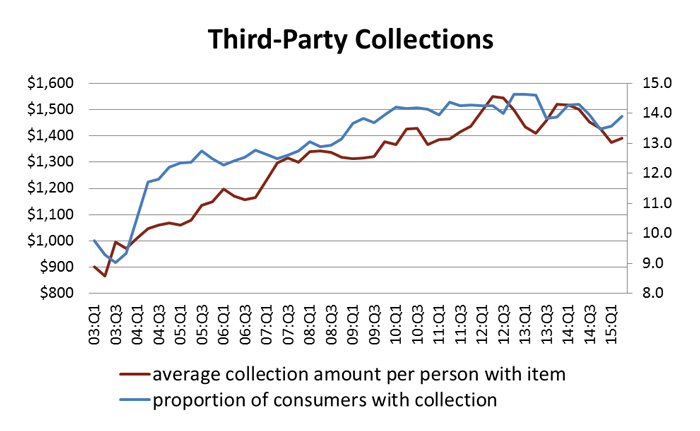
Consumer behavior is among one of the biggest changes, as illustrated by the graph above. The Federal Reserve Bank of New York’s (FRBNY) microeconomic release measures the percentage of accounts placed with third-party collection agencies and the face value of those accounts. Both lines grew consistently from 2003 until 2012, when consumers began a strong trend of paying down debt.

As the economy improves, banks have relaxed their lending standards, unemployment rates have leveled off, and consumers have started borrowing more, all trends that bode well for ARM companies.

KG post chart 2

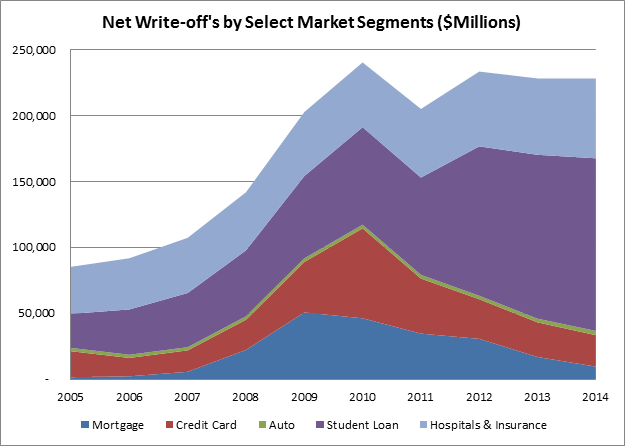
Another significant change, as the illustration above depicts, is the net write-off activity within the largest ARM market segments. Healthcare and student loans are growing at exponential rates; the total volume of these combined industries has expanded from $85 billion in 2005 to $228 billion in 2014.

Also worth noting: the auto loan industry has been front-page news these last few years, and fear-mongering from the CFPB hasn’t helped matters. Despite growth within charge-offs for this market, auto loans only account for a very small piece of the total net charge-off pie. While this is a growing market segment, it would have to increase nearly seven times to equal the credit card industry, and 20 times to be anywhere near the healthcare industry.

Additionally, the credit card market spiked during the years following the Great Recessions, but now it’s falling toward pre-recessionary levels. Most players in the credit card market are looking to other market segments for growth.

On the M&A front, large transactions led the way last year, including Alorica’s acquisition of West and Platinum Equity’s acquisition of NCO’s third-party collection business. On the debt-buying side, PRAA and Encore made moves outside the U.S. However, larger transactions have slowed down and will be replaced with consolidation among small and mid-sized ARM companies as owners are challenged to operate profitably as stand-alone businesses. Larger entities are better suited to absorb increased costs in today’s world of collections.

Arguably the most significant change within the ARM industry is the barrier-to-entry that has emerged in recent years. It used to be if you had a rotary telephone and a mouth, you could start a collection agency. Those days are long behind us. The cost of operating in this regulatory environment and credit grantors’ higher demands make for fewer successful startups. This is good news for established companies.


Major Changes in ARM
http://www.insidearm.com/obs-in-focus/major-changes-in-arm/
http://www.insidearm.com/feed
insideARM
Accounts Receivable Management

Technology Helps Mitigate Dialing Risks in Wake of TCPA Consent Order

DAKCS

In an effort to find solutions to the dilemmas posed by the latest FCC-TCPA ruling, DAKCS Software Systems polled its customers about the use of dialing and messaging technology and the FCC decision.

Based on the data gathered, DAKCS highlighted four ways to help mitigate the risks of using dialing and messaging technology, in addition to providing encouraging feedback from our installation base:

1) Scrubbing and Blocking Cell Phone Numbers

2) Obtaining Prior Express Consent

3) Pay Attention to Reassigned Numbers

4) Understanding Capacity or “Future Capacity”

All four are detailed in a whitepaper, available now for free download to registered subscribers of insideARM: Is Your Glass Half-Full or Half-Empty: Utilizing Technology to Mitigate the Risk of Dialing in the Wake of the Latest FCC-TCPA Ruling [whitepaper download link].

Below is an excerpt from DAKCS’s whitepaper


In regards to the one call rule, the FCC clarifies that the TCPA requires the consent of the current subscriber or user of the wireless phone number. In other words, it’s a violation of the TCPA to use an auto dialer to call a wireless number that the caller has actual or constructive knowledge no longer belongs to the person who properly gave the prior consent.

Because of the difficulty in knowing whether a wireless number has been reassigned, the 2015 ruling allows one call to determine whether a wireless number has been reassigned. If the one call does not result in actual knowledge that the number has been reassigned, the caller will be deemed to have constructive knowledge of the reassignment. In other words, a second call by auto dialer to a wireless number that has been reassigned will be assumed to be a violation of the TCPA (2015 Ruling Section 72).

As stated by the FCC, “where a caller believes he has consent to make a call and does not discover that a wireless number had been reassigned prior to making or initiating a call to that number for the first time after reassignment, liability should not attach for that first call, but the caller is liable for any calls thereafter.” (2015 Ruling Section 85). The FCC notes that nothing in the TCPA prevents callers from manually dialing wireless numbers or from sending emails to consumers to verify or confirm telephone numbers. The FCC states, “In other words, callers have options other than the use of auto dialers to discover reassignments. If callers choose to use auto dialers, however, they risk TCPA liability” (2015 Ruling Section 84). Solutions like the NeuStar application mitigates risk by verifying the phone number associated with a given consumer. Separating out the bad numbers allows for more focus on the collectible ones. NeuStar receives subscriber data from the actual carriers that provides accurate data on the reassignment of phone numbers. NeuStar will confirm that a specific customer owns a number.

Technology Helps Mitigate Dialing Risks in Wake of TCPA Consent Order
http://www.insidearm.com/connections-elevated/technology-helps-mitigate-dialing-risks-in-wake-of-tcpa-consent-order/
http://www.insidearm.com/feed
insideARM
Accounts Receivable Management

CFPB Wins Temporary Injunction Against Debt Settlement Company

Debt settlement company World Law Group thought it could skirt FTC rules by partnering with a lawyer and rebranding its offerings as “legal services.” That plan may not work much longer. The CFPB filed suit against World Law Group this month, alleging the company collected some $67 million in up-front fees from nearly 21,000 consumers since 2010 without doing much at all to help any of those consumers with their debt load. The U.S. District Court of the Southern District of Florida seems to agree. The court issued a temporary injunction against the debt settlement company this week, freezing company assets.

World Law Group “lured consumers with false promises of help from lawyers and collected millions in illegal upfront fees,” said CFPB Director Richard Cordray. “We are seeking to put an end to this scheme and prevent more consumers from being harmed.”

It has not been legal for companies to charge up-front fees in exchange for promised future debt management services since 2010, when the FTC amended the Telemarketing Sales Rule (TSR) in an attempt to rein in the growing number of debt relief companies targeting debt-saddled consumers.

It just so happens that right around 2010, according to the CFPB’s complaint, the management team behind two debt repair companies, Orion and Family Capital Investment & Management LLC (FCIAM), engaged in a plan to avoid TSR rule enforcement by partnering with a law firm – the aforementioned World Law Group – and offering essentially the same services for the same up-front fees, while marketing them as legal services performed by actual lawyers. The company claimed, in fact, that it had lawyers lined up in every state to help customers with their debt negotiations and that those negotiations would allow customers to pay back less then what they owe.

The CFPB alleges that the company not only violated the FTC’s Telemarketing rules, but also UDAAP, by:

  1. Charging illegal up-front fees. According to the complaint, approximately 99% of consumers paid up-front fees, including initial fees, attorney monthly fees and bundled legal service fees, amounting to hundreds of dollars.
  2. Promising legal representation without intent to deliver any. In practice, few if any of World Law Group’s customers had access to actual legal representation, according to the CFPB. Instead, company employees (i.e., non-lawyers) performed nearly all of the work, including negotiating with creditors and handling lawsuits if creditors sought to collect the debt through litigation.

The temporary injunction follows a temporary restraining order, also issued by the Southern District of Florida Court.

CFPB Wins Temporary Injunction Against Debt Settlement Company
http://www.insidearm.com/daily/featured-post/cfpb-wins-temporary-injunction-against-debt-settlement-company/
http://www.insidearm.com/feed
insideARM

Accounts Receivable Management

GAO Report Finds IRS Management of Collection Process Still Not Living Up to Expectations

A U.S. Government Accountability Office (GAO) report released on Septmember 10, 2015, found that the Internal Revenue Service (IRS) lacks written documentation of its collection program objectives and methodology. The GAO study concluded that these deficiencies make it difficult to assess the program’s effectiveness.

According to the report, the IRS estimated that for tax year 2006, the $450 billion gross tax gap included $46 billion due in delinquent tax liabilities and $28 billion due in unfiled tax returns. One of the primary means by which IRS pursues delinquent taxpayers is through the Automated Collection System (ACS). ACS, which in 2014 represented just over 25% of IRS collection program staff, is largely a call center operation that uses automated calls and letters to remind taxpayers of their tax delinquency. ACS also handles incoming calls from taxpayers responding to delinquency notices and enforcement actions.

The report states that ACS has experienced significant declines in staffing, with full time equivalents decreasing by 20 percent (from 3,672 to 2,932) from fiscal years 2012 through 2014, and that unresolved collection cases at the end of each year increased by 21 percent (from 4.2 million to 5.1 million).

As workload and staffing move in opposite directions, IRS must decide which cases to prioritize over others to ensure ACS carries out the IRS collection program mission through the fair and equitable application of the tax laws. Given this environment, the GAO was asked to review the IRS process for prioritizing and selecting collection cases to pursue in ACS.

The GAO report outlined four recommendations to the IRS:

  1. Establish, document and implement objectives for the collection program and ACS and define key terms such as “fairness” as it applies to collection activities, which can be communicated to IRS staff.
  2. Establish and implement clear guidance and documentation for the ACS case prioritization and selection process, including inventory, risk, and priority designations and changes to those designations over time, and communicate them to appropriate IRS staff.
  3. Establish, document and implement procedures to complete periodic evaluations of the ACS case prioritization and selection proces and structure.
  4. Establish, document, and implement a plan and time frame to ensure follow-up for ad-hoc evaluations of the ACS case prioritization and selection process.

In response, the IRS basically agreed to look into all of this, and if it finds it appropriate, will make changes.

insideARM Perspective

In 2009 the IRS cancelled a Private Debt Collection (PDC) pilot program, citing that the agency could do a better job – at a lower cost – in-house, and anticipated hiring over 1,000 new collection personnel in the current year to do the job.

A year later, the GAO said the study the IRS used to support its decision to cancel the program was “not soundly designed.”

In 2011 the Treasury Inspector General for Tax Administration (TIGTA) found – among other things – that the IRS did not take action on 47 percent of a sample of unpaid tax cases returned from the cancelled PDC program.

Here in 2015, it seems that the promised increase in IRS collection staff has not materialized — at least not in the ACS program.

Also of interest is that this is the second example in as many weeks of a government agency being found to lack appropriate written policies and procedures. When such deficiencies are found in regulated entities, those organizations are often fined or otherwise sanctioned in some way. Depending on the nature of the deficiency, perhaps this is appropriate. What’s the appropriate consequence for a government agency? In this case, it seems they get to say, “okay, we’ll look at it, and if WE think it makes sense we will make some changes.”

And gosh, isn’t this a dictionary definition of “the pot calling the kettle black”?

GAO Report Finds IRS Management of Collection Process Still Not Living Up to Expectations
http://www.insidearm.com/daily/debt-collection-news/accounts-receivables-management/gao-report-finds-irs-management-of-collection-process-still-not-living-up-to-expectations/
http://www.insidearm.com/feed
insideARM

Accounts Receivable Management

TekCollect Partners with Dress for Success Columbus for Corporate Drive

Columbus, OH –  TekCollect has collaborated with Dress for Success Columbus to conduct a large corporate clothing drive this month.

The drive was held for two weeks at the end of August as part of a larger effort to collect clothing for a variety of philanthropic organizations. TekCollect segmented a portion of the drive specifically to collect professional women’s clothing for Dress for Success, who promotes the economic independence of women in need by providing professional attire, a network of support, and the career development tools to help women thrive in work and in life.

 “This organization is close to our hearts. We were thrilled by the level of employee participation in what has become our third clothing drive this year. We are pleased to be able to partner with Dress for Success as they empower women in our community,” said Ron Douglas, Executive Vice President at TekCollect.

Molly Preston, Contributions Coordinator for Dress for Success, said, “We are so grateful for the clothing drive TekCollect held to benefit the women we serve at Dress for Success Columbus!  To date, we have suited over 8,000 women free of charge and we CANNOT do what we do without the fantastic community support from companies such as TekCollect!  Their overall contribution of over 150 professional pieces of clothing and outerwear, 25 pairs of professional ladies shoes, and 20 handbags will greatly empower the women on their way to financial independence.”

About Dress for Success

Dress for Success’s programs, including Interview and Employment Suiting, Career Center, and Professional Women’s Group Employment Retention are free of charge for every woman we assist. Any woman referred by a community partner is eligible for service. To learn more, visit www.dfscmh.org.

About TekCollect

TekCollect provides comprehensive revenue cycle management, collections and patient retention solutions to nearly 30,000 businesses nationwide. The Company partners with hospitals, clinics and practices to optimize their internal accounting practices, limit and control delinquencies, and improve positive cash flow for the long-term. TekCollect’s technologically advanced approach generates the highest recovery ratios in the marketplace, and their non-alienating strategies preserve practices’ valued patient relationships. For more information, visit www.tekcollect.com.

TekCollect Partners with Dress for Success Columbus for Corporate Drive
http://www.insidearm.com/doing-it-right/tekcollect-partners-with-dress-for-success-columbus-for-corporate-drive/
http://www.insidearm.com/feed
insideARM

Accounts Receivable Management

Disadvantaged Higher Ed Entrepreneur Achieves Federal HUBZone Certification

Buffalo, NY – Pulcher World Management, LLC (PWM) today announced it achieved Federal HUBZone certification late last month, a distinction further qualifying the company as an excellent choice for any Federal Private Collection Agency (PCA) seeking to meet subcontracting requirements for a U.S. Department of Education (ED) task order.

“I am very excited about the future of PWM and its ability to help PCAs meet their goals,” said James Cunningham, President. “Here in Western New York, our location provides a plethora of skilled potential employees and experienced executives.  Our core belief is to treat our biggest investment – our employees – with the ultimate respect, so they can best counsel borrowers.  I am looking forward to personally training and tutoring all of our people to ensure compliance across the board.”

With this announcement PWM is believed to be the only HUBZone-certified collection agency that is also a small disadvantaged business (SDB), enabling PCAs to take credit for necessary expenditures with both HUBZone and SDB firms through one relationship, saving the average PCA tens of thousands of dollars per month, and in some cases up to hundreds of thousands of dollars per month, in work that would otherwise be outsourced to multiple partners.  Federal regulations require those with HUBZone commitments in approved subcontracting plans to make subcontracting awards to certified firms only, and not those simply seeking a certification that may or may not be obtained.  To become certified, among other things, a firm must have its principal office within a HUBZone and must have at least 35% of its staff living in a HUBZone.

James Cunningham’s personal status as a socially and economically disadvantaged person makes the firm an SDB under U.S. Small Business Administration (SBA) guidelines, enabling PCAs to meet these requirements with a known performer on ED who has managed ED departments for PCAs and subcontractors alike.  When employed by NCO Financial Systems for nearly a decade prior to its rebranding, James managed 25 people and was the firm’s number one supervisor on ED based on the value of loans set up for rehabilitation.  More recently, James successfully implemented a subcontract for another PCA, with rehabilitation retention rates approaching 90% among a staff he trained with very little prior experience.

People in the PCA community think highly of Mr. Cunningham. “I had the pleasure of working with James for a number of years and consider him an outstanding talent with expertise in all areas of student loan collections.  Starting his own company seemed like the perfect next step in his career,” said Joe Dilucia, Vice President at Progressive Financial Services.

PWM is a member of the Fed Cetera Network. “We’re proud to say that all of the certified HUBZone collection agencies actively seeking to become Federal subcontractors are among our members,” said Nick Bernardo, who operates the Fed Cetera Network, a “business development organization” as the term is used within 48 CFR 52.219-9 that enables PCAs to comply with subcontracting requirements by helping prime contractors and subcontractors find one another and meet a host of underlying regulations and contractual requirements. “Our program helps startups and existing small businesses more efficiently compete for this work with no up-front costs, no need for fixed marketing or payroll expenses, and no need to pay compliance professionals to study Federal subcontracting rules and periodic changes to those rules.  Every time a small business joins the network, particularly a startup, we take it as an endorsement of our model.”

Fed Cetera is hosting a virtual trade fair series for PCAs this fall to enable PCAs to efficiently meet and pre-qualify potential subcontractors.  PCAs interested in interviewing PWM or attending the trade fair series in order to document a good-faith effort and comply with their subcontracting plans should contact Fed Cetera.

Disadvantaged Higher Ed Entrepreneur Achieves Federal HUBZone Certification
http://www.insidearm.com/daily/student-loan-collection-news/student-loan-collections/disadvantaged-higher-ed-entrepreneur-achieves-federal-hubzone-certification/
http://www.insidearm.com/feed
insideARM

Accounts Receivable Management

NARCA Applauds CFPB Action Against World Law Group

Washington, DC — NARCA, The National Creditors’ Bar Association, the only professional trade association solely dedicated to attorneys who practice creditors’ rights law, applauds the recent action by the Consumer Financial Protection Bureau in the case of the Consumer Financial Protection Bureau v. Orion Processing. LLC, Bradley James Haskins, World Law Debt Services, LLC, and World Law Processing, LLC. On September 2, 2015, the United States District Court of the Southern District of Florida granted the CFPB’s motion and entered a Temporary Restraining Order (TRO), which included an asset freeze, injunctive relief, and other equitable relief against the defendants. The Consumer Financial Protection Bureau filed a Complaint under the Consumer Financial Protection Act of 2010 and the Telemarketing and Consumer Fraud and Abuse Prevention Act based on Defendants’ violations of the CFPA and the Telemarketing Sales Rule.

The CFPB alleges “Defendants’ marketers lure consumers into signing up for debt settlement services by falsely promising that consumers will be represented by local attorneys and that they will negotiate with consumers’ creditors to settle their debts. Defendants are debt settlement veterans who joined forces after federal law changed to prevent fraud by banning the taking of up-front fees before settling consumers’ debts. In an apparent attempt to circumvent that new law, Defendants began claiming that they provide legal representation,” but then continued charging consumers up-front fees for debt relief services.

Since October 27, 2010, over 21,ooo consumers across the country-representing 99% of the consumers who enrolled with World Law-have paid more than $67 million in unlawful advance fees to Defendants, who ultimately provide little or none of the services promised to consumers. The agency sought preliminary and permanent injunctive relief, rescission or reform action of contracts, the refund of monies paid, restitution, and disgorgement of ill-gotten monies, the appointment of a temporary Receiver, and other equitable relief as well as civil money penalties.

NARCA’s commitment to insuring that creditors’ rights attorneys be held to the same high level of professional conduct required and expected when practicing law. NARCA’s law firm members are licensed attorneys who abide by and commit to the Rules of Professional Responsibility in their respective states as well as NARCA’s core principles of being PROFESSIONAL, ETHICAL and RESPONSIBLE.  Joann Needleman, NARCA’s Board President states, “It is incumbent on attorneys who practice in the field of creditors’ rights law to lead by example. NARCA members continue to provide the leadership necessary to demonstrate these qualities and actions in policy and in practice.”

The attorneys of NARCA member firms are dedicated to ensuring that the legal profession maintains the highest rigors of legal and ethical integrity. The failure of any law firm or attorney to uphold their ethical duty or responsibility denigrates the entire profession. NARCA raises that bar by mandating annual CLE requirements in the field of creditors rights for all of its attorneys. NARCA’s Grievance Committee is charged with reviewing the conduct of any member when necessary, who fails to strictly adhere to the Code of Professional Conduct and Ethics. In those instances where warranted, NARCA will issue the appropriate sanction and penalty.

About NARCA

NARCA is a nationwide professional trade association of over 650 skilled creditors rights law firms and in-house counsel of creditors.  NARCA members are committed to the fair and ethical treatment of all participants in the debt collection process and are required to adhere to NARCA’s Code of Professional Conduct and Ethics. As licensed practicing attorneys, members are also governed by state bar association Rules of Professional Conduct and must practice law in a manner consistent with their responsibilities as officers of the court.

NARCA Applauds CFPB Action Against World Law Group
http://www.insidearm.com/daily/collection-laws-regulations/collection-laws-and-regulations/narca-applauds-cfpb-action-against-world-law-group/
http://www.insidearm.com/feed
insideARM

Accounts Receivable Management