IC System Hosts Day of Wellness, Raises Funds for Charity

St. Paul, MN – IC System held its First Annual Wellness Day on October 9th, 2015, at its corporate headquarters in St. Paul, MN. The event was highlighted by a 5K Fun Run, which consisted of a customized 3 lap course around the expansive IC System headquarters and culminated in a post-race party.

IC Systems day of wellness

“The event was a fabulous opportunity to get out and enjoy the fall weather, socialize with employees, and even get some exercise,” said John Erickson, President of IC System. “It was really heartening to see so many employees, along with their families and children out enjoying the event and taking steps to improve their overall wellness.”

IC Systems day of wellness 5

The event was part of an ongoing Wellness Program sponsored by IC System that focuses on the health and well-being of its employees and the surrounding community. Employees had opportunities to register for an upcoming blood drive with the American Red Cross, get their blood pressure checked by some local nursing students from Century College, and even take a few throws at some employees that volunteered to get dunked for charity in a dunk tank. Volunteers also filled “breakfast bags” with healthy snacks for the Ronald Mc Donald House.

IC Systems day of wellness 2

Overall, 141 people participated, including over 100 IC System employees.

Proceeds from the event benefitted White Bear Area Emergency Food Shelf, St. Paul Children’s Hospital, and Ronald McDonald House Charities.

About IC System

IC System, a privately owned company founded in 1938, provides accounts receivable management services for thousands of clients within many industries, including healthcare, financial services, retail, education, utility, government and communications.  Headquartered in St. Paul, MN, IC System has a branch office in La Crosse, Wisconsin.  For more information about IC System, please visit www.icsystem.com.

IC System Hosts Day of Wellness, Raises Funds for Charity
http://www.insidearm.com/doing-it-right/ic-system-hosts-day-of-wellness-raises-funds-for-charity/
http://www.insidearm.com/feed
insideARM

Accounts Receivable Management

More ARM Firms Step Up to Hold Drives for Vets

Fundraiser Momentum Continues as Company-wide Drives Get Underway

Collingswood, NJ – With its sixth annual No Debts for Vets Charity Fundraiser currently underway, ARMing Heroes (www.armingheroes.org), the collection industry’s charity for military veterans, today spotlighted two more ARM industry firms that have chosen to support the charity’s efforts in 2015. EOS USA (www.eos-usa.com), located in Norwell, MA, and F.H. Cann & Associates (www.fhcann.com), headquartered in North Andover, MA, will both hold company-wide fundraisers during the drive, which runs from September 11th through Veterans Day, November 11th every year.

As an incentive for company-wide participation, EOS USA is offering a dress-down day that allows employees to wear jeans in exchange for making a charitable contribution to the organization. Commenting on why the company has chosen to support vets through ARMing Heroes this year, EOS USA President and Chief Executive Officer Paul Leary stated, “We’re proud to participate in the ARMing Heroes charity drive as a way to support our vets and show our gratitude to the men and women of the armed forces who served our country. We are grateful for the sacrifices they made on our behalf, and this is one way we can show our sincere appreciation.”

F.H. Cann & Associates, a perennial supporter of ARMing Heroes, will again offer its employees the option of donating to the charity via payroll deductions during October and November. Additionally, company President and CEO Frank Cann has committed to matching contributions, just like last year. The company will also hold a raffle for employees, with half of the proceeds going to the raffle winner and the other half going to the charity. Rick Broady, F.H. Cann’s Chief Administrative Officer, commented, “We are honored to be part of ARMing Heroes, both as individuals and as a company. It’s such great cause, a way to give something back to those men and women who have honorably served our country and given so much of themselves. Being able to help these heroes get back on their feet is incredibly rewarding and humbling.”

ARMing Heroes relies on the generosity of ARM industry companies across the country to make this grant program possible. Incentivizing employees to give to this worthy cause in exchange for dress down days or for other benefits management might think of is one of the easiest ways for those in the collection industry to get involved. Interested companies can sign up to hold a drive here. Once you register, you can download the Employee Fund Drive Starter Kit which outlines in four easy steps what is needed to announce, manage, and complete a successful employee drive. Additionally, any company that holds a drive and donates to the charity will receive Donor Dog Tags to commemorate their support of military veterans. Stories of past grant recipients remind us all how rewarding this program can be.

The charity’s flagship No Debts for Vets Charity Fundraising Drive runs from September 11th through Veterans Day, November 11th every year, however tax-deductible donations are accepted at any time online at www.armingheroes.org and via mail to PO Box 353, Collingswood, NJ 08108, payable to ARMing Heroes. Pledges may be made to info@armingheroes.org.  Any amounts pledged or donated now will be applied to the 2015 drive.

About EOS USA

Founded in 1991, EOS USA is one of the leading providers of customer care and receivables management services in the U.S., serving the key markets of healthcare, utilities, communications, higher education and government organizations.  EOS USA is committed to understanding customers’ challenges and goals, offering technology-driven customer care, and receivables management solutions. EOS USA is part of the international company EOS Group, which offers financial services in 150 countries with a workforce of more than 8,500 in more than 25 countries worldwide through 50 subsidiaries.

About F.H. Cann & Associates

Located just north of Boston in North Andover, MA, F.H. Cann & Associates has been a national leader in providing its clients with compliant, best-in-class recovery rates and services since 1999. Its highly-trained, motivated staff specializes in providing solutions to the most difficult account receivables for a broad spectrum of industries including student loans, financial institutions, commercial, state and local governments, and default aversion services.

About ARMing Heroes

ARMing Heroes was founded and began operating in March, 2009.  The organization’s mission is to serve the needs of U.S. military veterans, including their spouse and children. ARMing Heroes fills a charitable niche by linking people identified with employment, credit, and financial counseling needs with the accounts receivable management industry, an industry uniquely poised to help in these areas.  Persons interested in volunteering their time and others interested in applying for benefits or pledging other forms of support are encouraged to contact the organization at www.armingheroes.org.

What Can I Do Right Now to Help?

  • Visit www.armingheroes.org and donate now.
  • Make ARMing Heroes your designated charity through the AmazonSmile program.
  • Like the ARMing Heroes page and post this article to your page on Facebook.
  • Tweet about this article on Twitter.
  • Join our group on LinkedIn, the ARMing Heroes Veterans Charity Supporter / Assistance Center.
  • Forward this article via email to your key contacts.
  • Print this article and fax it to your local congressional office and ask them to post our website on theirs as a resource for vets.

More ARM Firms Step Up to Hold Drives for Vets
http://www.insidearm.com/doing-it-right/more-arm-firms-step-up-to-hold-drives-for-vets/
http://www.insidearm.com/feed
insideARM

Accounts Receivable Management

Executive Change: ERC Appoints New Chief Sales Officer

Jacksonville, FL, October 9, 2015 – Today, ERC announced the promotion of Denny Bender to CSO. Bender, who has most recently served as Senior Vice President of Business Development, has spent the past 10 years with ERC and continues to play an instrumental part in ERC’s rapid growth.

“We are very excited about this new chapter in our sales organization and are especially proud of Denny’s accomplishments over the years. This is a great time for ERC to create this position and I am confident that Denny is the right executive to lead this team,” expressed Marty Sarim, President and COO.

Bender has over 20 years of experience in the ARM space. In his new role, he’ll be responsible for overseeing and managing the ERC sales team globally.

“This strategic move is further evidence of ERC’s commitment to grow our recovery and BPO footprint,” commented ERC’s CEO, Kirk Moquin.

About Enhanced Resource Centers, LLC

Headquartered in Jacksonville, FL, and founded in 1999, ERC initially emerged as a leading firm in the Accounts Receivable Management industry. Through significant growth and diversification efforts, ERC now provides end-to-end BPO solutions to a diversified list of clients in a broad range of asset classes and account segment types.

More information: www.ercbpo.com

Executive Change: ERC Appoints New Chief Sales Officer
http://www.insidearm.com/daily/collections-jobs-news/executive-change-erc-appoints-new-chief-sales-officer/
http://www.insidearm.com/feed
insideARM

Accounts Receivable Management

Six Keys to Using Scorecards to Measure BPO and Contact Center Effectiveness

Practice Makes Perfect Scorecards – The Scorecard Series

dart-board-hi

Operational scorecards are a standard method for reporting productivity and effectiveness for BPOs and captive contact centers. Most organizations set up scorecards to measure operational effectiveness and to ensure accountability. A good BPO scorecard will align closely with the client’s key performance indicators like average handle time and conversion rates as well as internal revenue generating goals like retention and staffing demands. The keys to utilizing a scorecard as a performance, training, coaching, and accountability tool are:

  • Client calibration – Build a strong framework for your internal scorecard by adopting metrics that correlate with the client’s operational objectives for the outsourced program.
  • Goal setting – Metrics without goals are just numbers. Contact center employees at all levels must comprehend how the metric is achieved and what actions they can take to move toward the desired goal. The goals will often be driven directly from the client’s requirements and the company’s strategy for profitability on a given project.
  • Agility – The most effective scorecards are those that are fluid, living documents. What is important to the client today may not matter as much, or at all, tomorrow. Make sure that your scorecard administration is nimble and accommodating to the client’s needs. Remind employees that the scorecard is the pulse of their performance during one moment in time.
  • Data integrity – Define each metric so that everyone working on the program, whether it be the front line, quality, IT, or HR, is speaking the same language. Develop sound formulas for calculating goal achievement and train your teams on metric definitions as well as just how each metric ties to the program’s success.
  • Performance to goal tracking – Although a scorecard is the pulse of performance during one moment in time, scorecard performance over time should indicate an employee’s overall effectiveness. Establish week over week scorecard performance trending for every employee, supervisor, manager and team to drive accountability, identify training gaps, and support strong process improvement.
  • Scorecard delivery – To effectually drive the highest level of performance, scorecards should be delivered frequently and with predictability. Most organizations deliver scorecards at least once a month, but those that deliver them more frequently are able to deliver early intervention for low performance.

Having a scorecard that outlines key criteria and is delivered with predictability is only step one to driving performance. The scorecard is a microscope used to detect coaching, training, and process improvement opportunities. If used properly this tool and the corresponding actions will ultimately lead to performance that creates a greater probability of organic growth.

This is the first of three short features on scorecards. Part two will aim to outline scorecard metrics for BPO HR and recruiting teams. Part three will tackle metrics for the rest of the BPO support functions. Stay tuned.

Stacy Spradling is VP Human Resources at Radius Global Solutions. She has spent the last 15 plus years studying human behavior, researching generational diversity, working as a respected human resource leader, employee relations consultant, and call center talent acquisition expert. She is an authority on employee engagement, coaching, development and employee retention. Her career also includes extensive experience in system integration, acquisitions, call center management, leadership, compensation, benefits and compliance.

Six Keys to Using Scorecards to Measure BPO and Contact Center Effectiveness
http://www.insidearm.com/daily/bpo-crm/bpo/six-keys-to-using-scorecards-to-measure-bpo-and-contact-center-effectiveness/
http://www.insidearm.com/feed
insideARM

Accounts Receivable Management

The Consumer Relations Consortium Announces New Member: Cavalry Portfolio Services

The Consumer Relations Consortium (CRC) announced today that Cavalry Portfolio Services, LLC (Cavalry) recently joined as its newest member company.

The CRC is a membership group for larger market participants in the debt collection industry (defined by the Consumer Financial Protection Bureau as those firms with $10M or more in annual revenue from collection activity). The fundamental mission of the CRC is to approach industry and regulatory change by building relationships and engaging in meaningful dialogue with consumer advocacy groups and regulators.

Since its founding in September 2013, CRC members have been meeting repeatedly with consumer groups and regulators to discuss the details of the thorniest issues raised in the CFPB’s Advance Notice of Proposed Rulemaking as well as state rulemaking activities. Both consumer advocates and regulators have commented on the surprisingly candid and collaborative nature of CRC representatives during these extended small group sessions, which have been productive and eye-opening for all involved.

In addition to its efforts with regulators and consumer advocates, the CRC acts as a valued peer group for its members, who welcome the opportunity to discuss best practices and industry trends within a trusted group of similarly-sized companies.

Cavalry has immediately begun participating in strategic CRC initiatives, including the group’s current work with Consumer Action to develop a guide for consumers providing an insider’s perspective on communicating with debt collectors. Tim Stapleford, CEO of Cavalry, commented, “I truly believe that this is the right initiative at the right time. The CRC has developed relationships with consumer groups and is working to open lines of communication that have been closed for a long time. We are excited to be a part of this important effort, and to help where we can.”

Consumer Action has been a champion of underrepresented consumers nationwide since 1971. With offices in San Francisco, Los Angeles, and Washington, DC, the group focuses on consumer financial and privacy education to empower low- and moderate-income and limited English-speaking populations. More than 7,500 community-based organizations benefit annually from Consumer Action’s programs and materials. The organization also advocates for consumers in the media and before lawmakers to advance consumer fairness and promote industry-wide change.

In October 2014, the CRC was a sponsor of Consumer Action’s 43rd Annual Awards Event , which honors three individuals or organizations that have made a significant impact on consumer literacy.

The Consumer Relations Consortium Announces New Member: Cavalry Portfolio Services
http://www.insidearm.com/daily/debt-collection-news/accounts-receivables-management/the-consumer-relations-consortium-announces-new-member-cavalry-portfolio-services-2/
http://www.insidearm.com/feed
insideARM

Accounts Receivable Management

34 Countries Launch Improved Website to Help Catch Cross-Border Consumer Scammers

The Federal Trade Commission announced this week that the Agency, along with consumer protection agencies in 33 other countries that are part of the International Consumer Protection and Enforcement Network (ICPEN), unveiled an updated version of ICPEN’s econsumer.gov to help law enforcement authorities gather and share cross border consumer complaints that can be used to investigate and take action against international scams. Econsumer.gov originally was launched in 2001. This new version includes an updated logo and design, and is optimized for mobile devices.

ICPEN members announced the updated econsumer.gov website today during ICPEN’s semi-annual, network-wide meeting held from October 13-16 in Manchester, United Kingdom. Hosted by the UK Competition and Markets Authority (CMA), the semi-annual meeting brought together investigators and attorneys from agencies around the world for enforcement training.

Consumer complaints filed through econsumer.gov are entered into Consumer Sentinel, a complaint database maintained by the FTC, and are made available to enforcers and regulators in countries with participating agencies. Those agencies may use the complaints to investigate cross-border issues, uncover new scams, pursue regulatory or enforcement actions, and spot consumer trends.

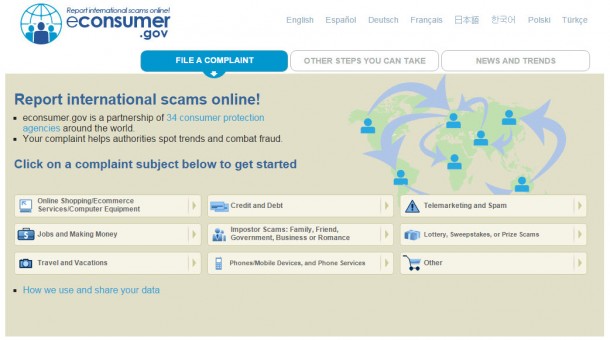
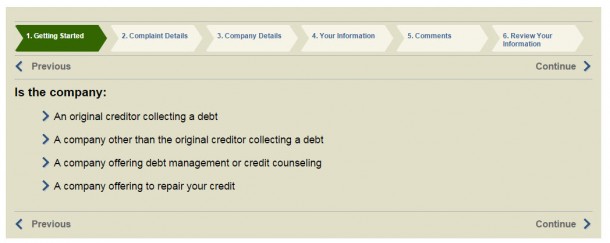
According to the website, 23,608 complaints were collected during 2014. The most frequent complaint category listed (22% of complaints) is “Other,” followed by 18% – “Merchandise or service never received,” and 13% – “Failure to honor refund policy.” Debt collection issues were not specifically referenced in the chart, which includes the top 10 categories. The following images show all complaint categories as they appear to consumers, and then the specific page related to “debt.”

international complaint categories


intl complaint 2

34 Countries Launch Improved Website to Help Catch Cross-Border Consumer Scammers
http://www.insidearm.com/ftc/34-countries-launch-improved-website-to-help-catch-cross-border-consumer-scammers/
http://www.insidearm.com/feed
insideARM
Accounts Receivable Management

The Plaintiffs’ Lawyer Protection Bureau

Editor’s note: This article was originally published earlier this week. Reprinted by permission, instituteforlegalreform.com, October 2015, Copyright 2015, U.S. Chamber Institute for Legal Reform.

At a Denver field hearing today, the Consumer Financial Protection Bureau will unveil its long-planned proposal to ban the use of arbitration to resolve consumer disputes. In taking this step, the Bureau once again departs from its consumer-protection mission and embraces a very different role—as the “Plaintiffs’ Lawyer Protection Bureau.”

The Bureau will claim that its decision is the product of a comprehensive multi-year study containing the most “empirical” information ever gathered. It will claim to maintain an “open mind” on the issue when it announces its intent to pursue banning arbitration, and likely take pains to say it is banning only “predispute” arbitration. All the while, its Denver “field hearing” will be stocked with consumer representatives criticizing arbitration, with token business representation to give the appearance of balance. The Bureau will conclude this latest show hearing with the promise to weigh carefully the comments received in the small-business review and rulemaking proceedings.

But don’t be fooled. The CFPB’s priority isn’t America’s consumers, but America’s plaintiffs’ lawyers.

Depriving consumers of a low-cost, easy-to-use dispute resolution system that can be accessed without lawyers is the class action lawyers’ publicly stated top priority. After all, without arbitration consumers are forced into the expensive, complex judicial system—where costly legal representation is necessary.

And the Bureau is rushing to do their bidding: ignoring requests from Congress and others to seek public input, and gerrymandering the study topics to reach its preferred result. As one academic analysis of the CFPB study by George Mason University concluded:

“The CFPB’s Report . . . provides no foundation for imposing new restrictions or prohibitions on mandatory arbitration clauses in consumer contracts . . . CFPB’s data does not allow for meaningful comparison between arbitration and class actions . . . [and] sheds no light on what is perhaps the key public policy question: whether class action settlements often represent a deal struck by defendants to avoid massive discovery costs threatened in lawsuits of questionable substantive merit . . .”

More than eighty Members of the House and Senate signed a letter stating: “[T]he process that led to the Bureau’s Arbitration Study has not been fair, transparent, or comprehensive” and that the CFPB “ignored requests from senior Members of Congress for basic information about the study preparation process” resulting in a “fatally flawed study” that “failed to provide even the most basic of comparisons needed to evaluate the use of arbitration agreements.”

Simply put: arbitration empowers consumers and hurts plaintiffs’ lawyers.

Consumers’ disputes are typically small and individualized. Before arbitration, those claims went unremedied because they could not attract a lawyer. Justice Breyer explained that without arbitration, “the typical consumer who has only a small damages claim (who seeks, say, the value of only a defective refrigerator or television set)” would be left “without any remedy but a court remedy, the costs and delays of which could eat up the value of an eventual small recovery.”

Arbitration allows consumers to pursue justice for these wrongs. The typical arbitration agreement requires the business to pay the costs of arbitrating small claims (under $75,000), and permits the consumer to make his case online or in a telephone hearing—without complying with the burdensome technical rules of proceeding in court.

Kaiser Health plan’s seven million members use arbitration. A 2014 review of its system found that 90 percent of the claimants and their attorneys participating in the system found that it is as good as or better than court.

Arbitration opponents claim that decision makers are biased and that businesses prevail more frequently than they do in court. That is false. Studies consistently show that consumers and employees do at least as well, and usually better, than they do in court.

As they have throughout this process, the CFPB will ignore all this. They’ll rely instead on three claims to justify their proposal:

First, they’ll say they aren’t banning arbitration. They’re just requiring that class actions be available. But no company is going to take on the extra costs of an arbitration system while also facing the huge costs associated with class action lawsuits. In the real world, the Bureau’s proposal will eliminate arbitration.

The Bureau’s priorities are clear: it is willing to sacrifice consumers’ ability to obtain justice on their individual claims—available only through arbitration—so that plaintiffs’ lawyers can obtain their huge legal fees by bringing class actions.

Second, class actions are essential to protect consumers, they’ll claim. The sad reality is that class actions are essential only to plaintiffs’ lawyers, providing little benefit to consumers. In fact, the Bureau’s own study showed that 87 percent of the class actions examined resulted in no consumer benefit. The 12 percent that were settled provided benefits on average to only four percent of consumers.

Using the Bureau’s own numbers, the 251 settlements examined had at least 34 million class members and a total of $1.1 billion in payments. That is an average settlement payment of no more than $32.35 per person. What did the plaintiffs’ lawyers average? $1 million. No wonder these lawyers are so eager to be able to bring class actions.

The notion that class actions are necessary to protect consumers ignores the CFPB’s own enforcement responsibilities; surely the CFPB’s $600 million-plus budget—and its very broad enforcement and supervisory powers—contribute something to consumer protection? Moreover, Justices Kagan, Breyer and Ginsburg observed in the American Express v. Italian Colors Restaurantcase that consumers can vindicate their rights without class actions by enabling consumers to “share, shift or reduce” litigation costs. That is exactly what many arbitration contracts do.

AT&T’s arbitration agreement, for example, gives successful consumers‎ more than they could obtain in court — a minimum recovery of $10,000 and double attorneys’ fees — as an incentive to pursue meritorious claims. Federal judges found that consumers were better off under their arbitration agreement with AT&T than they would have been as participants in a class action, which “could take months, if not years, and which may merely yield an opportunity to submit a claim for recovery of a small percentage of a few dollars.” And that consumers were “essentially guarantee[d]” to be made whole.”

But the Bureau entirely ignores that approach, preferring to give class-action lawyers the fee bonanza they seek. That is so even though the Bureau acknowledges that “class lawsuits have been subject to significant criticism that regards them as an imperfect tool that can be expensive and cumbersome for all parties.” But the Bureau goes on to demonstrate a shocking indifference to reality, “not[ing] that Congress, state legislatures, and the courts have mechanisms for managing and improving class procedures over time.” That is an unrealistically optimistic approach to class actions, which—according to the Bureau’s own study—fail to deliver benefits to 96 percent of consumers.

Director Cordray’s “Maria and Kate” story is thus a fiction in every respect. If consumers were being injured by illegality on such a broad scale shouldn’t the Bureau intervene rather than leaving consumers’ fate to plaintiffs’ lawyers? What he ignores is that Maria, Kate, and thousands of other customers might have individual disputes that could be redressed only through arbitration. In Director Cordray’s world, consumers would be left with no way to right those wrongs—because protecting trial lawyers is a higher priority than protecting consumers.

There is much more evidence than space here that demonstrates the benefits of arbitration, and the flaws in the Bureau’s study. Sadly, the full arbitration facts will never make it into the CFPB’s regulation.

What’s more, this is not the first time that the Bureau has slipped into the “Plaintiffs’ Lawyer Protection Bureau” role. It has ignored requests to investigate the shocking practice of unfair, high-interest rate loans to consumers to finance lawsuits. And it has included in its public “complaint database” information that it acknowledges to be misleading to the public—apparently because the information might be useful in providing “leads” to plaintiffs’ lawyers.

At its Mile High field hearing today, the Bureau will dress its attack on arbitration in pro-consumer garb. But look beneath the surface. Because the plaintiffs’ lawyers are the real beneficiaries and consumers the victims.

Andy Pincus is a partner at Mayer Brown LLP in Washington, D.C.

The Plaintiffs’ Lawyer Protection Bureau
http://www.insidearm.com/daily/credit-card-accounts-receivable/credit-card-receivables/the-plaintiffs-lawyer-protection-bureau/
http://www.insidearm.com/feed
insideARM
Accounts Receivable Management

As House Approaches Vote (Again) on Private Debt Collection for IRS, Members Should Consider This

Stephanie Eidelman

Stephanie Eidelman

I read an article last week on The Hill website that concerned me. It was by Chi Chi Wu, a staff attorney of the National Consumer Law Center, and argues that Congress should (again) dismiss the idea of the IRS using private debt collectors.

Ms. Wu references an upcoming vote on Section 52106 of H.R. 22, the bill that the Senate approved in July to extend the Highway Trust Fund. Section 52106 is in the list of “Offsets,” under Subtitle A – Tax Provisions, and is titled “Reform of rules relating to qualified tax collection contracts.”

When an article appeared on this topic in July in the Huffington Post, Tim Bauer wrote about the fact that it only presented one side of the story.

I have the same concern about Ms. Wu’s article in The Hill. I don’t know how widely read The Hill is or isn’t within the general public, but I suspect it is widely read by those House members and staffers who will influence this vote. Here is a summary of what she says:

  • The IRS tried using private collectors twice, and the results were “disastrous” both times.
  • The first attempt (in the mid-1990’s) was scrapped after a year after taxpayers lost $17 million and it was found that some collectors had violated the FDCPA.
  • The second attempt began in 2006 and was cancelled three years later

With government and politics, the devil is always in the details, which tend to get lost – because details are often complex and overwhelming – and boring. The facts are not so cut and dried as Ms. Wu would suggest.

In 2011 the Treasury Inspector General for Tax Administration (TIGTA) evaluated IRS progress on the accounts recalled in 2009 from the cancelled Private Debt Collection (PDC) program. Their report found that prior to the recall of PDC cases, the IRS did not have the resources to work the cases.  It also said that the IRS took appropriate action on cases returned from the PDC program in FY2007 because the 2007 recall included procedures that required IRS employees to work every case returned. However,  TIGTA said those procedures were not in place for the larger recall in 2009 and that these cases were not selected for collection action due to collection policies and inventory assignment practices.

“We did not consider a case actually worked unless it was assigned to an employee and collection actions were taken by that employee. Cases have a higher probability of collection when taxpayers are contacted,” Michael R. Phillips said in a memo.  Philips is the Deputy Inspector General for Audit at the TIGTA’s Small Business/Self Employed Division.

As a result of the inaction, the TIGTA estimated in 2011 that as much as $516 million will go uncollected over the next five years from similar unassigned cases in the IRS’ inventory that would have been assigned to the PDC collection program.

The government holds private companies to a very high standard when it comes to protecting consumers. I have no argument with that basic premise. But when government representatives, consumer advocates, and politicians claim that government can do so much better and upholding those standards, I see a serious double standard.

Colleen Kelley, then president of the National Treasury Employees Union, counted the cancelled PDC program among her achievements. She said IRS employees could do a better job, if only there were more of them. Okay, but then there weren’t more of them. Congress cut their budget. How was that going to work?

Earlier this week we came across this press release from TIGTA, which highlights the current finding that, in spite of warnings, the IRS continues to use Social Security Numbers on hundreds of millions of notices and letters mailed to consumers. This practice is a treasure-trove for identity thieves. If a private business — or worse, a collection agency — did this, the story would be national headlines and consumer rights attorneys would be screaming.

Indeed, I consider this every time I have to mail a tax payment – including (as instructed) my Social Security Number on my check, along with the form, which also includes the number, addressed to an IRS office. It couldn’t be a more obvious target. I am very uncomfortable leaving this in my mailbox.

So yes, private companies are not perfect. And big programs are likely to be flawed right out of the gate (gee, that never happens with government programs). Perhaps a better approach is to tweak and improve a process that has merit rather than throw the whole thing away in a feat of partisanship or one-sided conclusions. After all, this isn’t about politics; it’s about doing the best thing for taxpayers (or should I say “tax non-payers”), right?

As House Approaches Vote (Again) on Private Debt Collection for IRS, Members Should Consider This
http://www.insidearm.com/opinion/as-house-approaches-vote-again-on-private-debt-collection-for-irs-members-should-consider-this/
http://www.insidearm.com/feed
insideARM

Accounts Receivable Management

The Fall 2015 Accounts Receivable Management Review: Executive Brief

205-10- 2015 Fall ARM Review-downloadable-coverChange is upon the U.S. accounts receivable management industry. Small collection agencies and start-ups used to dominate the board; now, compliance regulations and costs have created a barrier-to-entry that’s difficult to overcome. The roll-up strategy era of the mid-90s is finally at an end, eliminating some of the largest players from the game. And a strong wave of consolidation will hit soon, impacting small and mid-sized players across the industry. With all of these new developments, it can be difficult to stay on top of growth and expansion opportunities within the markets ARM serves. But executives who have taken the time to wade through these changes and keep up with new requirements are poised to reap the benefits.

Kaulkin Ginsberg’s latest bi-annual industry report analyzes the market segments that have been making a splash across headlines over the past year, in addition to the economic trends that are impacting ARM right now. We also provide an update on mergers and acquisitions, noting some of the most important transactions that occurred during the second half of 2015. Rozanne Andersen, our good friend and unrivaled regulatory authority, offers her own spin on the July 2015 TCPA ruling and her outlook for medical debt collections now that increased consumer complaints have caught the CFPB’s eye. Finally, we share out outlook for the remainder of 2015 and into 2016 to help you improve your operation from the ground up.

The Fall 2015 Accounts Receivable Management Review is a product of Kaulkin Ginsberg’s exclusive information service, KG Prime. To request a copy of the full report, please email hq@kaulkin.com.

The Fall 2015 Accounts Receivable Management Review: Executive Brief
http://www.insidearm.com/freemiums/the-fall-2015-accounts-receivable-management-review-executive-brief/
http://www.insidearm.com/feed
insideARM

Accounts Receivable Management

Ontario Systems Names Hall of Fame Award Recipients at PowerUp 2015 Conference

Annual receivables and revenue cycle management education event and customer conference highlights Innovation, Technology and Leadership

INDIANAPOLIS, IN – Ontario Systems, a leading receivables and revenue cycle management technology and services provider, has announced the recipients of its annual Hall Of Fame Awards at PowerUp 2015, the company’s receivables education and customer conference. Selected from a pool of nominees by the organization’s Executive Leadership Team, winners represent an elite group who made breakthroughs this year in the areas of Innovation, Technology and Leadership.

Recipients in the Innovation category included Karan Negi, President and CEO with Credence Resource Management, and Doug Gardner, Vice President, Revenue Performance with Mercy Health.

Steve Gayheart, Chief Operating Officer at Receivables Management Partners and Paul Crytser, Director of Shared Services Training and Quality at Community Health Systems, were recognized in the Leadership category.

Finally, Ted Foote, Systems Administrator with Allied Business Services and Christopher Jackson, Consulting Application Engineer with Parallon Business Solutions, were awarded in the Technology category.

The Ontario Systems Hall of Fame Awards distinguish those who develop creative new services and strategies enabled by Ontario Systems products, actively work with Ontario Systems to enhance and develop the company’s products, and/or enhance their own companies’ expertise and talent with the skillful use of cutting-edge IT resources, as recognized by Ontario Systems as a company. Many highly-skilled managers and executives were nominated by Ontario Systems staff, and winners were selected by the company’s CEO, and Vice Presidents of Business Development, Sales, Marketing, Compliance, Services, and Technology.

“This year’s Hall of Fame Award recipients, in many different but equally impressive ways, have demonstrated characteristics that have progressed not only their own organizations and careers, but the ARM and healthcare receivables industries as a whole,” says Ontario Systems CEO, Ron Fauquher. “They represent an elite group of our clients, all of whom continue to drive the ARM and healthcare industries forward into a bright future, and a healthy economy.”

About Ontario Systems

Ontario Systems, LLC is a leading provider of accounts receivable and strategic receivables management solutions for the collection and healthcare industries. Offering a full portfolio of software, services and business process expertise, Ontario Systems customers include nine of the 10 largest collection agencies, and three of the top six best health systems in the U.S., with 55,000 representatives in more than 500 locations.

To learn more about how Ontario Systems can help power up your receivables, visit OntarioSystems.com, or email info@ontariosystems.com.

Ontario Systems Names Hall of Fame Award Recipients at PowerUp 2015 Conference
http://www.insidearm.com/daily/collection-technologies/collection-technology/ontario-systems-names-hall-of-fame-award-recipients-at-powerup-2015-conference/
http://www.insidearm.com/feed
insideARM

Accounts Receivable Management