
FTC Expands List of Banned Debt Collectors; Is There Any Connection to Legitimate Firms?

Stephanie Eidelman

Stephanie Eidelman

Today the Federal Trade Commission (FTC) announced it had added several new entries to its list of banned debt collectors; a list the FTC informally calls “The Debt Collection Hall of Shame.” The FTC first issued the list in February 2015, containing individuals and companies whose behavior was so egregious that courts have banned them permanently from participating in the debt collection business. At that time, the FTC’s Hall of Shame contained 63 inductees; there are now more than 100.

Those newly added to the list came out of the efforts of Operation Collection Protection — the first coordinated federal-state enforcement initiative targeting deceptive and abusive debt collection practices. They include: Broadway Global Master Inc., K.I.P., LLC (Payday Loan Recovery Group), National Check Registry, LLC  and Premier Debt Acquisitions, LLC.

I suspect I can speak for all legitimate debt collectors – as well as other stakeholders in the industry – when I say that I applaud these efforts to put scammers out of business. The FTC calls them “debt collectors,” but they are really in another category from those whose business models are not centered around deceit. They taint everyone’s image.

Many in the industry are craving clarity (and a fix for some truly grey areas in the debt collection laws such as the ability to leave voicemail messages that are not incredibly awkward for both consumers and collectors). And a great deal of time is being spent by many – on all sides of the equation – to sort this out.

I really wonder, though, whether the extraordinary effort being placed on new rules, regulations, and supervision of those who do seek to follow the law will have any effect at all on the proliferation of companies like those on the “Hall of Shame.” I don’t know that any of those entities/individuals ever attended industry conferences, participated in association activities, or anything else that would demonstrate that they attempt to operate “above board.” I doubt they would ever follow the laws, no matter what they are.

Best of all worlds: Fix the gray areas and spend even more effort shutting down the crooks, rather than on supervising those who make great effort to follow the law, and whose examinations largely turn up technical mistakes.


FTC Expands List of Banned Debt Collectors; Is There Any Connection to Legitimate Firms?
http://www.insidearm.com/opinion/ftc-expands-list-of-banned-debt-collectors-is-there-any-connection-to-legitimate-firms/
http://www.insidearm.com/feed
insideARM

Accounts Receivable Management

Another Anti-CFPB Television Ad Hits the Airwaves

Tim Bauer

Tim Bauer

Last night I received a text message from an industry colleague asking me if I was watching CNN.  He told me about a commercial that had just run that was highly critical of the Consumer Financial Protection Bureau (CFPB). Unfortunately, I was watching ESPN instead of “real news.” (What does that say about me and what does that say about my industry colleague?)

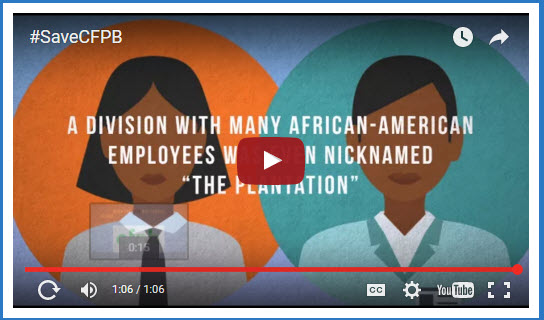
I started doing some searching for the commercial on the Internet.  However, before I could find it I received a second text from my friend with a link to the website of the organization that produced the commercial, called Protect America’s Consumers. (Again, what does that say about me and what does that say about my industry colleague?) Click on the image below to view the commercial.

Save the CFPB

I started doing some research on the group and the commercial. I came across this article from January 7, 2016 on POLITICO.

It seems that no one knows who is behind Protect America’s Consumers. The only person who has been identified with the group is spokesman Steve Gates. The POLITICO article states that Gates did not respond to requests for comment.  The article also notes, “The address on its Virginia incorporation record matches the law firm Holtzman Vogel Josefiak Torchinsky, which specializes in untraceable pressure groups for conservative causes and whose clients include Karl Rove’s American Crossroads, Sen. Marco Rubio’s presidential campaign and the National Republican Congressional Committee.”

Last night’s commercial focused on a single theme and then uses a number of specific issues to reinforce it. The main theme is the lack of accountability at the CFPB. To support that position the commercial first discusses the cost of the new CFPB building, stating that the Bellagio Hotel was cheaper to build, then moves to complaints about the Bureau’s treatment of female and minority employees, before finally discussing how the CFPB executives set their own salaries and the fact that those salaries “average” $10,000 per month. The commercial then closes with, “The CFPB is plagued with scandal and corruption and needs to be reformed.”

In November of last year insideARM published an article about a different anti-CFPB television commercial produced by The American Action Network (AAN). That commercial was slickly produced compared to the rather plain, under-produced Protect America’s Consumer commercial.

It will be interesting to see if these commercials have any impact, particularly during this election year.

Another Anti-CFPB Television Ad Hits the Airwaves
http://www.insidearm.com/daily/featured-post/another-anti-cfpb-television-ad-hits-the-airwaves/
http://www.insidearm.com/feed
insideARM

Accounts Receivable Management

CFPB Announces Proposed Order to Shut Down Student Debt Relief Scam

Yesterday the CFPB announced it had requested that a federal district court enter a final judgment and order that would shut down a student debt relief scheme that charged borrowers millions of dollars in illegal upfront fees for federal student loan services. If approved by the court, the proposed judgment would ban the company, Student Loan Processing.US, and its sole owner, James Krause, from any future involvement in debt relief and student loan services. The order would also require the company to pay refunds to thousands of harmed consumers and a civil money penalty.

Student Loan Processing.US is headquartered in Laguna Nigel, Calif., with an office in Dallas, Texas. The company also operates under the name IrvineWebWorks, Inc. and runs websites at StudentLoanProcessing.us, StudentLoanProcessing.org, and slpus.org. The student debt relief company has been in operation since at least May 2011 and its customers are located throughout the United States. James Krause is the company’s founder, president, and sole owner.

In December 2014, the CFPB filed a lawsuit against Student Loan Processing.US and Krause in federal district court in California alleging that the defendants charged consumers illegal upfront enrollment fees before providing any services, deceived customers about the costs of their services, and falsely represented an affiliation with the Department of Education.

According to the CFPB lawsuit, Student Loan Processing.US illegally marketed and sold services promising to advise and assist borrowers applying for Department of Education student loan repayment programs. The company charged consumers an initial enrollment fee for its services of 1 percent of the borrower’s federal student loan balance plus a monthly maintenance fee of at least $39 per month for the entire repayment term of the borrower’s federal student loan.

During initial enrollment calls with customers, the company’s representatives failed to disclose the recurring monthly fee before collecting payment information from the customer. The complaint alleges that the defendants also misrepresented the amount and duration of that fee. (The Department of Education offers numerous plans to borrowers, and charges no fees for enrollment.)

The Enforcement Action

If the proposed consent judgment is entered by the court, Student Loan Processing.US and Krause must:

  • Shut down illegal operations: Student Loan Processing.US must shut down all operations within 45 days of the entry of the court’s judgment.
  • Cancel all contracts with consumers and stop charging them: The company must immediately stop charging customers any fees for its services. All contracts between Student Loan Processing.US and its customers would also be cancelled.
  • Pay consumer refunds: The order imposes a judgment for relief and damages to consumers of over $8.2 million. A significant portion of that payment, however, is suspended based on the defendants’ inability to pay. Under the terms of the order, a payment of approximately $326,000 would be sent to the Bureau and would be distributed to compensate victims of the defendants’ illegal activities.
  • Stop participating in the debt relief and student loan industries: James Krause and Student Loan Processing.US would be permanently barred from marketing or providing debt relief and student loan services. Krause and the company would also be permanently barred from assisting anyone else who markets or provides such services.
  • Ensure student loan borrowers do not miss important repayment benefits: The Department of Education requires that student loan borrowers recertify their income-driven repayment plans every year. For consumers who have recertification or renewal deadlines for these programs that are within 30 days of the entry of the judgment, the company must prepare, process, and mail to the Department of Education all paperwork necessary for recertification or renewal. The company must also mail a notice informing customers that it is shutting down and reminding them of the steps that must be taken to remain enrolled in the Department of Education’s student loan repayment programs.
  • Pay a civil penalty: The order also imposes a penalty of at least $1 to be paid into the CFPB’s Civil Penalty Fund. By requiring the defendants to pay a penalty of at least $1, victims of the defendants’ illegal practices may be eligible for additional relief from the CFPB Civil Penalty Fund in the future, although that determination has not yet been made. The Bureau is seeking this nominal penalty because of the defendants’ limited financial resources.

The proposed final judgment and order follows a Feb. 5, 2016 court ruling in favor of the CFPB on its claim that the defendants violated the Telemarketing Sales Rule by charging customers an advance fee before providing the debt relief service they advertised. That ruling also found in favor of the CFPB on its claims that the defendants violated the Telemarketing Sales Rule and the Dodd Frank Act’s prohibition against deceptive acts or practices by collecting payment information from customers before disclosing the total cost of the company’s services.

This ruling creates an important precedent in the student debt relief market. It establishes that companies offering to enroll students in Department of Education repayment programs may be running afoul of federal consumer financial laws if such companies collect upfront fees, or do not clearly disclose all fees for their services before the consumer supplies any payment account information.

Click here to read the CFPB’s complaint against Student Loan Processing.US

Click here to read the proposed final judgment and order

Click here to read the court ruling

CFPB Announces Proposed Order to Shut Down Student Debt Relief Scam
http://www.insidearm.com/daily/debt-collection-news/debt-collection/cfpb-announces-proposed-order-to-shut-down-student-debt-relief-scam/
http://www.insidearm.com/feed
insideARM

Accounts Receivable Management

Major Credit Bureaus Issue Furnisher Data Reporting Process Changes

insideARM has learned that the three major credit bureaus — Equifax, Experian, and TransUnion — have distributed this document detailing new Furnisher Data Reporting and Process Requirement Changes.

Some of the changes are effective as soon as June 15, 2016 while others take effect over a year from now, September 15, 2017. However, the memo urges furnishers to implement the changes in advance of these dates.

The purpose of the changes is to provide consumers more transparency when interacting with consumer reporting agencies about their credit reports. The plan was produced in conjunction with the Attorneys General of several states.

The following chart summarizes the changes:


insideARM Perspective

It will be interesting to see what impact these changes have on the ARM industry.  Will there be fewer companies or clients that want to report to the Credit Bureaus? Will these changes lead to more or less consumer litigation on credit bureau reporting?

Additionally, anytime there are changes to a process or new rules promulgated there are often issues that appear that were not originally contemplated. Often there are unintended consequences to the changes. insideARM would love to hear from its readers of any such concerns, issues or unintended consequences.  We will be happy to share the information with the industry.

Major Credit Bureaus Issue Furnisher Data Reporting Process Changes
http://www.insidearm.com/daily/debt-collection-news/debt-collection/major-credit-bureaus-issue-furnisher-data-reporting-process-changes/
http://www.insidearm.com/feed
insideARM

Accounts Receivable Management

“Bad Apples” Practice Reputational Theft on Good Professionals

The National Creditors Bar Association (NARCA) applauds the federal government’s recent 41-count indictment of Alan Ceccarelli, a Buffalo, N.Y.-based debt collector, who allegedly misled and coerced thousands of people into paying debts they possibly didn’t owe. The grand jury indictment claims Ceccarelli made it appear to victims that the collector’s telephone call was coming from a police department or the office of a government official or local private attorney.  Once again a sole “bad apple” stealing the reputation of the tens of thousands of professionals – including police, government officials and creditors rights attorneys.

“A good reputation is the most valuable thing we have—men and women alike………. if you steal my reputation, you’re robbing me of something that doesn’t make you richer, but makes me much poorer.”  Othello Act 3, Scene 3 

The National Creditors Bar Association vociferously supports the cooperative efforts of both industry entities and governmental agencies to root out the businesses that harm consumers through truly deceptive practices. The industry and consumers are much better off by collaborative and complementary practices to insure that “bad players” are eliminated from practicing debt collection. You cannot repair the reputation of “good players” when you lump them into the pool of “bad apples” that poisons the well of public perception.

Harvey Moore, The National Creditors Bar Association Board President commented, “We should keep focusing on the fact that this is where the government’s actions should be directed and enforced. Creating additional regulations is not what prevents bad actors such as Ceccarelli, because the real bad players won’t follow the rules anyway. Stricter enforcement of existing laws and regulations will root out the bad and elevate the good ”

The National Creditors Bar Association has been at the forefront of insuring that its attorney members abide by a Code of Ethics and Professional Conduct that is separate and in addition to the rules in their respective states which govern their law licenses.  Mark Dobosz, Executive Director of NARCA commented, “ The cooperation between industry groups and the regulatory bodies which enforce laws to eliminate those who consciously harm consumers through deceptive practices is a mutual goal we want to continue to pursue together.”

Contact Information

Jim Podewitz
Communications Specialist
NARCA – The National Creditors Bar Association
Direct: 202-861-0706
Email: jim@narca.org
Web: www.narca.org

About NARCA

NARCA – The National Creditors Bar Association is a nationwide professional trade association of 600 creditors rights law firms and in‐house counsel of creditors.  NARCA members are committed to being professional, responsible and ethical in their practice of creditors rights law.

“Bad Apples” Practice Reputational Theft on Good Professionals
http://www.insidearm.com/daily/collection-laws-regulations/collection-laws-and-regulations/bad-apples-practice-reputational-theft-on-good-professionals/
http://www.insidearm.com/feed
insideARM

Accounts Receivable Management

Credit Reporting, Overdraft Issues and the Remittance Rule Dominate the CFPB’s 2016 Winter Supervisory Highlights

Credit Reporting, Overdraft Issues and the Remittance Rule Dominate the CFPB’s 2016 Winter Supervisory Highlights
http://www.insidearm.com/daily/collection-laws-regulations/collection-laws-and-regulations/credit-reporting-overdraft-issues-and-the-remittance-rule-dominate-the-cfpbs-2016-winter-supervisory-highlights/
http://www.insidearm.com/feed
insideARM

Accounts Receivable Management

Court Rules Express Consent Passes from Creditor to Collector

Yesterday, a United States District Court Judge in California granted Defendant’s motion for summary judgment on a TCPA claim where a plaintiff had provided a cell phone number as part of an in-store application for a credit card. The court ruled that Plaintiff provided her telephone number at the time she applied for the credit card that gave rise to the underlying debt, and she therefore consented to being contacted at that number by credit card issuer and collections companies acting on its behalf.

The case, Schwartz-Earp v. Advanced Call Center Technologies, LLC, from the United States District Court for the Northern District of California (Case No. 15-cv-01582-MEJ) involved claims for violation of the FDCPA, California’s Rosenthal Fair Debt Collection Practices Act, the TCPA, and invasion of privacy.

Background

In February 2014, Plaintiff applied in-store for a JC Penney-branded credit card, issued by Synchrony Financial (“Synchrony”). As part of the application process, the cashier asked Plaintiff for her telephone number, and Plaintiff provided her number. Plaintiff did not indicate it was for a cell phone. Plaintiff’s application was immediately approved, and she received a temporary bar code, which she used to make purchases. Eventually, Plaintiff received a permanent credit card in the mail, which she used to make additional purchases.

After Plaintiff stopped making payments on the account.  Synchrony placed Plaintiff’s credit card account with Defendant, Advanced Call Center Technologies, LLC (“ACCT”) for collections on January 17, 2015.

Between January 17, 2015 and February 22, 2015, ACCT placed at least 134 calls to Plaintiff at the number she provided. ACCT placed up to five calls to Plaintiff in a single day, but allowed at least 90 minutes to elapse between each call. ACCT maintained it never intentionally left voicemails for Plaintiff. However, its dialing software uses a voice recognition algorithm to distinguish live people from answering machines, and in the event that the algorithm mistakes an answering machine for a live person, a brief message may be left unintentionally.

For the first 119 calls, ACCT contended that Plaintiff did not answer. However, Plaintiff maintained she would answer calls, but a live agent would not respond and she would eventually hang up. It is undisputed that Plaintiff answered a call placed on February 13, 2015. During that call, Plaintiff asked the agent, “And who do I talk to about . . . being called six times a day?” ACCT contended the remaining 14 calls it placed to Plaintiff were not answered, while Plaintiff contends she would answer calls but a live agent would not respond. The last call from ACCT to Plaintiff was placed on February 22, 2015.

On February 22, 2015 Plaintiff called ACCT and agreed to a payment plan to bring her credit card account current. On February 23, 2015, Plaintiff called ACCT and asked to modify the payment plan she had previously agreed to. On February 25, 2015, Plaintiff again called ACCT and asked to cancel the payment plan. During that February 25, 2015 call, Plaintiff also asked for ACCT to stop calling her, and the agent stated that the calls would cease.

The Litigation

Plaintiff filed a Complaint on April 7, 2015, alleging four causes of action:

  1. violations of two sections of the Fair Debt Collection Practice Act (“FDCPA”), 15 U.S.C. §§ 1692(d) and (f);
  2. violation of California’s Rosenthal Fair Debt Collection Practices Act (“Rosenthal Act”), Cal. Civ. Code §§ 1788-1788.32;
  3. violation of the Telephone Consumer Protection Act (“TCPA”); and
  4. invasion of privacy.

ACCT moved for summary judgment on all claims.

(Editor’s NoteA motion for summary judgment is based upon a claim by one party (or, in some cases, both parties) that contends that all necessary factual issues are settled or so one-sided they need not be tried. This, summary judgment is appropriate when the court determines there no factual issues remain to be tried and therefore a cause of action or all causes of action in a complaint can be decided upon certain facts without trial.

The Court’s Order

As noted above, ACCT had moved for summary judgment on all claims. In the Order, United States Magistrate Judge Maria-Alena James reviews and discusses each claim.  Judge James denied ACCT’s Motion for Summary Judgment as to Plaintiff’s § 1692d FDCPA and Rosenthal Act claims, but granted their Motion as to Plaintiff’s § 1692f FDCPA, TCPA, and invasion of privacy claims.

insideARM Perspective

The court’s discussion of the TCPA claim was quite interesting.  It was, in essence, approval of a multi-step process for “prior express consent” to the collection agent.

First, in the case of an in-store application for a credit card the court found that merely providing a cell phone number to a cashier when asked for her telephone number constituted “prior express consent.”

Second, the store-branded credit card was issued by Synchrony. The court ruled that the express consent given to the cashier was express consent for Synchrony, stating:

“No reasonable consumer could believe that consenting to be contacted for a store credit card requires that all communications be made by direct employees of the store, but never by the company that issued the card.  When a consumer provides a cellular telephone number to a creditor as part of the underlying transaction, the provision of the number constitutes express consent for the creditor to contact the consumer about the debt.”

Third, the court deemed that “prior express consent” to the creditor was also prior express consent to agents of the creditor.  The court wrote:

“An individual may indirectly provide a third party with express consent to be called under TCPA. …calls placed by a third-party debt collector on behalf of the creditor are treated as if the creditor itself placed the call.

The court’s discussion of the invasion of privacy claim was also interesting.  Plaintiff had argued that this claim was not ripe for summary judgment since there was a factual issue in dispute; whether the volume of phone calls could be deemed highly offensive to a reasonable person.

On this issue the court wrote:

“Here, Defendant made all calls during a reasonable time of day, never intentionally left voicemails, Defendant’s collections agents clearly identified themselves at the outset of the call anytime they spoke with Plaintiff, and Defendant discontinued all efforts to contact Plaintiff after explicitly asked for the calls to stop. Thus, as Plaintiff fails to set forth facts establishing offensive conduct necessary to establish an invasion of privacy claim, summary judgment is appropriate.”

A copy of the complete Order can be found here.

It should be noted that that this Order may be subject to a future appeal.

Court Rules Express Consent Passes from Creditor to Collector
http://www.insidearm.com/daily/collection-laws-regulations/collection-laws-and-regulations/court-rules-express-consent-passes-from-creditor-to-collector/
http://www.insidearm.com/feed
insideARM

Accounts Receivable Management

Client Services 2015 Charitable Efforts End on a High Note

ST. CHARLES, Mo. — Client Services Incorporated (CSI), one of the largest employers in St. Charles County concluded its 2015 charitable giving efforts with two successful employee supported events.  CSI asked its employees to take time out of their busy holiday schedules in November and December and give back to the community by volunteering on behalf of the Salvation Army.  Setting a donation goal of $5,000, CSI employees were encouraged to volunteer two hours to one of four volunteer events: Wehrenberg Cans Festival, Wal-Mart Fill the Truck Toy Drive, Toy Town Distribution and Kettle Bell Ringing.  CSI employees responded by volunteering 87 hours of their personal time to the assist the Salvation Army efforts in St. Charles and St. Louis counties.  Scott Lindley, Executive Vice President, had this to say about his recent experience ringing bells,

“To help support an organization such as Salvation Army, the least we could do is to offer our employees an incentive for working.  For every two hours volunteered, that employee received a casual day of their choosing and CSI is donating $100 per hour worked, up to $5,000.  We have far surpassed our $5,000 goal, thanks to the generosity of our employees.”

Also during the month of December, CSI employees from our St. Charles location coordinated a toy drive to help bring a happy holiday season to a local Crisis Nursery. We are happy to report that thanks to these efforts, over $492 and more than 7 large containers of toys were donated to this worthy charity!

About Client Services, Inc.

Founded in 1987, Client Services, Inc. (CSI) is a growing, locally-owned, multi-faceted call center. From its inception, CSI has paid special attention to attracting and retaining outstanding talent.  As a result, CSI’s workforce is comprised of individuals with the drive and determination required to flourish and succeed in a competitive environment.  It is that same spirit that has helped CSI evolve into a full-service Customer Relationship Management company. Today, CSI offers a full suite of Accounts Receivable Management (ARM), Business Processing Outsourcing (BPO) and Healthcare solutions.

Client Services 2015 Charitable Efforts End on a High Note
http://www.insidearm.com/doing-it-right/client-services-2015-charitable-efforts-end-on-a-high-note/
http://www.insidearm.com/feed
insideARM

Accounts Receivable Management

Update: The Road Back to the IRS Private Debt Collection Program

Last month I wrote about IRS Commissioner John Koskinen’s testimony to the Senate Committee on Finance. Among many topics addressed in this hearing was the recently passed FAST Act provision to reinstate the use of private debt collectors within the IRS.

At the February 10 hearing the Commissioner said, “We’re going to do everything we can to get the program up and running as quickly as we can. We [are planning] a bidders conference this month. Within the 90 days we are committed to providing a timeline as to when the program would actually be up and running and implemented. The bidders conference is to get us started. Our goal – if we can pull it off – is to learn from mistakes and give it the best chance to succeed. As it stands now in the normal procurement process plus developing the program we expect to have contracts with those acceptable collectors before the end of this fiscal year.”

Evidently, IRS Commissioner John Koskinen told Sen. Chuck Grassley (R-Iowa) in a letter last Friday that the agency is currently planning to get quotes from private collection agencies in July, and would then be handing over actual cases to the winning companies by April 2017. The December highway bill, which brought back the private debt collection program, gave the IRS until early March of this year to start entering into contracts with companies. Koskinen also told Tax Notes that all sides are trying to figure out the best way to start a program when taxpayers are increasingly worried about identity theft. “If everyone hangs up the minute you say, ‘We’re from the IRS,’ it’s not going to help on the private debt collection,” Koskinen said.

According to an article in Politico earlier this week, Sen. Chuck Grassley (R-Iowa) said to Morning Tax in a statement that he was skeptical about why it would take a year to get the renewed private tax debt collection program running.

Update: The Road Back to the IRS Private Debt Collection Program
http://www.insidearm.com/daily/debt-collection-news/debt-collection/update-the-road-back-to-the-irs-private-debt-collection-program/
http://www.insidearm.com/feed
insideARM

Accounts Receivable Management

Cordray Addresses Industry Criticism at Consumer Bankers Conference

Earlier this week CFPB Director Richard Cordray addressed the Consumer Bankers Association annual conference in Phoenix. In his prepared remarks he reminisced about the evolution of supervision and enforcement of the banking industry over the last four years. He also addressed criticisms head-on, including the complaint database, rulemaking through enforcement, and the repeated industry argument that increased regulation will lead to negative consequences for consumers.

“Many of your comments over the years have raised the bar for our efforts, and we have been quite open to iterating our processes accordingly. As a result, our supervision tool has now grown into a rigorous, data-driven program based on sound analytics. Our processes have become more thoughtful, more complete, more consistent, more transparent, and more prompt. Our dialogue with CBA and others has materially assisted these objectives.

Another important way that our sometimes pointed discussions have helped refine our work is in the area of publication of information. Certainly the CBA has never been a fan of our public consumer complaint database. Some of your feedback has led to adjustments, as you know. Others have not, but we are always listening. Despite all of that lively debate back and forth, your member institutions have very much caught the spirit of the whole enterprise. Companies have come to realize that if they are going to make sure they are treating their customers fairly, it is not enough to rely solely on their own subjective impressions. Instead, they have to listen closely to what consumers are telling them, think carefully about what they are hearing, and act accordingly.”

Indeed, it would be “compliance malpractice” for executives not to take careful bearings from the contents of these orders about how to comply with the law and treat consumers fairly.

“Likewise, our public enforcement actions have been marked by orders, whether entered by our agency or by a court, which specify the facts and the resulting legal conclusions. These orders provide detailed guidance for compliance officers across the marketplace about how they should regard similar practices at their own institutions. If the same problems exist in their day-to-day operations, they should look closely at their processes and clean up whatever is not being handled appropriately. Indeed, it would be “compliance malpractice” for executives not to take careful bearings from the contents of these orders about how to comply with the law and treat consumers fairly.

Some have criticized this approach as regulation by enforcement, but I think that criticism is badly misplaced. Certainly any responsible official or agency charged with enforcing the law is bound to recognize that they should develop a thoughtful strategy for how to deploy their limited resources most efficiently to protect the public. That means working toward a pattern of actions that conveys an intelligible direction to the marketplace, so as to create deterrence that can be readily understood and implemented. The alternative is just a random series of actions that takes a few wild swipes at the bad actors without systematically cleaning up the practices that harm consumers across the marketplace.

Others have framed this criticism as a suggestion that law enforcement officials should think through and explicitly articulate rules for every eventuality before taking any enforcement actions at all. But that aspiration would lead to paralysis because it simply sets the bar too high. Particularly in an area like consumer financial protection, the vast majority of our enforcement actions involve some sort of deception or fraud. And courts have long noted that trying to craft specific rules to root out fraud or untruth is a hopeless endeavor, as they would likely fail to cabin “the ingenuity of the dishonest schemer.”  For these reasons, we strive to present specific enforcement orders that meticulously catalogue the facts we have found in our very thorough investigations and set out the legal conclusions that follow from those facts. These specific orders are also intended as guides to all participants in the marketplace to avoid similar violations and make an immediate effort to correct any such improper practices.

So yes, we are pushing you – hard – to become more consumer-focused and consumer-friendly institutions. And when you push back, we welcome your input. We welcome it because we realize that your input can make us a better and more effective agency. Indeed, that is exactly what everyone should want us to be, in order to improve the financial marketplace for all responsible businesses as well as for consumers.”

Cordray also addressed the often-used industry argument that more regulation will lead to less credit – or more expensive credit – for the consumers he is trying to protect.

“…At the same time, we found that credit is now cheaper and more available and the business remains attractive and profitable. In total, consumers had access to nearly $3.5 trillion in credit as of early 2015 – an increase of nearly $325 billion since early 2012. And new account openings are growing, with more than 100 million credit card accounts opened in 2014 – faster than the growth in the population. This is a sign of a healthy market – where credit card companies are making the decision to extend credit to responsible customers – and it is being reinforced by unusually low consumer credit card defaults.”

He also gives credit for these improvements to financial providers doing more than they “had to” with customer service, and to consumers themselves for modifying their behavior. “Thus,” he says, “we have the trifecta of progress noted earlier – a better regulated market, better institutional behavior, and better consumer performance.”

He then turned to other topics, continuing to lay the case for the fact that increased regulation has led to good, rather than bad, results for consumers. Including – the market for mortgage lending:

“…What has the effect of these rules been so far?  Some predicted that lending would be suffocated by the common-sense rules that we finalized in January 2013. On the contrary, the mortgage market is thriving. In 2014, the number of home purchase mortgages was up by almost 5 percent over the prior year, and preliminary data indicates that this trend accelerated last year. When our Know Before You Owe mortgage disclosure rule took effect in October, some again asserted that its implementation would paralyze the market. We are keeping a close eye on many transitional issues that lenders and others have faced in the past five months, but home purchase mortgages remain on the rise, and the housing market now is finally making a positive contribution to the ongoing recovery of the American economy.

…And while we saw minor consolidation in some parts of the mortgage market, there is no evidence of any mass exodus, as doomsayers had predicted. In fact, after adjusting for merger activity, the latest data indicates that the number of lenders originating mortgages has been increasing.

…Reasonable regulation of financial markets, which includes evenhanded oversight and enforcement of the law, should always tend to benefit the most responsible providers.”

He moved next to what’s ahead, and said the CFPB’s rulemaking agenda will remain active. He briefly mentions debt collection, but makes no specific reference to timing, appearing to suggest that other topics are first in line.

“Soon we will be finalizing a rule to provide basic consumer protections for prepaid accounts for the first time ever… In the coming months, we will issue our notice of proposed rulemaking on small-dollar loans such as payday loans, car title loans, and certain installment loans. We will also issue a notice of proposed rulemaking on the use of arbitration clauses in consumer finance contracts, advancing a process that Congress first set in motion in the Dodd-Frank Act.

We are also looking at the incidence and transparency of overdraft fees, including the opt-in process for overdraft coverage of electronic transactions…

Another focus is on debt collection practices – still the most-complained-about activity affecting consumers in the financial marketplace – including the practices of third-party debt collectors, first-party creditors, debt sellers, and debt buyers.

And we have begun work on another project required by Congress, which is to establish a rule governing the collection and publication of data on small business lending – as well as determining how to organize and manage that data collection and publication. We are moving forward with this project now that we have completed our statutory task to update the framework for collecting similar data on mortgage lending under the Home Mortgage Disclosure Act.”

Finally, Cordray talked about financial education. He mentioned several of the bureau’s initiatives in this arena – specifically with young people, at the workplace, and with older Americans — and encouraged bankers to feel the responsibility to take this on as well.


Cordray Addresses Industry Criticism at Consumer Bankers Conference
http://www.insidearm.com/daily/featured-post/cordray-addresses-industry-criticism-at-consumer-bankers-conference/
http://www.insidearm.com/feed
insideARM

Accounts Receivable Management