
FactorTrust Hires Barbara Sinsley as General Counsel and Chief Compliance Officer

The Alternative Credit Bureau Makes Strategic Addition as it Sharpens Focus on Compliance

ATLANTA FactorTrust, The Alternative Credit Bureau, announces the addition of Barbara Sinsley, general counsel and chief compliance officer, as part of the company’s commitment to compliance. Sinsley will provide FactorTrust with legal and regulatory guidance and manage the company’s internal and external compliance programs and products.

Sinsley’s 26 years of experience perfectly aligns with FactorTrust’s efforts to provide lenders with the most up-to-date and effective regulatory compliance information and solutions. She has extensive experience working with regulators such as the Consumer Financial Protection Bureau (CFPB), the Federal Trade Commission (FTC) and Attorneys General. Prior to joining FactorTrust, Sinsley practiced with Barron & Newberger, where she made a name for herself through intelligent representation of servicers, creditors, debt collectors, and debt buyers; focusing on improving compliance management systems.

“We are confident Barbara will be instrumental in expanding our footprint as a trusted partner to lenders, helping them stay compliant amidst ongoing industry changes and ultimately helping underbanked consumers get the credit they deserve,” states FactorTrust CEO Greg Rable. “Barbara is a highly accomplished attorney who has managed complex compliance issues, and her insight and comprehension of the regulatory environment will be a true asset to the company as we continue to develop our line of regulatory products.”

FactorTrust creates products for lenders based on the evolving needs of the industry. The recent CFPB Proposed Rule on short-term small-dollar loans has encouraged lenders and service providers alike to mobilize. New products will help to meet compliance requirements and reduce risk. FactorTrust’s Ability to Repay offering is a recent example of a product that meets proposed regulations, while also providing new avenues for revenue as well as creating more opportunities for lenders and better credit options for non-prime and near-prime consumers.

About FactorTrust

FactorTrust, The Alternative Credit Bureau, is relentlessly dedicated to proven analytics and clean credit information that provide lenders opportunities to grow more revenue, meet compliance regulations and serve more consumers with more credit options.

At the core of FactorTrust is alternative credit data not available from the Big 3 bureaus and analytics and risk scoring information lenders need to make informed decisions about the consumers they want. FactorTrust Alternative Credit Data and Analytics accurately predicts risk and ability to repay of near and non-prime consumer loans in real-time and enables financial service companies an opportunity to uncover creditworthy prospects that are not surfacing via traditional credit sources. Headquartered in Atlanta, the experienced FactorTrust team of predictive analytics specialists, statisticians and financial industry experts has delivered unique data and valuable insight to lenders throughout the U.S. for 10 years. For more information on the quarterly FactorTrust Underbanked Index or the company itself, visit www.FactorTrust.com.

FactorTrust Hires Barbara Sinsley as General Counsel and Chief Compliance Officer
http://www.insidearm.com/daily/collections-jobs-news/factortrust-hires-barbara-sinsley-as-general-counsel-and-chief-compliance-officer/
http://www.insidearm.com/feed
insideARM


Accounts Receivable Management

Whatever the Question Is… The Answer is 6 Clicks

Payment by Phone Success

Success, especially for the collections industry, requires taking the consumer through the payment-by-phone process, end-to-end, in 6 clicks or fewer.

In today’s collections industry environment, getting a consumer on the phone is only one-third the battle. You then must collect a payment, get the consumer to agree to an acceptable payment arrangement and comply with Reg E. The problem with adding more steps to any payment process is that with each new step, there is a higher chance of a breakdown before completing the payment by phone process.

Collections Industry Payment Processing Dance

A consumer on the line is uncomfortable and anxious to finish the transaction as quickly and painlessly as possible. You may be asking them to make commitments they are not confident they can keep. An agent dealing with an anxious consumer, who is already overwhelmed by the subject of the conversation, needs more than what compliance says you can and cannot say. They need a system in place allowing them to complete the delicate dance of moving the consumer toward a payment agreement without a disconnect.

A slow process, complicated terms, or too many clicks, and it is game over.

Payment by Phone and Reg E Hurdles

One of the biggest hurdles with Reg E Compliance is getting the required consumer signature in a manner that is easy for both the consumer and the collection agent. This process is where 6 clicks come in. Consumer research determining the amount of patience a consumer has when interacting with technology overwhelming shows that a transaction must be completed in six clicks or fewer.

So, the question becomes how do you get the consumer to agree to the payment arrangement and comply with Reg E in six clicks or fewer?

The answer is to use PDCflow’s patent pending Digital Signature Solution fully integrated with your payment processing to facilitate the consumer agreement and capture an electronic signature while the collection agent has the consumer on the phone. We have created a seamless process allowing the consumer to digitally sign from the cell phone in their hand, while the collection agent is on the phone with them, in less than six clicks. This concise, easy work flow, for both the collection agent and the consumer, allows a much higher chance of completing the payment arrangement and receiving the sought after payment.

For more information on digital payment authorizations, click HERE or call 877-732-4814.

Whatever the Question Is… The Answer is 6 Clicks
http://www.insidearm.com/revenue-resource/whatever-the-question-is-the-answer-is-6-clicks/
http://www.insidearm.com/feed
insideARM

Accounts Receivable Management

Judge Cites “Zone of Interests” Protections, Dismisses “Nomorobo” TCPA Lawsuit

On August 8, 2016 a Federal Judge in Illinois dismissed a Telephone Consumer Protection Act (TCPA) case by determining that the Plaintiff in the matter was not an individual or entity in the “zone of interests” intended to be protected by the TCPA.

The case is Telephone Science Corporation. v. Asset Recovery Solutions, Case No. 15-CV-5182 (N.D. Ill. Aug. 8, 2016). A copy of the Memorandum Opinion and Order can be found here.

The Plaintiff in the case, Telephone Science Corporation (TSC) is the operator of a service called “Nomorobo.” The website for the Nomorobo service is https://www.nomorobo.com/.

On the website the company claims they have stopped over 125,504,140 robocalls. In 2013, the FTC declared Nomorobo a winner of its contest to “design a system to stop unsolicited telemarketing calls before the calls can ring through to the subscriber of the called telephone number.”

District Court Judge Amy J. St. Eve describes the Nomorobo service.

“Specifically, TSC maintains a “honeypot” of telephone numbers to which TSC subscribes.  Nomorobo analyzes calls placed to TSC’s honeypot numbers using a specialized algorithm, enabling it to “detect high frequency robocalling patterns and distinguish between calls placed by robocallers and calls placed by non-robocallers.

Consumers and businesses subscribe to Nomorobo’s call-blocking services for a fee. These users choose to route their incoming calls to both their personal phones and the Nomorobo server, using simultaneous ring technology. “If Nomorobo determines that it is a robocaller, Nomorobo answers the call on behalf of the user.” The robocaller, however, is “presented with an audio CAPTCHA [Completely Automated Public Turing Test to tell Computers and Humans Apart]. If the caller passes the test and proves they are human, the call is allowed through. If they fail, Nomorobo hangs up the call. Nomorobo either blocks or allows the call within 200 milliseconds of its receipt.”

Background

The Defendant, Asset Recovery Solutions (ARS), is an asset recovery management and debt purchasing company that uses a “predictive dialer” in connection with its business. Judge St. Eve wrote that the ARS “predictive dialer is an ATDS within the meaning of the TCPA.”

In the complaint TSC alleged:

  1. Around March 2014, ARS began calling telephone numbers in the TSC honeypot (“TSC Numbers”) using a predictive dialer.
  2. TSC “was the subscriber to each TSC Number [that ARS] called at the time of the call,” and TSC “continues to subscribe to each TSC Number.”
  3. TSC never consented to these calls.
  4. TSC does not solicit or otherwise entice incoming calls to TSC Numbers.
  5. Each TSC Number is assigned to a voice over Internet protocol (“VoIP”) telephone service.
  6. The VoIP service provider, Twilio, Inc. (“Twilio”), assesses (i) a monthly per-line charge for each TSC Number, as well as (ii) a per-minute charge for each inbound call that TSC answers.
  7. That between March 2014 and February 2016, ARS placed approximately 12,240 robocalls to TSC Numbers from ten telephone numbers using a predictive dialer.

ARS brought a Motion to Dismiss the TSC Complaint under Rule 12(b)(1) and Rule 12(b)(6). Rule 12(b)(1) is motion to dismiss for lack of standing. Rule 12(b)(6) challenges the viability of a complaint by arguing that it fails to state a claim upon which relief may be granted.

The Judge’s Opinion

The Judge’s Memorandum Order and Opinion is 33 pages long. The first portion discusses the Rule 12(b)(1) motion and the “standing” issue that has become a hot topic since the Supreme Court decision in Spokeo, Inc. v. Robins.

After a lengthy analysis of the law, Judge St. Eve determined that Plaintiff did, in fact, have standing under Rule 12(b)(1).

The court then turned to the Rule 12(b)(6) motion. As noted above, the 12(b)(6) motion is based upon the argument that the complaint fails to state a claim upon which relief may be granted.  ARS argued that TSC was outside the TCPA’s “zone of interests.” In short, that TSC was not the person or entity intended to be protected by the TCPA as their claims did not fall into the category of interests against privacy intrusion and nuisance that underpin the TCPA.

According to ARS arguments, the TCPA guards against the “invasion of privacy, the nuisance, and the cost that results when consumers receive certain types of unwanted calls;” it does not protect a company that “intentionally sought out the alleged calls so that it could build and sustain its for-profit telecom business.”

Judge St. Eve agreed with ARS. She wrote:

“The Court discerns several interests protected under 47 U.S.C. § 227(b)(1)(A)(iii), including individual privacy rights, public safety interests, and interstate commerce. Underlying each is the principle that a person or business should be free from nuisance robocalls and their associated costs.

According to ARS, TSC’s relevant “interest” is commercial data collection – not individual privacy rights, public safety protection, or interstate commerce facilitation. Indeed, some courts have placed similar interests outside Section 227(b)(1)(A)(iii)’s zone of interests. Ultimately, even accepting all factual allegations as true, and drawing all reasonable inferences in TSC’s favor, TSC’s asserted interests do not fall within Section 227(b)’s protected zone of interests.

As TSC acknowledges, the focus of the TCPA—and related efforts—is to provide “consumer protection for millions of Americans harassed by unwanted and unwelcome robocalls.” Indeed, TSC’s Nomorobo service represents one such effort in the battle against robocalls. TSC’s “good guy” status, however, does not automatically entitle it to claim protection under the TCPA. TSC does not allege any injuries in the form of privacy invasion, nuisance, and/or inconvenience. To the contrary, the sole reason TSC subscribes to “thousands” of honeypot numbers is to gather a “large quantity” of data in order to “detect high frequency robocalling patterns” and to “distinguish” between callers for its Nomorobo customer-service offerings. Thus, instead of being “unwanted and unwelcome,” robocalls to TSC Numbers provide the analytical basis on which the Nomorobo service operates. “[T]he only reason for this volume of calls,” thus, ‘is due to the nature of [TSC’s] business, which is providing telecommunications services rather than consuming them.

Here, TSC did not suffer the injury contemplated by the TCPA— that is, invasion of privacy and/or general nuisance. Even drawing all reasonable inferences in TSC’s favor, the Court does not see how TSC suffered any injury within Section 227(b)(1)(A)(iii)’s “zone of interests” that would allow it to act as a “private attorney general” under Section 227(b)(3).”

insideARM Perspective

This decision provides an interesting discussion of the various issues surrounding “standing” to bring a TCPA case. On Monday and Tuesday of this week we wrote about 2 different TCPA “standing” cases that saw two different results, one in Minnesota and another in California. See here for the article on the Minnesota case. See here for the article on the California case.

Of note, in its reasoning, the court referenced the recent case of Stoops v. Wells Fargo Bank, N.A., (Case No. 3:15-83, Western District of Pennsylvania, June 24, 2016). That case involved an individual plaintiff who had admitted that she files TCPA actions as a business. insideARM wrote about that case on June 28, 2016.


Judge Cites “Zone of Interests” Protections, Dismisses “Nomorobo” TCPA Lawsuit
http://www.insidearm.com/daily/collection-laws-regulations/tcpa/judge-cites-zone-of-interests-protections-dismisses-nomorobo-tcpa-lawsuit/
http://www.insidearm.com/feed
insideARM
Accounts Receivable Management

District Court Rules in Favor of Bank in Mandatory Arbitration Case

Mandatory arbitration provisions have been a hot topic for Consumer Financial Protection Bureau (CFPB) regulators, with the Bureau publishing proposed rules that would prohibit mandatory arbitration clauses. The topic has come up again in Beattie v. Credit One Bank, a new case from the U.S. District Court for the Northern District of New York (Case No. 5:15-cv-1315 (LEK/TWD).

In this case, the plaintiff signed up for a credit card and consented to being contacted by the defendant on their cell phone. Eventually, the plaintiff changed their mind and revoked consent, but the defendant kept making “multiple telephone calls” to the plaintiff. This led the plaintiff to accuse the defendant of a Telephone Consumer Protection Act (TCPA) violation, but the Cardholder Agreement stipulates that any dispute is subject to “mandatory, binding arbitration.”

District Court Judge Lawrence E. Kahn ruled in favor of the defendants in this case, granting their request to allow the arbitration process to proceed. The court ruled that the plaintiff knowingly agreed to the terms of the Cardholder Agreement, that the Agreement was not unconscionable, that the scope of the agreement is broad enough, and that the TCPA claims in this case are subject to arbitration.

This case is similar to a case from earlier this year, Harrington v. Regions Bank, which involved alleged TCPA violations and arbitration provisions. In that case, the District Court for the Middle District of Florida ruled in favor of the bank.

insideARM Perspective

In October 2015, the CFPB convened a Small Business Regulatory Enforcement Fairness Act (SBREFA) panel to review the proposals it was considering regarding arbitration provisions. At that time, the CFPB provided the SBREFA panel with an outline of their proposals regarding arbitration. The CFPB’s report on the input it received from the SBREFA panel was also made public as part of the release of the proposed rule. The SBREFA report can be found here. The Bureau has remarked that the “proposal is designed to protect consumers’ right to pursue justice and relief, and deter companies from violating the law.”

Now that the CFPB’s Notice of Proposed Rulemaking has been released, the best guess at this point is that any final rule would take effect sometime in 2017.

insideARM will continue to monitor and report on mandatory arbitration decisions in the courts. We will also continue to monitor and report on the CFPB rulemaking in the area.

District Court Rules in Favor of Bank in Mandatory Arbitration Case
http://www.insidearm.com/daily/credit-card-accounts-receivable/district-court-rules-in-favor-of-bank-in-mandatory-arbitration-case/
http://www.insidearm.com/feed
insideARM
Accounts Receivable Management

Spokeo Redux: Minn. District Court Judge Denies Motion to Dismiss TCPA Case for Lack of Standing

Relying on the Supreme Court case of Spokeo v. Robbins, (136 S.Ct. 1540 (2016), on August 3rd U.S. District Court Judge Richard H. Kyle denied a request to dismiss a plaintiff’s Telephone Consumer Protection Act (TCPA) claim for lack of standing.

The case is Ung v. Universal Acceptance Corporation, (Case No. 15-127-( RHK/FLN) (United States District Court, District of Minnesota, August 5, 2016). A copy of the Order denying Defendant’s motion to dismiss for lack of subject matter jurisdiction can be found here.

In this action, Plaintiff Spencer Ung alleged that Defendant Universal Acceptance

Corporation (Universal) made unauthorized calls to his cell phone, in violation of the TCPA.

In June of this year, Defendant had asked the court to dismiss the case as moot arguing theories from the Supreme Court case of Campbell-Ewald Co. v. Gomez, 136 S. Ct. 663 (2016). On June 3, 2016 the court denied Universal’s Motion to Dismiss, concluding that a settlement offer by Universal in March 2016 had not mooted the case. A copy of the court’s June 3rd Memorandum Opinion and Order on that motion can be found here.

On June 10, 2016 Universal moved again for dismissal, this time arguing Ung lacks standing based on the Supreme Court’s recent decision in Spokeo, Inc. v. Robins.

Background

The Complaint alleged that beginning in June 2014, Universal repeatedly called

Ung’s cell phone in an attempt to reach an individual named Joseph Holly, for whom

Mr. Ung was apparently listed as a credit reference. Ung alleged that he had no prior

relationship with Universal and had never consented to being contacted on his cell phone by the company. He also alleged that he repeatedly told Universal to stop calling, but the calls continued unabated, including from an automated telephone dialing system.

Ung eventually sued, alleging that Universal had violated the TCPA by calling his cell phone using an Automated Telephone Dialing System (ATDS) without his consent; he purported to seek relief for himself and a class of similarly situated individuals.

The Court’s Decision

Universal’s latest motion to dismiss is based upon the above referenced Spokeo decision and the Supreme Court’s discussion of “injury in fact.” Universal argued that Ung has not suffered a sufficient concrete injury here.

Judge Kyle did not agree. He wrote:

“Cases, however, have repeatedly recognized that the receipt of unwanted phone calls constitutes a concrete injury sufficient to create standing under the TCPA. See, e.g., Caudill v. Wells Fargo Home Mtg., Inc., Civ. No. 5:16-066, 2016 WL 3820195, at *2 (E.D. Ky. July 11, 2016) (noting that calls caused harms “such as the invasion of privacy [that] have traditionally been regarded as providing a basis for a lawsuit in the United States”); Rogers v. Capital One Bank (USA), N.A., No. 1:15-CV-4016, 2016 WL 3162592, at *2 (N.D. Ga. June 7, 2016) (rejecting argument plaintiffs lacked standing under TCPA where they alleged “the Defendant made unwanted phone calls to their cell numbers”); Mey v. Got Warranty, Inc., __ F. Supp. 2d__, 2016 WL 3645195, at *7 (N.D. W. Va. 2016) (collecting cases); see also, e.g., Cour v. Life360, Inc., Civ. No. 16-805, 2016 WL 4039279, at *2 (N.D. Cal. July 28, 2016) (receipt of single unauthorized text message sufficient to create standing under TCPA). Indeed, Universal correctly notes that both Congress (in passing the TCPA) and the Federal Communications Commission (when interpreting the statute) have recognized the harms inherent in the receipt of automated calls, in particular the invasion of privacy and the intrusion upon seclusion. (See Def. Mem. at 8-10.) And Universal does not seriously quibble with the notion that receipt of autodialed calls constitutes an invasion of privacy sufficient to create standing.”

However, Universal’s motion was based on more than a simple “injury in fact” argument. Judge Kyle wrote:

“Universal’s argument is more nuanced. It contends the TCPA is intended only to remedy calls placed by an “automatic telephone dialing system,” 47 U.S.C. § 227(b)(1)(A)(iii), but the FCC has interpreted that term to include equipment with the capacity to place automated calls. In other words, according to the FCC, a defendant may transgress the statute by manually dialing an unwanted phone call, as long as the system used to make the call has the capacity to autodial. Universal claims that is precisely what happened here: it “called Plaintiff twelve times [and] the evidence shows[] these calls were made by a live person who manually placed the calls to Plaintiff’s phone number.” (Def. Mem. at 2.) As a result, Universal argues that Ung can demonstrate, at most, only the type of “bare procedural violation” insufficient to create standing under Spokeo, since the prevention of manually dialed calls was not the TCPA’s aim.

Ung hotly contests whether the calls he received from Universal were manually dialed rather than autodialed. But the Court need not wade into that dispute at this juncture, because assuming arguendo the calls were placed manually, Ung still has standing to sue. This is because Universal’s argument conflates the means through which it (allegedly) violated the TCPA with the harm resulting from that alleged violation.

An example best makes this clear. Assume that a plaintiff sued after receiving only one unwanted phone call from the defendant. In that instance, how would the plaintiff’s harm differ if he had received a manually dialed call placed on equipment capable of autodialing versus a call that was in fact autodialed? In either case, the plaintiff received only one call, and hence the alleged invasion of his privacy would have been precisely the same. While the injury in such a situation might well be minimal, it is enough to clear Article III’s low bar for a concrete injury.

The manner in which the call was placed has no bearing on the existence of the injury; the use of an autodialer might increase the possibility of a plaintiff receiving hundreds or thousands of phone calls, thus perhaps increasing the extent of the invasion of his privacy, but it is the fact of the call (or calls) that creates the injury sufficient to confer standing.

In this Court’s view, therefore, it makes no difference whether the calls Ung received were manually dialed or autodialed because the resultant harm is the same. And that alleged harm is a concrete injury-in-fact sufficient to confer standing.”

insideARM Perspective

This case has seen three separate issues addressed that have been used to defend TCPA cases; 1) Using Campbell Ewald to moot a TCPA claim, 2) Using Spokeo to dismiss a case for lack of subject matter jurisdiction, and, 3) The definition of an ATDS. All three issues have gone in favor of the Plaintiff and against the Defendant.

Yesterday insideARM wrote about another TCPA case (Romero v. Department Stores National Bank, (Case No. 15-cv-193-CAB-MDD) Southern District of California, August 5, 2016) that addressed Spokeo. See that article here. In Romero a United States District Court Judge in California came to a completely opposite decision on the issue of standing.

insideARM suspects that TCPA decisions will continue to be split for a significant period of time as courts throughout the country address the Spokeo ramifications.


Spokeo Redux: Minn. District Court Judge Denies Motion to Dismiss TCPA Case for Lack of Standing
http://www.insidearm.com/daily/collection-laws-regulations/tcpa/spokeo-redux-minn-district-court-judge-denies-motion-to-dismiss-tcpa-case-for-lack-of-standing/
http://www.insidearm.com/feed
insideARM
Accounts Receivable Management

U.S. District Court in California Dismisses TCPA case for Lack of Standing

Relying on the Supreme Court case of Spokeo v. Robbins, (136 S.Ct. 1540 (2016), on August 5th United States District Court Judge Cathy Ann Bencivengo dismissed a plaintiff’s Telephone Consumer Protection Act (TCPA) claim for lack of standing.

The case is Romero v. Department Stores National Bank, (Case No. 15-cv-193-CAB-MDD (Southern District of California, August 5, 2016). A copy of the Order granting Defendant’s motion to dismiss for lack of subject matter jurisdiction can be found here.

Background

In 2014, Plaintiff failed to make payments on the amount owing on her Macy’s credit card. To collect that debt, Defendants, who were the creditors, called Plaintiff on her cellular telephone, which is the only telephone number Plaintiff had provided for her account. Plaintiff contends that Defendants called her over 290 times using an automated telephone dialing system (“ATDS”) over the course of six months between July and December 2014. Plaintiff answered only three of these telephone calls: one in July, one in September, and one in December.

In January 2015, Plaintiff filed this lawsuit, asserting claims for violation of California’s Rosenthal Fair Debt Collection Practices Act, Cal. Civ. Code § 1788 et seq. (“RFDCPA”), intrusion upon seclusion, negligent infliction of emotional distress, and violation of the Telephone Consumer Protection Act, 47 U.S.C. § 227 (“TCPA”).

After the close of discovery, Defendants’ moved for summary judgment on the RFDCPA, intrusion upon seclusion, and negligent infliction of emotional distress claims, and the Court granted the motion. The court granted that motion. After the Court’s order, only the TCPA claim remained in the lawsuit.

The Court held a pretrial conference on April 8, 2016, at which it set this matter for trial to begin on June 13, 2016, on the TCPA claim. Plaintiff also filed a pre-trial memorandum of facts and law, and the Court entered a pre-trial order prepared by the parties. Neither of these documents make any mention of any actual damages suffered by Plaintiff.

On May 26, 2016, Defendants filed a motion to dismiss, which they state was prompted, at least in part, by the Supreme Court’s May 16, 2016 decision in Spokeo v. Robins.  Plaintiff filed an opposition brief on May 31, 2016, and the Court held oral argument on June 2, 2016. Due to the condensed briefing schedule and specific issues raised by the Court at oral argument that were not addressed in the briefs, the Court vacated the pending trial date and gave the parties an opportunity for supplemental briefing on the motion. After considering those briefs, the Court determined that further oral argument was unnecessary and took the motion under submission.

The Court’s Decision

Judge Bencivengo’s decision began with an analysis of Spokeo –  she wrote:

“The standing to sue doctrine is derived from Article III of the Constitution’s limitation of the judicial power of federal courts to “actual cases or controversies. The doctrine limits the category of litigants empowered to maintain a lawsuit in federal court to seek redress for a legal wrong. [T]he irreducible constitutional minimum’ of standing consists of three elements. The plaintiff must have (1) suffered an injury in fact, (2) that is fairly traceable to the challenged conduct of the defendant, and (3) that is likely to be redressed by a favorable judicial decision. This case primarily concerns the first element.

The first element, injury in fact, “is a constitutional requirement, and it is settled that Congress cannot erase Article III’s standing requirements by statutorily granting the right to sue to a plaintiff who would not otherwise have standing. To establish injury in fact, a plaintiff must show that he or she suffered ‘an invasion of a legally protected interest’ that is ‘concrete and particularized’ and ‘actual or imminent, not conjectural or hypothetical.’”

For an injury to be ‘particularized,’ it ‘must affect the plaintiff in a personal and individual way. Therefore, a plaintiff does not “automatically satisf[y] the injury-in-fact requirement whenever a statute grants a person a statutory right and purports to authorize that person to sue to vindicate that right. Article III standing requires a concrete injury even in the context of a statutory violation. A “bare procedural violation, divorced from any concrete harm,” does not satisfy the injury-in-fact requirement of Article III.”

The Court also determined that each alleged violation of the TCPA is a separate claim, meaning that Plaintiff must establish standing for each violation, which means that Plaintiff must establish injury in fact caused by each individual call. In other words, for each call Plaintiff must establish an injury in fact as if that was the only TCPA violation alleged in the Complaint.

The court wrote:

“The determination of standing to bring a TCPA claim based on a call made using an ATDS does not change whether it is the only call alleged to have violated the TCPA or 1 of 290 calls that allegedly violated the TCPA. Accordingly, the Court must determine whether Plaintiff has evidence of an injury in fact specific to each individual call, and not in the aggregate based on the total quantity of calls.”

Judge Bencivengo determined that the Plaintiff did not meet this burden of proof.

The Court evaluated Plaintiff’s claims of injury in fact with more specificity by dividing the calls into the following categories:

(1) calls of which Plaintiff was not aware either because her phone did not ring or she did not hear it ring;

(2) calls that Plaintiff heard ring on her phone but that she did not answer; and

(3) calls that Plaintiff answered and spoke with a representative of Defendants.

Judge Bencivengo addressed all three categories in detail.

Calls of which Plaintiff was not aware because her phone didn’t ring or she didn’t hear it ring

“The record is unclear as to how many of these 290 calls Plaintiff was aware of when they were made. To the extent Plaintiff was unaware of any of Defendants’ calls either because her ringer or phone were turned off, or because she did not have her phone with her when the calls occurred, none of her alleged injuries in fact are plausible or could be traceable to the alleged TCPA violation. That Defendants placed a call to Plaintiff’s cell phone using an ATDS is merely a procedural violation. For Plaintiff to have suffered “lost time, aggravation, and distress,” she must, at the very least, have been aware of the call when it occurred. Accordingly, because Plaintiff has not, and likely could not, present evidence of an injury in fact as a result of calls placed by Defendants to Plaintiff’s cell phone of which Plaintiff was not aware, Plaintiff lacks standing to assert a claim for a TCPA violation based on any of these calls.”

Calls that Plaintiff heard ring on her phone but that she did not answer

“Plaintiff asserts that for many of Defendants’ calls, she heard the phone ring but did not answer the call. For each of these calls, to establish a TCPA violation, Plaintiff must demonstrate that she suffered an injury in fact solely as a result of the telephone ringing for that particular call. Plaintiff has not, and cannot, do so. No reasonable juror could find that one unanswered telephone call could cause lost time, aggravation, distress, or any injury sufficient to establish standing. When someone owns a cell phone and leaves the ringer on, they necessarily expect the phone to ring occasionally. Viewing each call in isolation, whether the phone rings as a result of a call from a family member, a call from an employer, a manually dialed call from a creditor, or an ATDS dialed call from a creditor, any “lost time, aggravation, and distress,” are the same. Thus, Defendants’ TCPA violation (namely, use of an ATDS to call Plaintiff) could not have caused Plaintiff a concrete injury with respect to any (and each) of the calls that she did not answer. Accordingly, Plaintiff lacks Article III standing for her TCPA claims based on calls she heard ring but did not answer.”

Calls that Plaintiff answered and spoke with a representative of Defendants

Plaintiff once again does not, and cannot, connect her claimed “lost time, aggravation, and distress” with Defendants’ use of an ATDS to have called her. Put differently, Plaintiff does not offer any evidence demonstrating that Defendants’ use of an ATDS to dial her number caused her greater lost time, aggravation, and distress than she would have suffered had the calls she answered been dialed manually, which would not have violated the TCPA. Therefore, Plaintiff did not suffer an injury in fact traceable to Defendants’ violation of the TCPA, and lacks standing to make a claim for any violation attributable to the calls she actually answered.”

insideARM Perspective

The decision in this case is thoughtful and well-reasoned. It provides a glimmer of hope to TCPA defendants going forward. It will be interesting to see what courts in the future will follow the logic of Judge Bencivengo. You can be sure that Defendants will use these arguments and cite this case.

However, to be clear, as outlined in today’s insideARM article by David Kleber on the current history of Spokeo, (See here) the courts are not at all consistent in their interpretation of Spokeo.

U.S. District Court in California Dismisses TCPA case for Lack of Standing
http://www.insidearm.com/daily/collection-laws-regulations/collection-laws-and-regulations/u-s-district-court-in-california-dismisses-tcpa-case-for-lack-of-standing/
http://www.insidearm.com/feed
insideARM
Accounts Receivable Management

NACS Joins in the Solution – Stop Soldier Suicide

CHATTANOOGA, Tenn. – North American Credit Services has committed to join in the solution to Stop Soldier Suicide, national campaign this September. “Sometimes our service men and women come home wounded inside and out,” states NACS Chief Executive Officer Dallas S. Bunton, Sr. “Possibly while in other countries America’s heroes have lost wives, families and their sense of being a part of life. Too many times these brave service members become drained of the will to live and turn to suicide.”

According to a 2012 Department of Veterans Affairs report, it’s estimated that 22 soldiers take their lives each day. There are nearly 23 million Veterans of war in the United States and 1.5 million active duty military men and women. Also reported in 2014 by the Center for Public Integrity, the suicide rate for Veterans far exceeds that of the civilian population. Additionally, the Stop Soldier Suicide Foundation estimates that over 400,000 Veterans suffer from Post-Traumatic Stress (PTS) along with 40% from Traumatic Brain Injury (TBI), both being reported as leading indicators of military suicide.  “For way to long these heroes that have served our country and kept us safe, have often lost everything for themselves in the process,” states Mr. Bunton, a Veteran having served in Korea during the Pueblo Crisis with the 7th Infantry Division on the DMZ.

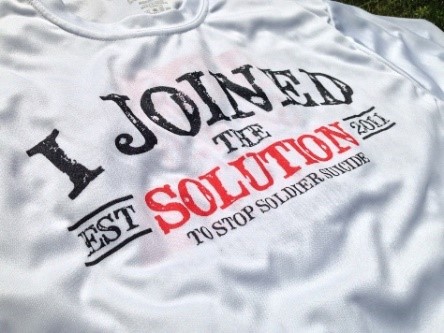
The employees and executive management at NACS and Medical Services in Chattanooga are pledging to support the mission of the Stop Soldier Suicide (SSS) Foundation, in empowering veterans for life, with multiple activities the week of September 12-16; including providing employees with an ‘I Joined the Solution’ SSS T-shirt from the Through Struggle organization, to be proudly worn along with blue jean, casual dress fundraising days on campus. Additionally, NACS has committed to match dollar-for-dollar, plus a donation of $3,000 over and above what is raised from the company’s 300+ employees.  Mr. Bunton’s community challenge states, “We hope through supporting this campaign we will bring awareness and to show our service men and women that we care and appreciate what they do.”

All campaign donations will directly benefit the Stop Solider Suicide Foundation, www.stopsoldiersuicide.org/.

Media Contact

Joel Henderson | North American Credit Services

Vice President, Public Affairs & Legislative Liaison

423.894.5654 Ext 110 | joelh@nacscom.com


NACS Joins in the Solution – Stop Soldier Suicide
http://www.insidearm.com/doing-it-right/nacs-joins-in-the-solution-stop-soldier-suicide/
http://www.insidearm.com/feed
insideARM

Accounts Receivable Management

FCC Releases Rules Limiting Federal Government Debt Collection Calls

Yesterday the Federal Communications Commission (FCC) released its Final Rules (Rules and Regulations Implementing the Telephone Consumer Protection Act of 1991, CG Docket No. 02-278) to implement an amendment passed by Congress in the Bipartisan Budget Act of 2015. That 2015 Act exempted autodialed calls “made solely to collect a debt owed to or guaranteed by the United States” from the Telephone Consumer Protection Act’s prior express consent requirement and directed the FCC to issue a regulation to implement the amendments to the TCPA within nine months of enactment.

insideARM has written extensively about this issue, most recently in a July 25, 2016 blog. But see also our November 5, 2015 story and our June 21, 2016 story.

The rules apply to calls initiated through an automatic telephone dialing system (ATDS) for the purpose of collecting debts owed to the federal government without the consumer’s prior express consent. The rules are effective 60 days after the FCC publishes notice in the Federal Register.

insideARM will be providing more extensive analysis of the Rules in the coming weeks. However, for this Breaking News story we will discuss a few of the highlights included in FCC Chairman Tom Wheeler’s Statement that was published in connection with the rule.

  1. The rules limit the number of calls to a cellphone, including text messages, to three per month.
  2. The rules also only allow calls concerning debts that are delinquent or at imminent risk of delinquency, unless there is prior express consent otherwise.
  3. The rules require that, absent consent, callers only call the individual who owes the debt, not his or her family or friends.
  4. The rules limit the number of calls allowed to reassigned numbers, consistent with last year’s July, 10, 2015 TCPA Omnibus Declaratory Ruling and Order (Adopted on June 18th, released on July 10th).
  5. The rules reiterate that consumers have the right to stop calls they do not want at any point they wish, and require callers to inform consumers of that right.
  6. The rules apply to each caller, rather than each debt.  Otherwise, consumers who have multiple loans with a single owner of the debt, as many do, could be receiving an excessive number of calls per month to their cell phones.  This limitation prevents that from occurring.
  7. The rules limit the time of day when calls can take place, requiring that no calls can be made before 8 a.m. and after 9 p.m. local time at the called party’s location.

FCC Commissioner Michael O’Rielly issued a very strong Dissenting Statement. O’Rielly wrote, in part (emphasis added by insideARM),

“When Congress enacted the Bipartisan Budget Act of 2015 (Budget Act), which included certain relief from the Telephone Consumer Protection Act (TCPA), the intent seemed clear.  Faced with the alarming prospect that the FCC’s misguided interpretations of the TCPA, culminating in the order last June, might prevent the United States from collecting its debts, Congress stepped in to exempt calls regarding such debts from the TCPA’s prior express consent requirements.  In other words, out of all of the legitimate entities that have valid reasons to autodial consumers, the federal government, along with companies servicing loans or collecting debts on behalf of the federal government, were moved to the front of the line and granted significant relief from the FCC’s wrongheaded rules.

Against this backdrop, and without knowing how the FCC would ultimately decide pending petitions about whether federal agencies and their contractors were subject to the TCPA, Congress enacted the Budget Act exemption to ensure that, at a minimum, federal agencies and their contractors are protected when calling to collect debts owed to or guaranteed by the U.S. government. Just two months ago, however, a near unanimous Commission provided further clarification, determining that all federal agencies and their contractors performing any legitimate, government authorized functions are exempt from the TCPA.  That’s because the Commission determined, consistent with Supreme Court precedent, that the federal government and its agents are not “persons” under the TCPA.

Therefore, it is beyond disappointing that the order decides that the federal government and its contractors will face more restrictions when making calls to collect debts than for any other type of call they make.  That’s the exact opposite of what the Budget Act exemption was designed to accomplish. Clearly, no good law goes unabused in this Commission.

The order further restricts the exemption to three call attempts per month.  While the law gives the Commission the authority to limit the number of calls, this is far too narrow.  The Commission is counting calls that never even go through.  How is that supposed to help borrowers get the relief they might need or want?  Multiple commenters noted that it can take dozens of call attempts just to reach a borrower, much less help them navigate their loan options.  Counting call attempts as calls, therefore, will only hurt the people that the Budget Act exemption is trying to help.

Moreover, there is absolutely no justification for the number three other than the fact that some particular commenters liked it.  These commenters, however, did not provide any explanation or data to support a three call limit.  The Commission can’t make policies based on the number of likes it gets or emojis.  It is required to have a rational basis for its decisions, and that is utterly lacking here. 

The Commission’s laziness stands in sharp contrast to the comments of parties that could actually be impacted by the rules, who provided plenty of reasons and data for choosing a higher number.  Chief amongst these is that fact that some are required by federal laws and rules to place more than three calls per month.”

These rules are published two weeks after the Consumer Financial Protection Bureau (CFPB) published its Outline of Proposed Rules governing debt collection, and present the possibility that rules on calls to collect government debt could be more restrictive than calls to collect all other types of debt.

FCC Releases Rules Limiting Federal Government Debt Collection Calls
http://www.insidearm.com/daily/debt-collection-news/debt-collection/fcc-releases-rules-limiting-federal-government-debt-collection-calls/
http://www.insidearm.com/feed
insideARM

Accounts Receivable Management

Court Affirms Dismissal of Crawford Case for FDCPA ‘Time-Barred’ Proof of Claim, Case Was Itself ‘Time-Barred’

This article was originally published on the Maurice Wutscher blog and is republished here with permission.

Brent Yarborough

Brent Yarborough

On July 10, 2014, the United States Court of Appeals for the Eleventh Circuit issued its opinion in Crawford v. LVNV Funding, LLC. That opinion began by decrying the “deluge” of proofs of claim filed by debt buyers on debts that are unenforceable under state statutes of limitations. It ended by holding that the filing of a “stale” claim in bankruptcy violates the Fair Debt Collection Practices Act. As expected, the Eleventh Circuit’s opinion led to another sort of deluge: numerous FDCPA claims based upon the filing of proofs of claim or other collector conduct in bankruptcy. While courts across the country are dealing with the fallout of Crawford, the adversary proceeding that started it all has been dismissed because, as it turns out, it was filed too late.

After the Eleventh Circuit’s ruling in July 2014, Crawford was remanded back to the United States Bankruptcy Court for the Middle District of Alabama. On remand, the defendants again moved to dismiss the debtor’s adversary proceeding, this time on the grounds that the debtor’s claim regarding a time-barred proof of claim was itself barred by the FDCPA’s one-year statute of limitations. The Bankruptcy Court granted the motion to dismiss and the debtor appealed that dismissal to the U.S. District Court.

Crawford’s Own FDCPA Claim ‘Time Barred’

On Aug. 9, 2016, the District Court affirmed the Bankruptcy Court’s dismissal of the adversary proceeding. The proof of claim at issue was filed on May 21, 2008, but the debtor did not file his adversary proceeding until May 3, 2012, well beyond the FDCPA’s one-year statute of limitations. The debtor argued that his adversary proceeding should be treated as a compulsory counterclaim or as a claim in recoupment. Under the debtor’s analogy, the filing of the proof of claim was like the filing of a lawsuit, which would serve to toll the statute of limitations for a compulsory counterclaim. And a claim in recoupment generally survives the expiration of the limitation period.

The District Court noted that compulsory counterclaims and claims in recoupment must arise out of the same transaction as the original claim. Here, the original claim arose out of the debtor’s purchase of furniture on credit back in 1999. But the debtor’s FDCPA claim concerned the method of collecting the resulting debt. Because the debtor’s FDCPA claim “does not rise out of the same transaction as and is ‘not logically related’ to [the collector’s] proof of claim,” it cannot qualify as a compulsory counterclaim or as a claim in recoupment.

The debtor can now appeal this dismissal to the Eleventh Circuit. But as things currently stand, he recovers nothing in this case. In fact, because he failed to timely object to the proof of claim, the very proof of claim that lead to his FDCPA claim is included in his bankruptcy plan.

Practice Still Violates FDCPA in 11th Circuit

While an ironic outcome, this latest chapter in the Crawford saga does not change the legal treatment of “time-barred” proofs of claim in the Eleventh Circuit. Indeed, the court just revisited the issue in a May 2016 opinion. In Johnson v. Midland Funding LLC and Brock v. Resurgent Capital Services, L.P., the Eleventh Circuit held that there is no irreconcilable conflict between the FDCPA and the Bankruptcy Code. But other circuits disagree with the Eleventh Circuit. In July, the U.S. Court of Appeals for the Eighth Circuit held in Nelson v. Midland Credit Management, Inc., that “[a]n accurate and complete proof of claim on a time-barred debt is not false, deceptive, misleading, unfair, or unconscionable under the FDCPA.” And on Aug. 10, 2016, the U.S. Court of Appeals for the Seventh Circuit, in Owens v. LVNV Funding, LLC, likewise declined to follow the Eleventh Circuit’s approach. It is anticipated that the U.S. Court of Appeals for the First, Third, Fourth and Sixth Circuits will issue opinions addressing the treatment of “time-barred” proofs of claim under the FDCPA within the next year.

Interesting Crawford Trivia

Those following Crawford as it has wound its way up and down the federal court system might be interested in one other tidbit from this recent opinion. When the Eleventh Circuit’s opinion was released in 2014, some commenters noted that it was written by a senior judge from the United States Court of International Trade. Of course, it is not unusual for judges from one federal court to take an assignment “by designation” with another federal court. When Crawford’s second bankruptcy appeal reached the United States District Court for the Middle District of Alabama, the chief judge of the district assigned the case to a different senior judge from the United States Court of International Trade.

Court Affirms Dismissal of Crawford Case for FDCPA ‘Time-Barred’ Proof of Claim, Case Was Itself ‘Time-Barred’
http://www.insidearm.com/daily/collection-laws-regulations/collection-laws-and-regulations/court-affirms-dismissal-of-crawford-case-for-fdcpa-time-barred-proof-of-claim-case-was-itself-time-barred/
http://www.insidearm.com/feed
insideARM

Accounts Receivable Management

7th Cir. Deepens Split on FDCPA Liability for ‘Time-Barred’ Claims

This article was originally published on the Maurice Wutscher blog and is republished here with permission.

Don Maurice

Don Maurice

Filing a proof of claim with a bankruptcy court representing a debt subject to an expired state law limitations period does not violate the federal Fair Debt Collection Practices Act (FDCPA) under an opinion released yesterday from the Seventh Circuit Court of Appeals.

Under the ruling, in Owens v. LVNV, the Seventh Circuit joins the Eighth Circuit Court of Appeals in rejecting the Eleventh Circuit’s holding under Crawford v. LVNV that such proofs of claim violate the FDCPA.

A copy of the opinion is available at:  Link to Opinion.

In this consolidated appeal of three cases, debt purchasers or their attorneys had filed proofs of claims in Chapter 13 cases. The debtors in each Chapter 13 case objected to the proofs of claim on the basis they were “time-barred.” The objections were sustained and each claim was disallowed.

Each objecting debtor then sued in federal district court alleging that because the debts represented by the proofs of claim were time-barred, the debts were not valid claims because they were not “legally enforceable.” Therefore, the claims filings in the bankruptcy courts amounted to false, unfair and deceptive practices in violation of the FDCPA.

The federal district courts dismissed the complaints, finding that the proofs of claim were complete and accurate and the mere filing of a proof of claim for a debt subject to an expired limitations period did not violate the FDCPA.

Out of Statute Debts are Claims

The Court of Appeals rejected the argument that the Bankruptcy Code only permits “legal enforceable” claims. Finding that the Bankruptcy Code’s definition of a claim is broadly construed, the Court pointed to Third Circuit law, which considered a claim “more extensive than the existence of a cause of action that entitles an entity to bring suit.” The Bankruptcy Code, the opinion notes, contemplates claims subject to expired state-law limitations periods and, through the bankruptcy process, the debtor can object and cause them to be disallowed.

Bankruptcy Process Provides Protections

The debtors also argued that the process of filing such proofs of claims can be false and deceptive because even though the claims may be subject to disallowance, debt collectors contemplate that no objection will be made because the “process sometimes will break down and fail.” This same rationale is behind the Eleventh Circuit’s decision in Crawford.

Here the Seventh Circuit, like the Eighth Circuit, looked to the Second Circuit Court of Appeals decision in Simmons v. Roundup Funding, decided long beforeCrawford. In Simmons, the Second Circuit held that the mere filing of a proof of claim representing an inflated debt did not violate the FDCPA. The bankruptcy process provides debtors with sufficient protections against, as the Seventh Circuit put it, an “invalid or enforceable” claim. Unlike a civil lawsuit, where the debtor may be misled to believe no defense exists to entry of a judgment and simply “give in,” in a bankruptcy case (particularly one where the debtor has counsel, as was the situation in all three of the consolidated cases here), the same concern is not present. The proof of claim must identify the age and the origin of the debt, providing sufficient information to determine whether the debt is subject to an expired limitations period.

Another factor distinguishing the bankruptcy process is the presence of trustees, who are “duty-bound” to object to claims and cause them to be disallowed for a variety of reasons, such as a defense that the claim is past a state-law limitations period.

Finally, unlike a civil lawsuit, because the debtor initiated the bankruptcy process, he “thus demonstrated a willingness to participate” and would be “unlikely to give in rather than fight the claim.”

No Evidence of False, Deceptive or Unfair Practices

The Seventh Circuit evaluates communications subject to the FDCPA by not examining how the plaintiff interpreted them, but instead considers how the communication would be interpreted by a hypothetical “unsophisticated consumer.” However, because in each of the three bankruptcy cases here the debtors were represented by counsel, the Seventh Circuit employed its less stringent, “competent attorney” standard. Under this standard the Court reasoned that a hypothetical competent attorney was provided all the information required from the face of each of the three proofs of claim to determine whether any were subject to a state-law expired statute of limitations.

Because the proofs of claim would not confuse the hypothetical competent attorney, no evidence was presented that any of the proofs of claim contained deceptive or misleading information or constituted unfair or abusive conduct.

FDCPA Not Precluded by Bankruptcy Code

The opinion notes that it is sympathetic to situations where claims subject to state-law limitations periods are not disallowed and are paid through a Chapter 13 plan because it “harms not only the debtor, who is forced to pay a portion of the stale debt out of limited means, but also creditors with legally enforceable debts whose share of the pie is reduced because an additional creditor is claiming a piece.”  But that risk did not support a finding of an FDCPA violation here because all three claims were in the bankruptcy process because all the plaintiffs here object to the claims, which were not allowed in their bankruptcy cases.

Further, the opinion does not preclude the FDCPA from the bankruptcy process when debt collectors file proofs of claim “with inaccurate information” or otherwise engage in “deceptive or misleading debt collection practices.”

Other Circuits Expected to Weigh in Soon

Appeals on the same issue are pending before the First, Third, Fourth and Sixth Circuit Courts of Appeals.

7th Cir. Deepens Split on FDCPA Liability for ‘Time-Barred’ Claims
http://www.insidearm.com/daily/debt-buying-topics/debt-buying/7th-cir-deepens-split-on-fdcpa-liability-for-time-barred-claims/
http://www.insidearm.com/feed
insideARM

Accounts Receivable Management