CFPB’s Proposal for Collection of Decedent Debt: a Misguided Approach (Part 2 of 2)

This article previously appeared on Ballard Spahr’s CFPB Monitor and is re-published here with permission.

Gary Becker

Gary Becker

In my blog post yesterday, I shared my concerns regarding the potential consequences of the CFPB’s proposed 30-day hold on all collection contacts after the date of a consumer’s death.  A 30-day holding period in which collectors are prohibited from contacting a surviving spouse about a debt would, standing alone, have little impact on the way that decedent debt is collected today at the major agencies that specialize in this work.  However, combining the 30-day hold with the radical proposal to prohibit all collector contact with the tens of thousands of personal representatives who regularly administer the majority of probate estates would completely change the way decedent debt is collected.

Informal personal representatives who have not been court-appointed manage most decedent estates.  This has been true for decades.  The CFPB’s proposals would prohibit collectors from contacting these people.  Decedent debt collectors could only contact people who have “state- approved documentation,” showing that they are formally appointed to administer an estate.  Such a rule would not only gut the FTC’s enforcement policy, it would make informal estate administration useless.  The FTC’s research concluded that most estates do not go through formal probate and thus no executor or administrator is appointed.  Although precise data is difficult to ascertain, today no more than roughly 11% of decedent estates go through a formal process.  The overwhelming majority of personal representatives would thus be off-limits to collectors under the CFPB’s proposals.

The 30-day hold would not help informal representatives; it would complicate and impede their ability to pay creditors.  Nor would the hold protect surviving spouses.  Instead, it would expose them to difficulties that informal probate already resolves.  Here’s a typical example:

Dad passes away leaving an 87-year-old widow. The couple has 61-year-old son who is a CPA. The son is taking care of dad’s estate informally because there is no reason to incur the time and expense of formal probate.  Under the CFPB’s proposals, collectors could not communicate with the CPA son. Collectors would be required to communicate only with the widow.

A 30-day hold would also have the unwanted effect of encouraging collectors to use the option of forcing open estates.  Here’s what a typical scenario might look like:

Mom, who was a widow, passed away. She leaves a 55-year-old daughter who has an MBA. It took a creditor about five months to learn that mom has passed. The daughter is taking care of matters informally, and does not plan to open a formal estate. Collectors cannot legally contact the daughter, so they have no way to determine whether their bills will get paid.  They decide to force open the estate and appoint an executor.

The FTC’s enforcement policy is the principal reason why both above examples above are currently resolved differently.  Collectors can talk to the CPA son and not trouble his widowed mother.  Or they can contact the MBA daughter, get the information and cooperation they need and resolve her deceased mother’s debts without forcing open an estate.

The CFPB’s proposal to require collector contact only with formally-appointed executors and administrators is also inconsistent with existing CFPB rules implementing the CARD Act.  Under Section 504 of the CARD Act, credit card issuers must have procedures in place so that an “administrator” of an estate can timely resolve credit card balances.  The official staff commentary to Regulation Z (Comment 1026.11(c)-1) defines the term “administrator” as “an administrator, executor, or any personal representative of an estate who is authorized to act on behalf of the estate.” (Emphasis added). Thus, the definition recognizes that persons without a formal appointment can act on behalf of an estate.

The CFPB’s proposals would thus create a muddled scenario where a person acting as an informal personal representative has the right under the CARD Act to contact a credit card issuer and receive information about the decedent’s credit card balance, but the creditor’s collector could not follow-up and communicate with that same individual about payment.  The creditor would be forced to open an estate to get its bill paid.

Both the FTC in its policy statement and the Federal Reserve Board in adopting the CARD Act regulations (authority for which was later transferred to the CFPB) sought to spare consumers from the time and expense of having formal estates forced open against their wishes.  The FTC cautioned that it hoped to avoid “a hyper-technical reading of the [FDCPA] that allows contact only with statutorily mandated, but in reality, non-existent administrators or executors.”

Cost to Consumers.  The American Public has been turning away from the considerable expense of probate court ever since Norman Dacey wrote his best-selling book in 1965, How to Avoid Probate.  That’s why the overwhelming majority of estates are settled informally.  Thousands of families make this economically sensible rational and practical choice every week.  Congress, the FTC, and every state legislature all recognize informal estate resolution is a choice the public needs to be able to make.  The CFPB’s proposal takes this option away.

I don’t think the CFPB understands the magnitude of the cost shifting from debt owners and collectors to consumers that would result from its proposals.  What Dacey wrote more than 50 years ago is as true today as it was nearly 165 years ago when Dickens wrote Bleak House—probate court is the greatest engine for fees the legal profession has ever created.

If the CFPB is acting out of distaste for the decedent collection industry and thinks that a rule eliminating contact with informal representatives is going to deter collections, they are completely incorrect.  Their proposal will enrich creditors and shifts the entire cost of collection to consumers.

Currently, here’s how the economics of deceased collections play out:

Assume the decedent had a credit card bill of $1200.  The collection agency contacts the personal representative and they agree on a settlement of $1000.  The collection agency has a contingent fee arrangement of 20%–so the agency keeps $200 and sends the creditor $800.  The estate has paid $1000.  The creditor has incurred collection costs of $400: $200 in fees and $200 as a settlement discount.  The estate has saved $200.

Now let’s take the same scenario, except the CFPB has prohibited the collection agency from contacting the informal personal representative:

An attorney is retained to force open an estate and appoint an executor.  The attorney is not going to negotiate with himself over a $1200 bill, so he will send the executor a bill for the full $1200.  The attorney will then resolve other estate issues and receive very typical court-approved fees of $5000.  The creditor has paid collection costs of $0.  The estate has paid $6200.

Let’s assume that only 50,000 cases a year shifted from the current informal paradigm to forced administration.  That’s a very modest estimate, only a fraction of the annual new inventory of new deceased accounts.  Assume that the average fees for attorneys, accountants, appraisers and other professional involved in each formal estate are a frugal $5000.  The result would be an annual additional cost to consumers of $250,000,000.  In its introduction to the SBREFA outline, the CFPB states that it has recovered over $300 million for consumers.  Under its proposals for decedent debt collection, that amount of money would be disgorged from consumers in about fifteen months.

The current state of affairs in which informal probate administration is recognized is beneficial to all concerned.  The CFPB’s proposals would throw that system out of balance, if not destroy it.  Today, creditors, collectors, and personal representatives have managed to create arrangements where collection costs are kept low and estates are resolved quickly.  Time is of the essence for creditors when filing probate claims.  For example, in California there is an absolute deadline of one year from the date of death for filing a claim seeking payment from an estate.  If a collector cannot contact persons acting informally and there is a 30-day hold on contacting a surviving spouse, there will be an industry-wide shift towards creditors and collectors forcing open estates.

Once the economic benefits of that approach are understood, there will be no turning back.  The work of collection agencies will become much easier— if they cannot quickly settle the account with the surviving spouse or file a claim if there is an existing probate estate, they will take the next step of forcing open an estate.  Creditors will adjust because the delays they will experience in receiving most payments will be offset by the fact that they will have collection costs of near zero.  There will be no shortage of lawyers available to do this relatively simple and highly remunerative work.  Only the general public will suffer.

CFPB’s Proposal for Collection of Decedent Debt: a Misguided Approach (Part 2 of 2)
http://www.insidearm.com/daily/debt-collection-news/accounts-receivables-management/cfpbs-proposal-for-collection-of-decedent-debt-a-misguided-approach-part-2-of-2/
http://www.insidearm.com/feed
insideARM

Accounts Receivable Management

NACS Provides Industry Update to Congressman

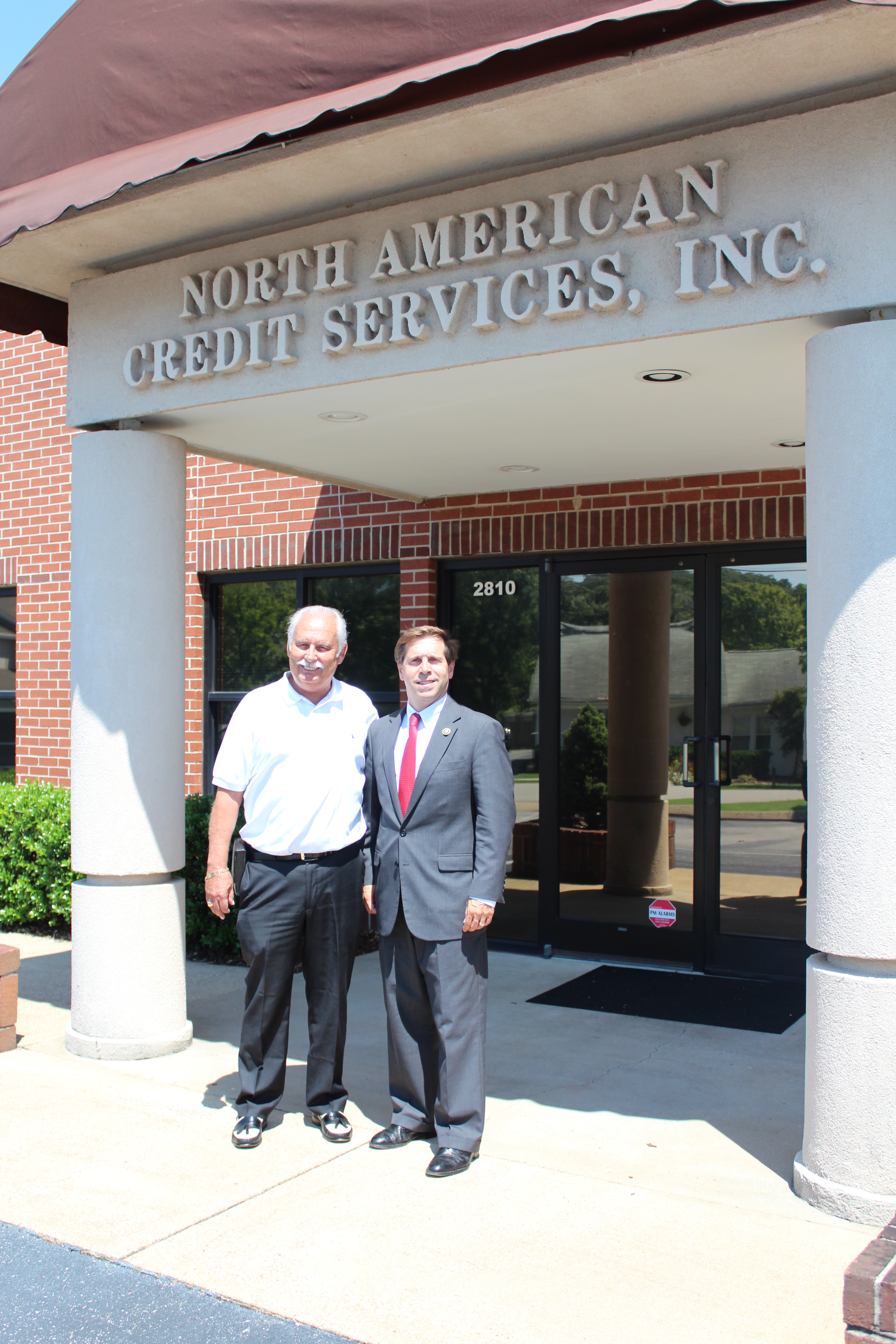
CHATTANOOGA, Tenn. — North American Credit Services Chairman and CEO Dallas S. Bunton, Sr. recently welcomed U.S. Congressman Chuck Fleischmann (R-TN.) and Senior Congressional staff for a brief campus tour and further comprehensive discussion of current credit and collection industry issues.

Congressman Chuck Fleischmann (R-Tenn.) with NACS and Medical Services CEO/Chairman Dallas S. Bunton, Sr. at the company’s headquarters in Chattanooga, Tenn.

Congressman Chuck Fleischmann (R-Tenn.) with NACS and Medical Services CEO/Chairman Dallas S. Bunton, Sr. at the company’s headquarters in Chattanooga, Tenn.

Much of the discussion time was focused on an exchange of information about the healthcare revenue management industry and its impact on the global economy. Mr. Bunton discussed challenges with compliance, oversight by the Consumer Financial Protection Bureau and the impact of the Telephone Consumer Protection Act on costs, efficiency and contacting consumers.

“It’s always great to have elected officials meet with us on campus, especially when it’s our United States Congressman,” said Mr. Bunton. “Informal conversations such as these are crucial and effective ways to communicate the challenges we face in our industry and to bring to light the seriousness of real business matters we encounter on a day-to-day.”

During his years of service in Congress, Fleischmann has voted to repeal Obamacare and cut trillions from the federal budget, and he has a 100% 2nd amendment voting record. He serves on the House Committee on Appropriations and a number of subcommittees that are important to the residents of the 3rd District in Tennessee. “We continue to need strong determined thinkers and servant leaders in Washington like, Chuck Fleischmann,” stated Mr. Bunton.

NACS Provides Industry Update to Congressman
http://www.insidearm.com/doing-it-right/nacs-provides-industry-update-to-congressman/
http://www.insidearm.com/feed
insideARM

Accounts Receivable Management

Executive Change: ACSI Announces the Appointment of Rick Blair to President

NASHVILLE, Tenn. — Automated Collection Services, Inc. (ACSI), a national accounts receivable management company, is pleased to
announce the recent promotion of Mr. Rick Blair to President.

Mr. Blair joined ACSI in 2001 and over the past 15 years has steadily taken on more responsibility assuming key roles in the company. Starting at an entry level position and using his experience in telemarketing and sales has excelled at each level within the
organization. Most recently as Chief Operating Officer, he exhibited excellent leadership skills and made significant contributions to the growth of the company.

“Rick has demonstrated consistent dedication and commitment at a high level to ACSI’s mission, continuous improvement for the benefit of our clients, employees and company, over the past 15 years. I am confident ACSI will excel in serving our clients under his leadership.” said Rob Duffy, CEO.

Rick Blair

Rick Blair

As President of ACSI, he will lead all departments of the company as we continue to grow and perform for our clients. Having spent his entire industry career at ACSI he is uniquely qualified having demonstrated essential leadership qualities. Of particular note
is ACSI’s recognition as “Best Places to Work” in middle Tennessee for the past three years.

“I have thoroughly enjoyed working closely with Rick over the past four years and I am very pleased he has been promoted to lead ACSI. He is a respected leader who values our employees. I look forward to working with him in the future.” said Don Taylor, former President

About ACSI

For 28 years, Automated Collection Services, Inc. has been a leading provider of collection services serving the educational, healthcare, financial services and government markets. ACSI’s national headquarters is in Nashville, Tennessee, is licensed nationally and has placed a major emphasis in data security and compliance.
Learn more at www.automatedcollections.com.

Executive Change: ACSI Announces the Appointment of Rick Blair to President
http://www.insidearm.com/daily/collections-jobs-news/executive-change-acsi-announces-the-appointment-of-rick-blair-to-president/
http://www.insidearm.com/feed
insideARM

Accounts Receivable Management

ConServe Donations Surpass $500k: Jeans for Charity

ROCHESTER, N.Y. – Continental Service Group, Inc., d/b/a ConServe, is committed to giving back. In fact, helping to improve the human condition is part of its corporate mission statement. Towards that goal, the company’s employees created its Jeans For Charity initiative:  A program in which ConServe employees can elect to participate in monthly charitable donations in exchange for the option of wearing jeans to work.

The effort provides employees with a way to support varied, local agencies and organizations on a regularly scheduled basis.  Inspired by the exceptional generosity of his team, ConServe President and CEO, Mark Davitt, vowed to match that generosity:  So he created the organization’s Matching Gift Program – symbolizing ConServe’s commitment to good corporate citizenship.

“This program is testament to our organization’s commitment to community involvement and corporate social responsibility” states Davitt.  He continues “not only does this initiative provide much needed support to the diverse agencies within our community and the critical services they provide to our neighbors, but it also conveys to our valued Clients and prospects the extent to which we are committed to ethical business practices on a larger scale – we practice what we preach:  Doing the right thing, at the right time, the right way. We are steadfast in partnering with our Clients, employees, vendors and the community as a whole to foster financial freedom, create positive change and to make a difference.”

As part of its comprehensive community investment plan, ConServe supports a variety of cultural, educational, diversity, civic & economic development and health & human services organizations.  Through the years, the Jeans For Charity program has reinforced the efforts of groups as widely-known as The American Cancer Society, Make-A-Wish Foundation, Habitat For Humanity, Veterans Outreach, ACA International Education Foundation, Toys For Tots and The Juvenile Diabetes Research Foundation as well as smaller, local agencies such as Camp Good Days & Special Times, Honor Flight of Rochester & Buffalo, Upstate New York Transplant Services (Unyts), The Association for the Blind and Visually Impaired (ABVI), The Ibero American Action League and The Strong Museum to name just a few.

ConServe-Jeans for Charity

About ConServe

ConServe has been ranked as a top-performer by the federal government during specific performance periods. Representing less than 1% of collection agencies nationwide, ConServe has achieved the ACA International Professional Practices Management System (PPMS) certification, representing the collection industry’s standard for quality management, and has completed the SSAE 16 Type II Engagement. Nationally accredited by the Better Business Bureau (BBB) with an A+ rating, ConServe is a recipient of the Rochester Business Ethics Award, has recurrently appeared on Inc. Magazine’s Inc. 5000 list of fastest-growing companies and has been named a Rochester Top 100 company 13 times in the last 14 years.  ConServe has been voted a Best Places to Work in Collections (for the last three consecutive years) and has been repeatedly recognized as a Workplace Dynamics Top Workplace.  Training magazine has named ConServe on its Top 125 list of organizations with the most successful learning and development programs in the world,  Dale Carnegie has awarded ConServe with the Enthusiasm Award for maintaining a dynamic corporate culture and the Greater Rochester Quality Council has presented ConServe with both the Customer Excellence and Operations Excellence Awards.

Visit ConServe online at: www.conserve-arm.com

About ConServe’s Jeans For Charity program

ConServe’s Jeans For Charity initiative began in 2008 when the team’s employees had an idea to launch a program that would provide a way for the company’s mission of “improving the human condition” to coordinate with the organization’s commitment of giving back to their community.  ConServe employees are given the opportunity to participate in monthly charitable donations, benefitting a wide-range of recipients, in exchange for having the option of dressing down and wearing jeans to work for the entire month. The funds raised by the employees’ generosity are supplemented by the organization’s Matching Gift Program – symbolizing ConServe’s commitment to good corporate citizenship. This ongoing initiative, which has inspired countless replications throughout the region, is just one of the ways in which ConServe supports varied and diverse community agencies and organizations.

ConServe Donations Surpass $500k: Jeans for Charity
http://www.insidearm.com/doing-it-right/conserve-donations-surpass-500k-jeans-for-charity/
http://www.insidearm.com/feed
insideARM

Accounts Receivable Management

Former Regulator Accuses CFPB of Targeting the Biggest Companies and Imposing “The Maximum Fines They Can Afford to Pay”

The Weekly Standard has just published an article written by attorney and former regulator Ronald L. Rubin that you will want to read.

In the post, Rubin shares his insider experience as a former enforcement attorney with the CFPB, leading one of the Bureau’s first two debt collection investigations. He shares what he understood – and still believes — to be the CFPB’s strategy; generating “dramatic headlines by suing ‘choke points’ – i.e. the leading firms in every consumer financial business.”

This article comes at an interesting time — on the heels of the debt collection SBREFA hearing, a milestone in the years-long rulemaking process, where – it appears – that CFPB staff is expending a great deal of energy to understand the market and its nuances. If Rubin’s accusations are true, the strategy (and intentions) of the rules has already been written.

Read the article here.

You can find Ronald Rubin here.

Former Regulator Accuses CFPB of Targeting the Biggest Companies and Imposing “The Maximum Fines They Can Afford to Pay”
http://www.insidearm.com/daily/debt-buying-topics/debt-buying/former-regulator-accuses-cfpb-of-targeting-the-biggest-companies-and-imposing-the-maximum-fines-they-can-afford-to-pay/
http://www.insidearm.com/feed
insideARM

Accounts Receivable Management

CFPB’s Proposal for Collection of Decedent Debt: a Misguided Approach

This article previously appeared on Ballard Spahr’s CFPB Monitor and is re-published here with permission.

Gary Becker

Gary Becker

This blog post is the first of two on the proposals being considered by the CFPB regarding the collection of decedent debt.  In part two, I share my thoughts on the CFPB’s proposal to prohibit debt collector contact with informal representatives. You can read that post here.

Some background.  The CFPB has been sending signals for quite some time that it finds fault with decedent debt collection.  In its November 2014 report, “A Snapshot of Debt Collection Complaints Submitted by Older Consumers,” there is a reference to an older widow who sadly became upset during a phone call she placed to a collection agency.  The woman’s narrative did not indicate that the collector she talked to said anything wrong.  The CFPB’s underlying data for the period that was covered by the Snapshot had so few complaints about decedent debt collection that the category did not even register a slice on the Snapshot’s illustrative complaint pie chart.  It is thus somewhat remarkable that in the materials accompanying the CFPB’s outline of its debt collection proposals for the SBREFA panel, the CFPB reported that a survey it conducted just a few months later showed that of the consumers responding to the survey who had been contacted about a debt in collection, six percent reported they had been contacted about a decedent debt.

In an earlier blog post, I criticized the CFPB for failing to make any attempt at external validation of its complaints.  There is also reason to question the validity of its data on decedent debt.  Given that, for the reasons explained below, there is so little collection of decedent debts, it’s hard to believe that even a weighted sample of consumers who had a 60-day delinquency, a reported collection or both, would include that many consumers who had been contacted about decedent debt.

If someone were to review the approximately 10,000 FDCPA cases that are filed each year, he or she would find that there are very few lawsuits brought against collectors of decedent debt. The reason there are so few lawsuits is simple.  Those engaged in decedent debt collection are made aware daily that many consider the task distasteful.  Collectors operate knowing that a single misstep, never mind a violation of law, can result in bad press, a loss of business, investigations by regulators and attorneys general, and even the intervention of elected officials.  And collectors of decedent debt know that surviving spouses, personal representatives, administrators, and executors often have ready access to lawyers.  These factors mandate the exercise of restraint at every point.

Despite these facts, the debt collection proposals being considered by the CFPB would both upend the FTC’s successful and well-settled 2011 enforcement policy for the collection of decedent debt and destroy the ability of consumers to resolve estates through informal methods.  In developing its “Statement of Policy Regarding Communications in Connection with the Collection of Decedents’ Debts,” the FTC spent over a year investigating the decedent debt collection industry and conducting a comprehensive survey of state probate law.  (In fact, I have been told by two former senior FTC officials that they consider the Statement of Policy to be one of the best examples of guidance the FTC has ever produced.)

30-day hold. The proposals being considered by the CFPB would impose a 30-day hold on all collection contacts after the date of a consumer’s death.  The FTC considered and rejected this idea because it found that there was no significant incidence of contact by collectors immediately following a debtor’s death.  Contrary to common perception, there is no database that gives collectors (or anyone else) immediate information about recent deaths.  The FTC noted that it typically takes a significant period of time—weeks or even months for a creditor to learn of a debtor’s death and then it takes even more time for the creditor to transfer the account to an agency that specializes in decedent debt collection.

Many of the agencies that collect decedent debt have their own internal holds on some classes of accounts.  But a mandated 30-day hold is unlikely to be a universal solution for all creditors and collectors.  It is also unlikely to benefit survivors and estate administrators because it ignores the common fact that family members universally want quick resolution of a decedent’s financial matters.  Ask any probate judge and one will quickly learn that the most frequent complaint about the estate process is that it takes too long.

The 30-day hold will also create fertile ground for litigants to raise technical violations.  The collector who mistakenly sends a letter that is received on day 29 becomes a target. There are cases that occur daily where the consumer is alive at the time the debt goes to collection but dies while has his or her spouse is working with the collector towards resolution of the debt.  Would the CFPB place even common decency on hold, thereby exposing a collector who calls the spouse to express condolences to potential liability for a technical violation?

The proposed 30-day hold does not account for the fact that, under the FDCPA, many spouses have dual status.  A spouse who is a co-signer on a loan or lives in a community property state is a “consumer” under Section 803(3) of the FDCPA because that person has a legal obligation to pay the debt.  The spouse is also simultaneously a “consumer” under FDCPA Section 805(d) because the FDCPA includes a person’s spouse as a “consumer” with whom a collector can discuss that person’s debts.  Under the proposed rule, it appears that even where a surviving spouse has a legal obligation to pay the debt, collectors would be prohibited from contacting the surviving spouse for 30 days.

CFPB’s Proposal for Collection of Decedent Debt: a Misguided Approach
http://www.insidearm.com/daily/debt-collection-news/accounts-receivables-management/cfpbs-proposal-for-collection-of-decedent-debt-a-misguided-approach/
http://www.insidearm.com/feed
insideARM

Accounts Receivable Management

Telrock Introduces New Age Collection & Recovery Platform

Unique offering based on a combination of integrated capabilities, modern technology, broad set of features, rapid deployment and attractive pricing

ATLANTA, GA. and LONDON, England — Telrock Systems (www.telrock.com), an emerging leader in collections and recovery software, has announced the launch of Optimus, a new Software as a Service (SaaS) enterprise-wide solution that will serve as the new standard for what modern collection platforms require to meet the high and ever increasing demands of credit granting organizations today.

Telrock logoOptimus represents a unique proposition that was not altogether possible for most lenders until now,” says Dale Williams, CEO at Telrock Systems. “This has been made possible through an approach that leveraged a dedicated team with hundreds of years of combined collections software development and domain experience, designing and developing a new solution from the ground up. Unhindered by any requirement to work with legacy technologies or existing solutions, the Optimus team was able to take full advantage of available modern technologies and superior designs supported by such technologies.”

Many existing platforms based on outdated technology and designs are not able to perform in the manner and/or to the degree required for today’s demanding collections arena. Optimus meets today’s collection software demands not because of any one specific feature it provides but because of the more holistic and comprehensive offering that it is:

  • enterprise-wide, fully integrated end-to-end collections and recovery platform
  • built from the ground up with modern technology, tools and designs
  • provides a broad set of new and enhanced features / functions for use with any type of consumer debt
  • capable of rapid deployment/realization of benefits
  • value-based commercial model aligned with benefits derived by clients

“The timing for Optimus could not be better”, says Rob Fite, Telrock’s Vice President of Business Development in North America. According to Fite, the market has not provided any major advances in collections platforms in the last decade. Optimus provides many new features and functions, including digital channel engagement, 3600 customer view and real time work allocation and strategy updates. In addition, mainstay functionality found in most platforms, such as strategy design / deployment, user interface, and reporting have all been significantly enhanced in Optimus, to an entirely new level of capability.

For more information about Telrock and its other solutions, visit www.telrock.com.

Contact:
North America
Robert Fite
Telrock Systems, Inc.
+1.678.451.9975
rob.fite@telrock.com

Europe
Mitch Armstrong
Telrock Systems Limited
+44 (0) 207 183 1573
mitch.armstrong@telrock.com

Telrock Introduces New Age Collection & Recovery Platform

http://www.insidearm.com/daily/collection-technologies/collection-technology/telrock-introduces-new-age-collection-recovery-platform/
http://www.insidearm.com/feed
insideARM

Accounts Receivable Management

Small Business Representative Shares Her Thoughts About Yesterday’s Debt Collection SBREFA Hearing

Kelly Knepper-Stephens

Kelly Knepper-Stephens

Yesterday, I was honored to be among the small business representatives who testified in front of the Small Business Review Panel for the CFPB Debt Collector and Debt Buyer Rulemaking.

The process started on July 28, 2016 with the CFPB field hearing in Sacramento, California where the CFPB released the Outline of Proposals Under Consideration and Alternatives Considered (Outline).  The Outline consisted of over 70 pages explaining the rules the CFPB is considering under their rulemaking authority.  The Outline applies to defaulted debt and the entities servicing the debt—collection agencies, debt buyers, collection law firms, and loan servicers.

The CFPB, with the help of our industry associations, chose nineteen small business representatives (SERs) to report to the Panel concerning the economic impact of the Outline on small businesses.  We had exactly 28 days to digest the Outline and alternatives, gather data and information concerning the cost of the different proposals, and assess how the proposals would impact the access to credit of small businesses.

Prior to the SBREFA panel meeting, the CFPB and Small Business Administration held several introductory phone calls with the SERs and panel members.  During the phone calls, the SERs asked the CFPB questions about the proposals.  We answered CFPB questions about our internal operations related to areas where the Outline proposed new regulations.  For example, under the section regarding information integrity, the CFPB asked questions regarding our processes for reviewing account information for warning signs and steps we would take after discovering a warning sign.

The hearing included several hours of answering similar questions, discussing concerns, and presenting data related to the cost of the Outline to the industry.  We testified from 9:00 AM to 5:00 PM with a 15 minute break in the morning and afternoon and a working lunch.  Although the SERs represented four distinct groups, the feedback centered on three themes:

  1. Clear, concise rules with defined terms, model language, and safe harbor provisions to eliminate the uncertainty that results in lawsuits over technical violations of the FDCPA and other consumer protection statutes with no harm to the consumer.
  2. Flexible rules that can be applied to all the different types of accounts serviced by the different entities in the industry.
  3. Establishing a future date certain after which the rules would apply, as retroactive application of the rules would have significant negative financial implications.

For example, there was general consensus concerning providing consumers with the date of default, amount owed at default, and any payments applied after default.  First, “default” is not defined in the Outline.  As the SERs explained, default is a legal term of art that is handled differently across asset classes with different rules in all 50 states.  Many reported that requiring small businesses to determine date of default on accounts currently in our offices would be extremely costly and time intensive.  Many SERs explained with data that, if applied retroactively, such a rule could result in a total loss of certain portfolios.  Alternatively, the SERs proposed using dates that are already known – such as charge-off date – in the case of credit cards or service date in the case of medical.

Throughout the hearing, the CFPB rulemaking team members were receptive to our comments and concerns.  They engaged in discussion and asked follow-up questions.  The day ended with Director Cordray making a short appearance to thank everyone for their participation.  The industry associations were instrumental in our preparation assisting in data gathering.  Thanks to everyone who participated in surveys, provided thoughts, feedback, data and alternative ideas.  Several of the CFPB representatives said they were very impressed with the amount of data the SERs provided and the quality of alternate proposals offered.

The CFPB indicated that before any debt collection rule proposal would be released, they will hold a first party debt collection SBREFA with the creditors.  They are not sure what role debt collectors, debt buyers, loan servicers and collection law firms would have in that process; however, they seemed to understand the overlap and need to hear again from the third-party SERs and industry associations on the impact of any proposed first party outline.

The process is not over, the SERs have a couple more weeks to prepare our written submissions.  The written submission is a more comprehensive opportunity to provide cost analysis and alternative suggestions.  The written submissions-due on September 9, 2016-will become a part of the public record if the CFPB does propose a rule.

Kelly Knepper-Stephens is General Counsel and Chief Compliance Officer at Stoneleigh Recovery Associates.  If you want to share your concerns about the rule, please contact Kelly Knepper-Stephens at kstephens@stoneleigh.biz.  For more about Stoneleigh Recovery Associates please contact Matthew Ales at matthew@stoneleigh.biz

Small Business Representative Shares Her Thoughts About Yesterday’s Debt Collection SBREFA Hearing
http://www.insidearm.com/daily/debt-collection-news/accounts-receivables-management/small-business-representative-shares-her-thoughts-about-yesterdays-debt-collection-sbrefa-hearing/
http://www.insidearm.com/feed
insideARM

Accounts Receivable Management

U.S. District Court Judge in New Jersey Dismisses TCPA Case Based on Single Unanswered Call to a Cell Phone

On August 1, 2016 United States District Court Judge Peter Sheridan dismissed with prejudice a putative class action brought against Work Out World (WOW) under the Telephone Consumer Protection Act (TCPA). The case, Sussino v. Work Out World (Case No. 15-cv-5881 (PGS)(TJB), United States District Court for the District of New Jersey) involved a plaintiff, Noreeen Sussino, who filed her complaint after a single unanswered phone call to her cell phone.

A copy of the 1-page Order dismissing the case can be found here.

Background

Ms. Susinno alleged that on July 28, 2015, WOW left a pre-recorded message on her cellular telephone’s voicemail regarding membership. The message lasted a total of 1 minute and 6 seconds.

The complaint was originally filed on July 30, 2015 (2 days after the call) and later amended on June 15, 2016. A copy of the Amended Complaint can be found here.  The Amended Complaint alleges a litany of “harm” to the plaintiff caused by that single call, including:

  • Defendant’s action harmed Plaintiff by causing the very harm that Congress sought to prevent – a “nuisance and invasion of privacy.”
  • Defendant’s action harmed Plaintiff by trespassing upon and interfering with Plaintiff’s rights and interest in Plaintiff’s cellular telephone.
  • Defendant’s action harmed Plaintiff by intruding upon Plaintiff’s seclusion.
  • Defendant’s action harmed Plaintiff by causing Plaintiff aggravation and annoyance.
  • Defendant’s action harmed Plaintiff by wasting the Plaintiff’s time.
  • Defendant’s action harmed Plaintiff in the loss of use of her phone during the time that her phone was occupied by incoming calls.
  • Defendant’s action harmed Plaintiff by depleting the battery life on Plaintiff’s cellular telephone.

On June 28, 2016, WOW filed a motion to dismiss the complaint. WOW’s motion to dismiss relied heavily on the recent decision by the United States Supreme Court in Spokeo, Inc. v. Robins. (578 U.S. ___, 136 S. Ct. 1540). WOW argued that Ms. Susinno had failed to allege any concrete harm and that, pursuant to the Supreme Court’s decision in Spokeo, the complaint should be dismissed. A copy of the Memorandum of Law in Support of Defendant’s Motion to Dismiss can be found here.

The Court’s Decision

As noted above, the court only issued a 1-page Order in the case. However, insideARM was able to obtain a transcript of the hearing on the motion. The transcript provides detail into the court’s reasoning. A copy of the 32-page transcript can be found here.

During the hearing the court asked the attorneys to focus the bulk of their arguments on the Spokeo case. After hearing from both sides Judge Sheridan made his ruling from the bench.

In rendering his decision, Judge Sheridan commented:

“All right. So, a motion to dismiss for want of standing is properly brought pursuant to 12(b)(1). It’s a jurisdictional issue. Constitutional Party, 777 F.3d 347, 357. Generally, the court must accept as true all material facts or allegations in the complaint, and construe the facts in favor of the non-moving party. That’s Storino v. Point Pleasant, 322 F.3d 293. Plaintiff always bears the burden of establishing standing. Generally, standing comes under cases in controversy as in the federal Constitution, and the doctrine of standing gives meaning to these constitutional limits by identifying those disputes which are appropriately resolved in the judicial process. That’s Lujan, 504 U.S. 555.

To establish standing you usually need an injury in fact; causal connection between the injury and the conduct complained of, and the likelihood that the injury will be redressed by a favorable decision. That’s Lujan again at 561. Generally, the injury, to be sufficient, must be concrete and particularized.

And that brings us to the Spokeo case, and it’s a decision by Judge Alito. So within that Spokeo case, Justice Alito identified the terms concrete and particularized, upon which the plaintiff must show in order to have a case or controversy. And for the injury to be particularized, it must affect the plaintiff in a personal and individual way. And then he indicates that the injury must also be concrete; concrete injury must be de facto, that is, it must actually — it says: When we have used the adjective concrete, Judge Alito writes, we have meant to convey the usual meaning of that term, real and not abstract. And he cites to Webster’s Dictionary. And then he indicates that concreteness is different than particularization, and that both needed to be shown in order to have standing. Concrete is not always synonymous with tangible, but Alito says intangible injuries can nevertheless be concrete. And then there’s some explanation of that, and he does add in there that: In addition, because Congress is well positioned to identify intangible harms that meet minimum Article III requirements, its judgment is also instructive and important. Thus, in Spokeo, Alito continues, Congress may elevate the status of legally cognizable injuries, concrete de facto injuries that were previously inadequate in law, and there he’s citing to Lujan at page 578.

And in all these TCPA cases there’s this underlying thought that Congress has passed the statute, and therefore they’re identifying a concrete injury that has occurred to the person. So, with regard to that, I decided that I should look at the Telephone Consumer Protection Act to see if this is the type of case that Congress was trying to protect people against. And here, it seems to be admitted by Mr. Marcus that there was only one telephone call, and it lasted — I believe it was a minute and a few seconds. And, at any rate, when Congress was enacting the Telephone Consumer Protection Act, it had four purposes: (1) minimizing random solicitation calls which tied up private and business phone lines and fax machines; (2) the prevention of annoying and repeated telemarketing calls and blast faxes, amounting to invasion of privacy; (3) elimination of the imposition of non-consensual calls to recipients of calls and faxes who have no prior relationship with the advertiser; (4) debt collection and creditor calls initially were not considered to fall within the ambit of the TCPA, which was directed to advertisers and solicitors. So, that’s another purpose I take it.

But generally, if you look at those purposes, when it says “tied up private and business phones,” this means if the phone is tied up, and that is usually not the case on a one-minute call.

Secondly, the prevention of annoying and repeated telemarketing calls, seems to require that there needs to be some type of pattern or repeatedness to the telephone calls, so that does not mean once; there’s three, five, seven, something like that. We’ve all been subject to those calls once or twice in our past. It’s those types of telephone call patterns that Congress was looking at.

The elimination of nonconsensual calls to recipients — and it’s in the plural there — of the calls and faxes, who had no prior relationship; so that seems to indicate that Congress was thinking about more than one call.”

And then it gets into the debt collectors and creditor callers.

So generally, when you look at concreteness – and concreteness, as I had indicated, that is, it must actually exist; we have used the word concrete, we have meant to convey the usual meaning of the term — real and not abstract. And this one-minute call — and I know plaintiff talks about the loss of battery power and things of that nature; but that seems de minimus to me.

Paragraph 18 of the complaint says: On or about July 28th, 2015, plaintiff received a telephone call on her cellular phone. And that’s really the full explanation. There’s no pattern related to it, there’s no repeatedness, there’s no annoying — it wasn’t really that annoying. Paragraph 20 does say there was a prerecorded message, and it was followed by a six-second pause and lasted one minute and two seconds in total. So, it doesn’t seem as if it’s a significant period of time, and it doesn’t seem to be annoying in the sense that I think of that word.

So, with regard to the Spokeo case, it’s my view that, as explained by Judge Alito in that case, the concreteness is not really set forth within the complaint. Any injury seems to be rather abstract; a loss of some de minimus battery power over a minute, doesn’t seem to be significant in my mind.

Okay. So for those reasons, the defendant’s motion to dismiss is granted. Mr. Marcus (Plaintiff’s Attorney) had indicated that he was stipulating that there was only one call, so I don’t see how I can allow an amendment at this point, because it would be futile based on the rationale that I had decided. So, thank you for coming in.”

insideARM Perspective

This is a positive outcome for defense of TCPA cases. It is an interesting discussion by Judge Sheridan on the congressional thought process on the intended purpose of the TCPA – to prevent annoying and multiple calls.   We will see whether other courts follow this logic.

There was a second argument raised by Defendants in their motion to dismiss. They argued that they had made an Offer of Judgment that fit the parameters discussed in the recent Supreme Court case of Campbell-Ewald v. Gomez (136 S. Ct. 663, 2016). However, since the Judge had already dismissed the case for lack of standing, that argument was deemed moot and not addressed by the court.

Joshua S. Bauchner of the law firm of Ansell Grimm & Aaron, P.C. represented the Defendant in this matter. insideARM contacted Mr. Bauchner for his thoughts on the case and Judge Sheridan’s decision. Mr. Bauchner commented,

“The case marks one of the first applications in the nation of the Supreme Court’s guidance in Spokeo to dismiss a putative class action and serves as a deterrent to curtail frivolous TCPA cases whose only purpose is to extort a settlement from defendants who otherwise face severe statutory penalties.  As Judge Sheridan concluded, a single, unanswered call sent to voicemail does not rise to the level of ‘annoying and repeated’ calls constituting an ‘invasion of privacy’ which Congress sought to prohibit.”

U.S. District Court Judge in New Jersey Dismisses TCPA Case Based on Single Unanswered Call to a Cell Phone
http://www.insidearm.com/daily/collection-laws-regulations/tcpa/u-s-district-court-judge-in-new-jersey-dismisses-tcpa-case-based-on-single-unanswered-call-to-a-cell-phone/
http://www.insidearm.com/feed
insideARM

Accounts Receivable Management

Massachusetts Jumps into the Active Debt Collection Regulation Pool

The Massachusetts Division of Banks and the Massachusetts Office of the Attorney General have scheduled a meeting to seek input on the current state of debt collection and debt collection regulation within the State. They are considering whether changes may be warranted.

The live session details are:

September 22, 2016
10AM-12PM
1000 Washington Street
Hearing Room 1-E, First Floor
Boston, MA 02118

Written comments may also be submitted until 5PM on Friday October 21, 2016 to:

Massachusetts Division of Banks
1000 Washington Street, 10th Floor
Boston, MA 02118-6400

The regulators are seeking input specifically in response to the following questions:

  • How has the debt collection industry changed over time? How have advances in technology shaped the debt collection industry in recent years?
  • What types of organizational structures are typical or common in the debt collection and debt buying industries? What are the business purposes for those arrangements?
  • Do debt buyers and debt collectors assign ownership and collection functions to separate, but affiliated, organizations? What are the details and purposes of such arrangements?
  • Where a debt collector or debt buyer has multiple separate, but affiliated entities, which entities should be subject to licensure and why?
  • Should passive debt buyers be licensed as debt collectors or required to be registered in some way?
  • Do law firms exclusively or primarily engaged in debt collection employ non-attorneys who are themselves engaged in debt collection activities? If so, how do firms supervise the debt collection activities of these non-attorneys?
  • What information is typically provided to a debt buyer as part of the sale of a debt and does it vary depending on the type of debt?
  • Do consumers have access to all or part of this information upon request?
  • Aside from residential mortgage debt, do creditors typically notify consumers that their debt has been sold? If not, should notification be required for all types of debts?
  • Should the scope of the attorney-at-law exemption be clarified? If so, how?
  • Are there practices that should be prohibited that are not currently prohibited?
  • How should changes in the federal laws and regulations governing debt collection practices be reflected in the Commonwealth’s regulations
  • What litigation-related issues/problems do consumers face regarding debt collection? What changes could be incorporated into the Division’s regulation to address these challenges?
  • What other debt collection related issues do consumers and/or industry members face?
  • Additional comments and testimony, including specific recommendations, are welcome.

insideARM Perspective

Wow. If engaged ARM professionals weren’t already busy enough digesting and responding to the Consumer Financial Protection Bureau’s extensive Outline of Proposed Rules released just one month ago — in advance of today’s SBREFA hearing – buckle your seat belts; it’s going to be a very busy fall.

Massachusetts Jumps into the Active Debt Collection Regulation Pool
http://www.insidearm.com/daily/debt-buying-topics/debt-buying/massachussetts-jumps-into-the-active-debt-collection-regulation-pool/
http://www.insidearm.com/feed
insideARM

Accounts Receivable Management