California Court Dismisses Action for Lack of Jurisdiction Pursuant to Spokeo

On August 11, 2017, a judge from the Central District of California dismissed a complaint for lack of subject-matter jurisdiction in a Federal Debt Collection Practices Act, 15 USC 1692 et seq. (FDCPA) case. Yes, it is from a few months back but any case that discusses dismissal of an FDCPA claim for lack of standing is worth highlighting. The case is Blue v. Diversified Adjustment Service (5:17-cv-366), U.S.D.C., Central District of California). 

You can find a copy of the order here

Background 

Defendant Diversified Adjustment Service (DAS) sent plaintiff Shon Blue a collection letter containing a number of payment options including via mail, online, phone or in-person. If deciding to pay online, the consumer needed to affirmatively opt-in, but DAS charged a convenience fee to process the payment. The plaintiff logged onto the online pay portal, but did not pay the debt or the convenience fee. Plaintiff then filed suit against DAS alleging that because DAS directed consumers to the website and then charged a convenience fee that was not part of the initial debt, it violated the FDCPA and Rosenthal Fair Debt Collection Practices Act (RFDCPA). 

Defendant moved for summary judgment.

Editor’s note: A motion for summary judgment is based upon a claim by one party (or, in some cases, both parties) that contends that all necessary factual issues are settled or so one-sided they need not be tried. The summary judgment is appropriate when the court determines there no factual issues remaining to be tried, and therefore a cause of action or all causes of action in a complaint can be decided upon certain facts without trial. 

The Court’s Decision 

The court ruled in favor of defendant and dismissed the action for lack of subject matter jurisdiction. 

The court relied heavily on Spokeo v. Robins, 136 S. Ct. 1540 (2016) in its decision, stating that per Spokeo, in order to have Article III standing, several criteria must be met, including that the plaintiff must have “suffered an injury-in-fact.” A mere procedural violation does not give the court adequate jurisdiction. The court determined that plaintiff did not suffer an actual injury as he did not pay the convenience fee or the debt, and his claims were “conjectural or hypothetical.” 

insideARM Perspective

The impact of the Spokeo decision on FDCPA actions has been, at best, mixed. This decision, however, offers a ray of sunshine. While this was not a letter case, the decision suggests that FDCPA actions based on an agency process, such as access to an online portal, may require a consumer to prove they were harmed by that process to allege an FDCPA violation.

California Court Dismisses Action for Lack of Jurisdiction Pursuant to Spokeo
http://www.insidearm.com/news/00043467-california-court-dismisses-action-lack-ju/
http://www.insidearm.com/news/rss/
News


CFPB Director Richard Cordray to Step Down

Consumer Financial Protection Bureau Director Richard Cordray announced his intention to step down from the CFPB. Director Cordray made his announcement to CFPB staff via email earlier today. The controversial regulator did not give his agency much notice. According to his email, he plans to leave the agency in just a few weeks.

“I wanted to share with each of you directly what I have told the senior leadership in the past few days, which is that I expect to step down from my position here before the end of the month,” wrote Cordray, in an email quoted in multiple sources.  “As I have said many times, but feel just as much today as I ever have, it has been a joy of my life to have the opportunity to serve our country as the first director of the Consumer Bureau by working alongside all of you here.”

Cordray did not announce any future plans, but, according to several sources, Cordray may be planning to run for governor in Ohio, where he previously served as State Attorney General.

The vacancy frees President Donald Trump to name and install his own choice to lead the regulatory agency. insideARM will continue to monitor this story as new details emerge.

CFPB Director Richard Cordray to Step Down
http://www.insidearm.com/news/00043475-cfpb-director-richard-cordray-leave-cfpb/
http://www.insidearm.com/news/rss/
News
Survey Finds Most Healthcare Providers Plan to Dump Traditional Collections Methods by Q4 2018

According to Black Book’s 2017 Revenue Cycle Management survey, a staggering 82% of medical providers and 92% of hospitals plan to abandon ‘time-intensive, error-prone, manual efforts to back-end process and reconcile bills’ by Q4 2018.

This data point is among other eye-popping insights found in a compilation of two focused polls conducted among consumers and healthcare providers.

The results confirmed what many revenue cycle professionals have observed anecdotally: There is an acute need for more medical debt financing options, early-cycle patient engagement, analysis of consumers’ propensity to pay, and cost transparency. Black Book collected data between April 1 and September 30, 2017 from 2,698 healthcare providers, plus a focused group of 850 healthcare consumers insured under high deductible health plans (HDHPs).

The research study is designed to report trends in consumer satisfaction and patient experiences, outline payment challenges, and identify best corrective strategies for healthcare providers. The consumer portion of the survey aimed to determine how patient responsibility for medical costs, which shifted from employers to patients, is impacting uncollected provider revenue.

Among the survey’s other key findings:

  • Tech on top. 83% of surveyed providers expect to answer increased consumerism with technology solutions to help patients anticipate, manage and track the costs of their health care.
  • OOP costs skyrocketing. Since 2015, patients have experienced a 29.4% increase in both deductible and out-of-pocket maximum costs.
  • Deductibles per surveyed consumers this year averaged $1820 and out-of-pocket costs rose to over $4400.
  • Online pay is the way. Nearly 62% of medical bills are currently paid online and 95% of consumers polled would pay online if the provider’s website offered the option.
  • 71% of surveyed patients reveal that mobile pay and billing alerts have improved their satisfaction with their healthcare provider.
  • Info. and choices boost satisfaction. Online cost estimation, payment plan administration, and on-demand instructions support (top-ranked elements consumers say would boost their satisfaction) support increased cost transparency for consumers—and translate into faster posting and collection of payments.
  • Get ready for mobile pay. 89% of financial administrators expect that healthcare payments will be chiefly made on phones and mobile devices by Q4 2018, yet only 20% are currently ready for electronic payments beyond checks, cash or credit/debit cards.
  • Slow pay strangles physician practices. 83% of physician practices with fewer than 5 practitioners said the slow payment of high-deductible plan patients is their top collection challenge, followed by the difficulties practice staff have communicating patient payment accountability (81%)
  • Inaccurate estimates getting worse. Despite efforts from health plans to provide current data back to providers on patient deductibles, 83% of ambulatory providers including surgical centers, diagnostic facilities and rehabilitation facilities indicated that estimates are wrong, and the problem is worsening: 78% of respondents reported this chronic problem last year.
  • Focus on payment enhancements. Providers say these are the most urgent things they need to work on improving:
  1. Managing consumer expectations through insurance eligibility verification prior to appointment (91%)
  2. Cost transparency via out-of-pocket cost estimation (85%); and
  3. Convenience enhancements for payment remittance (87%)

Survey methodology, auditing, resources, comprehensive research and ranking data can be found at http://www.blackbookmarketresearch.com.

Survey Finds Most Healthcare Providers Plan to Dump Traditional Collections Methods by Q4 2018
http://www.insidearm.com/news/00043469-survey-finds-most-healthcare-providers-pl/
http://www.insidearm.com/news/rss/
News

Nurses and RIP Continue Efforts to Forgive Medical Debt

Last week Crain’s Detroit Business published a story about an effort by the nurses at Sparrow Hospital in Lansing, Michigan to buy and forgive the medical debts of 500 patients. This follows a recent story about a similar effort by nurses in Minnesota.

The Michican nurses raised $10,000 and worked with nonprofit RIP Medical Debt to purchase and forgive more than $1 million in debt for the affected families.

RIP is a not-for-profit charity that buys portfolios of medical debt and then forgives the debt. insideARM has written on multiple occasions about the activities and progress of this group.

In June 2017 RIP and others convened a summit in New York to study the impact of medical debt forgiveness.

In December 2016 a Q&A addressed questions about the non-profit, how it works, where the money comes from, how it addresses HIPAA requirements, and more.

The group first made big headlines in June 2016 when it became associated with an episode of “Last Week Tonight with John Oliver” on HBO when the host dedicated the entire show to the debt-buying industry. He famously claimed his show was “giving away” $15 million, double the value of the infamous Oprah Winfrey car giveaway, making it the largest television giveaway in history. What he actually did was buy a portfolio of medical debt for about $60,000, and then gave it to RIP so they could properly forgive it without tax consequences to the patients.


Nurses and RIP Continue Efforts to Forgive Medical Debt
http://www.insidearm.com/news/00043470-nurses-and-rip-continue-efforts-forgive-m/
http://www.insidearm.com/news/rss/
News

Interprose Invests in AWS Cloud Computing Infrastructure

VANCOUVER, Wash. -– InterProse, a software company specializing in Software as a Service for the debt recovery market, responded to increasing security and infrastructure compliance demands by investing heavily in a partnership with CorpInfo, a premiere AWS consulting partner, and migrating to Amazon’s AWS Cloud Computing Services for WebAR ACE and its customer database hosting and data storage.

“My number one goal when I come to work is that our customers are able to focus on their core business and don’t even think about their software. By making the move to AWS, we now promise unmatched uptime performance and alleviate enormous time and capital investments in security and compliance for our customers. That feels amazing.”

 -Greg Johnson, CTO

All WebAR ACE customers “inherit” the class-leading security and compliance certifications the AWS infrastructure provides, including (but not limited to) SSAE18, FISMA, HIPAA, SOC-III, and PCI DSS. Adding to those inherited certifications are InterProse’s independent audits, which InterProse completes annually with top marks for penetration testing, PCI DSS, SSAE18 SOC 1, Type II audits.

“Our customers are in the fight of their company’s lives with the increased requirements for security and compliance. One of the ways we helped was to move our computing infrastructure to AWS. This move not only helps with compliance but also takes away the worry about server maintenance, backups, and data recovery. All rendered unnecessary in one move.”

 -Matthew Hill, President & CEO

InterProse is taking the current state, and future of, security and infrastructure compliance demands very seriously, setting the bar for the industry, and absorbing those costs for its customers. For WebAR ACE customers who need to provide evidence of security and compliance audits to their clients, InterProse provides full reports of its certifications and processes protecting their data and adhering to the various standards, saving them significant investments of time and treasure.

About InterProse

InterProse is software company serving the debt recovery market with a web-based, open-platform software solution to facilitate debt recovery efforts. Specializing in efficiency through process automations and capable of integrating various third-party technologies to keep pace with modern advancements, InterProse continually upgrades the platform at no charge to its customers and strives to be the most flexible, modern solution available for its target markets of third party debt collections and original credit grantors.

[article_ad]

Interprose Invests in AWS Cloud Computing Infrastructure
http://www.insidearm.com/news/00043473-interprose-invests-aws-cloud-computing-in/
http://www.insidearm.com/news/rss/
News

FCC Commission Meets Tomorrow; Will Address Robocall Blocking

Tomorrow the Federal Communcation Commission (FCC) will hold its latest Open Commission Meeting. On the agenda is consideration of a Report and Order that addresses the blocking of unlawful robocalls.

According to the agenda,

The Commission will consider a Report and Order that would expressly authorize voice service providers to block certain types of robocalls that falsely appear to be from telephone numbers that do not or cannot make outgoing calls. It also would prohibit voice service providers from blocking 911 calls under these rules, encourage voice service providers to provide a mechanism to allow subscribers whose legitimate calls are blocked in error to stop such blocking, and clarify that providers may exclude calls blocked under these rules from their call completion reports. (CG Docket No. 17-59)

In Sepbember the FCC’s Consumer Advisory Comittee met to discuss recommendations for the Commission. 

In March a Robocalls Working Group developed a set of recommendations that were made available in a Notice of Proposed Rulemaking (NPRM) and Notice of Inquiry (NOI). The goal of the rulemaking activity was to facilitate voice service providers’ blocking of illegal robocalls. You can download the complete text of the NPRM and NOI here. You can read insideARM’s summary of their recommendations here.

The FCC Commission meeting will take place on Thursday November 16 (tomorrow), from 10:30am-12:30pm EST. It is open to the public and will be live streamed here

insideARM Perspective

insideARM first covered this topic on August 2, when the FTC announced it would start sharing complaint information about illegal robocalls with companies developing technology to stop them.

On September 11, as more became known, we covered the latest developments in this growing avalanche.

In late October Hiya – a mobile phone app company that develops software in this space – announced it had closed on $18M in funding. As we also reported at that time, there is an industry effort underway, led in part by PACE (the Professional Association for Customer Engagement), to work together to address this and other issues with the carriers and software providers. 

On November 3, USTelecom, the Broadband Association, hosted a robocall scoring and analytics workshop. Approximately 75 representatives of carriers, analytics companies, regulators, consumer advocates attended. I represented the debt collection industry on a panel and shared – among other things – the unique challenges related to FDCPA compliance and third party disclosure.

The Innovation Council, a part of the Consumer Relations Consortium, holds its third meeting of the year this week. In conjunction with the primary topic of ‘competing on data analytics,’ we will engage in an in-depth discussion of the fast-moving robocall blocking and labeling initiative. Joining us will be executives from several of the analytics companies — those firms developing the apps that can be downloaded directly by consumers, and developing the software that is used by major carriers.

insideARM will continue to share information on this topic as it unfolds.


FCC Commission Meets Tomorrow; Will Address Robocall Blocking
http://www.insidearm.com/news/00043471-fcc-commission-meets-tomorrow-will-addres/
http://www.insidearm.com/news/rss/
News

3 Questions and Answers About Mobile Phone ‘Blacklists’

This article previously appeared on the LiveVox blog and is republished here with permission.

Over the last few months the apparent acceleration in adoption of blacklist services and applications has caught the attention of contact center leaders. The concern over blacklists is understandable since a blacklisted number could make it more complicated to reach a customer. This, in combination with the fluid regulatory environment spanning the TCPA, CFPB, and FTC, is compounding the challenge of cell phone outreach.

So, what do contact center leaders need to understand about blacklists? Are they having an actual impact? How do you manage your operations with them in the mix? As the saying goes – Knowledge is Power – so here are some key points about blacklists you should know, as well as tips on how to work with them in your contact centers.

The first question to ask is “What are the various types of blacklists?”

We’re going to quickly look at three types of blocking methods and blacklists:

  • The FTC ‘Do Not Call’ data list 
  • Mobile blocking services
  • Mobile phone blocking apps

1) The FTC ‘Do Not Call’ data list 

The Federal Trade Commission posts files on a daily basis (M-F) containing the phone numbers reported by consumers that have made an unwanted/SPAM call. The focus of the FTC Do Not Call (DNC) Reported Calls Data List is to provide carriers and developers with up-to-date data about phone numbers that have been reported by consumers as undesirable. This ‘blacklist’ data contains information including the phone number, time and date of the call, location of the consumer and the subject matter. The FTC reported call lists data can be found here: The FTC Do Not Call Data

2) Mobile phone blocking services

Blacklist Service Screenshot

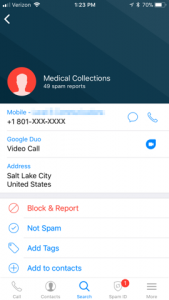
The next level of blacklisting type is a carrier or third party provided service facilitating call blocking. These services can combine with an on-device application to leverage crowd-sourcing capabilities that generate “blacklists” shared with/by other users. They can provide notices on the incoming call screen with the caller’s information and the ability for the consumer to designate how to disposition the call.

Service carriers compile blacklists for these services through a number of sources including:

•  FTC managed blacklist data

•  Local phone contact list comparison

•  Basic CNAM database comparison

The mobile carriers may offer these blocking capabilities at no cost or for a monthly fee.

3) Mobile phone blocking apps

On device phone number blocking apps have been around for a while. These apps may not be nearly as impactful as the blocking services, but they still provide cell phone users with additional options to choose from. These applications use various methods to limit or block the calls the consumer receives. Some simply send any inbound call that is not tied to a specific contact in the consumer’s address book straight to voicemail. Others allow the user to designate specific numbers in their address books that should receive the ‘direct to voicemail’ treatment when such calls come in.  

The next, and perhaps more important, question to ask is: “How is this impacting contact center performance?”

To determine the potential impact of “blacklisting,” LiveVox analyzed our real-time contact center connection data across our clients. Knowing that Blacklist apps and services mainly send calls directly to voicemail, one would anticipate a notable decrease in connect rates.

[article_ad]

After extensive analysis comparing data over the past 18+ months, our data shows little, to no, reduction of connect rates across all of our clients, meaning the impact of the FTC list and blocking apps for our clients remains minimal. Other businesses not on LiveVox many have lower connect rates and be impacted by blacklists to a greater degree.

insideARM Editor’s note: The Innovation Council, a part of the Consumer Relations Consortium, holds its third meeting of the year this week. In conjunction with the primary topic of ‘competing on data analytics,’ we will engage in an in-depth discussion of the fast-moving robocall blocking and labeling initiative. Joining us will be executives from several of the analytics companies — those firms developing the apps that can be downloaded directly by consumers, and developing the software that is used by major carriers.

While call blocking (as a result of so-called “blacklists”) is part of the issue, call labeling may have bigger consequences for the ARM industry. There is a significant effort occurring among the full range of stakeholders in this process to find a way to accomplish what consumers want most — to block the onslaught of scam calls — while delivering calls made by legitimate businesses. Accurate labeling is a major part of this. From a consumer’s perspective, accurate labeling of an incoming call would be extremely desirable. From the perspective of a 3rd party debt collector, this could be fraught with risk.

App developers will tell you that no one – or even two – factors, such as being on the FTC’s list, will get you blocked. They each have their own alogorithm based on a series of inputs, and how any given number is characterized is fluid.

The Consumer Relations Consortium is engaged in this process, and insideARM will provide updates as they are available.

Prior meetings of the Innovation Council have addressed innovations in payments and omni-channel communications. Innovation Council dialogues put senior executives from larger collection agencies, creditors and leading technology firms together to share best practices and develop tomorrow’s ideas. If you are interested in this type of engagement, send us a note.

3 Questions and Answers About Mobile Phone ‘Blacklists’

http://www.insidearm.com/news/00043460-3-questions-and-answers-about-mobile-phon/
http://www.insidearm.com/news/rss/
News

San Francisco Partners With CSS, Inc. for New Financial Cloud

SAN FRANCISCO, Calif. — The San Francisco Office of the Treasurer & Tax Collector (TTX) earlier this month launched their first Cloud Financial Ecosystem, “CSS IMPACT! HD™ 2.0”. CSS, Inc., the developers of “IMPACT! HD™ 2.0” is the leading provider of Cloud Financial Ecosystem platforms for enterprises & government.

CSS’s financial cloud architecture removes the prohibitive costs of acquiring new technology and workforces to overcome fundamental day to day processes. Municipalities, like the City and County of San Francisco, have experienced a huge uplift in automation with CSS’s cloud Financial Ecosystem platform, enabling them to cost-effectively leverage the latest financial technology rapidly and with the added benefit of a streamlined workforce. This in turn frees the City’s veteran operations staff to focus solely on revenue management and customer service.

José Cisneros, the Treasurer of the City and County of San Francisco, spearheaded the “CSS IMPACT! HD™ 2.0” Go-Live inauguration and stated, “This partnership helps the City and County by leveraging CSS’s expertise, acumen, and technology to help us collect more revenue, and automate business processes to maximize service and productivity.”

“We have been able to switch with extreme success to the IMPACT! HD™ 2.0 Platform from our old system of 22 years in only 11 months,” said Jeff Smejkal, Assistant Director, Bureau of Delinquent Revenue in the Office of the Treasurer & Tax Collector.

“The City of San Francisco is the leading authority in FinTech. We are honored & privileged to have been recognized by the City for our advanced Financial Ecosystem Technology, as well as becoming the City’s first ever approved Cloud platform for delinquent revenue collection. We look forward to a long partnership with the great City of San Francisco,” said Carl A. Briganti, President of CSS, Inc.

To learn more about how municipalities are leveraging CSS’s Financial Ecosystem cloud, please visit http://www.cssimpact.com/software/tax-information-platform-system or download our tax platform brochure at http://tax.cssimpact.com

About San Francisco – Office of the Treasurer & Tax Collector (TTX)

The Office of the Treasurer & Tax Collector serves as the banker, tax collector, collection agent, and investment officer for the City and County of San Francisco.

For more information, visit http://sftreasurer.org

About CSS, Inc.

CSS is a leading provider of end-to-end cloud Financial Ecosystem platforms & Contact Center solutions for enterprises that generate & manage mass receivables, payments, recoveries & revenues. By delivering cognitive cloud Financial Ecosystems technology, CSS helps municipalities and enterprises improve and automate all their daily financial processes, consumer engagement & business process.

For more information, download our brochure at http://brochure.cssimpact.com or visit us http://www.cssimpact.com or call 877.277.4621


San Francisco Partners With CSS, Inc. for New Financial Cloud
http://www.insidearm.com/news/00043466-san-francisco-partners-css-inc-new-financ/
http://www.insidearm.com/news/rss/
News

Don’t Miss Your Opportunity to Automate These 3 Parts of Your Account Workflow

This article, the second in a series by Dan Womack, previously appeared on Ontario Systems’ blog and is republished here with permission.

Now that you’ve run your A/B testing, listened to your agents, and established clear account segments, it’s time for the real automation to begin.

Using these three methods to identify your best tactics (analyzing them from day 3 through 96 for example), you should be able to identify some key account triggers that push your treatments forward. For example:

  • Does a group of accounts warrant a certain letter or a certain call? What comes afterward?
  • At what point do you consider an exhaust treatment on an account?
  • When do you opt to extend settlement, and what terms do you offer?
  • When and under what conditions do you pursue legal?

Free up time to monitor how each of these choices perform, then repeat as necessary and carry out analysis again. Doing so will give you the best idea of which practices are your best ones, and where you should place your focus as you establish efficient workflow.

You will likely find three factors don’t need a manual touch for optimization:

  1. Distribution of account placement
    When you bring in a group of accounts from a creditor, how are you distributing them to your agents? Demographic information, scoring, balance ranges, and account types are all common metrics that inform which agents work which groups. For example, if you conduct an account analysis and see Collector A is particularly good with a certain demographic, your technology should be able to automatically place that account into their work queue – You may have millennial agents work millennial accounts, for example. Pooling can also be completed automatically, grouping a certain type of account for collectors to work as a team. Analytics drive this process, and you should pay close attention to how frequently each type of account gets worked, and by whom.
  2. Initial account treatment
    When an account enters your system, do you send a letter or make a phone call right away? Making a phone call before letters are sent may save you a significant amount on letter costs, but be careful to ensure those letters are going out accurately, and on-time while maintaining compliance. Either of these paths can be automated. Based on the outcome of an attempt, you can then gauge the success or failure and take the next action. No response to a letter? Make a series of phone attempts, rotating through daytime, evening, and weekend attempts to known phones. Still no contact? Consider additional skiptrace efforts. Point being, your system should be able to decide automatically what the next appropriate action is, take that action, return an automated response, and build appropriate work queues for your agents’ manual efforts.
  3. Running reports as time goes on
    As you continue your efforts, your system should tell you what’s working and what isn’t. Ask yourself how you’re measuring, assessing and making changes to your account treatments – If a group of accounts are stuck in a workflow of a phone call every week, or a letter every month, and nothing’s happening, what changes do you need to make? Your exhaust strategy is an important part of an account’s workflow: If you’ve made four or five contact attempts to no avail, then your reports should show that failure, and move an account to a manual pool before possibly taking it out of the system entirely. Late-stage score and skiptrace requests can also be made automatically. Your system should automatically review these attempts and make decisions about the next treatment.

insideARM Editor’s note: The Innovation Council, a part of the Consumer Relations Consortium, holds its third meeting of the year this week. The topic to be covered is competing on data analytics. Prior meetings addressed innovations in payments and omni-channel communications. Innovation Council dialogues put senior executives from larger collection agencies, creditors and leading technology firms together to share best practices and develop tomorrow’s ideas. If you are interested in this type of engagement, send us a note.

— 

Disclaimer: Ontario Systems is a technology company and provides this blog article solely for general informational and marketing purposes. You should not rely on the content of this material for any other purpose or as specific guidance for your company. Ontario Systems’ advice, services, tools and products described herein do not guarantee compliance with any law or industry standard. You are ultimately responsible for your own company’s actions and compliance efforts. Because everyone’s situation is different, you must consult your own attorneys, accountants, and/or other advisors to obtain specific advice on your company’s compliance, legal, tax, regulatory and/or other business needs. Despite Ontario Systems’ efforts to provide current and up-to-date information, you need to recognize that the information contained herein may become outdated quickly and may contain errors and/or other inaccuracies.

© 2017 Ontario Systems, LLC. All rights reserved. Information contained in this document is subject to change. Reproduction of this publication is not permitted without the express permission of Ontario Systems, LLC.


Don’t Miss Your Opportunity to Automate These 3 Parts of Your Account Workflow
http://www.insidearm.com/news/00043457-dont-miss-your-opportunity-automate-these/
http://www.insidearm.com/news/rss/
News

Users Now Able to Add Custom Questions to StackUp, The Training Game for Recovery Professionals

CAMAS, Wash. – The Intelitech Group™, a premier analytics provider and consulting service in the Accounts Receivables Management industry, is pleased to announce the latest upgrade to their training game for recovery professionals, StackUp™.

This update will allow managers to add their own questions for their associates playing StackUp. By allowing the ability to add custom questions, managers will be able to tailor the game around their business to satisfy their specific training needs.

StackUp comes preloaded with hundreds of questions that help test and train recovery professionals, these questions are based primarily around industry regulations and best practice communication techniques. 

The Intelitech Group’s training game has undergone several enhancements since its launch, the most recent of these has been the new analytic reporting feature, and now the ability for users to add their own questions. “We will continue to invest in the evolution of StackUp and our mission to keep collectors engaged and educated through fun, incentive-driven training,” said Daniel Houston, Associate Partner at The Intelitech Group.

For more information on StackUp’s latest update, contact The Intelitech Group at (360) 260-9780 and schedule a free demo to see how it works.

About StackUp

StackUp is a unique training solution that uses gamification to help keep recovery professionals energized and in-tune with the latest methods and regulations.  By playing for only a few minutes a day, they will improve their skills that will help keep their business complaint as they become updated on the latest collection laws and regulations.  For additional information, visit http://www.playstackup.com.

About The Intelitech Group

The Intelitech Group, a premier analytics provider for the Accounts Receivables Management industry, provides consulting and technology solutions to help businesses work smarter to achieve optimal results. Leveraging industry expertise and market intelligence with latest technology innovations, The Intelitech Group brings extensive knowledge, insights and practical tools to help agencies delve deep into all facets of the organization to measure, analyze and implement results-oriented solutions. For additional information, visit http://www.intelitechgroup.com.

Users Now Able to Add Custom Questions to StackUp, The Training Game for Recovery Professionals
http://www.insidearm.com/news/00043461-users-now-able-add-custom-questions-stack/
http://www.insidearm.com/news/rss/
News