Second Circuit Opinion Repeats Its Prior Ruling on Interest Disclosures Because of Continued Litigation on Already-Decided Issues

Just when you think that you’ve seen the last of the interest disclosure issue out of New York, it rears its ugly head again. Luckily, the Second Circuit has yet again stood by the collection letter sent by the agency, finding no Fair Debt Collection Practices Act (FDCPA) violation despite the plaintiffs’ many attempts to twist and turn the interest disclosure argument. The decision is Kolbasyuk v. Capital Management Services, LP, No. 18-1260 (2d Cir. 2019).

Capital Management Services, LP (CMS) sent a collection letter that stated:

As of the date of this letter, you owe $5918.69. Because of interest, late charges, and other charges that may vary from day to day, the amount due on the day you pay may be greater. Hence, if you pay the amount shown above, an adjustment may be necessary after we receive your check, in which event we will inform you before depositing the check for collection. For more information, write the undersigned or call 1‐877‐335‐6949. 

Plaintiff filed an FDCPA suit alleging that the letter didn’t adequately state the amount of the debt, break down what part of the balance is the principal, nor provide the interest rate or calculations about how to determine the balance at a future date. The Second Circuit noted that plaintiff’s arguments seemed to mirror its decision in Carlin v. Davidson Fink, LLP.

[article_ad] Why is this a problem? The Second Circuit found that CMS’s letter is different from the letter in Carlin, making the old case inapplicable to this instance. In Carlin, the Second Circuit took issue with an estimated payoff amount for a future date when a breakdown of the calculation was not provided. The CMS letter avoids this issue altogether since it explicitly states the amount owed as of the date of the letter rather than a future estimated amount.

Another claim made by the plaintiff was that the letter somehow misleads the consumer to believe that he could pay amount listed as due on a date later than the letter and still satisfy the debt. The court noticed the obvious — the exact opposite is true. The letter clearly states that the balance on the letter is “as of the date of the letter” and that the balance may be greater in the future.

The court also noted that the letter used by CMS “identically tracks” the safe harbor language the Second Circuit adopted for accounts where the balance is subject to change.

Finally, the court found that there is no requirement to provide a precise breakdown of the debt or inform the consumer of the precise interest that might occur going forward. (Which should hopefully be the final nail in the coffin for the Balke issue in case any are still out there.)

insideARM Perspective

Did we just do a time warp back to 2016/2017? Despite the Second Circuit already ruling extensively on the interest disclosure issues (in Avila, Taylor, and DeRosa), it seems prior decisions have not deterred the filing of these claims. At insideARM, we’d talked extensively about the litigation dilemma and how the current structure of the FDCPA makes debt collectors easy targets to line pockets with settlements. When will enough be enough? How many times does the Second Circuit have to put forward similar rulings with almost identical reasonings on these issues? Do these repeated hyper-technical actions really protect consumers from unscrupulous debt collectors, as is the mission of the FDCPA, or are they just clogging up court dockets and wasting everyone’s resources?

Second Circuit Opinion Repeats Its Prior Ruling on Interest Disclosures Because of Continued Litigation on Already-Decided Issues
http://www.insidearm.com/news/00044846-second-circuit-publishes-opinion-repeatin/
http://www.insidearm.com/news/rss/
News
All the latest in collections news updates, analysis, and guidance

Fact Checking John Oliver’s Robocall Bit: It was Hilarious– but was it Accurate?

Over the weekend John Oliver took on the robocall epidemic in this country with a fantastic–but potentially highly misleading– piece of advocacy on his HBO Show Last Week Tonight.

The bit was hilarious–although the language was certainly blush-inducing for those of us that don’t frequently watch late night television– and Oliver is obviously immensely talented. The bit ended with a giant foam finger pushing a giant red button to launch robocalls at the FCC encouraging it to keep Wheeler-era TCPA regulations in place. It was comedy gold and actually quite a convincing piece of advocacy. But were his various statements regarding robocalls and the federal regulations governing automated calls accurate?  We here at TCPAworld.com decided to dive into the record and find out.

[article_ad]

As you’ll see below, we’re pretty critical of a number of assertions made in the bit. We don’t mean to suggest that Oliver was intentionally misleading people–his objective is to entertain after all– but given how serious the issue of TCPA reform is, reigning in potential misinformation–no matter how benign– is pretty important stuff.  So–ready to dive in? Here we go.

Assertion 1: Robocalls are Infuriating

TCPAworld.com Accuracy Score: Dead on accurate– sort of.

No one cares for true robocalls. Random-fired spam calls are the bane of our telecommunications existence, rendering our phones close to obsolete at this point. And this is not a new problem. When the Telephone Consumer Protection Act (“TCPA”) was passed way back in 1991 Congress recognized that computerized telemarketing messages were the “scourge of modern civilization.”

The first part of the bit focuses on “true” robocalls– IRS scam calls and pre-recorded messages pitching cruises or solar panels at random. Without question those robocalls must be stopped and Congress and the FCC must act to protect our phones.

But the bit quickly shifts away from true robocalls in a most unhelpful way and begins treating legitimate calls made by legitimate American businesses as if they were the same as random-fired spam or scam messages. As we shall see, however, this sort of sleight of hands only works to the advantage of spammers and makes an ultimate solution to the robocall epidemic more difficult to come by.

Assertion 2: Robocalls are the number one complaint to the FCC

TCPAworld. com Accuracy Score: True, but only as far as it goes.

It shouldn’t be forgotten that the FCC is not a general consumer protection organization. Its job is to facilitate interstate communications in the country. And how do we communicate interstate? Our cell phones. And what annoys us most about our cell phones? Right. Spam calls.  So unsurprisingly consumers are complaining most about spam calls to the FCC– what other forms of interstate communication are they using these days? Ham radio interference? The tinny sound of telegraph bursts?

But the point isn’t that consumers complain about “robocalls” more than other kinds of telecommunication disruption– the point is the focus should be on what sort of robocalls are they complaining about. But again, watch for the bait and switch. People call the FCC complaining about scam/spam calls–true robocalls.  But some people–mostly consumer lawyers–want to misapply the TCPA to legitimate businesses making calls on a volume basis (usually because they want to collect the millions in attorneys’ fees available in these lawsuits.) So they point to consumer “robocall” complaints to the FCC to support their lawsuits–even though those complaints are about spam calls and not legitimate calls made using modern dialers.

Again, the problem is definitional. “Robocall” complaints are generally focused on random-fired scam calls. Legitimate businesses do not make those calls.  But consumer lawyers want to sue legitimate businesses (they have real green money in real bank accounts–unlike off-shore scammers). So they label all calls made using automated dialers “robocalls” and act as if consumers are complaining to the FCC in legion about calls from legitimate business. Tricky tricky.

Luckily, a reputable comedian like John Oliver will see right through that bunk right?

Assertion 3: Robocalls are any call using a pre-recorded or artificial voice or any call where a machine automatically dialed your number

TCPAworld. com Accuracy Score: Dangerously inaccurate

Nooooooo! John, what are you doing man? You’re playing right into the ruse.

The bit starts with a discussion of scam robocalls, talks about all the complaints about scam robocalls to the FCC, but then offers a definition of “robocall” that includes legitimate phone calls made by legitimate businesses using efficient dialing technology. But that definition lumps in every fraud alert, account balance reminder, bill pay sms notification, stock price update, informational servicing call and pharmacy pick up text as equivalent to IRS and foreign-language scammers. It treats informational calls to consumers who may be facing foreclosure of their residence or repossession of their vehicles as equivalent with a random-fired message pitching solar panels. Bad bad bad terrible. How can we possibly get to the root of the scam call problem with definitions that label legitimate businesses with the same terrible “robocall” mantle that we affix to vile ne’er-do-wells that pepper us with Chinese-language scam calls?

There’s even more here to unpackage. The “robocall” definition Oliver offers is actually a crib of the expanded definition of automated telephone dialing system (“ATDS”)–a highly technical legal phrase embedded within the TCPA– that was recently handed down by the Ninth Circuit Court of Appeal in Marks v. Crunch. But the Marks ATDS definition is hardly the law of the land–indeed many courts have refused to follow it because it overly expands the definition of ATDS contained within the TCPA in a way that Congress did not intend. So by borrowing the Marks definition, Oliver has chosen only the broadest–and most misleading–potential definition of ATDS.

But way way more importantly–ATDS calls are not robocalls. The two concepts are absolutely not co-extensive, which is an absolutely critical point that Oliver’s bit misses entirely. Robocalls are bad scam calls. ATDS calls can sometimes be completely legitimate. So imagining a Venn diagram some ATDS calls are also robocalls–but not all calls using dialer technology are going to be the sort that lead to consumer complaints or irritation.

By conflating these terms Oliver inadvertently makes TCPA reform–a much needed policy shift that the FCC was poised to implement– more difficult. That means more frivolous lawsuits against legitimate businesses and less focus on the true scammers out there.

Assertion 4: Legitimate American Businesses are the Top Robocallers in the Nation

TCPAworld. com Accuracy Score: Cheater cheater pumpkin eater.

This assertion is totally inaccurate and based upon inaccurate–or at least inaccurately applied–data.

Oliver’s list of top robocallers is compiled from the same list submitted by the NCLC to the FCC last year which, in turn, was compiled from the robocall index compiled by a company called YouMail.

I wondered who YouMail was and who died and made it king of defining robocalls. So I invited YouMail’s CEO Alex Quilici onto my podcast at my former firm last year to discuss. In the podcast –which can be found here— Quilici confirms that he does not actually know how calls are being placed by the companies listed by NCLC–meaning the list just contains numbers making lots of calls, not robocalls– and cannot even confirm that the calls were actually coming from those companies. He also could not confirm whether the calls were wanted or unwanted. For those reasons he lists only phone numbers on the robocall index and does not name the callers.

But special interest groups–like the NCLC–unmask the numbers and lob them at the FCC and Congress as if they were accurate. And because YouMail labels its list the “robocall index”–even though it would more accurately be called the “top makers of legitimate phone calls list”–these special interest groups label legitimate companies as the “top robocallers” in the nation. But its just not true, as I’ve explained over and over again on my old website. (I still wonder how YouMail can get away with calling its index the “robocall index” to begin with. To a hammer everything looks like a nail and to a robocall-blocking app manufacturer everything looks like a robocall. So trusting YouMail to accurately count robocalls is like trusting a mattress salesman to estimate the number of Americans with preventable back problems.)

We later spoke with the CEO of a rival call blocking app who explained why focusing on “unwanted” robocalls is a far more accurate measure. When you look at his data, however, only 2% of true “robocalls” are made by the legitimate businesses that top YouMail’s list.

Translation: the data Oliver relied on in labeling legitimate American businesses as the top robocallers in the country was inaccurately applied. Had he done his homework–as we did– he would have discovered that only a tiny sliver of unwanted robocalls come from those companies.

Assertion 5: Robocall Volume Exploded After A Court Decision Overturned the FCC’s Rules Expanding the TCPA

TCPAworld. com Accuracy Score: Liar liar pants on fire.

This was the worst part of the bit.

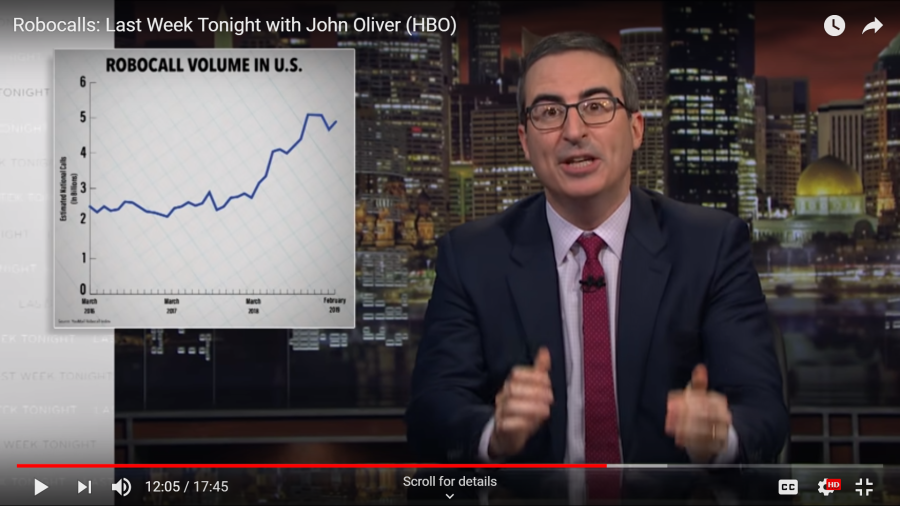
Oliver states that robocalls exploded after ACA Int’l set aside the FCC’s expansion of the TCPA last year. He even throws up a blurry little graph to prove it. (Check it out at the 12:05 mark.)

But wait a second. Take a close look at that graph.

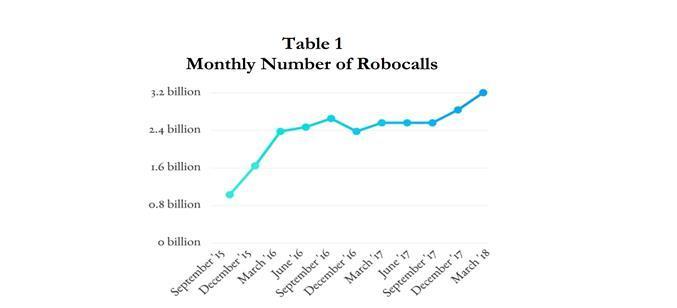
What you’ll see is that robocalls actually exploded AFTER the 2015 Omnibus Ruling expanding the TCPA and BEFORE the court set aside those rulings. Here’s a more accurate graph:

See– robocalls went up after July 10, 2015–when the Omnibus was decided–and peaked right when ACA Int’l was decided in March, 2018.

So whereas Oliver states that we had a “solution” to the robocall problem and then the courts ruined it he is just flat wrong. The FCC’s massive expansion of the TCPA did absolutely nothing to stop robocalls.  The number of “robocalls” literally quadrupled following the FCC ruling that Oliver touts as a solution. 

The reason is simple–the TCPA does not prevent robocalls. You can expand the statute all you want and the bad guys will keep on coming. That’s because the TCPA is only–or mostly–enforced against legitimate businesses, who are not causing the problem.

And that leads us to our last point.

Assertion 6: If the FCC Limits the ATDS Definition under the TCPA Robocalls Will Increase

TCPAworld. com Accuracy Score: Specious reasoning and misleading.

As just shown, when the FCC expanded the ATDS definition robocalls went up. There is no reason to assume, therefore, that narrowing that same definition will have any impact on robocalls. Robocalls are going up either way.

Instead the solution to the robocall problem is recognizing that the TCPA is not–and never was–the solution to the robocall problem. By highlighting the TCPA and acting as if it is a legitimate fix to the problem Oliver is actually making it more difficult for the FCC to focus on real solutions– like carrier requirements– by forcing it to fight political battles and waste resources over an ATDS definition that does nothing but foment frivolous litigation and does not actually stop robocalls. And that doesn’t help anyone but the consumer lawyers who rake in millions in fees under the TCPA every year.

Gross.

So TCPAworld.com’s overall take: Hilarious stuff. But not particularly accurate and perhaps even counter-productive to finding a real solution to the robocall problem.

But that giant finger pushing that giant red button was cool though.

Editor’s note: This article is provided through a partnership between insideARM and Squire Patton Boggs LLP, which provides a steady stream of timely, insightful and entertaining takes on TCPAWorld.com of the ever-evolving, never-a-dull-moment Telephone Consumer Protection Act. Squire Patton Boggs LLP — and all insideARM articles – are protected by copyright. All rights are reserved.  

Fact Checking John Oliver’s Robocall Bit: It was Hilarious– but was it Accurate?
http://www.insidearm.com/news/00044850-fact-checking-john-olivers-robocall-bit-i/
http://www.insidearm.com/news/rss/
News

All the latest in collections news updates, analysis, and guidance

FTC Seeks Comment on Data Security and Privacy Rules

Last week, the Federal Trade Commission (FTC) announced that it is seeking comments on proposed amendments to rules dealing with privacy and security of consumer information held by financial institutions. The two rules in question are the Safeguards Rule, which relates to information security programs, and the Privacy Rule, which relates to how the information is used.

Andrew Smith, Director of the FTC’s Bureau of Consumer Protection, states:

We are proposing to amend our data security rules for financial institutions to better protect consumers and provide more certainty for business. While our original groundbreaking Safeguards Rule from 2003 has served consumers well, the proposed changes are informed by the FTC’s almost 20 years of enforcement experience. It also shows that, where we have rulemaking authority, we will exercise it as necessary to keep up with marketplace trends and respond to technological developments.

The proposed changes to the Safeguards Rule would “require financial institutions to encrypt all customer data, to implement access controls to prevent unauthorized users from accessing customer information, and to use multifactor authentication to access customer data.”

The proposed changes to the Privacy Rule would bring it in line to give examples of only the entities that the FTC has rulemaking authority over. Specifically addressed here are motor vehicle dealers.

The comments will be due within 60 days of publication of the proposed changes in the Federal Register, which has yet to occur.

[article_ad]

insideARM Perspective

Data security and privacy are important issues in 2019. The 2017 Equifax security breach caused a lot of concern regarding data security, specifically in the financial sector. On the privacy front, all eyes are on California as its implementation of the new Consumer Privacy Act continues to unfold. It is speculated that consumer privacy issues will spread throughout the country. Some states, including New York, Utah, Washington, and North Dakota, have already begun exploring their own privacy laws. Sounds like this is just the tip of the iceberg, folks.

FTC Seeks Comment on Data Security and Privacy Rules
http://www.insidearm.com/news/00044849-ftc-seeks-comment-data-security-and-priva/
http://www.insidearm.com/news/rss/
News

All the latest in collections news updates, analysis, and guidance

iA Video Series: The Power of Connection for Women in Consumer Finance

Back in December, insideARM hosted its inaugural Women in Consumer Finance Conference (WiCF). It left a lasting mark on all of us who were present. In this video, you’ll hear the powerful words of attendees describing the impact this event had on them. I hope all women in the industry — regardless of position, experience level, or type of organization — answer the call and join us in December for our second annual WiCF, in Scottsdale, Arizona. Find more information here.  Early bird rates are now in effect. Don’t miss out.


[article_ad]


iA Video Series: The Power of Connection for Women in Consumer Finance
http://www.insidearm.com/news/00044842-ia-video-series-power-connection-women-co/
http://www.insidearm.com/news/rss/
News

All the latest in collections news updates, analysis, and guidance

Three Lessons for Debt Collectors from the CFPB’s Latest Supervisory Highlights: Amount Owed Accuracy, Disclosures, And Payment Dates

Yesterday, the Consumer Financial Protection Bureau (CFPB or Bureau) announced the release of its latest edition of Supervisory Highlights (which, according to the CFPB’s website, was published on February 28, 2019). The Highlights cover the Bureau’s activities between June and November 2018. While this Highlights edition contains no specific reference to debt collection agencies or law firms, there are several nuggets of information that present three lessons for debt collectors.

[article_ad]

Lesson 1: Ensure Amounts in Collection Letters are Accurate

The Highlights discuss two separate issues where the Bureau observed incorrect calculations of the amount owed by the consumer.

The first occurred in relation to ancillary products in auto loan servicing. If consumers finance a vehicle through the auto manufacturer, they often have the ability to purchase ancillary products through the same loan, such as extended warranties. In the event of total loss or repossession of the vehicle, the servicer has the option to cancel ancillary products and obtain a pro-rated rebate for the unused portions. This rebate is first applied to the servicer for the deficiency, then the remainder goes to the borrower. Frequently, these rebates depend on the mileage of the vehicle. The CFPB observed instances where:

  • The servicer either didn’t apply for the rebate at all, yet reflected in the deficiency letter to the consumer that the amount listed took into account rebates and credits to the account, and
  • In the case of a used vehicle, servicers used the total mileage of the vehicle (rather than the mileage accumulated since the borrower purchased the vehicle) to apply for the rebate.

The CFPB found that borrowers in both situations were misled about the amounts that they owed on the deficiency.

The second observation related to unauthorized charges by mortgage servicers. Specifically, the CFPB observed that certain servicers charged late fees greater than those permitted by the mortgage notes. This was caused, according to the Highlights, by “programming errors” and “lapses in oversight.”

The Takeaway: These two observations show the importance of diligence and compliance oversight when it comes to calculating or determining the amount that a consumer owes. This is especially important where a debt collector is collecting on a balance that is subject to change due to interest, fees, or charges. Whether it be ensuring that whatever benefits the consumer may be eligible for are correctly applied to the account or ensuring that the debt collector’s systems are correctly calculating amounts owed and are regularly monitored by compliance teams, the onus is on financial institutions to get this right.

Lesson 2: Do Your Due Diligence with Disclosures

In another mortgage servicing observation, the Bureau focused on incomplete information being provided to consumers. In this specific example, the Bureau notes that mortgage servicers failed to tell the consumers the full story of why their requests to cancel private mortgage insurance (PMI) were denied. PMI can be cancelled upon the consumer’s request (1) if the principal balance of the mortgage reaches 80% of the original value based on extra payments the consumers made on principal, or (2) after the date the amortization schedule reaches the 80% value marker.

The CFPB observed a service mortgager who denied consumers’ requests to cancel PMI stating that balance has not reached the 80% value marker. In these instances, the amortization schedule didn’t reach the 80% mark, but the consumer’s extra principal payments satisfied the first option listed above. Even though the consumers had not met other criteria for cancellation of PMI, the misrepresentation of conditions for removal of PMI would affect the borrower’s choice to re-request the cancellation.

The Takeaway: There is a lot of pressure from both regulators and the courts for debt collectors to adequately inform consumers about their rights. As we have seen through myriad court decisions, ensuring that disclosures made to consumers are accurate is paramount (even when courts don’t agree on what the correct disclosures are). While we may not have all of the answers on what disclosures to use yet (maybe we will in the forthcoming CFPB debt collection rules), it is important to be diligent about the information that debt collectors provide to consumers. For example, responses to requests for validation of debt or credit reporting disputes should accurately disclose the full picture to consumers.

Lesson 3: Pay Attention to Payment Debit Dates

The Bureau observed issues with bill pay debit dates that occurred earlier than the consumer was led to believe, causing overdraft fees. This occurred where an online bill pay portal disclosed that the payment would be debited on or a few days after the selected date, leading the consumer to believe that the payment would not be debited earlier than this date. However, payees who accept only a paper check failed to disclose that the check could be debited on an earlier date.

The Takeaway: There are many different forms of payment available and it is important to ensure the proper disclosures are provided for each so that consumers can plan for when the money will be taken out of their accounts.

Three Lessons for Debt Collectors from the CFPB’s Latest Supervisory Highlights: Amount Owed Accuracy, Disclosures, And Payment Dates
http://www.insidearm.com/news/00044841-three-lessons-debt-collectors-cfpbs-lates/
http://www.insidearm.com/news/rss/
News

All the latest in collections news updates, analysis, and guidance

New Jersey Judges Change Their Minds on 1692g Written Dispute Issues: One Case Dismissed, Another Certified for Interlocutory Appeal

Last week, the District of New Jersey issued two decisions on the written dispute requirement issue specifically where the validation notice language tracks the statutory language found in the Fair Debt Collection Practices Act (FDCPA).

In one case, Bencosme v. Caine & Weiner, No. 18-cv-7990 (D.N.J. Mar. 6, 2019), Judge Arleo granted the defendant’s motion to dismiss, finding that the validation notice language is clear about the writing requirement and that a generic invitation to call does not overshadow the written requirement. In the second case, Cadillo v. Stoneleigh Recovery Associates, LLC, No. 17-cv-7472 (D.N.J. Mar. 8, 2019), Judge Wigenton found that the validation notice language does confuse the consumer about whether or not a dispute must be in writing but also certified the opinion for interlocutory appeal.

Editor’s Note: Typically, appeals occur after a final order is issued that fully disposes of the case, such as granting summary judgment or the findings after trial. Some court decisions, such as a denial of a motion to dismiss or denial of a motion for summary judgment, do not dispose of the case but a party may desire to appeal such order. An interlocutory appeal is the appeal of a non-dispositive court decision, procedurally requiring the judge to certify the particular order for an interlocutory appeal.

Bencosme Case

In the Bencosme case, the letter in question included a validation notice that tracks the statutory language of the FDCPA. Immediately after the validation notice paragraph, the letter states “To speak to us directly, contact us at [phone number.]” In her decision, Judge Arleo mentioned the myriad cases that have found the statutory validation notice language sufficiently describes the consumer’s rights. The judge also noted that the remainder of the letter’s content and form did not cause any issues. The inclusion of a telephone number with nothing else does not overshadow the written requirement for disputes as outlined in the validation language.

This decision comes as somewhat of a surprise considering Judge Arleo ruled in the opposite direction back in September in her decision denying a similar motion to dismiss in Poplin v. Chase Receivables, Inc., No. 18-cv-404 (D.N.J. Sept. 26, 2018). In that decision, the judge cited the Cadillo decision denying a motion to dismiss (discussed below) and found that that the inclusion of the word “if” in the validation language itself as well as an invitation to call in the letter was sufficient for plaintiff to state a claim and warrant denial of the motion to dismiss.

[article_ad]

Cadillo Case

The Cadillo decision comes less as a shock since Judge Wigenton denied the defendant’s motion to dismiss the case on similar grounds back in 2017. Specifically, the judge took issue with the word “if” in the statutory validation notice language (“if you notify this office in writing.”). The word “if,” according to the judge, implies that there is another way to dispute the debt.

The judge, however, her tune regarding an interlocutory appeal. Judge Wigenton denied certification for interlocutory appeal of her order denying Stoneleigh’s motion to dismiss two years ago. However, her new decision denying Stoneleigh’s summary judgment motion recognizes that district courts are ruling differently on the matter and that there is no Third Circuit authority on the issue and certies the order for an interlocutory appeal.

insideARM Perspective

It’s hard to see straight with all of the twists and turns occurring within the Third Circuit on this whole written dispute issue.

To start with, the Third Circuit seems to be the lone ranger that believes there is a written requirement in all disputes under 1692g. An open letter to the Consumer Financial Protection Bureau discusses the difficulties posed by this. The first case to pose this issue to the U.S. Supreme Court had its petition to be heard denied.

Next, the District of New Jersey and the Eastern District of Pennsylvania cannot seem to agree about whether or not a validation notice that tracks the language of 1692g is confusing as to dispute procedures. Over the past year, many cases have been decided in different directions on the issue.

Now, we have judges slowly changing their minds on the issue. The trend in these two new decisions seems to favor the defendants and it shows the benefit of defending these types of claims.

Amid all of this mess, there seems to be one group that is benefitting most from this uncertainty.

New Jersey Judges Change Their Minds on 1692g Written Dispute Issues: One Case Dismissed, Another Certified for Interlocutory Appeal
http://www.insidearm.com/news/00044831-new-jersey-judges-change-their-mind-1692g/
http://www.insidearm.com/news/rss/
News

All the latest in collections news updates, analysis, and guidance

Twin Bills To Alleviate Cost of Higher Education and Student Debt Introduced in House and Senate

On Wednesday, March 6, twin bills – identical in title and text – were introduced in both the House of Representatives and in the Senate aiming to provide the opportunity for students to attend in-state public colleges and universities without debt. The Debt-Free College Act was introduced by Sen. Brian Schatz (D-HI) as S. 672 in the Senate and Rep. Mark Pocan (D-WI) as H.R. 1571 in the House.

In a joint press release, Sen. Schatz states:

The full cost of college – including books, room and board, and supplies — is more than twice as much as tuition. If we are going to be serious about solving the student loan debt crisis we need to focus on the real cost to students and their families. My bill brings states back to the table and leverages federal dollars to reinvest in public education, and help people cover the full cost of college.

Rep. Pocan states:

Higher education is one of the most certain paths to economic security and opportunity for Americans. However, while college-degree holders earn significantly more than workers with only high school degrees, the cost of higher education – including tuition, living expenses, books, housing, meals, and more – is now out of reach for many students and their families. The Debt-Free College Act creates a critical federal-state partnership that would make debt-free college a reality for students within five years. With the federal government, states, colleges and universities, and students and their families all contributing, we can ensure that students graduate debt free and are not at a competitive disadvantage as a result of being burdened with student loan debt.

The bills aim to provide “a dollar-for-dollar federal match to state higher education appropriations in exchange for a commitment to help students pay for the full cost of attendance without having to take on debt.” The bills also seek to make DREAMer students eligible for Federal Pell Grants and to repeal the suspension of eligibility under the Higher Education Act of 1965 for drug related offenses.

[article_ad]

insideARM Perspective

Many, including Department of Education (ED) secretary Betsy DeVos, that student loan debt is heading toward crisis level. Student debt was also front-and-center during a House Financial Services Committee hearing held on Thursday. Seth Frotman, the Consumer Financial Protection Bureau’s former student loan ombudsman who resigned with a bang and launched an organization called the Student Borrower Protection Center, was one of the key witnesses at the hearing. Frotman’s testimony included descriptions of what the Bureau has done to protect student borrowers under Former Director Richard Cordray’s leadership and what Frotman viewed as a reversal of these protections under Former Acting Director Mick Mulvaney. Currently, the outstanding student loan debt balance sits at a staggering $1.5 trillion.

Twin Bills To Alleviate Cost of Higher Education and Student Debt Introduced in House and Senate
http://www.insidearm.com/news/00044826-twin-bills-alleviate-cost-higher-educatio/
http://www.insidearm.com/news/rss/
News

All the latest in collections news updates, analysis, and guidance

Transcript of Teleconference in Dept. of ED NextGen Case Reveals Maddening Exchange

A scheduling teleconference was held last week in the case of FMS Investment Corp. (FMS) v. The United States (Department of Education, or ED), in what we’ve dubbed Chapter 6 in the years-long quest for a contract for private collection agency (PCA) services for federal student loans in default. The transcript of this 24-minute discussion revealed a head-shakingly unbelievable exchange between the Court and the attorneys for the parties.

This latest action is a pre-award protest challenging ED’s decision to procure default recovery services through a bundled solicitation under its NextGen Procurement (NextGen), rather than a separate Procurement, as has been done in the past.

This article published last week on the heels of the second pre-award protest, filed by Continental Service Group (ConServe), provides detailed context of the plaintiffs’ concerns with the NextGen structure.

The protests filed on February 27, 2019 (by FMS) and March 7, 2019 (by ConServe) argue that ED ignored the September 2018 Court of Federal Claims (COFC) decision that invalidated ED’s May 2018 cancellation of the separate Default Collection Procurement (ED-FSA-16-R-0009), as well as the Court’s order to figure out how to revisit that Procurement in a way that is fair and reasonable. These two new cases were consolidated last week under lead plaintiff, FMS.

Instead of returning with a “fair and reasonable” solution, one day before the March 7th scheduling conference, ED canceled Solicitation No. ED-FSA-16-R-0009 for unrestricted debt collection services, dated 12/11/2015. (Yes, the same one they cancelled last May, and the same one that the Court permanently enjoined them from cancelling last September.)

The PCAs are requesting that the Court permanently enjoin the Department of Education from procuring default recovery services under the New NextGen Solicitations unless they are canceled and amended to unbundle default recovery services, and those services are procured separately.

ED wants to move forward with NextGen, and has set an upcoming deadline of March 27th for submission of proposals for its Enhanced Servicing Solution. ED claims the impact to the plaintiffs will be minimal because the Enhanced Servicing Solution is only temporary, while the permanent solution will be covered by the next RFP round. The PCAs claim that “temporary” is a misnomer because it could literally take years to implement even an interim solution of the scope required. And, if it’s continuously protested, the process could take even longer. The Government’s timeframe for “temporary” is a contract award of two base years, followed by two option years.

The PCAs also raised other issues:

One – If they are forced to bid on this Procurement as subcontractors, they will be forced to provide their proprietary information and trade secrets to organizations that may in the future (should the PCAs be successful in their protests) become their competitors.

Two – It would be impossible to meet such a tight deadline, as partnerships of this scope and complexity do not simply come together in a matter of a few weeks.

Mr. Canni, the attorney for ConServe stated,

“Mr. Pehlke (the attorney for ED) might imagine it to be that you sort of walk in somewhere and there’s teaming partners sort of waiting for you to approach them and integrate. It’s an enormous effort to integrate the default recovery services with these other service offerings. And that can’t happen in a few weeks, one. But, two,” he continued, “it’s an enormous investment of time and human resources, as well as money. And our client has been investing millions in the Department of Education procurement model of procuring these services separately for many, many years. And so to try to accelerate an integration where we put forth a viable proposal with other partners that could potentially perform the other services needed isn’t even possible.”

Mr. Johnson, the attorney for FMS, reminded the Court that on February 15th he had requested the record of what efforts ED had been making since the Court’s September 18, 2018 permanent injunction against ED’s May 3, 2018 cancellation of Solicitation No. ED-FSA-16-R-0009. To date, no record has been produced, so providing it now, along with an Adiministrative Record (AR) covering the development of the New NextGen Procurement, would be a sensible next step. Johnson said,

“Mr. Pehlke said they had been dutifully working on it, they had been doing a lot of analysis, they had been looking at it. That record, now with the cancellation yesterday, should be in the can somewhere. And they should also have the record already for how they developed these RFPs and why they think they’re legal, why they think it’s appropriate to bundle an IT platform with loan servicing and debt collection, three things that not — there’s no IT firm that does servicing or debt collection. There’s no debt collection firm that does IT build-outs and so forth…”

After a brief retort by Pehlke that – quite honestly – sounded like one of those maddeningly unreasonable arguments a clever child might have made (“I know you are but what am I?”) the Court agreed with Johnson’s suggested next step and gave ED until Wednesday to produce an administrative record (AR), after which there will be another teleconference on March 18th.

Pehlke: “My immediate response is I don’t understand why the cancellation AR is bundled into that. There currently isn’t even a protest of the cancellation, and I don’t see what that has to do with the proposal date of March 27th. I mean, if we want to move quickly, why are we combining ARs, including an AR from a procurement that’s actually not under protest right now?”

Johnson: “It’s not under protest right now because the agency decided to issue a cancellation yesterday. I don’t think –”

Pehlke: “Understood. That’s exactly what I’m saying.”

Johnson: “I don’t — you have to have a justification. We think you did nothing. You say you’ve got a record. It’s — we’ve been through this. The Court doesn’t need to slow that down and give any other opportunity. Let’s get the complete record out and then we can come back and have a proposal to how we’re going to get this thing to a conclusion, Judge Wheeler. Because when we talked last time, you were saying, why aren’t these parties getting together? We’ve tried in the interim, we’ve asked for meetings. They’ve all been declined. They never took you up on the suggestion to file for a mediation. So we’d like to get the full record, see if they’ve actually done anything and what they’ve done. The Court may have some feedback right away to tell them this is another half-baked opportunity and, you know, they’re going to end up on the losing end. And then we can react to that.”

Finally, Wheeler brought it to conclusion:

“Well, let me provide a few thoughts. First of all, based upon the allegations in the complaint, I think the Protestors, once again, have put together a viable basis for protest. Now, I’m certainly open about looking at the record, the parts that you tell me are relevant, and I’m happy to listen to the Government’s side justifying this. But the way that the default collection work has been bundled into a much larger effort, it just makes very little sense to me. And I don’t know why, you know, the agency can’t proceed in a more typical way with this.

If I were the agency here, I would think about at least an interim bridge-type contract to perform default collection kind of work, which could be for as long as you want to make it…But I’m fearful of us spending a lot of time and effort, and causing more delay and then ending up really in the same spot we are right now… I’m at a loss to understand the rationale behind some of these procurement actions.”

insideARM Perspective

I can’t even. 

Transcript of Teleconference in Dept. of ED NextGen Case Reveals Maddening Exchange
http://www.insidearm.com/news/00044824-transcript-teleconference-dept-ed-nextgen/
http://www.insidearm.com/news/rss/
News

All the latest in collections news updates, analysis, and guidance

Dan Weot named SVP, Business Development for ezPay365

DUBLIN, Ohio — ezPay365, a provider of payment processing solutions for the accounts receivable management (ARM) industry, has named Dan Weot, senior vice president, business development. In his new role, Dan will be responsible for expanding ezPay365’s market share while developing new sales channels and additional vertical markets.

“Dan’s business development and ARM industry experience, combined with his natural ability to build strong client relationships fits well within our company mission,” said Kevin Gaffer, president of ezPay365. “With an increasing amount of payments being processed online and mobile platforms, it’s an exciting time and we’re glad to have Dan join the team,” said Gaffer.

Weot brings more than fifteen years’ experience in the ARM industry, most recently in business development for payment products at RevSpring. Focused on strengthening its long-term commitment to the payments industry, ezPay365 will leverage Weot’s knowledge to help clients reduce their fees and improve their customers’ payment experience.

“I’m excited to join ezPay365, and for the opportunity to deliver high quality payment solutions that offer outstanding value and ease for our clients,” said Weot. “Kevin and I have forty years combined experience in the ARM industry, we understand the challenges our clients face, and we’re dedicated to providing the right solutions for their business,” said Weot.

Learn more about ezPay365’s payment processing solutions at www.ezpay365.com.

Tweetable Highlights

  • Dan Weot joins @ezPay365 as SVP, Business Development and brings more than 15 years ARM industry experience to his new role. Learn more about ezPay365’s payment solutions at www.ezpay365.com.
  • “I’m excited to join @ezPay365 and for the opportunity to deliver high quality payment solutions that offer outstanding value and ease for our clients,” says Dan Weot, new SVP, Business Development at ezPay365. Learn more at www.ezpay365.com.

About ezPay365

ezPay365 is a payment processing provider for companies within the ARM, collection, healthcare and legal markets. With 25 years ARM industry experience and multiple banking relationships, ezPay365 payment channels consist of debit and credit card, HSA/FSA, ACH payments and a convenience fee model. ezPay365’s payment solutions consist of collector/software integration and virtual terminal, online payment portal, IVR, Text2Pay and MobilePay.

Learn more at www.ezpay365.com, follow @ezPay365 on Twitter or call (614) 792-3525.

Dan Weot named SVP, Business Development for ezPay365
http://www.insidearm.com/news/00044830-dan-weot-named-svp-business-development-e/
http://www.insidearm.com/news/rss/
News

All the latest in collections news updates, analysis, and guidance

Enformion Brings on ARM Industry Expert as New VP of Sales — Collections

SACRAMENTO, Calif. — Enformion is proud to announce the addition of David Morton to its leadership team. As the new VP of Sales – Collections, Morton brings more than 20 years of experience in the Accounts Receivable Management (ARM) industry.

Most recently, Morton was VP of Sales and Marketing for FMS, Inc. and Van Ru Credit. His past experience includes managing collection agencies for GE Capital and Citibank, as well as sales roles for a variety of unsecured credit issuers, private and government lenders, and more.

In other words, Morton has worked in all aspects of the ARM industry; he has been the collector, the auditor, the vendor manager, and the vendor. Such broad experience gives Morton unparalleled understanding of the collections process, as well as the unique data needs of collections agencies.

“I understand how accurate, affordable information is a key attribute to the most successful solutions in collections. And I look forward to working with our clients to maximize their performance,” says Morton. “I am also excited to work with the dynamic team of experienced sales professionals that have gathered together at Enformion to bring the ARM industry the most affordable, best-in-class customer location and contact information, and other solutions.”

As pleased as Morton is about his move to Enformion, existing company leadership is equally enthusiastic. 

“We are excited about David joining Enformion. His extensive experience working with the ARM industry, both on the agency side and first party, brings a depth of knowledge and an understanding of our clients’ challenges and how best to address them,” says Amber Higgins, Chief Executive Officer at Enformion. “He will continue our client-centric focus as we look to expand our footprint in this exciting and ever-changing industry.”

About Enformion

Enformion is a leading aggregator of public records data for business and public sector. 30+ years in the data technology industry has resulted in a database of 42 billion up-to-date records for more than 250 million American adults, from 6000+ data sources. For more information about our customized government and enterprise data solutions, visit https://www.enformion.com/ or call (855) 281-3915. For ARM-specific data products and services, contact David Morton directly at david.morton@enformion.com.

Enformion Brings on ARM Industry Expert as New VP of Sales — Collections
http://www.insidearm.com/news/00044828-enformion-brings-arm-industry-expert-new-/
http://www.insidearm.com/news/rss/
News

All the latest in collections news updates, analysis, and guidance